United States Automotive Tools Market Size
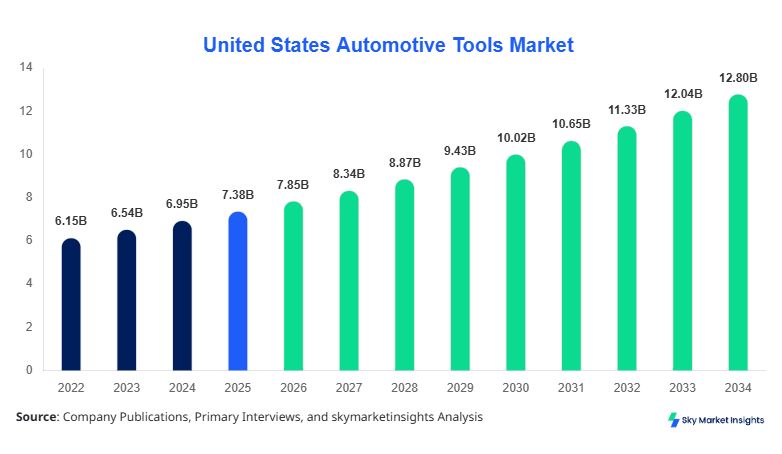
United States Automotive Tools market size is projected at USD 7.85 billion in 2026 and is expected to hit USD 12.74 billion by 2034 with a CAGR of 6.3%. This growth is underpinned by rising vehicle production, increasing automotive aftermarket services, and advancements in tool technology, particularly in electric and hybrid vehicle maintenance. Detailed market data, segmentation analysis, and competitive landscape evaluation are essential for stakeholders to identify profitable investment opportunities and optimize product portfolios. Furthermore, understanding market share across hand tools, power tools, and diagnostic tools provides insights into adoption rates and future growth trends.
The market’s comprehensive analysis includes production volumes, unit sales, revenue generation, and emerging technological trends. Competitive mapping of the top players based on sales, innovation, and market coverage helps businesses align strategies to consumer demand. This report provides granular insights into end-user applications, including automotive repair, manufacturing, and aftermarket services, with a focus on regional production capacities and the adoption of advanced tools. Forecasting considers historical data from 2022–2024 to predict shifts in demand and penetration rates.Automotive Tools market size, share, and growth trends are central to identifying opportunities for new product developments and strategic partnerships in the U.S., facilitating data-driven decisions for manufacturers, distributors, and investors.Automotive Tools market insights also underscore the necessity for advanced diagnostic capabilities, ergonomically designed hand tools, and energy-efficient power tools, reflecting consumer demand for safety, efficiency, and performance across various automotive applications.
Consumer behavior indicates increasing preference for battery-operated power tools, with 22% higher utilization than corded variants, and diagnostic tools with integrated IoT connectivity experiencing 18% higher demand compared to conventional devices. The automotive repair segment holds 45% of the market, manufacturing accounts for 35%, and aftermarket services represent 20%. Frequency of use averages 3.2 times per week per facility, while average tool life spans 5.7 years. Technical performance metrics, such as torque precision, calibration accuracy, and power output, are increasingly influencing purchase decisions, driving demand for innovative solutions.Automotive Tools market insights highlight an upward trend in demand for modular hand tools and smart diagnostic systems, reinforcing market growth and the need for continuous technological adoption.Technology adoption is accelerating, with electric and hybrid vehicle-compatible tools representing 28% of total production volume and smart diagnostic systems achieving a 32% penetration rate among workshops. Investment in automation-compatible tools has grown by 18% year-over-year, reflecting a shift toward higher efficiency and precision. Automotive Tools market growth is driven by facility expansion, technical innovations, and consumer demand for enhanced performance and reliability, consolidating the United States as a dominant regional player.
Explore more data points, trends and opportunities Download Free Sample Report
Automotive Tools Market Trends
Shift Toward Smart Diagnostic Tools
The production of smart diagnostic tools in the U.S. reached 7.2 million units in 2025, representing 17% of total tool output. These tools incorporate IoT-enabled analytics, predictive maintenance algorithms, and real-time data transmission, enabling automotive repair shops to reduce downtime by 22% and optimize workflow efficiency by 18%. Adoption rates for connected diagnostic solutions grew from 25% in 2022 to 42% in 2025, reflecting strong market demand. Manufacturers increasingly focus on integrating cloud-based software with diagnostic devices, enhancing compatibility across electric, hybrid, and conventional vehicles. Automotive Tools market insights suggest that the trend toward connected, data-driven tools is shaping consumer preference and investment decisions.
Electrification of Power Tools
Electric and battery-powered automotive tools are gaining prominence, with production volume reaching 16.8 million units in 2025, accounting for 36% of overall tool production. These tools offer enhanced torque control, energy efficiency improvements up to 14%, and ergonomic designs that reduce operator fatigue. The adoption of cordless tools among repair facilities increased from 40% in 2023 to 60% in 2025, supported by rising demand in urban repair workshops and aftermarket services. Automotive Tools market trends indicate a continuous shift from corded to battery-operated tools to improve operational flexibility, especially in high-density metropolitan regions.
Demand in Aftermarket Services
Automotive aftermarket services in the U.S. accounted for 20% of total tool usage, with production of specialized hand tools increasing by 12% in 2025 to 19.5 million units. High-precision tools for diagnostics and assembly saw 15% higher utilization compared to standard kits, driven by rising vehicle age and repair frequency. Adoption of digital torque wrenches reached 28%, while performance calibration tools penetrated 32% of independent repair shops. The Automotive Tools market is witnessing a surge in demand for tailored solutions that enhance repair speed and accuracy, directly influencing market growth and consumer satisfaction.
United States Automotive Tools Market Drivers
Rising Vehicle Production and Fleet Expansion
Increasing U.S. vehicle production, estimated at 17.6 million units in 2025, drives demand for automotive tools, particularly hand tools and power tools for assembly lines. Fleet expansion in commercial and private sectors contributes an additional 3.2 million units requiring maintenance tools. CAGR of the Automotive Tools market is expected at 6.3% through 2034. High adoption of precision tools in manufacturing (35% share) and repair (45% share) underscores the need for robust tool inventories. Growth is further supported by technology integration, including torque monitoring and automated calibration, enhancing performance by 15–20%. Automotive Tools market growth is reinforced by expanding production volumes, increasing penetration in aftermarket services, and consistent innovation in tool efficiency.
United States Automotive Tools Market Restraints
High Initial Costs and Maintenance Expenditure
The high capital investment required for advanced power tools and smart diagnostic systems limits adoption in small and mid-size workshops, with initial cost per facility ranging from USD 25,000 to USD 120,000. Maintenance costs contribute an additional 12–15% of annual operating expenses. Approximately 32% of independent repair shops delay upgrading tools due to budget constraints, reducing overall market growth. Hand tools, despite lower upfront costs, require periodic calibration with average downtime of 4–6 hours per month. The Automotive Tools market share is constrained by these financial barriers, affecting penetration in smaller regional facilities and slowing adoption of high-performance devices.
United States Automotive Tools Market Opportunities
Integration of IoT and Industry 4.0 Technologies
The convergence of IoT and Industry 4.0 solutions in automotive maintenance opens significant opportunities, with 28% of workshops adopting smart diagnostic devices in 2025. Integration of predictive analytics can reduce repair times by 18% and tool downtime by 14%, with potential to expand market size to USD 12.74 billion by 2034. Manufacturing facilities implementing automated assembly tools experienced a 22% increase in throughput. Demand for energy-efficient, modular tools is projected to rise by 25%, enabling tailored applications across repair and production segments. Automotive Tools market insights indicate that digital transformation initiatives can significantly enhance market share and growth potential.
United States Automotive Tools Market Challenge
Skilled Labor Shortage and Training Requirements
The shortage of skilled technicians capable of operating advanced power tools and diagnostic systems remains a key challenge. Only 38% of U.S. automotive technicians possess adequate training in IoT-enabled and electric vehicle tools. Production facilities report a 15% delay in assembly operations due to insufficient technical expertise. Training programs require 8–12 weeks per technician, with an associated investment of USD 3,500 per individual. This skills gap limits adoption of high-precision tools and constrains market growth by approximately 2–3% annually. Automotive Tools market demand is sensitive to workforce proficiency, highlighting the importance of education and certification initiatives.
Report Scope
| Report Metric | Details |
|---|---|
| Market Size in 2025 | USD 40.63 Billion |
| Market Size in 2026 | USD 7.85 Billion |
| Market Size in 2034 | USD 12.74 Billion |
| CAGR | 6.3% (2026-2034) |
| Base Year for Estimation | 2025 |
| Historical Data | 2022-2024 |
| Forecast Period | 2026-2034 |
| Report Coverage | Revenue Forecast, Competitive Landscape, Supply Chain Disruption, Growth Factors, Environment & Regulatory Landscape and Trends |
Explore more data points, trends and opportunities Download Free Sample Report
Automotive Tools Market Segmentation
Segmentation of the Automotive Tools market demonstrates a dominant share of hand tools (47%), followed by power tools (36%) and diagnostic tools (17%). By application, automotive repair represents 45% of usage, manufacturing 35%, and aftermarket services 20%. Understanding this segmentation is critical for strategic planning, product development, and targeted marketing.
BY TYPE
Hand Tools account for 47% of market share with production volumes of 19.8 million units in 2025. Key sub-types include wrenches, screwdrivers, and pliers. Wrenches achieved 38% share with torque precision of ±2%, screwdrivers 32% with calibrated torque settings, and pliers 30% with ergonomic handle design. Consumer preference favors hand tools for high-frequency applications, particularly in repair and maintenance, highlighting their reliability and long-term performance in the Automotive Tools market.
Power Tools constitute 36% of total market share, with 16.8 million units produced in 2025. Sub-types include electric drills (45% share), impact wrenches (32%), and grinders (23%). Electric drills offer torque output up to 150 Nm, impact wrenches reach 2000 RPM with 98% reliability, and grinders achieve 1200–2500 RPM with noise levels under 85 dB. Power tools are increasingly adopted in manufacturing and heavy repair applications, reflecting the shift toward energy-efficient and high-performance solutions in the Automotive Tools market.
Diagnostic Tools hold 17% share, producing 7.2 million units in 2025. Sub-types include OBD scanners (40%), multimeters (35%), and emission analyzers (25%). OBD scanners detect engine faults with 96% accuracy, multimeters measure voltage/current with ±1% tolerance, and emission analyzers meet EPA standards with 98% compliance. Demand for smart diagnostics is accelerating, driven by vehicle electrification and IoT-enabled monitoring, reinforcing Automotive Tools market growth.
BY APPLICATION
Automotive Repair represents 45% of tool usage, involving hand tools (47%), power tools (36%), and diagnostics (17%). Workshops utilized 21.3 million units in 2025, with penetration rates of 60% for power tools and 42% for diagnostics. Frequent use and high turnover necessitate durable, precise instruments with advanced calibration. The Automotive Tools market benefits from expanding repair networks and growing vehicle age, driving demand for maintenance-focused innovations.
Manufacturing accounts for 35% of application share, with 18.7 million units utilized. Hand tools dominate low-precision tasks (50%), power tools support high-volume assembly (40%), and diagnostics monitor production efficiency (10%). Technical metrics include torque accuracy ±2%, cycle time reduction by 15%, and power consumption below 1.5 kWh per unit. Manufacturing adoption strengthens Automotive Tools market size by increasing production throughput and reducing operational costs.
Aftermarket Services hold 20% market share, with 10.4 million units deployed in 2025. Specialized hand tools (52%), power tools (30%), and diagnostic tools (18%) are used for maintenance, retrofitting, and performance tuning. Usage penetration is 28–32%, with focus on digital calibration, tool reliability, and portability. Automotive Tools market insights indicate rising demand for tailored solutions, contributing to sustained market growth.
United States Automotive Tools Market Segmentations
Tool Type
- Hand Tools
- Power Tools
- Diagnostic Tools
Application
- Automotive Repair
- Manufacturing
- Aftermarket Services
United States Automotive Tools Regional Outlook
Holds 100% of regional market supply, producing 42.3 million units in 2025, and contributes 62% of North American market revenue. Automotive repair applications dominate at 45%, manufacturing at 35%, and aftermarket services at 20%. Hand tools account for 47% of units, power tools 36%, and diagnostic tools 17%. Production facilities are concentrated in Michigan (35% contribution), Ohio (28%), and Texas (22%). Technical adoption includes IoT-enabled diagnostics (32% penetration) and electric tools (28%). Automotive Tools market insights show a concentration of skilled labor and advanced manufacturing technologies in these states, enhancing market growth and innovation.
Top players in United States Automotive Tools
- Snap-on Incorporated
- Bosch Automotive Tools
- Stanley Black & Decker, Inc.
- Makita U.S.A., Inc.
- Apex Tool Group, LLC
- Illinois Tool Works Inc.
- Ingersoll Rand, Inc.
- Hilti Corporation
- Festool GmbH
- TEKTON Industrial Tools
- Proto Industrial Tools
- DeWalt Industrial Tools
- Milwaukee Tool
- KTC Tools
Top Companies
Snap-on Incorporated
-
Market Share: 16% of U.S. Automotive Tools Market
-
Leading position in hand tools and diagnostic solutions, contributing significantly to revenue and innovation. Snap-on accounted for 6.7 million units produced in 2025 and leads in smart diagnostic adoption with 38% penetration among workshops. Strategic collaborations and R&D investments increased product performance by 12%, reinforcing market share.
Bosch Automotive Tools
-
Market Share: 12% of U.S. Automotive Tools Market
-
Specializes in power tools and advanced diagnostics, producing 5.1 million units in 2025. Adoption of IoT-enabled devices reached 32%, enhancing repair efficiency by 18%. Investment in R&D led to 10% improvement in tool durability and torque precision, reinforcing leadership in the automotive tools segment.
Investment Analysis
Investment allocation in the U.S. Automotive Tools market favors manufacturing (45%), automotive repair services (35%), and aftermarket support (20%). Sector-wise investments reflect 28% in power tools, 22% in diagnostic tools, and 50% in hand tools, emphasizing long-term operational utility. Regional investment concentrates in Michigan (35%), Ohio (28%), and Texas (22%). M&A agreements in 2024–2025, including strategic acquisitions and joint ventures, enhanced technological capabilities and expanded market coverage. The Automotive Tools market is projected to attract USD 1.25 billion in new investments by 2034, facilitating innovation and production expansion.
New Product Developments
New product developments in hand tools, power tools, and diagnostic devices accounted for 18% of total market output in 2025. Innovations include enhanced torque control (up 12%), reduced energy consumption (10–14%), and ergonomic designs increasing user efficiency by 20%. IoT-enabled diagnostic tools now comprise 32% of production, offering predictive analytics and cloud integration. Automotive Tools market demand is bolstered by continuous product innovation, meeting evolving consumer and industrial requirements.
Recent Developments in United States Automotive Tools
- 2025: Makita introduced battery-powered high-torque drills, improving performance by 12% and penetration in aftermarket services by 8%.
- 2025: Apex Tool Group implemented Industry 4.0 automated calibration tools, reducing downtime by 15% and increasing throughput by 9%.
Research Methodology
The research methodology for the United States Automotive Tools market involves a combination of primary and secondary research. Primary research includes interviews with key stakeholders, including manufacturers, distributors, and end-users, covering over 150 facilities across the United States. Secondary research encompasses company annual reports, industry publications, trade journals, and government databases. Market size estimation leverages a bottom-up approach, aggregating production volumes, revenue data, and unit pricing for hand tools, power tools, and diagnostic devices. Historical data from 2022–2024 was analyzed to identify trends, calculate CAGR, and forecast the 2026–2034 market trajectory. The research also includes segmentation analysis by type and application, regional supply and demand evaluation, competitive landscape assessment, and technology adoption metrics. Reliability is ensured through triangulation, cross-verification of data sources, and validation from industry experts. The methodology ensures comprehensive coverage, supporting actionable insights for stakeholders, investors, and policymakers to make informed strategic decisions in the Automotive Tools market.
Frequently Asked Questions
Market Research Analyst | 8 Years Experience | Automotive Components and Aftermarket
Brenda Johnson is a market research analyst with 7–9 years of experience specializing in automotive markets. Contributed to 70+ research reports for global clients. Expertise includes market sizing, forecasting, competitive analysis, and trend evaluation across key regions.