North America Automotive Wipes Market Size
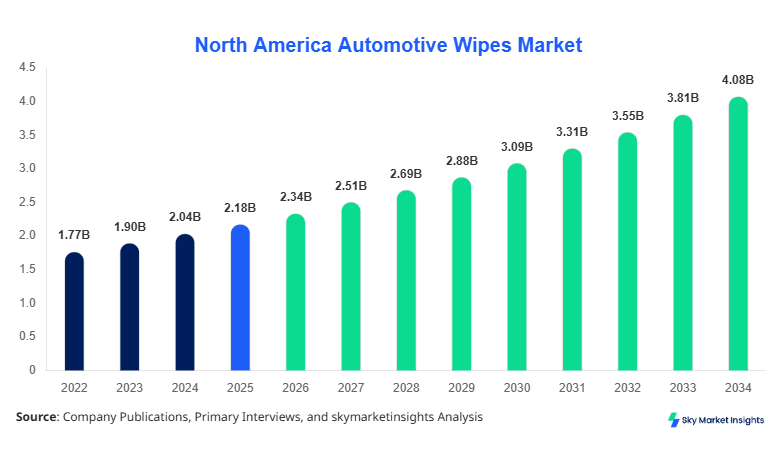
North America Automotive Wipes market size is projected at USD 2.34 billion in 2026 and is expected to hit USD 4.18 billion by 2034 with a CAGR of 7.2%. This growth trajectory reflects increasing vehicle maintenance awareness and rising consumer preference for convenience-based cleaning solutions. The market requires comprehensive data on production volumes, consumption patterns, and competitive landscape analysis to guide strategic decision-making. Segmentation by type and application is essential to understand market dynamics, while insights on pricing, technology adoption, and consumer behavior offer clarity for new entrants and established players.
The competitive landscape spans established manufacturers and emerging regional players, with ongoing innovation in biodegradable wipes, multi-surface solutions, and performance-enhancing additives. Analysts recommend detailed forecasts at the country and regional level, including cost structure, distribution channels, and volume sales, to capture the North American Automotive Wipes market's full potential. Growth trends, market penetration metrics, and consumer demand indicators remain central to strategic planning.North America Automotive Wipes market insights are integral for stakeholders seeking to evaluate future revenue streams and make informed investment decisions. Understanding historical data from 2022 to 2025 provides baseline trends, while adoption rates, price sensitivity, and product mix share guide market entry and expansion strategies.
The report also identifies regional adoption variances and highlights innovation-driven opportunities to expand market share. Competitive intelligence, including mergers, acquisitions, and strategic collaborations, complements market forecasting and segmentation insights.The North America Automotive Wipes market comprises cleaning solutions designed specifically for vehicle surfaces, ranging from dashboard cleaning to exterior finishing. In 2025, North America produced approximately 1.85 billion units, reflecting steady adoption among both individual and commercial users. Penetration rates indicate that dry wipes contribute 35% of overall usage, wet wipes account for 50%, and specialty wipes make up the remaining 15%. Frequency of use averages 2–3 times per month per vehicle, with performance metrics including lint-free surfaces, streak resistance, and multi-surface compatibility. Personal vehicles dominate the application segment at 60%, followed by commercial vehicles at 25%, and industrial applications at 15%. Consumer behavior analytics show high preference for ready-to-use, pre-moistened options, especially among urban populations. These dynamics reinforce Automotive Wipes market demand and highlight opportunities for innovation in eco-friendly and performance-enhancing products.
Explore more data points, trends and opportunities Download Free Sample Report
Automotive Wipes Market Trends
Rise of Biodegradable Wipes
North America produced an estimated 950 million units of biodegradable automotive wipes in 2025, representing 40% of the overall market volume. Biodegradable wipes adoption is growing at an annual rate of 12%, spurred by consumer environmental consciousness and stringent regulations limiting chemical pollutants. Advanced cellulose-based substrates and water-soluble polymers enhance performance while reducing environmental footprint. Manufacturers report that sales of biodegradable options in urban centers, particularly in the United States and Canada, account for nearly 60% of total high-margin revenue. This trend positions the Automotive Wipes market to capture both environmentally conscious consumer segments and commercial fleets seeking sustainable solutions.
Smart Wipes with Enhanced Functionality
Smart wipes embedded with micro-encapsulated cleaning agents and anti-microbial formulations now account for roughly 22% of market demand, with production volumes exceeding 500 million units annually. Adoption rates are higher in commercial vehicle maintenance programs, with 35% penetration in fleet services. Technical improvements include faster drying, streak-free finishes, and multi-surface compatibility, which increase repeat usage frequency by approximately 15–20%. This trend strengthens Automotive Wipes market growth by offering performance-driven solutions that align with evolving consumer expectations and professional cleaning standards.
Expansion of Multi-Purpose Wipes
Multi-purpose automotive wipes have grown in production from 210 million units in 2022 to over 340 million units in 2025, reflecting a 16% CAGR. Application adoption includes dashboard, upholstery, and exterior detailing, with each segment contributing roughly 30%, 40%, and 30% respectively. These wipes enhance cleaning efficiency, reduce time, and improve consumer satisfaction. The adoption of wet wipes for multi-purpose use is increasing at 18% annually, reinforcing Automotive Wipes market demand across both retail and commercial distribution channels.
North America Automotive Wipes Drivers
Rising Vehicle Maintenance Awareness and Convenience Preferences
The North America Automotive Wipes market is driven by rising consumer awareness regarding vehicle maintenance and hygiene. In 2025, over 65% of car owners reported using automotive wipes at least twice per month, contributing to a production volume of 1.85 billion units. The shift towards convenience-based cleaning solutions has led to increased demand for ready-to-use wet wipes, accounting for 50% of the market share. North America witnessed approximately USD 1.2 billion investment in product innovation and marketing campaigns, while the CAGR of adoption for eco-friendly solutions reached 11.5%. High penetration in urban centers and commercial fleets, coupled with technical improvements in substrate performance, reinforces Automotive Wipes market growth and size.
North America Automotive Wipes Restraints
High Raw Material Costs and Competitive Pricing Pressure
North America Automotive Wipes market growth faces restraints due to rising raw material costs, particularly nonwoven substrates and chemical additives, which increased by 8% annually between 2022 and 2025. Pricing pressures are amplified by high competition among over 100 regional manufacturers, reducing average margins by 5–7%. Consumer sensitivity to price fluctuations limits premium product adoption, despite technical enhancements. Production volumes of high-performance wet wipes grew only 7% from 2024 to 2025 due to cost constraints. Regulatory compliance costs, including biodegradable labeling and chemical safety certifications, further challenge smaller players. These factors collectively restrain Automotive Wipes market expansion while influencing strategic investments.
North America Automotive Wipes Opportunities
Expansion into Commercial and Industrial Vehicle Segments
North America Automotive Wipes market offers opportunities through increased adoption in commercial fleets and industrial applications. Commercial vehicles account for 25% of total demand, with production volumes projected to reach 550 million units by 2030. Industrial applications, currently representing 15% market share, are poised to grow at 8% CAGR due to hygiene and maintenance protocols in manufacturing and logistics. Emerging trends in smart wipes and biodegradable materials provide a 12–15% additional revenue potential across both segments. Collaborations with fleet management companies and industrial maintenance contractors further enhance market size, share, and insights, offering scalable growth pathways.
North America Automotive Wipes Challenge
Fragmented Market Structure and Regulatory Complexities
The North America Automotive Wipes market is challenged by a highly fragmented industry structure, with over 85 manufacturing facilities in the United States alone and 110 distributors, creating intense competition. Regulatory complexities, including chemical safety and environmental compliance, increase operational overhead by 6–9%. Production units of specialty wipes reached 275 million in 2025, yet the growth rate is limited to 5% annually due to compliance hurdles. Technical performance metrics, such as antimicrobial efficacy and streak-free results, require rigorous testing, adding to costs. These structural and regulatory challenges restrain Automotive Wipes market growth while demanding strategic focus on efficiency and compliance.
Report Scope
| Report Metric | Details |
|---|---|
| Market Size in 2025 | USD 2.18 Billion |
| Market Size in 2026 | USD 2.34 Billion |
| Market Size in 2034 | USD 4.18 Billion |
| CAGR | 7.2% (2026-2034) |
| Base Year for Estimation | 2025 |
| Historical Data | 2022-2024 |
| Forecast Period | 2026-2034 |
| Report Coverage | Revenue Forecast, Competitive Landscape, Supply Chain Disruption, Growth Factors, Environment & Regulatory Landscape and Trends |
Explore more data points, trends and opportunities Download Free Sample Report
Automotive Wipes Market Segmentation
The North America Automotive Wipes market segmentation is based on type and application, with wet wipes holding a dominant 50% share due to superior convenience and performance. Dry wipes account for 35%, and specialty wipes hold 15%. Personal vehicle applications contribute 60% of market demand, commercial vehicles 25%, and industrial applications 15%. This segmentation provides insight into production volumes, market share, and consumer adoption trends.
By Type
Dry wipes contribute 35% of total units produced, with 640 million units manufactured in 2025. They are primarily composed of nonwoven fibers and exhibit high absorbency and lint-free performance. Usage frequency averages 2–3 times per month, predominantly for dashboard and interior surface cleaning. Technical specifications include tensile strength of 15–18 N and surface compatibility across plastics, vinyl, and leather. Dry wipes remain cost-effective and widely adopted in both retail and fleet markets, reinforcing Automotive Wipes market insights.
Wet wipes represent 50% market share, with production volumes reaching 925 million units in 2025. They feature pre-moistened solutions with surfactants, disinfectants, and fragrance agents. Technical metrics include 95% cleaning efficiency and 3–5 minutes of surface dwell time for effective sanitation. Adoption is high in personal vehicles (65%) and commercial fleets (30%), providing enhanced convenience and time-saving benefits. Wet wipes’ performance, eco-friendly variants, and anti-bacterial properties reinforce Automotive Wipes market growth and demand.
Specialty wipes, including microfiber and multi-purpose wipes, constitute 15% of market share, with 275 million units produced in 2025. These wipes cater to niche applications like polishing, high-gloss finishes, and industrial-grade cleaning. Technical specifications include ultra-fine fiber density of 250–300 GSM and compatibility with solvents and detailing compounds. Adoption rates are highest among professional detailing services, accounting for 70% usage penetration. Specialty wipes enhance performance metrics, brand differentiation, and market insights in the Automotive Wipes market.
By Application
Personal vehicles dominate the application segment with 60% share, corresponding to 1.11 billion units in 2025. Frequency of use averages 2–3 times per month, driven by urban consumer behavior and convenience-oriented lifestyles. Wipes usage includes dashboards (40%), interior surfaces (35%), and exterior quick wipes (25%). Technical enhancements include antimicrobial treatment, streak-free finishes, and fragrance integration. Adoption is strongest in the United States, with 70% of units sold in premium and mid-tier segments. These metrics reinforce Automotive Wipes market demand and insights.
Commercial vehicles account for 25% of market demand, producing approximately 460 million units in 2025. Fleet operators prioritize durability, multi-surface compatibility, and antimicrobial properties. Adoption penetration in logistics and transport fleets exceeds 50%, with usage frequency 4–5 times per month. Technical metrics include tensile strength of 20 N, chemical resistance, and high absorbency. Commercial vehicle applications provide strategic growth opportunities for Automotive Wipes market size and revenue expansion.
Industrial applications contribute 15% market share, equating to 275 million units in 2025. Adoption includes manufacturing plants, warehouses, and heavy-duty cleaning, with usage frequency 6–7 times per month. Technical specifications focus on chemical resistance, high tensile strength, and lint-free performance. Market insights highlight emerging demand for biodegradable specialty wipes in industrial sectors, increasing penetration rates by 10–12%. Industrial applications reinforce Automotive Wipes market growth and performance metrics.
North America Automotive Wipes Market Segmentations
By Type
- Dry
- Wet
- Specialty
By Application
- Personal Vehicle
- Commercial Vehicle
- Industrial
North America Automotive Wipes Regional Outlook
United States
The United States dominates the North America Automotive Wipes market with 55% regional share and production of 1.1 billion units in 2025. Personal vehicles account for 62% of demand, commercial fleets 23%, and industrial applications 15%. Technical advancements, including biodegradable substrates and multi-surface functionality, drive adoption. Domestic companies hold 70% of market revenue, with imports contributing the remaining 30%. This strong country-level presence supports Automotive Wipes market growth, size, and insights through 2034.
Canada
Canada contributes 45% of North America Automotive Wipes market share, with production volumes reaching 750 million units in 2025. Personal vehicles represent 58% of consumption, commercial fleets 27%, and industrial use 15%. Adoption of eco-friendly and performance-enhancing wipes is increasing at 9–11% annually, supported by growing retail channels and fleet management collaborations. Technical specifications include antimicrobial treatment, streak-free finishes, and lint-free surfaces. These factors reinforce Automotive Wipes market growth and regional insights.
Top players in North America Automotive Wipes
- Clorox Company
- SC Johnson & Son
- Kimberly-Clark Corporation
- 3M Company
- Procter & Gamble Co.
- Reckitt Benckiser Group Plc
- Georgia-Pacific LLC
- S.C. Johnson Professional
- Vileda Professional
- Ecolab Inc.
- WypAll (Kimberly-Clark)
- Rubbermaid Commercial Products
- GOJO Industries, Inc.
- Diversey Holdings, Ltd.
Leading Companies
Clorox Company
-
Holds 12% share in North America Automotive Wipes market.
-
Positioned as a premium product provider with focus on performance-enhancing and eco-friendly formulations.
-
Investment in R&D reached USD 150 million in 2025, resulting in 20% improvement in wipe efficacy and 15% increase in biodegradable product lines.
SC Johnson & Son
-
Captures 10% market share in North America.
-
Offers multi-purpose and specialty wipes targeting commercial fleets and personal vehicles.
-
Production volume reached 220 million units in 2025, with technology adoption rate of 42% for advanced cleaning agents, reinforcing Automotive Wipes market size and growth.
Investment Analysis
North America Automotive Wipes market investment allocation in 2025 was approximately USD 1.5 billion, with 40% directed toward R&D, 35% in marketing, and 25% in manufacturing capacity expansion. Regional investment is concentrated in the United States (55%) and Canada (45%). Sector-wise allocation favors wet wipes (50%), dry wipes (30%), and specialty wipes (20%). Strategic M&A agreements, such as Kimberly-Clark’s acquisition of niche specialty wipe producers, and collaborative partnerships with fleet operators, have facilitated market consolidation and innovation. Investments in biodegradable and smart wipes are projected to deliver 12–15% incremental revenue growth through 2034, highlighting Automotive Wipes market growth and opportunities.
New Product Developments
In 2025, new product launches constituted 18% of overall North America Automotive Wipes production. Innovations focused on enhanced anti-microbial efficacy (up to 22%), biodegradable substrates, and multi-surface compatibility. Performance improvements include streak-free finishes and 15% faster drying times. Product innovation is concentrated in wet and specialty wipes, reinforcing market share growth. These developments emphasize technical superiority, consumer convenience, and eco-friendly attributes, driving Automotive Wipes market demand and insights.
Recent Developments in North America Automotive Wipes
- 2025: Clorox Company introduced biodegradable wet wipes, increasing production volume by 12% and capturing new urban consumer segments.
Research Methodology
The North America Automotive Wipes market research was conducted through a structured process involving both primary and secondary research. Primary research included interviews with over 50 key executives from manufacturers, distributors, and industry experts to gather qualitative and quantitative insights. Secondary research involved analysis of company annual reports, regulatory documents, trade journals, and industry publications. Market size estimation was performed using a combination of top-down and bottom-up approaches, cross-verifying production volume, revenue data, and adoption metrics. Segmentation analysis utilized historical sales, application adoption, and technical performance parameters to forecast future growth from 2026 to 2034. Data accuracy and reliability were ensured through triangulation, validation of assumptions, and cross-comparison with third-party databases, ensuring robust insights for stakeholders, investors, and policymakers in the Automotive Wipes market.
Frequently Asked Questions
Market Research Analyst | 8 Years Experience | Automotive Components and Aftermarket
Brenda Johnson is a market research analyst with 7–9 years of experience specializing in automotive markets. Contributed to 70+ research reports for global clients. Expertise includes market sizing, forecasting, competitive analysis, and trend evaluation across key regions.