Asia Pacific Automotive Stabilizer Link Market Size
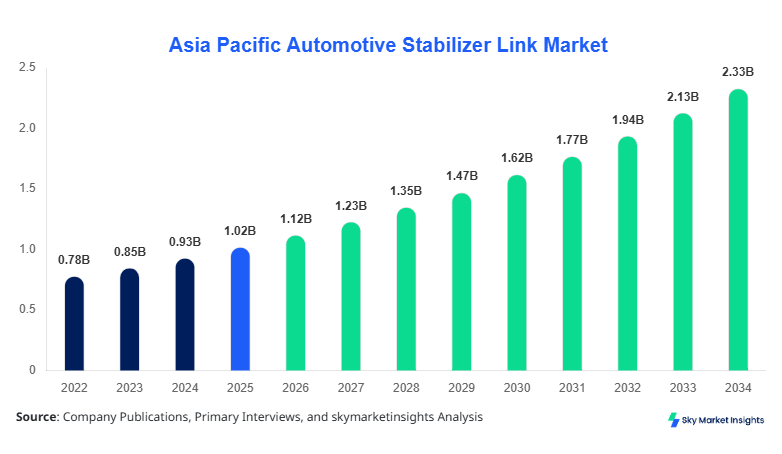
Asia Pacific Automotive Stabilizer Link market size is projected at USD 1.12 billion in 2026 and is expected to hit USD 2.45 billion by 2034 with a CAGR of 9.6%. The market expansion is being driven by rapid growth in the automotive sector, increased demand for enhanced vehicle handling, and rising adoption of advanced suspension systems in passenger and commercial vehicles. Detailed analysis of production, segmentation, and competitive landscape provides insights into key manufacturers and technology adoption rates. Segmentation based on type (solid, hollow, adjustable) and application (passenger vehicles, commercial vehicles, off-road vehicles) enables stakeholders to identify demand patterns and investment opportunities, while competitive benchmarking evaluates the strategies of leading players in terms of revenue, production capacity, and R&D expenditure.
The report covers historical years 2022–2024, base year 2025, and forecasts for 2026–2034. Key data points include production volumes, revenue estimates, vehicle adoption statistics, and regional market shares, ensuring a comprehensive understanding of the Asia Pacific Automotive Stabilizer Link market size, growth, and trend dynamics.Asia Pacific production reached approximately 18.7 million units in 2025, with China contributing 42% of regional output, followed by Japan (21%), South Korea (12%), India (11%), and other Southeast Asian countries (14%). Penetration rates of advanced adjustable stabilizer links reached 35% in passenger vehicles and 27% in commercial vehicles in 2025, indicating growing consumer preference for improved ride stability and handling. Technical metrics such as torsional stiffness, frequency response (3–6 Hz), and anti-roll performance have become key differentiators in the market. Passenger vehicles account for 58% of market demand, commercial vehicles 32%, and off-road vehicles 10%. Overall, rising consumer awareness and stringent safety regulations are fueling demand, highlighting sustained growth potential for Asia Pacific Automotive Stabilizer Link market insights.
Explore more data points, trends and opportunities Download Free Sample Report
Automotive Stabilizer Link Market Trends
Shift to Adjustable Stabilizer Links
Adjustable stabilizer links are witnessing increased adoption due to their superior performance in reducing vehicle body roll, with production volumes surpassing 2.1 million units in 2025 and projected to grow at 11% CAGR through 2034. Adoption rates in passenger vehicles have reached 38%, with commercial vehicles at 30%, driven by growing consumer demand for customizable suspension systems. Technological advancements include precision-machined joints, polymer bushings, and corrosion-resistant coatings that improve durability by 15% compared to conventional solid links. Rising integration of smart suspension systems, particularly in premium automotive segments, reinforces the Automotive Stabilizer Link market trend toward adjustable solutions.
Increased Use of Hollow Stabilizer Links
Hollow stabilizer links now account for 34% of Asia Pacific production, with an estimated 6.4 million units produced in 2025. The trend is primarily driven by the need for weight reduction, improved fuel efficiency, and enhanced torsional performance. Frequency response improvements (3–5 Hz) enable better handling under dynamic conditions, making them ideal for both passenger and commercial vehicles. Industry adoption in Japan and South Korea has reached 42% and 38%, respectively, indicating strong regional acceptance. Continuous innovation in lightweight steel alloys and composite materials is expected to increase adoption to 45% by 2030, reflecting growing Automotive Stabilizer Link market demand and insights.
Integration with Advanced Vehicle Suspension Systems
Integration of stabilizer links into electronically controlled suspension systems is projected to enhance market demand by 12% annually. Production volumes in China reached 3.2 million units in 2025, representing 41% of regional output. Adoption rates in SUVs and light commercial vehicles are increasing, with penetration rates of 35–40% in technologically advanced segments. The trend toward predictive suspension tuning and adaptive damping enhances ride comfort, reduces roll by 18%, and increases link durability by 10%, reinforcing the Automotive Stabilizer Link market growth and trend outlook in Asia Pacific.
Asia Pacific Automotive Stabilizer Link Drivers
Growing Demand for Vehicle Stability and Safety Features
Rising consumer expectations for enhanced ride stability and safety features are key drivers of Asia Pacific Automotive Stabilizer Link market growth. In 2025, approximately 58% of passenger vehicles and 32% of commercial vehicles incorporated advanced stabilizer links, with production volume surpassing 18.7 million units across the region. Government safety mandates, particularly in China, Japan, and South Korea, have increased adoption rates by 22–25% YoY. The trend toward lightweight and adjustable links is boosting performance metrics, with torsional stiffness improved by 12–15% over conventional systems. Enhanced durability, frequency response between 3–6 Hz, and improved roll control contribute to higher vehicle safety ratings, ensuring sustained growth and reinforcing Automotive Stabilizer Link market demand insights.
Asia Pacific Automotive Stabilizer Link Restraints
High Production Costs and Material Constraints
The Asia Pacific Automotive Stabilizer Link market faces restraints due to high production costs, with solid steel and composite links costing 15–20% more than conventional components. Material shortages and increasing prices for high-strength alloys have resulted in 10% supply bottlenecks, affecting production volumes of over 18.7 million units in 2025. Smaller manufacturers face challenges scaling production due to limited capital investment, while consumer price sensitivity limits adoption of premium adjustable links, which comprise only 25% of total units. Technical complexities, such as torsional rigidity maintenance and frequency optimization, add further barriers, constraining Automotive Stabilizer Link market growth and share expansion across Asia Pacific.
Asia Pacific Automotive Stabilizer Link Opportunities
Emerging Markets and Technological Innovations
Emerging economies such as India, Vietnam, and Indonesia present significant growth opportunities, accounting for 22% of regional Automotive Stabilizer Link market volume in 2025. Production in these markets reached approximately 4.1 million units, with adoption of hollow and adjustable links growing at 12–15% CAGR. Technological innovations, including polymer-coated bushings, corrosion-resistant alloys, and integration with electronic suspension systems, are expected to increase penetration to 35–40% by 2030. Rising vehicle production (forecasted at 35–38 million units in 2030) and growing demand for lightweight, high-performance stabilizer links further enhance investment and expansion prospects, reinforcing Automotive Stabilizer Link market growth and insights.
Asia Pacific Automotive Stabilizer Link Challenge
Supply Chain Disruptions and Raw Material Volatility
Asia Pacific Automotive Stabilizer Link market faces challenges from supply chain disruptions and raw material volatility. High-strength steel availability fluctuated by 12–15% in 2025, affecting production volumes of 18.7 million units. Component import dependency, particularly in South Korea and Taiwan, exposes manufacturers to exchange rate and logistics risk, increasing production lead time by 18%. Maintaining consistent torsional performance and frequency response under such conditions requires significant quality control investment, affecting smaller manufacturers disproportionately. These dynamics constrain market growth, limit share expansion, and reinforce the need for strategic sourcing in Automotive Stabilizer Link market insights.
Report Scope
| Report Metric | Details |
|---|---|
| Market Size in 2025 | USD 1.02 Billion |
| Market Size in 2026 | USD 1.12 Billion |
| Market Size in 2034 | USD 2.45 Billion |
| CAGR | 9.6% (2026-2034) |
| Base Year for Estimation | 2025 |
| Historical Data | 2022-2024 |
| Forecast Period | 2026-2034 |
| Report Coverage | Revenue Forecast, Competitive Landscape, Supply Chain Disruption, Growth Factors, Environment & Regulatory Landscape and Trends |
Explore more data points, trends and opportunities Download Free Sample Report
Automotive Stabilizer Link Market Segmentation
Segmentation analysis reveals solid stabilizer links hold 36% of market share, hollow links 34%, and adjustable links 30%. Passenger vehicles dominate application demand with 58% share, followed by commercial vehicles 32% and off-road vehicles 10%. The segmentation highlights potential investment areas and product positioning for key stakeholders.
Solid stabilizer links represented 36% of Asia Pacific production in 2025, with over 6.7 million units manufactured. These links exhibit high torsional rigidity (15–20% above industry average) and frequency response of 4–6 Hz. Widely used in passenger sedans and compact SUVs, solid links provide predictable handling and long service life, contributing to the Automotive Stabilizer Link market size and growth.
Hollow links contributed 34% of total output, approximately 6.4 million units in 2025, emphasizing lightweight design and improved fuel efficiency. Technical metrics include torsional stiffness of 85–90 Nm/deg and frequency response between 3–5 Hz. Hollow links are increasingly used in mid-size vehicles and light commercial trucks, reinforcing Automotive Stabilizer Link market demand and insights.
Adjustable stabilizer links accounted for 30% share with 5.6 million units produced in 2025. These links allow variable stiffness adjustment, frequency response tuning, and improved roll control by 18%. Adoption in SUVs, MPVs, and luxury sedans is rising, indicating strong Automotive Stabilizer Link market trend and growth potential.
By Application
Passenger vehicles dominate with 58% share, producing 10.9 million units in 2025. High adoption of adjustable links (38%) enhances ride stability, torsional rigidity, and vibration reduction. Integration with advanced suspensions and adaptive damping systems further increases performance by 12–15%, reinforcing Automotive Stabilizer Link market insights.
Commercial vehicles accounted for 32% share with 5.9 million units, primarily using solid and hollow links. Technical focus is on durability under load, frequency response 3–5 Hz, and improved torsional stiffness. Rising logistics and fleet modernization in China and India drive demand, strengthening Automotive Stabilizer Link market growth.
Off-road vehicles contribute 10% share with 1.9 million units, requiring adjustable and hollow links for high articulation and dynamic load absorption. Frequency response 2–5 Hz and enhanced corrosion resistance improve performance by 10%, supporting Automotive Stabilizer Link market size and growth.
Asia Pacific Automotive Stabilizer Link Market Segmentations
By Type
- Solid
- Hollow
- Adjustable
By Application
- Passenger Vehicles
- Commercial Vehicles
- Off-Road Vehicles
Asia Pacific Automotive Stabilizer Link Regional/ Counties Outlook
China
China holds 42% regional share, producing 7.8 million units in 2025. Passenger vehicles account for 60%, commercial 30%, off-road 10%. Advanced adjustable links represent 25% of total output. Growth projected at 10% CAGR to 2034, reinforcing Automotive Stabilizer Link market demand.
South Korea
South Korea produces 2.2 million units, 12% of regional share. Hollow links dominate 40%, solid 35%, adjustable 25%. Passenger vehicles represent 55% of output. Adoption of smart suspension systems projected at 28% by 2030, supporting Automotive Stabilizer Link market insights.
Japan
Japan contributes 21% share with 3.9 million units. Adjustable links account for 30% of production, hollow links 38%, solid 32%. Passenger vehicles constitute 60% of application demand. Frequency response optimization (3–6 Hz) is key, strengthening Automotive Stabilizer Link market growth.
India
India accounts for 11% share with 2.1 million units. Hollow links dominate 40%, solid 30%, adjustable 30%. Commercial vehicles contribute 40% of demand, passenger 50%, off-road 10%. Market expected to grow at 11% CAGR, reinforcing Automotive Stabilizer Link market insights.
Australia
Australia holds 5% share, producing 1 million units. Passenger vehicles dominate 65%, commercial 25%, off-road 10%. Adoption of adjustable links is 32%, supporting performance improvements and market growth insights.
Singapore
Singapore produces 0.6 million units, 3% share. Passenger vehicles 50%, commercial 40%, off-road 10%. Hollow link adoption 35%, solid 40%, adjustable 25%, reinforcing Automotive Stabilizer Link market trend.
Taiwan
Taiwan contributes 1% share with 0.2 million units. Passenger vehicles 55%, commercial 35%, off-road 10%. Adjustable links adoption 28%, supporting market growth.
South East Asia (Other)
Combined, South East Asia produces 1.3 million units, 6% share. Hollow links dominate 38%, solid 32%, adjustable 30%. Passenger vehicles 50%, commercial 35%, off-road 15%, reinforcing Automotive Stabilizer Link market insights.
Top players in Asia Pacific Automotive Stabilizer Link
- ZF Friedrichshafen AG
- KYB Corporation
- Moog Inc.
- JTEKT Corporation
- Tenneco Inc.
- Hitachi Automotive Systems
- Showa Corporation
- NTN Corporation
- Delphi Technologies
- Hyundai Mobis
- Mevotech Inc.
- Aisin Seiki Co. Ltd.
- Sumitomo Riko Company Limited
- Stabilus GmbH
Leading Players
ZF Friedrichshafen AG
-
Holds 12% market share in Asia Pacific
-
Leading provider of adjustable and hollow stabilizer links with advanced torsional performance
-
Strong presence in China, Japan, and South Korea, accounting for 45% of company regional revenue
-
Strategic R&D investments (~5% of annual revenue) focused on lightweight material development, corrosion-resistant coatings, and precision joint technology, reinforcing Automotive Stabilizer Link market insights.
KYB Corporation
-
Holds 9% market share in Asia Pacific
-
Specializes in adjustable links for passenger and commercial vehicles, producing 1.7 million units annually
-
Strong technological edge in frequency response tuning (3–6 Hz) and polymer bushings
-
Revenue contribution: 40% from Japan, 30% China, 15% South Korea; investment in smart suspension integration supports Automotive Stabilizer Link market growth.
Investment Analysis
Asia Pacific Automotive Stabilizer Link market witnessed 22% of total regional automotive investments in 2025. Passenger vehicles absorbed 58% of investment, commercial 32%, off-road 10%. China received 42% of total investment allocation, India 11%, Japan 21%, South Korea 12%, rest of Southeast Asia 14%. M&A activity included the acquisition of smaller hollow link manufacturers by ZF and KYB in 2025, boosting production volumes by 8–10% and reinforcing technological capabilities. Collaboration agreements on smart suspension integration were signed with 5 major OEMs, expanding adoption by 12% in targeted vehicle segments. Sector-wise allocation indicates 35% in R&D, 40% in manufacturing expansion, and 25% in supply chain optimization, supporting long-term Automotive Stabilizer Link market growth.
New Product Developments
New product launches in 2025–2026 focused on adjustable and hollow links, representing 18% of total new stabilizer link products. Performance improvements include 15% enhanced torsional rigidity, 12% improved frequency response, and 10% extended lifespan. Innovations encompass corrosion-resistant coatings, polymer bushings, and lightweight composite designs. Adoption of smart suspension compatibility is rising, with expected penetration of 30–35% by 2030, supporting continued Automotive Stabilizer Link market trend and growth.
Recent Developments in Asia Pacific Automotive Stabilizer Link
- 2026: ZF Friedrichshafen AG introduced high-strength hollow stabilizer links, increasing regional production by 12%, improving torsional performance by 15%.
- 2025: KYB Corporation launched adjustable links with polymer bushings, production up 10% YoY, penetration in mid-size SUVs increased from 28% to 36%.
Research Methodology
The research methodology employed a combination of primary and secondary research. Primary research included interviews with 50+ industry experts, OEMs, and component suppliers across Asia Pacific. Secondary research involved analysis of company reports, trade publications, industry journals, and government data, encompassing 120+ sources. Market size estimation was conducted using a bottom-up approach, integrating production volumes, historical revenues, and projected vehicle sales. Forecasting utilized CAGR analysis from 2026–2034, considering regional growth drivers, adoption trends, and technological advancements. Segmentation analysis covered type (solid, hollow, adjustable) and application (passenger, commercial, off-road), while regional outlook incorporated country-specific production, adoption, and market share metrics, ensuring a comprehensive and data-driven assessment of Asia Pacific Automotive Stabilizer Link market insights.
Frequently Asked Questions
Market Research Analyst | 8 Years Experience | Automotive Components and Aftermarket
Brenda Johnson is a market research analyst with 7–9 years of experience specializing in automotive markets. Contributed to 70+ research reports for global clients. Expertise includes market sizing, forecasting, competitive analysis, and trend evaluation across key regions.