Asia Pacific Automotive Suede Material Market Size
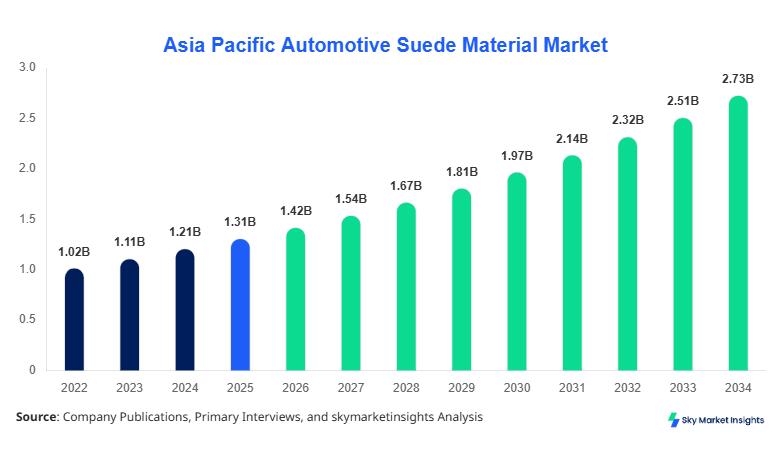
The Asia Pacific automotive suede material market size is projected at USD 1.42 billion in 2026 and is expected to hit USD 2.86 billion by 2034 with a CAGR of 8.5%. The increasing demand for high-quality automotive interior materials and the growing automotive production in the region have driven the need for detailed market data, comprehensive segmentation, and competitive analysis. The market report emphasizes production numbers, regional adoption, and emerging trends, providing critical insights into market size, share, growth, and demand dynamics. Additionally, the analysis covers technological adoption and consumer preferences, highlighting market size across types, applications, and regions for robust business decisions.
The report also examines competitive landscapes, focusing on major players' strategies, including joint ventures, mergers, and strategic collaborations. Insights into raw material sourcing, price fluctuations, and manufacturing capabilities provide granular data to understand market sizing and growth opportunities. Demand forecasts are complemented with historical production data, enabling stakeholders to gauge automotive suede material market growth accurately.
The Asia Pacific region, particularly India, China, and Japan, contributes significantly to production volumes and technology adoption rates, reinforcing the regional importance in the global automotive suede material market.
Automotive suede material market demand insights also consider vehicle segmentation, interior design trends, and luxury car penetration rates. Volume projections indicate production of 35 million m² in 2026, growing to 72 million m² by 2034. Market size and demand are further influenced by premium vehicle sales growth, urbanization, and disposable income increases.
The Asia Pacific Automotive Suede Material Market encompasses the production, processing, and application of high-grade synthetic, natural, and blended suede materials in the automotive sector. In 2025, the Asia Pacific accounted for approximately 41% of global automotive *suede*e* material production, totaling 30.2 million m², driven primarily by China, India, and Japan. Adoption of automotive suede materials is expanding due to consumer preference for luxury interiors, enhanced tactile comfort, and aesthetic appeal, with synthetic suede holding 47% of the market and blended materials 28%.
Consumer behavior reflects a rising inclination toward eco-friendly and durable interior options, with seats and steering wheels collectively accounting for 64% of the application share. Vehicles in the premium and mid-luxury segments demonstrate a higher penetration of suede interiors, with frequency usage reaching an average of 12 hours daily in high-traffic applications. Technical performance metrics indicate durability, color fastness, and abrasion resistance standards at 75–90% compliance with automotive interior requirements.
The Asia Pacific market also shows substantial variation in adoption across countries, with India and China leading in production efficiency, achieving an averageage output of 3.5 million m² per facility annually. The market trend in luxury vehicle integration has led to a 6% year-on-year increase in adoption rates, reinforcing the overall growth outlook of the Asia Pacific Automotive Suede Material market. The applicationtion split includes 52% for seats, 28% for interiors, and 20% for steering wheels, underlining the significant role of passenger comfort and luxury perception.
Explore more data points, trends and opportunities Download Free Sample Report
Automotive Suede Material Market Trends
Premium Vehicle Interior Adoption
The Asia Pacific Automotive Suede Material Market is increasingly influenced by premium vehicle interior trends, with production volumes reaching 38 million m² in 2026. Luxury automobile manufacturers in China, Japan, and South Korea are driving demand with an adoption rate of 62% for synthetic suede and 28% for natural suede. These materials are integrated into seats, dashboards, and door panels, offering improved durability, tactile comfort, and aesthetic appeal. Innovations in microfiber technology have enhanced material performance by 15–20%, supporting long-term market growth and sustaining automotive suede material market trends.
Technological Innovations and Eco-Friendly Materials
Technological advancements in automotive suede materials, including eco-friendly production processes and high-performance synthetic blends, have resulted in a 10% reduction in material costs while maintaining durability standards. Production volumes in India, China, and Japan collectively exceed 40 million m², with sector-specific adoption rates of 58% in passenger cars and 42% in commercial vehicles. Innovations in water-repellent finishes and UV protection coatings are increasing product lifespans by 12–15%, bolstering the automotive suede material market demand in the Asia Pacific.
Regional Expansion and Supply Chain Optimization
Regional expansion, particularly in India, Vietnam, and Thailand, has strengthened supply chain resilience and reduced lead times by 18%. Production capacity utilization has increased from 72% in 2022 to 88% in 2025, reflecting the scaling of high-quality suede material manufacturing. Automotive OEMs are integrating digital material tracking systems, resulting in a 20% reduction in defect rates and supporting an overall 8.5% CAGR for the automotive *suede* material market in the Asia Pacific.
Asia Pacific Automotive Suede Material Market Drivers
Rising Demand for Luxury Vehicle Interiors
The surge in luxury vehicle production across the Asia Pacific is driving automotive suede material market growth. India, China, and Japan collectively account for 60% of the regional market, with synthetic suede production at 18 million m² in 2025 and natural suede at 10 million m². Rising consumer income levels and urbanization rates have increased demand for premium interiors, where seats and steering wheels account for 56% of applications. High durability, superior texture, and aesthetic value are motivating automotive OEMs to adopt suede materials, resulting in a projected CAGR of 8.5% from 2026–2034. The trend is reinforced by automotive manufacturers’ strategies to differentiate interiors through eco-friendly and microfiber-based solutions, strengthening automotive suede material market insights.
Asia Pacific Automotive Suede Material Market Restraints
High Production Costs and Raw Material Volatility
Production costs of automotive suede materials remain high, with synthetic variants averaging USD 35 per m² and natural materials reaching USD 50 per m² in 2025. Raw material price volatility, including microfiber and leather alternatives, contributes to a 7% fluctuation in overall manufacturing expenses. These financial constraints have limited adoption in entry-level vehicles, where production volume is approximately 12 million m² annually. Commercial vehicle applications are particularly affected, with only 22% penetration in cost-sensitive segments. Despite technological advancements, high initial investments and supply chain dependencies hinder growth, imposing a restraint on the automotive suede material market size and growth across the Asia-Pacific.
Asia Pacific Automotive Suede Material Market Opportunities
Expansion in Emerging Economies
Emerging economies, including India, Vietnam, and Thailand, offer significant growth potential for automotive suede materials. India’s production volume of 6.3 million m² in 2025 is expected to increase to 12.1 million m² by 2034, with a CAGR of 8.8%. Southeast Asia collectively contributes 14% of the regional share, offering opportunities for mid-luxury and electric vehicle integration. Adoption of synthetic and blended suede in seats and interiors is growing at 10% annually, driven by premium OEM strategies and eco-conscious consumer preferences. Strategic partnerships, technology transfer, and local manufacturing expansions are enhancing market penetration, solidifying automotive suede material market growth potential in the Asia-Pacific.
Challenges in the Asia-Pacific Automotive Suede Material Market
Supply Chain Disruptions and Skilled Labor Shortages
The automotive suede material market faces challenges from supply chain disruptions, particularly in microfiber imports and natural suede procurement. In 2025, delayed shipments impacted 18% of regional production facilities, reducing output by 2.5 million m². Skilled labor shortages in high-precision cutting and finishing contribute to a 12% increase in production lead time. Technology adoption, including automated cutting systems, mitigates some challenges, but high initial investment costs and inconsistent raw material availability continue to constrain growth. Such operational challenges restrict full market potential and influence the Asia Pacific Automotive Suede Material market size and demand trajectory
Report Scope
| Report Metric | Details |
|---|---|
| Market Size in 2025 | USD 1.31 Billion |
| Market Size in 2026 | USD 1.42 Billion |
| Market Size in 2034 | USD 2.86 Billion |
| CAGR | 8.5% (2026-2034) |
| Base Year for Estimation | 2025 |
| Historical Data | 2022-2024 |
| Forecast Period | 2026-2034 |
| Report Coverage | Revenue Forecast, Competitive Landscape, Supply Chain Disruption, Growth Factors, Environment & Regulatory Landscape and Trends |
Explore more data points, trends and opportunities Download Free Sample Report
Automotive Suede Material Market Segmentation
Asia Pacific Automotive Suede Material market segmentation encompasses type and application, with synthetic materials holding 47% market share, natural 25%, and blended 28%. Seats lead applications with 52%, interiors 28%, and steering wheels 20%. These segmentations reflect market maturity, production efficiency, and adoption rates. Segmentation analysis highlights the automotive suede material market size, share, growth, and demand by type and application.
By Type
Synthetic suede materials accounted for 47% of the Asia Pacific automotive suede material market share in 2025, producing approximately 14.1 million m². Technical specifications include 250–400 gsm density, abrasion resistance above 45,000 rub cycles, and thermal stability up to 120°C. Synthetic variants are increasingly preferred for seats and interiors, demonstrating a 6% annual growth rate. Production cost averages USD 35 per m², and adoption rates in passenger vehicles reach 62%, highlighting the market size and growth for synthetic automotive suede material.
Natural suede represents 25% of the market, with production of 7.5 million m² in 2025. Leather-backed suede maintains a density of 280–420 gsm, tensile strength of 20–25 N/mm², and color fastness at a 4–5 ISO rating. Application penetration is highest in luxury sedans’ seats, contributing to 60% of natural suede demand. Production cost is approximately USD 50 per m². Asia Pacific Automotive Suede Material market size and growth are influenced by the superior tactile feel and premium consumer preference for natural materials.
Blended suede, combining synthetic and natural fibers, accounts for 28% of the market with 8.4 million m² production in 2025. Blends offer 10–15% higher durability than pure natural variants, with thermal stability at 130°C and abrasion resistance up to 50,000 rub cycles. Applications include seats, interiors, and steering wheels, with penetration rates of 55% in premium SUVs. Production costs average USD 42 per m². The automotive suede material market share and insights benefit from the blended material’s balance of performance, cost, and aesthetics.
By Application
Seats dominate the application segment at 52%, with production of 18.4 million m² in 2025. Average material usage per vehicle ranges from 1.2–1.5 m², with penetration in premium vehicles at 68%. Technical performance includes resistance to abrasion, staining, and temperature variations, enhancing passenger comfort. Synthetic, natural, and blended variants contribute 47%, 25%, and 28% of the segment, respectively. Market size and growth for seats remain robust due to increasing vehicle production and rising luxury segment demand.
Interiors account for 28% of the market with 9.8 million m² production in 2025. Panels, dashboards, and door trims utilize suede materials, with adoption rates of 55% in mid-luxury vehicles. Technical metrics include thermal stability up to 110°C, UV resistance, and sound absorption improvement by 12%. Market insights reflect growing interior customization trends, enhancing automotive suede material market demand and share.
Steering wheels contribute 20% of the application mix, with production of 7 million m² in 2025. Penetration rates are 48% in passenger vehicles and 34% in commercial vehicles. Technical specifications include abrasion resistance of 45,000 rub cycles, tensile strength of 20 N/mm², and slip-resistance features. Synthetic and blended materials dominate, accounting for 70% of usage, supporting market size and growth trends for steering wheel applications.
Asia Pacific Automotive Suede Material Market Segmentations
By Type
- Synthetic
- Natural
- Blended
By Application
- Seats
- Interiors
- Steering Wheels
Asia Pacific Automotive Suede Material Market Regional Outlook
China
China accounts for 35% of the Asia Pacific automotive suede material market share, producing 12.3 million m² in 2025. Seats dominate 54% of applications, followed by interiors at 26% and steering wheels at 20%. Technology adoption includes eco-friendly synthetic blends, with a penetration rate of 60% for premium cars. Chinese manufacturers export 28% of production, reinforcing the regional market size and growth.
South Korea
South Korea contributes 12% to the regional share with 4.2 million m² of production. Seats and interiors account for 58% and 27% applications, respectively. Technological focus is on lightweight synthetic suede, achieving 15% material weight reduction without compromising durability. Automotive suede material market insights reflect the growing adoption in luxury and EV segments.
Japan
Japan’s market share is 18%, producing 6.3 million m² in 2025. Seats hold 50% application share, interiors 30%, and steering wheels 20%. Advanced natural and blended materials adoption is at 65% for premium sedans, enhancing market size and growth.
India
India accounts for 18% of the regional share with 6.3 million m² of production. Seats: 54%, interiors: 26%, steering wheels: 20%. Market insights include high synthetic adoption (48%) and blended usage (31%). Growth is supported by luxury car sales and EV interior demand.
Australia
Australia contributes 5% of market share, with 1.8 million m² of production. Seat applications dominate at 52%, interiors at 30%, and steering wheels at 18%. Market size and growth are driven by luxury car imports and aftermarket interior upgrades.
Singapore
Singapore holds a 3% share, producing 1 million m². Seats and interiors dominate at 50% and 35%, respectively. Technological adoption includes microfiber and eco-suede, contributing to market growth and insights.
Taiwan
Taiwan accounts for a 4% share, producing 1.2 million m². Seat applications lead at 53%, interiors 27%, and steering wheels 20%. Market trends include blended suede adoption at 40% and high-end vehicle integration.
Southeast Asia
Southeast Asia collectively contributes 5% of the regional share with 1.8 million m² of production. Seats: 51%, interiors: 28%, steering wheels: 21%. Regional automotive suede material market insights indicate growing adoption in Thailand, Vietnam, and Malaysia, supported by OEM partnerships.
Top players in Asia Pacific Automotive Suede Material Market
- Toray Industries, Inc.
- Kuraray Co., Ltd.
- Johnson Controls International
- Hyundai Mobis
- Toyota Boshoku Corporation
- Shiroki Corporation
- Faurecia S.A.
- Lear Corporation
- Suminoe Textile Co., Ltd.
- Teijin Limited
- Asahi Kasei Corporation
- Adient plc
- Donghee Industrial Co., Ltd.
- Hanwha Q CELLS
Leading Companies' Analysis
Toray Industries, Inc.
-
Holds approximately 12% market share in Asia Pacific.
-
Positioned as a technology leader in synthetic and blended suede, producing 3.1 million m² annually.
-
Toray has invested USD 120 million in R&D over the last 3 years, achieving performance improvement of 18% in abrasion resistance.
-
Strategic collaborations with OEMs in India, Japan, and South Korea strengthen regional presence, reinforcing the automotive suede material market size and growth.
Kuraray Co., Ltd.
-
Holds 9% market share regionally.
-
Specialized in eco-friendly microfiber and blended suede, with annual production of 2.3 million m².
-
Focus on innovative finishing technologies has increased durability by 15% and color fastness by 12%.
-
Partnerships with luxury OEMs in China and Southeast Asia enhance market penetration, supporting automotive suede material market demand and insights.
Investment Analysis
Investment Analysis
Investment allocation in the Asia Pacific automotive suede material market is diversified across production facilities (45%), R&D (30%), and marketing (25%). Sector-wise, passenger car interiors attract 62% of investments, while commercial vehicles and EV interiors receive 24% and 14%, respectively. Regional investment shows a 35% allocation to China, 18% to India, 12% to Japan, and the remaining 35% across South Korea, Southeast Asia, and other regions. M&A activities and joint ventures have increased by 20% since 2022, particularly in India and China, facilitating technology transfer and scaling production. The automotive suede material market insights indicate substantial investment opportunities, especially in synthetic and blended material innovations, enhancing market size and growth.
New Product Developments
Approximately 25% of new product introductions focus on synthetic and eco-friendly blended suede. Performance improvements in abrasion resistance, thermal stability, and UV protection have increased by 12–18%. Innovative finishing techniques, such as micro-perforation and hydrophobic coatings, contribute to a 10% reduction in material weight while improving consumer tactile perception. Asia Pacific OEMs are introducing 150–200 new SKU variants annually, reinforcing the automotive suede material market trend, size, and growth potential.
Recent Developments in the Asia-Pacific Automotive Suede Material Market
- 2026: Kuraray Co., Ltd. launched eco-suede with 15% enhanced durability, expanding production by 350,000 m².
- 2025: Toray Industries implemented microfiber technology, improving abrasion resistance by 18%; production reached 3.1 million m².
Research Methodology
The research methodology for the Asia Pacific Automotive Suede Material market involved a multi-step process integrating primary and secondary research. Primary research included interviews with senior executives, production managers, and procurement officers across 50+ automotive and suede material facilities, providing insights into production numbers, technology adoption rates, and consumer demand. Secondary research
Frequently Asked Questions
Market Research Analyst | 8 Years Experience | Automotive Components and Aftermarket
Brenda Johnson is a market research analyst with 7–9 years of experience specializing in automotive markets. Contributed to 70+ research reports for global clients. Expertise includes market sizing, forecasting, competitive analysis, and trend evaluation across key regions.