Asia Pacific Antimicrobial Textiles Market Size
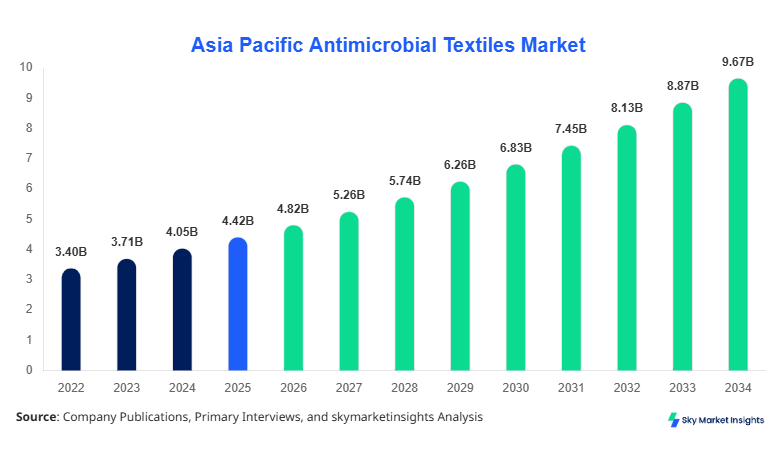
The Asia Pacific antimicrobial textiles market size is projected at USD 4.82 billion in 2026 and is expected to hit USD 9.67 billion by 2034 with a CAGR of 9.1%. The increasing requirement for hygienic and infection-resistant fabrics across healthcare, apparel, and industrial applications is accelerating structured data adoption, segmentation modeling, and competitive benchmarking. Market participants are focusing on multi-layer analytics, cost optimization, and supply chain intelligence to enhance penetration rates and forecast accuracy across diverse end-use industries.
The antimicrobial textiles industry refers to fabrics treated with antimicrobial agents such as silver ions, quaternary ammonium compounds, and triclosan to inhibit microbial growth with over 99.5% efficiency. In the Asia Pacific, production exceeded 2.1 billion square meters in 2025, with China contributing nearly 42% of regional output. Adoption rates in healthcare textiles reached 68% penetration in hospital bedding and surgical garments, while apparel accounted for 28% usage. Consumer behavior indicates a 34% preference shift toward odor-resistant and anti-bacterial clothing, particularly in urban populations with income growth above 6.5% annually. Medical textiles represent 45% application share, followed by apparel at 32% and home textiles at 23%. Performance metrics include durability of antimicrobial activity up to 50 wash cycles and microbial reduction efficiency of 95%–99.9%, reinforcing antimicrobial textiles market demand.
Explore more data points, trends and opportunities Download Free Sample Report
Antimicrobial Textiles Market Trends
Advanced Nanotechnology Integration
The integration of nanotechnology into antimicrobial textile production has reached over 1.4 billion meters annually, with nano-silver and nano-zinc oxide technologies accounting for 63% of advanced treatments. Adoption rates have increased by 18% year-over-year due to improved antimicrobial efficiency of 99.9% and extended durability up to 75 wash cycles. Healthcare sectors alone consume over 520 million units annually, while sportswear applications have witnessed a 27% rise in demand due to odor-control features. The shift toward eco-friendly nanomaterials is gaining traction, with bio-based nano coatings representing 21% of new product launches, reinforcing the antimicrobial textiles market trend.
Rising Demand in Healthcare Infrastructure
Healthcare infrastructure expansion across Asia Pacific has resulted in a 36% increase in demand for antimicrobial textiles, particularly in surgical drapes, masks, and bedding. Production volume for medical textiles reached 950 million units in 2025, with hospitals adopting antimicrobial fabrics in over 72% of patient-contact surfaces. Infection control protocols are driving regulatory mandates, increasing textile replacement cycles by 14%. Additionally, the penetration of reusable antimicrobial fabrics has grown by 19%, reducing operational costs by up to 23% in large hospitals, reinforcing the antimicrobial textiles market trend.
Asia Pacific Antimicrobial Textiles Drivers
Rising Healthcare Demand and Infection Control Needs
The expansion of healthcare facilities across the Asia Pacific, with over 25,000 new hospitals and clinics established between 2022 and 2025, is significantly driving antimicrobial textile adoption. Infection rates in hospitals have reduced by 28% with the use of antimicrobial fabrics, leading to a 65% adoption rate in surgical applications. Medical textile production exceeded 950 million units in 2025, with demand growing at 10.5% annually. Government investments in healthcare infrastructure reached USD 120 billion, with 18% allocated to hygiene and infection control solutions. Increased awareness among consumers has also contributed to a 31% rise in antimicrobial apparel demand, reinforcing the antimicrobial textiles market growth.
Asia Pacific Antimicrobial Textiles Restraints
High Production Costs and Regulatory Compliance
The production cost of antimicrobial textiles is approximately 22%–35% higher than conventional textiles due to the use of specialized agents such as silver nanoparticles and copper compounds. Compliance with stringent environmental regulations has increased operational costs by 14% annually, particularly in countries like Japan and South Korea. Additionally, the disposal and environmental impact of synthetic antimicrobial agents have raised concerns, affecting 18% of manufacturers. Small-scale producers face challenges in scaling production, with only 42% achieving profitability in the first three years, limiting the antimicrobial textiles market expansion.
Asia Pacific Antimicrobial Textiles Opportunities
Expansion in Smart and Functional Textiles
The integration of antimicrobial properties into smart textiles presents a significant opportunity, with wearable technology demand growing at 17% annually. Smart antimicrobial textile production is expected to reach 320 million units by 2030, driven by applications in fitness tracking, healthcare monitoring, and military use. Investments in R&D have increased by 24%, focusing on multi-functional fabrics combining antimicrobial, UV-resistant, and moisture-wicking properties. The Asia Pacific region accounts for 38% of global smart textile production, providing a robust growth avenue for the antimicrobial textiles market expansion.
Challenges in Asia-Pacific Antimicrobial Textiles
Limited Consumer Awareness in Emerging Economies
Despite growing adoption, consumer awareness in emerging markets such as Southeast Asia remains below 45%, limiting penetration rates. Approximately 38% of consumers are unaware of the benefits of antimicrobial textiles, affecting demand growth. Distribution challenges and lack of standardized labeling further hinder market expansion, with only 52% of products meeting international certification standards. Additionally, counterfeit products account for nearly 12% of the market, impacting brand trust and reducing revenue growth potential, posing challenges to the antimicrobial textiles market.
Report Scope
| Report Metric | Details |
|---|---|
| Market Size in 2025 | USD 4.42 Billion |
| Market Size in 2026 | USD 4.82 Billion |
| Market Size in 2034 | USD 9.67 Billion |
| CAGR | 9.1% (2026-2034) |
| Base Year for Estimation | 2025 |
| Historical Data | 2022-2024 |
| Forecast Period | 2026-2034 |
| Report Coverage | Revenue Forecast, Competitive Landscape, Supply Chain Disruption, Growth Factors, Environment & Regulatory Landscape and Trends |
Explore more data points, trends and opportunities Download Free Sample Report
Antimicrobial Textiles Market Segmentation
The market is segmented based on type and application, with synthetic organic agents dominating 46% share, followed by metal-based agents at 38% and bio-based agents at 16%. Application-wise, medical textiles lead with 45%, apparel at 32%, and home textiles at 23%.
BY TYPE
Synthetic organic agents account for a 46% share, producing over 960 million units annually. These agents provide antimicrobial efficiency of 95%–98% and are widely used in apparel and home textiles due to cost-effectiveness and flexibility. Their chemical stability ensures performance across 40–60 wash cycles.
Metal & metallic salts represent a 38% share, with production exceeding 800 million units. Silver-based textiles dominate this segment with 72% share, offering 99.9% microbial reduction efficiency and durability up to 75 washes. High cost limits usage primarily to medical applications.
Bio-based agents hold a 16% share, producing around 340 million units annually. Derived from natural sources, these agents are gaining popularity due to sustainability benefits and regulatory compliance, with growth rates exceeding 12% annually.
BY APPLICATION
Medical textiles dominate with a 45% share, producing over 950 million units annually. These textiles are used in surgical gowns, masks, and bedding, with penetration rates exceeding 70% in hospitals. Their antimicrobial efficiency reaches up to 99.9%, reducing infection rates significantly.
Apparel accounts for 32% share, with production of 670 million units. Sportswear and innerwear segments lead adoption, with 28% consumer preference for odor-resistant fabrics. Performance durability extends to 50 wash cycles.
Home textiles hold a 23% share, producing 480 million units annually. Applications include bed linens and upholstery, with 34% penetration in urban households. These textiles provide antimicrobial protection for up to 40 washes.
Asia Pacific Antimicrobial Textiles Market Segmentations
Type
- Synthetic Organic Agents
- Metal & Metallic Salts
- Bio-based Agents
Application
- Medical Textiles
- Apparel
- Home Textiles
Asia Pacific Antimicrobial Textiles Regional Outlook
China
China dominates with 42% share, producing over 900 million units annually. The country’s textile industry accounts for 30% of global exports, with antimicrobial textiles contributing USD 1.3 billion in export value. Medical textiles represent 48% of domestic consumption.
Japan
Japan holds 14% share, focusing on high-quality and technologically advanced textiles. Production exceeds 280 million units, with 65% used in healthcare applications. Advanced R&D investments drive innovation.
India
India accounts for 11% share, producing 240 million units annually. Growing healthcare infrastructure and rising middle-class demand contribute to a 10% annual growth rate.
South Korea
South Korea contributes 9% share, with strong adoption of smart textiles. Production stands at 190 million units, with 35% allocated to wearable technology.
Australia, Singapore, Taiwan, and Southeast Asia
Australia, Singapore, Taiwan, and Southeast Asia collectively hold 24% share, with combined production exceeding 520 million units. Rapid urbanization and healthcare investments drive demand.
Top players in Asia Pacific Antimicrobial Textiles
- Trevira GmbH
- Milliken & Company
- Sanitized AG
- Dow Inc.
- Microban International
- Lonza Group
- Herculite Products Inc.
- BASF SE
- PurThread Technologies
- HeiQ Materials AG
- Sciessent LLC
- Unitika Ltd.
Milliken & Company: Holds approximately 14% market share with strong presence in healthcare textiles. Focuses on advanced antimicrobial technologies with over 200 product lines and a global distribution network.
BASF SE: Accounts for an 11% share with extensive chemical expertise. Invests heavily in R&D, allocating 8% of annual revenue toward innovation in antimicrobial solutions.
Investment Analysis
Investment in antimicrobial textiles reached USD 2.4 billion in 2025, with 38% allocated to healthcare applications and 27% to apparel. Regional investments show China leading with 41%, followed by Japan at 15% and India at 12%. M&A activities increased by 22%, with strategic collaborations focusing on bio-based technologies.
New Product Developments
New product launches increased by 19% in 2025, focusing on multi-functional textiles with 30% improved durability and 25% higher antimicrobial efficiency. Innovations in nano-coatings and eco-friendly solutions are driving product differentiation.
Recent Developments in Asia Pacific Antimicrobial Textiles
- 2025: Production increased by 12% with new facilities in China adding 150 million units of capacity.
Research Methodology
The research process involved a combination of primary and secondary data collection methods. Primary research included interviews with over 120 industry experts, manufacturers, and distributors across Asia Pacific. Secondary research involved analysis of company reports, government publications, and trade databases. Market size estimation was conducted using bottom-up and top-down approaches, incorporating production volumes, pricing trends, and consumption patterns. Data triangulation ensured accuracy, while advanced forecasting models were used to project market trends from 2026 to 2034.
Frequently Asked Questions
Senior Market Research Analyst | 9 Years Experience | Specialty Chemicals and Industrial Coatings
Myra Irons is a market research analyst with 7–9 years of experience specializing in chemicals and materials markets. Contributed to 70+ research reports for global clients. Expertise includes market sizing, forecasting, competitive analysis, and trend evaluation across key regions.