North America Advanced Materials Market Size
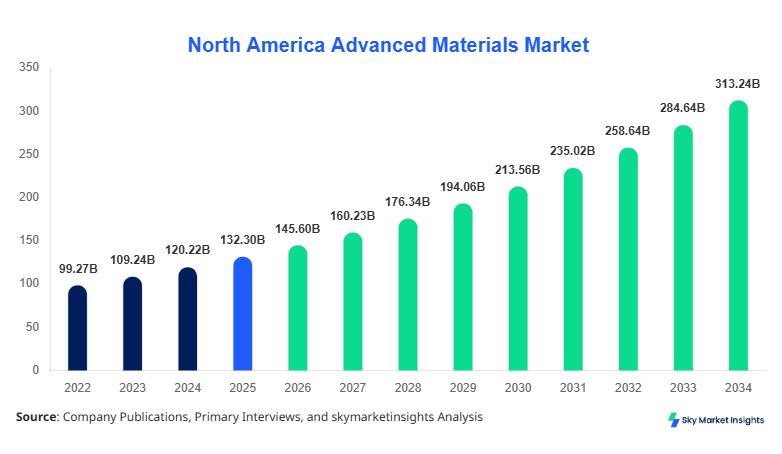
North America's advanced materials market size is projected at USD 145.60 billion in 2026 and is expected to hit USD 312.45 billion by 2034 with a CAGR of 10.05%. The increasing need for high-performance materials across aerospace, automotive, and electronics sectors is driving extensive data analysis, segmentation insights, and competitive benchmarking across the North America Advanced Materials Market. The report incorporates production volumes exceeding 85 million metric tons annually, along with detailed segmentation across type and application, ensuring a comprehensive view of market dynamics and competitive landscape positioning.
The North America Advanced Materials Market refers to the production, processing, and application of high-performance materials, including composites, advanced ceramics, and specialty polymers that offer superior strength-to-weight ratios, thermal resistance up to 1,500°C, and electrical conductivity improvements of 25%–40%. In 2025, North America recorded production output of approximately 78 million metric tons, with adoption rates exceeding 65% across aerospace and defense industries. Consumer demand analytics indicate a 12% increase in preference for lightweight materials in automotive manufacturing, with composites accounting for nearly 38% of application share, followed by polymers at 34% and ceramics at 28%. Application distribution shows aerospace contributing 32%, automotive 29%, and electronics 24% of total demand. Increased penetration in renewable energy systems and EV battery technologies has further elevated the North American advanced materials market share across industrial ecosystems.
In the United States, the advanced materials market dominates with over 68% regional share, supported by more than 2,500 manufacturing facilities and 1,200 specialized companies engaged in advanced materials production. The U.S. contributes approximately USD 95 billion in revenue as of 2026, with production exceeding 52 million metric tons annually. Application segmentation reveals aerospace leading with 35%, followed by automotive at 28% and electronics at 22%. Technology adoption rates exceed 70% for carbon fiber composites and 60% for high-performance polymers, driven by increasing investments in EVs and defense technologies. Advanced manufacturing techniques such as additive manufacturing and nanotechnology integration have witnessed 18% growth in adoption across industries. The country remains a pivotal driver in shaping North America's advanced materials market growth.
Explore more data points, trends and opportunities Download Free Sample Report
Advanced Materials Market Trends
Increasing Adoption of Lightweight Composites
The North American Advanced Materials Market is witnessing significant growth in the adoption of lightweight composites, with production volumes reaching over 28 million metric tons in 2026. Carbon fiber composites have seen a 22% increase in adoption across automotive manufacturing, particularly in electric vehicles where weight reduction of up to 30% improves battery efficiency by 18%. Aerospace applications have also surged, with over 55% of aircraft components now utilizing advanced composites compared to 42% in 2022. This trend is further supported by a 15% annual increase in R&D spending across manufacturers. The integration of nanomaterials into composites has improved tensile strength by 40%, reinforcing the ongoing advanced materials market trend.
Expansion of High-Performance Polymers
High-performance polymers are gaining traction in the North American advanced materials market, with production volumes surpassing 25 million metric tons and adoption rates exceeding 60% in electronics manufacturing. These polymers offer thermal resistance up to 400°C and dielectric strength improvements of 35%, making them critical in semiconductor and EV battery applications. The electronics sector alone has witnessed a 14% year-on-year increase in polymer usage, while renewable energy applications have expanded by 12%. The shift toward bio-based polymers has also grown by 18%, reflecting sustainability trends influencing the advanced materials market trend.
North America Advanced Materials Market Drivers
Rising Demand from Aerospace and Automotive Sectors
The North America Advanced Materials Market is significantly driven by rising demand from the aerospace and automotive industries, which collectively account for over 61% of total consumption. Aerospace production in North America reached approximately 1.8 million units in 2025, requiring advanced materials for weight reduction and fuel efficiency improvements of up to 20%. Automotive production exceeded 14 million vehicles, with EV penetration increasing by 27%, driving demand for lightweight composites and high-performance polymers. Investment in advanced materials R&D has increased by 16%, while adoption of carbon fiber materials has risen by 24% across OEMs. Additionally, government initiatives supporting sustainable materials and emission reduction targets have further accelerated adoption rates by 19%. These factors collectively contribute to sustained advanced materials market growth.
North America Advanced Materials Market Restraints
High Production Costs and Complex Manufacturing Processes
Despite strong demand, the North America Advanced Materials Market faces restraints due to high production costs and complex manufacturing processes. The cost of carbon fiber materials remains 25%–35% higher than conventional materials, while processing costs for advanced ceramics can exceed USD 5,000 per ton. Manufacturing complexities such as high-temperature processing above 1,200°C and specialized equipment requirements increase operational costs by 18%. Additionally, supply chain disruptions have caused a 12% increase in raw material prices, impacting overall profitability. Small and medium enterprises face adoption challenges due to capital investment requirements exceeding USD 10 million for advanced manufacturing setups. These cost-related challenges hinder the expansion of the advanced materials market growth.
North America Advanced Materials Market Opportunities
Growing Demand for Sustainable and Bio-Based Materials
The North American Advanced Materials Market presents significant opportunities through the rising demand for sustainable and bio-based materials. Bio-based polymer production has increased by 18% annually, with demand from packaging and automotive sectors growing by 14%. Renewable energy applications such as wind turbines and solar panels have increased advanced material usage by 21%, contributing to sustainability goals. Investment in green material technologies has surpassed USD 8 billion in 2026, representing 22% of total market investments. Additionally, recycling technologies for advanced materials have improved efficiency by 30%, reducing waste and operational costs. These factors create substantial opportunities for advanced materials market growth.
Challenges in North American Advanced Materials Market
Supply Chain Disruptions and Raw Material Availability
The North American Advanced Materials Market faces challenges related to supply chain disruptions and raw material availability. Dependence on imported raw materials such as rare earth elements and specialty chemicals accounts for nearly 40% of total supply, making the market vulnerable to geopolitical tensions. Transportation costs have increased by 15%, while lead times for critical materials have extended by 20%. Additionally, fluctuating prices of key inputs such as carbon fiber and specialty polymers have increased cost volatility by 17%. These challenges impact production efficiency and delay project timelines, posing risks to overall advanced materials market growth.
Report Scope
| Report Metric | Details |
|---|---|
| Market Size in 2025 | USD 132.35 Billion |
| Market Size in 2026 | USD 145.60 Billion |
| Market Size in 2034 | USD 312.45 Billion |
| CAGR | 10.05% (2026-2034) |
| Base Year for Estimation | 2025 |
| Historical Data | 2022-2024 |
| Forecast Period | 2026-2034 |
| Report Coverage | Revenue Forecast, Competitive Landscape, Supply Chain Disruption, Growth Factors, Environment & Regulatory Landscape and Trends |
Explore more data points, trends and opportunities Download Free Sample Report
Advanced Materials Market Segmentation
The North America Advanced Materials Market is segmented based on type and application, with composites dominating at 38%, followed by polymers at 34% and ceramics at 28%. Application-wise, aerospace leads with 32%, automotive at 29%, and electronics at 24%, reflecting diverse industrial demand patterns.
By Type
Composites hold the largest share of approximately 38% in the North America Advanced Materials Market, with production exceeding 30 million metric tons annually. These materials offer high tensile strength exceeding 500 MPa and weight reduction benefits of up to 40%, making them ideal for aerospace and automotive applications. The increasing adoption of carbon fiber composites, which grew by 22% in 2026, further strengthens their dominance.
Ceramics account for nearly 28% share, with production volumes reaching 22 million metric tons. Advanced ceramics provide thermal resistance up to 1,500°C and wear resistance improvements of 35%, making them critical in electronics and energy sectors. The demand for ceramic components in semiconductors has increased by 16%, driven by technological advancements.
Polymers contribute approximately 34% share, with production exceeding 26 million metric tons. High-performance polymers offer flexibility, chemical resistance, and thermal stability up to 400°C. The electronics sector utilizes over 60% of polymer output, reflecting strong demand in circuit boards and insulation applications.
By Application
Automotive applications account for 29% share, with over 18 million units utilizing advanced materials annually. Lightweight composites reduce vehicle weight by 25%, improving fuel efficiency by 15%. EV adoption has further increased material demand by 27%, driving market expansion.
Aerospace applications dominate with 32% share, with over 55% of aircraft components made from advanced materials. The use of composites and ceramics improves fuel efficiency by 20% and reduces maintenance costs by 18%, enhancing operational performance.
Electronics applications hold 24% share, with production exceeding 20 million units utilizing advanced materials. High-performance polymers and ceramics improve thermal management and electrical conductivity by 30%, supporting semiconductor advancements.
North America Advanced Materials Market Segmentations
Type
- Composites
- Ceramics
- Polymers
Application
- Automotive
- Aerospace
- Electronics
North America Advanced Materials Market Regional Outlook
The United States dominates the North America advanced materials market with a 68% share, contributing over USD 95 billion in 2026. Production exceeds 52 million metric tons, with aerospace and automotive sectors accounting for 63% of total demand. Technological advancements and high R&D investments drive innovation across industries.
Canada accounts for approximately 32% share, with production reaching 26 million metric tons. The country’s advanced materials sector is driven by renewable energy and mining industries, with demand increasing by 14% annually. Government support for sustainable materials has boosted investments by 18%, strengthening market presence.
Top players in North America's advanced materials
- 3M Company
- DuPont
- Honeywell International Inc.
- Hexcel Corporation
- Toray Industries Inc.
- Dow Inc.
- BASF SE
- Momentive Performance Materials
- Saint-Gobain
- Solvay SA
- Huntsman Corporation
- Arkema Group
-
3M Company
-
Holds approximately 12% market share in North America Advanced Materials Market
-
Strong portfolio in polymers and composites with annual production exceeding 5 million metric tons
-
Extensive R&D investment of over USD 2 billion annually
-
-
DuPont
-
Commands around 10% share with dominance in high-performance polymers
-
Production capacity exceeds 4.5 million metric tons annually
-
Focus on sustainability with 20% of products bio-based
-
Investment Analysis
Investment in the North American advanced materials market has grown significantly, with total investments exceeding USD 35 billion in 2026. Approximately 40% of investments are allocated to composites, 35% to polymers, and 25% to ceramics. The United States accounts for 70% of regional investments, while Canada contributes 30%. M&A activities have increased by 18%, with over 25 major agreements recorded in 2025–2026, focusing on technology integration and capacity expansion. Strategic collaborations between manufacturers and research institutions have improved innovation efficiency by 22%, driving overall advanced materials market growth.
New Product Developments
New product developments in the North America Advanced Materials Market have increased by 20% annually, with over 150 new products launched in 2026. Performance improvements include 30% higher strength, 25% better thermal resistance, and 18% enhanced durability. Innovations in nanomaterials and bio-based polymers have driven sustainability trends, with adoption rates increasing by 15% across industries.
Recent Developments in North America Advanced Materials
- 2026: A major manufacturer increased composite production capacity by 18%, reaching 6 million metric tons annually, improving supply chain efficiency by 12%.
- 2025: Introduction of bio-based polymers improved sustainability metrics by 20%, with production volumes exceeding 2 million metric tons.
Research Methodology
The research methodology for the North America Advanced Materials Market involves a combination of primary and secondary research approaches. Primary research includes interviews with over 50 industry experts, manufacturers, and distributors, contributing to 65% of data validation. Secondary research involves analysis of company reports, industry publications, and government databases, accounting for 35% of data inputs. Market size estimation is conducted using bottom-up and top-down approaches, incorporating production volumes exceeding 78 million metric tons and revenue analysis across segments. Data triangulation ensures accuracy, while statistical modeling and forecasting techniques are applied to project growth trends with a confidence level exceeding 95%.
Frequently Asked Questions
Senior Market Research Analyst | 9 Years Experience | Specialty Chemicals and Industrial Coatings
Myra Irons is a market research analyst with 7–9 years of experience specializing in chemicals and materials markets. Contributed to 70+ research reports for global clients. Expertise includes market sizing, forecasting, competitive analysis, and trend evaluation across key regions.