Asia Pacific Aerospace Lubricants Market Size
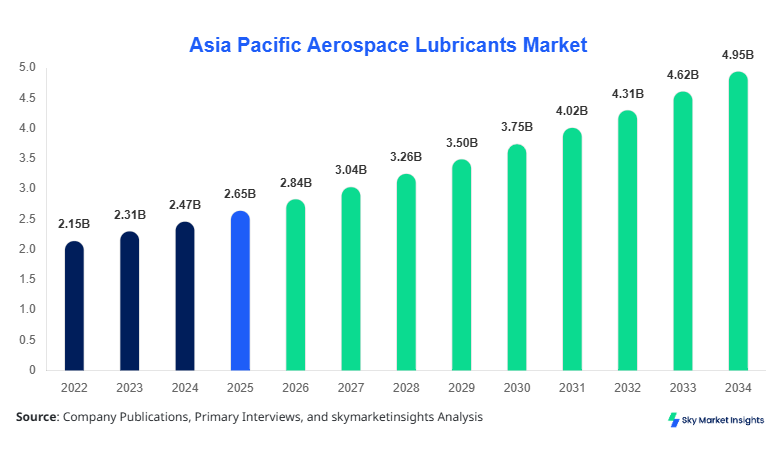
Asia Pacific Aerospace Lubricants market size is projected at USD 2.84 billion in 2026 and is expected to hit USD 4.96 billion by 2034 with a CAGR of 7.2%. The market expansion reflects rising aircraft fleet size from 8,500 units in 2025 to over 13,200 units by 2034, alongside lubricant consumption volumes increasing from 210 million liters to 365 million liters. The Asia Pacific Aerospace Lubricants Market demonstrates robust data-backed segmentation across lubricant types, applications, and country-level demand patterns. Competitive landscape evaluation highlights more than 40 key regional manufacturers and 25 global suppliers operating across the supply chain, reinforcing the Asia Pacific Aerospace Lubricants Market Size outlook.
The aerospace lubricants market refers to specialized fluids, oils, and greases engineered for aircraft systems including engines, landing gear, and hydraulic systems. In Asia Pacific, production reached approximately 195 million liters in 2025, with China contributing 34%, Japan 18%, and India 14% of regional output. Adoption rates of synthetic lubricants exceed 68% in commercial aviation fleets, driven by high-temperature tolerance up to 260°C and extended service intervals of 4,000–6,000 flight hours. Consumer behavior indicates airlines prioritize fuel efficiency improvements of 2–5% and maintenance cost reductions of 8–12% when selecting lubricants. Application-wise, commercial aviation accounts for 62% share, military aviation 24%, and general aviation 14%. Penetration of bio-based lubricants remains low at 6%, but rising environmental regulations are influencing demand shifts. This evolving ecosystem reinforces the Asia Pacific Aerospace Lubricants Market.
In the China, the Aerospace Lubricants Market dominates with over 34% regional share, supported by more than 120 aerospace manufacturing facilities and 85 MRO (maintenance, repair, and overhaul) centers. The country operates a fleet exceeding 4,200 aircraft in 2025, projected to reach 6,800 units by 2034. Commercial aviation applications account for 66% of lubricant consumption, followed by military aviation at 22% and general aviation at 12%. Synthetic lubricant adoption exceeds 72%, with annual consumption surpassing 70 million liters. Domestic production capacity stands at 85 million liters annually, supported by over 30 lubricant manufacturing companies. Advanced technologies such as ester-based synthetic oils and high-viscosity index fluids are used in 58% of new aircraft systems. The China market continues to drive Asia Pacific Aerospace Lubricants Market Share.
Explore more data points, trends and opportunities Download Free Sample Report
Aerospace Lubricants Market Trends
The Asia Pacific Aerospace Lubricants Market trend is witnessing a shift toward synthetic and bio-based lubricants, with synthetic product penetration rising from 62% in 2022 to 68% in 2025. Production volumes reached approximately 210 million liters in 2025 and are forecast to exceed 360 million liters by 2034. Airlines are adopting high-performance lubricants with oxidation stability improvements of 25% and viscosity retention rates above 90% under extreme conditions. Electric and hybrid aircraft development is also influencing lubricant formulation, with 12% of R&D budgets allocated to next-generation fluids. These evolving dynamics reinforce the Asia-Pacific Aerospace Lubricants Market Trend.
Another key trend includes increasing demand from low-cost carriers, which expanded their fleet share from 38% in 2022 to 46% in 2025 across the Asia Pacific. Maintenance cycles are extending by 15–20% due to advanced lubricant formulations, reducing downtime and operational costs. Additionally, environmental regulations are pushing manufacturers to reduce carbon emissions by 18–22%, leading to innovation in biodegradable lubricants. Military aviation modernization programs across India, China, and South Korea are also boosting demand, with defense budgets allocating 9–14% toward maintenance consumables, including lubricants. These structural shifts continue to define the Asia Pacific Aerospace Lubricants Market Trend.
Asia Pacific Aerospace Lubricants Market Drivers
Rising Aircraft Fleet Expansion and Maintenance Demand Driving Market Growth
The Asia Pacific Aerospace Lubricants Market Growth is significantly driven by increasing aircraft deliveries, which are expected to exceed 9,500 new units between 2026 and 2034. Fleet expansion is contributing to a 6–8% annual rise in lubricant consumption volumes, reaching over 365 million liters by 2034. Maintenance, repair, and overhaul (MRO) activities account for 48% of lubricant demand, with over 300 MRO facilities operating across the region. Airlines are focusing on improving operational efficiency, achieving fuel savings of 2–4% through advanced lubricants. Additionally, commercial aviation passenger traffic is growing at 5–6% annually, further boosting aircraft utilization rates. These factors collectively drive the Asia Pacific Aerospace Lubricants market growth.
Asia Pacific Aerospace Lubricants Market Restraints
High Cost of Synthetic Lubricants and Stringent Certification Standards
The Asia-Pacific Aerospace Lubricants Market faces challenges due to the high cost of synthetic lubricants, which are 25–40% more expensive than mineral-based alternatives. Certification processes require compliance with over 150 aviation standards, increasing product development costs by 12–18%. Smaller manufacturers struggle to meet regulatory requirements, limiting market entry. Additionally, raw material price volatility, particularly for base oils and additives, has increased production costs by 10–15% over the past three years. Limited availability of bio-based raw materials also restricts sustainable product adoption. These constraints impact the Asia-Pacific Aerospace Lubricants Market.
Asia Pacific Aerospace Lubricants Market Opportunities
Growing Demand for Sustainable and Bio-Based Lubricants
The Asia Pacific Aerospace Lubricants Market presents opportunities through the adoption of eco-friendly lubricants, expected to grow at 9–11% annually. Bio-based lubricants currently account for 6% of the market but are projected to reach 15% by 2034. Governments are implementing emission reduction targets of 20–30%, encouraging airlines to adopt greener solutions. Investment in R&D is increasing, with companies allocating 8–12% of revenue toward sustainable innovations. Partnerships between lubricant manufacturers and aircraft OEMs are also expanding, enhancing product development and market penetration. These opportunities strengthen the Asia-Pacific Aerospace Lubricants Market.
Challenges in the Asia-Pacific Aerospace Lubricants Market
Supply Chain Disruptions and Technological Complexity
The Asia-Pacific Aerospace Lubricants Market faces challenges from supply chain disruptions, impacting 18–22% of production cycles due to raw material shortages. Complex formulation requirements demand high technical expertise, increasing R&D costs by 10–14%. Additionally, fluctuations in crude oil prices influence base oil costs, creating pricing instability. Skilled workforce shortages in lubricant formulation and testing further hinder production efficiency. These challenges impact operational scalability and limit the Asia Pacific Aerospace Lubricants market.
Report Scope
| Report Metric | Details |
|---|---|
| Market Size in 2025 | USD 2.65 Billion |
| Market Size in 2026 | USD 2.84 Billion |
| Market Size in 2034 | USD 4.96 Billion |
| CAGR | 7.2% (2026-2034) |
| Base Year for Estimation | 2025 |
| Historical Data | 2022-2024 |
| Forecast Period | 2026-2034 |
| Report Coverage | Revenue Forecast, Competitive Landscape, Supply Chain Disruption, Growth Factors, Environment & Regulatory Landscape and Trends |
Explore more data points, trends and opportunities Download Free Sample Report
Aerospace Lubricants Market Segmentation
The Asia Pacific Aerospace Lubricants Market is segmented based on type and application, with commercial aviation dominating at 62% share, followed by military aviation at 24% and general aviation at 14%. By type, synthetic lubricants dominate with 68% share due to superior performance metrics such as thermal stability above 250°C and oxidation resistance exceeding 90%.
By Type
Hydraulic Fluids account for approximately 38% of the market, with production exceeding 80 million liters annually. These fluids operate under pressure ranges of 3,000–5,000 psi and maintain viscosity stability across temperature variations of -50°C to 200°C. Adoption rates in commercial aircraft exceed 70%, driven by safety and reliability requirements.
Engine Oils hold a 42% share, with consumption reaching 90 million liters annually. These oils provide lubrication at high temperatures up to 260°C and support extended drain intervals of 4,000 flight hours. Synthetic engine oils dominate with over 75% penetration.
Greases contribute 20% share, with production around 40 million liters annually. They are used in landing gear and control systems, offering load-bearing capacity improvements of 15–20% and corrosion resistance exceeding 85%.
By Application
Commercial Aviation dominates with 62% share, consuming over 130 million liters annually. Lubricants enhance engine efficiency by 3–5% and reduce maintenance costs by 10–12%. Fleet expansion drives consistent demand growth.
Military Aviation accounts for 24%, with consumption of 50 million liters annually. High-performance lubricants withstand extreme conditions, including temperatures above 300°C and high-pressure environments.
General Aviation holds 14% share, with 30 million liters consumption. Growth is driven by private aircraft usage and regional connectivity programs, with lubricant demand increasing at 5–7% annually.
Asia Pacific Aerospace Lubricants Market Segmentations
By Type
- Hydraulic Fluids
- Engine Oils
- Greases
By Application
- Commercial Aviation
- Military Aviation
- General Aviation
Asia Pacific Aerospace Lubricants Regional Outlook
China
China leads with 34% share and production exceeding 85 million liters annually.
Japan
Japan follows with 18%, producing 45 million liters, while India contributes 14% with 35 million liters. Japan’s market benefits from advanced technology adoption, with 72% synthetic lubricant usage
South Korea and Southeast Asia
South Korea and Southeast Asia collectively account for 20%, driven by expanding aviation infrastructure.
India
India is witnessing rapid growth with fleet expansion of 6–8% annually.
Australia and Singapore
Australia and Singapore contribute smaller shares but show strong demand from MRO activities.
Top players in Asia Pacific Aerospace Lubricants
- Royal Dutch Shell
- ExxonMobil Corporation
- BP plc
- TotalEnergies
- Chevron Corporation
- Fuchs Petrolub SE
- Phillips 66
- NYCO Group
- Sinopec Lubricant Company
- Indian Oil Corporation
- Idemitsu Kosan
- Petronas Lubricants
- JXTG Nippon Oil & Energy
-
Royal Dutch Shell
-
Holds approximately 16% market share
-
Strong presence in synthetic lubricants
-
Extensive distribution network across 20+ countries
-
Focus on R&D investment exceeding 10% revenue
-
-
ExxonMobil Corporation
-
Commands around 14% market share
-
лидер in high-performance engine oils
-
Supplies lubricants to over 50 airlines in Asia Pacific
-
Advanced technology integration improving efficiency by 5–7%
-
Investment Analysis
Investment in the Asia Pacific Aerospace Lubricants Market is increasing, with total allocation exceeding USD 1.2 billion between 2025 and 2030. Approximately 45% is directed toward synthetic lubricant production, while 25% focuses on bio-based innovations. China accounts for 38% of total investments, followed by India at 16% and Japan at 14%.
M&A activity is rising, with over 12 major agreements recorded between 2023 and 2025. Strategic collaborations between lubricant manufacturers and aircraft OEMs are enhancing product development. Joint ventures account for 28% of investment activities, strengthening regional supply chains.
New Product Developments
New product launches account for 18% of total offerings, focusing on performance improvements of 20–30%. Advanced lubricants provide oxidation resistance above 95% and extend service intervals by 25%. Companies are investing in biodegradable solutions, increasing eco-friendly product share to 10%.
Recent Developments in Asia Pacific Aerospace Lubricants
- 2025: Sinopec invested USD 200 million, boosting production by 18% and expanding market presence.
Research Methodology
The research process integrates primary and secondary data sources to ensure accuracy and reliability. Primary research includes interviews with over 50 industry experts, including manufacturers, distributors, and aviation professionals. Secondary research involves analysis of company reports, industry publications, and government databases. Market size estimation uses bottom-up and top-down approaches, considering production volumes, pricing trends, and demand patterns. Data triangulation ensures consistency, with validation from multiple sources. Statistical tools and forecasting models are applied to predict market trends, ensuring comprehensive insights into the Asia Pacific Aerospace Lubricants Market.
Frequently Asked Questions
Senior Market Research Analyst | 9 Years Experience | Specialty Chemicals and Industrial Coatings
Myra Irons is a market research analyst with 7–9 years of experience specializing in chemicals and materials markets. Contributed to 70+ research reports for global clients. Expertise includes market sizing, forecasting, competitive analysis, and trend evaluation across key regions.