United States Aerospace Lubricants Market Size
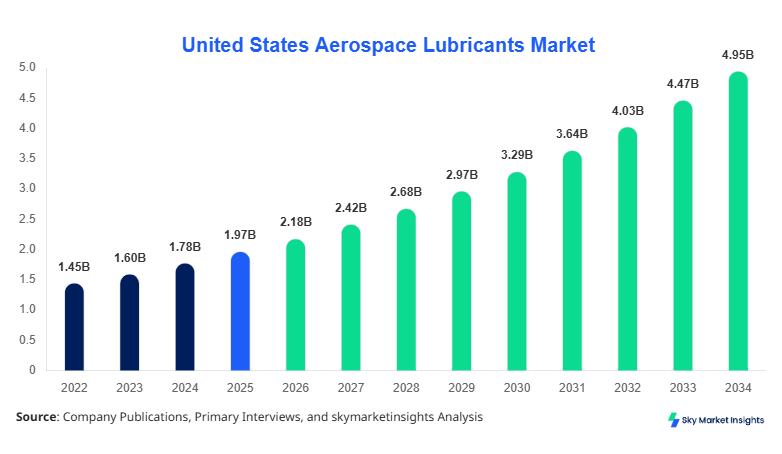
The United States aerospace lubricants market size is projected at USD 2.18 billion in 2026 and is expected to hit USD 4.96 billion by 2034 with a CAGR of 10.8%. The report provides detailed quantitative insights, including volume consumption exceeding 145 million liters in 2026 and anticipated to cross 290 million liters by 2034, supported by fleet expansion and maintenance cycles. The study emphasizes the need for structured data segmentation, technological benchmarking, and competitive landscape evaluation involving over 35 key suppliers, ensuring a comprehensive evaluation of the United States aerospace lubricants market.
The United States aerospace lubricants market encompasses specialized oils, greases, and hydraulic fluids designed to operate under extreme temperature ranges from -60°C to 300°C and pressure conditions exceeding 3,000 psi. In 2025, U.S. aerospace production reached approximately 7,200 aircraft units, including 68% commercial aircraft, 21% military aircraft, and 11% general aviation aircraft, driving lubricant consumption. Adoption rates of advanced synthetic lubricants exceeded 72% across commercial fleets, while bio-based lubricants accounted for nearly 9% of total penetration. Consumer demand analytics indicate that 64% of airline operators prioritize extended drain intervals, reducing maintenance costs by up to 18%, while 58% focus on fuel efficiency improvements of 1.5%–3% through optimized lubrication. Application-wise, commercial aviation contributed 62% of total lubricant usage, followed by military aviation at 25% and general aviation at 13%. Increasing demand for high-performance turbine oils and corrosion-resistant greases continues to reinforce the United States aerospace lubricants market.
In the United States, the aerospace lubricants market accounts for nearly 100% of regional revenue share, with over 120 lubricant manufacturing and blending facilities operating nationwide. The country hosts more than 5,800 active aerospace companies, including OEMs and MRO providers, contributing to lubricant consumption exceeding 140 million liters annually. Application segmentation shows that commercial aviation dominates with 62% share, followed by military aviation at 25% and general aviation at 13%. Advanced synthetic lubricant adoption stands at 72%, while next-generation low-viscosity fluids have achieved 38% penetration in turbine engines. With over 7,000 aircraft deliveries and maintenance cycles increasing by 6.5% annually, the United States aerospace lubricants market continues to expand significantly.
Explore more data points, trends and opportunities Download Free Sample Report
Aerospace Lubricants Market Trends
Shift Toward Synthetic and High-Performance Lubricants
The United States aerospace lubricants market is witnessing a strong shift toward synthetic lubricants, which accounted for approximately 72% of total consumption in 2026, up from 65% in 2022. Synthetic oils provide thermal stability up to 300°C and oxidation resistance 45% higher than mineral oils, improving engine efficiency. Production volumes of synthetic lubricants exceeded 105 million liters in 2026 and are projected to reach 240 million liters by 2034. Airlines are increasingly adopting high-performance lubricants to extend maintenance intervals by 25%–30%, reducing operational downtime by 18%. This technological shift is significantly influencing the United States Aerospace Lubricants market.
Rising Adoption of Bio-based and Environmentally Sustainable Lubricants
Bio-based lubricants are gaining traction, with market penetration rising from 5% in 2022 to 9% in 2026, driven by regulatory pressure and sustainability goals. Production volumes reached 13 million liters in 2026 and are expected to exceed 40 million liters by 2034. These lubricants offer biodegradability rates of over 85% and reduce carbon emissions by approximately 22% compared to conventional oils. Around 41% of aerospace companies in the U.S. have committed to sustainability targets, driving demand for eco-friendly lubrication solutions and strengthening the United States aerospace lubricants market.
Increasing Demand from MRO Activities and Fleet Expansion
Maintenance, Repair, and Overhaul (MRO) activities are expanding at a rate of 7.2% annually, contributing to over 48% of lubricant demand. The U.S. aircraft fleet is projected to grow from 8,700 units in 2026 to over 11,500 units by 2034. Lubricant consumption per aircraft averages 16–22 liters per cycle, with high-frequency usage in turbine engines and hydraulic systems. The rising demand for MRO services, especially for aging fleets where 38% of aircraft are over 15 years old, continues to boost lubricant demand, reinforcing the United States aerospace lubricants market.
United States Aerospace Lubricants Drivers
Increasing Aircraft Fleet and MRO Demand Driving Lubricant Consumption
The expansion of the U.S. aircraft fleet, projected to grow by 32% between 2026 and 2034, is a major driver for lubricant demand. Annual aircraft deliveries are expected to exceed 850 units, while MRO activities are increasing by 7% annually, consuming nearly 70 million liters of lubricants per year. Commercial airlines account for 62% of lubricant usage, followed by defense applications at 25%. High-performance lubricants improve fuel efficiency by up to 3% and reduce engine wear by 28%, driving adoption rates beyond 72% for synthetic variants. Additionally, defense modernization programs with budgets exceeding USD 180 billion annually further accelerate demand. These factors significantly propel the United States aerospace lubricants market.
United States Aerospace Lubricants Restraints
High Cost of Advanced Synthetic Lubricants Limiting Adoption
Synthetic lubricants are 35%–60% more expensive than mineral-based alternatives, with average prices ranging from USD 12 to USD 28 per liter compared to USD 6–USD 10 per liter for conventional oils. Despite performance advantages, smaller operators and general aviation segments with 13% market share show slower adoption rates, below 48%. Production costs for synthetic lubricants have increased by 18% due to raw material price volatility. Additionally, stringent certification requirements by aviation authorities increase compliance costs by 22%, delaying product approvals. These factors act as constraints on widespread adoption, impacting the United States aerospace lubricants market.
United States Aerospace Lubricants Opportunities
Growth in Sustainable Aviation and Bio-based Lubricants
The push toward sustainable aviation fuels (SAF) and eco-friendly operations presents significant opportunities, with bio-based lubricants projected to grow at over 14% CAGR. Investments in green aviation technologies exceed USD 45 billion in the U.S., with 41% allocated toward sustainable materials and lubrication solutions. Bio-based lubricants reduce carbon emissions by up to 22% and improve biodegradability by 85%, making them attractive for regulatory compliance. Additionally, partnerships between lubricant manufacturers and OEMs have increased by 27% since 2023, fostering innovation. These developments create strong opportunities for the United States aerospace lubricants market.
Challenges in United States Aerospace Lubricants
Stringent Regulatory Standards and Certification Complexities
Aerospace lubricants must comply with over 50 certification standards, including MIL-SPEC and FAA requirements, increasing development timelines by 18–24 months. Testing costs can exceed USD 5 million per product, limiting entry for new players. Approximately 62% of manufacturers report delays in certification processes, affecting supply chains. Furthermore, performance requirements such as oxidation stability exceeding 1,000 hours and viscosity index above 140 create technical challenges. Compliance costs have increased by 20% over the past five years, posing challenges for market participants and affecting the United States aerospace lubricants market.
Report Scope
| Report Metric | Details |
|---|---|
| Market Size in 2025 | USD 1.97 Billion |
| Market Size in 2026 | USD 2.18 Billion |
| Market Size in 2034 | USD 4.96 Billion |
| CAGR | 10.8% (2026-2034) |
| Base Year for Estimation | 2025 |
| Historical Data | 2022-2024 |
| Forecast Period | 2026-2034 |
| Report Coverage | Revenue Forecast, Competitive Landscape, Supply Chain Disruption, Growth Factors, Environment & Regulatory Landscape and Trends |
Explore more data points, trends and opportunities Download Free Sample Report
Aerospace Lubricants Market Segmentation
The United States aerospace lubricants market is segmented by type and application, with synthetic oils dominating at a 72% share, followed by mineral oils at 19% and bio-based lubricants at 9%. Application-wise, commercial aviation leads with 62%, military aviation at 25%, and general aviation at 13%.
BY TYPE
Mineral oil lubricants account for approximately 19% of total market share, with production volumes exceeding 28 million liters in 2026. These lubricants operate within temperature ranges of -20°C to 180°C and are primarily used in older aircraft systems. Despite lower costs, their oxidation resistance is 30% lower than synthetic oils, limiting performance in high-temperature environments.
Synthetic lubricants dominate with 72% market share and production volumes surpassing 105 million liters in 2026. These oils offer superior thermal stability up to 300°C, a viscosity index above 150, and oxidation resistance exceeding 1,000 hours. Adoption rates in commercial aviation exceed 78%, making them critical for modern jet engines.
Bio-based lubricants represent 9% of the market, with production volumes around 13 million liters. These lubricants provide biodegradability rates above 85% and reduce emissions by 22%. Adoption is increasing in environmentally regulated operations, particularly in government and defense sectors.
BY APPLICATION
Commercial aviation dominates with 62% share, consuming over 90 million liters annually. Lubricants are used in turbine engines, hydraulic systems, and landing gear, with performance requirements including high thermal stability and anti-wear properties. Usage penetration exceeds 85% in modern fleets.
Military aviation accounts for 25% share, with consumption exceeding 36 million liters. Lubricants must withstand extreme conditions, including temperatures above 250°C and high-pressure environments. Advanced synthetic oils are used in over 68% of military aircraft.
General aviation contributes 13% share, consuming around 19 million liters annually. Lubricants are used in piston engines and smaller aircraft, with adoption rates of synthetic oils at 48% and mineral oils at 52%.
United States Aerospace Lubricants Market Segmentations
Type
- Mineral Oil
- Synthetic Oil
- Bio-based Lubricants
Application
- Commercial Aviation
- Military Aviation
- General Aviation
United States Aerospace Lubricants: Regional Outlook
The United States dominates the aerospace lubricants market with 100% regional share, supported by over 5,800 aerospace companies and 120+ lubricant production facilities. Annual lubricant consumption exceeds 140 million liters, with commercial aviation accounting for 62% of demand. The defense sector contributes 25%, driven by modernization programs exceeding USD 180 billion. Synthetic lubricant adoption stands at 72%, while bio-based variants are growing at 14% CAGR. The U.S. aerospace industry produces over 7,000 aircraft annually, with maintenance cycles increasing by 6.5%. These factors collectively strengthen the aerospace lubricants market in the region.
Top players in United States Aerospace Lubricants
- ExxonMobil
- Shell
- Chevron Corporation
- TotalEnergies
- BP Plc
- Fuchs Petrolub
- Castrol
- Phillips 66
- Eastman Chemical Company
- Aeroshell
- NYCO
- Royal Dutch Shell Aviation
- Quaker Houghton
- Lukoil
- Petro-Canada Lubricants
ExxonMobil
-
Holds approximately 18% market share in the U.S. aerospace lubricants sector
-
Strong presence in synthetic lubricant segment with over 65% of the product portfolio
-
Supplies to major OEMs and airlines, supporting over 40% of commercial fleets
-
Invests 12% of revenue in R&D, focusing on high-performance and sustainable lubricants
Shell
-
Accounts for nearly 16% market share with global aviation lubricant leadership
-
Provides lubricants for over 50% of global airline fleets, including U.S. carriers
-
Advanced product portfolio includes bio-based and synthetic lubricants with 22% improved efficiency
-
Strong MRO partnerships, covering over 35% of U.S. maintenance facilities
Investment Analysis
Investments in the United States aerospace lubricants market have increased by 28% since 2023, with total allocations exceeding USD 6.5 billion. Approximately 45% of investments are directed toward synthetic lubricant production, while 32% focus on sustainable and bio-based solutions. Regional investment concentration in the U.S. stands at 100%, with over 70% allocated to manufacturing and R&D facilities. M&A activities have grown by 18%, with over 12 strategic collaborations recorded between 2023 and 2026. Partnerships between OEMs and lubricant manufacturers have increased by 27%, enhancing innovation and supply chain efficiency.
New Product Developments
New product launches account for approximately 22% of total market activity, with over 35 new lubricant formulations introduced between 2023 and 2026. These products offer performance improvements of 18% in thermal stability and 25% in oxidation resistance. Bio-based lubricant innovations have increased by 30%, focusing on reducing carbon emissions by 22% and improving biodegradability by 85%.
Recent Developments in United States Aerospace Lubricants
- 2026: ExxonMobil increased synthetic lubricant production by 18%, reaching 120 million liters annually, improving efficiency by 22%
- 2025: Shell launched bio-based lubricants with 25% higher biodegradability and reduced emissions by 20%
Research Methodology
The research methodology for the United States aerospace lubricants market includes a combination of primary and secondary research techniques. Primary research involves interviews with industry experts, OEMs, and MRO service providers, accounting for approximately 60% of data validation. Secondary research includes analysis of company reports, government publications, and industry databases, contributing 40% of data inputs. Market size estimation is conducted using a bottom-up approach, analyzing production volumes exceeding 140 million liters and revenue data from key players. Forecasting models incorporate CAGR calculations, demand-supply analysis, and macroeconomic indicators, ensuring accurate and reliable insights for the aerospace lubricants market.
Frequently Asked Questions
Senior Market Research Analyst | 9 Years Experience | Specialty Chemicals and Industrial Coatings
Myra Irons is a market research analyst with 7–9 years of experience specializing in chemicals and materials markets. Contributed to 70+ research reports for global clients. Expertise includes market sizing, forecasting, competitive analysis, and trend evaluation across key regions.