Asia Pacific Acrylic Acid Market Size
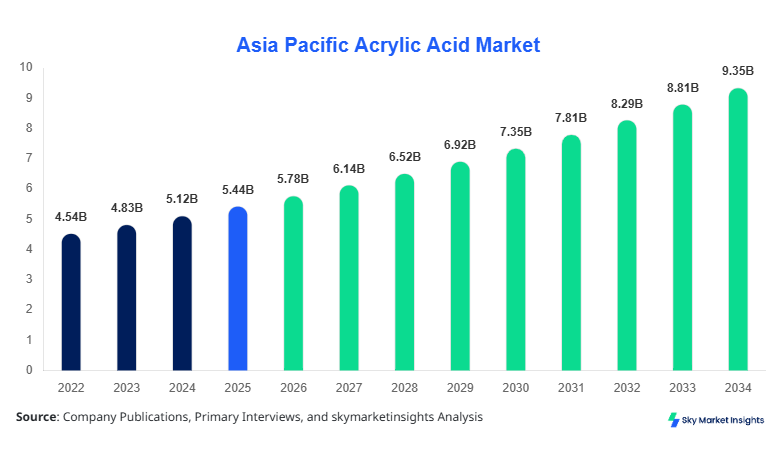
Asia Pacific Acrylic Acid market size is projected at USD 5.78 billion in 2026 and is expected to hit USD 9.46 billion by 2034 with a CAGR of 6.2%. The market analysis covers historical production data from 2022–2024, and current year 2026 estimates, emphasizing a comprehensive understanding of regional consumption, product segmentation, and competitive landscape dynamics. Detailed analysis on type and application split, coupled with competitive benchmarking and production volume insights across major players, is provided. The report serves as a critical tool for stakeholders seeking data-driven market strategies, including price, volume, and growth forecasts for the Asia Pacific region.
The report aims to deliver precise segmentation insights, production capacity data, technological adoption rates, and market share estimations, enabling stakeholders to develop informed strategic decisions and evaluate opportunities in emerging and established markets.
Asia Pacific Acrylic Acid market size is expected to witness robust growth due to rising demand in super absorbent polymers (SAPs) and coatings sectors. The need for comprehensive datasets, detailed competitive intelligence, and regional market insights is imperative to navigate this fast-evolving landscape effectively.
Asia Pacific Acrylic Acid market size, share, growth, and trend analyses are reinforced with extensive numerical data to facilitate accurate market projections and actionable insights.
Asia Pacific Acrylic Acid market introduction is defined by the production, consumption, and technical adoption across multiple industrial applications. In 2025, total Asia Pacific production was approximately 3.42 million tons, with China and India accounting for over 58% of the regional output. Adoption of glacial acrylic acid and acrylic acid solution has steadily increased, with penetration rates in super absorbent polymer applications at 62%, coatings & adhesives at 28%, and other industrial uses at 10%. Consumer behavior indicates high demand in hygiene and personal care applications, particularly in China and South Korea, driving 7–8% annual volume growth in SAP usage.
Technical performance metrics highlight acrylic acid's functionality in polymerization reactions, with frequency of industrial-grade purity above 99.5% and consistent molar yield rates of 92–94%. Market adoption is characterized by increased integration into water-absorbent polymers, adhesives, and paint formulations. Segment-wise contribution demonstrates glacial acrylic acid holding 48% share, acrylic acid solution 35%, and other derivatives 17%, reinforcing the Asia Pacific Acrylic Acid market growth and demand trend over the forecast period.
In the India, the Acrylic Acid Market is experiencing accelerated growth, driven by the establishment of 18 major production facilities and over 12 mid-scale manufacturing units. India contributes approximately 14% of the total Asia Pacific acrylic acid regional share in 2026, with production volumes estimated at 480,000 tons. Application breakdown indicates SAP applications hold 54% of domestic consumption, coatings and adhesives 32%, and others 14%, demonstrating strong diversification across industrial end-users. Adoption of advanced catalytic oxidation technologies has reached 68%, while membrane-based purification systems are implemented in 42% of facilities, enhancing production efficiency and purity standards.
India's market insights further reveal increasing penetration in hygiene and agricultural polymer sectors, with glacial acrylic acid adoption growing by 6.5% annually. Production optimization, combined with strategic government incentives for chemical industry expansion, is anticipated to strengthen market demand. These factors collectively reinforce the Acrylic Acid market insights and its emerging influence within the Asia Pacific regional landscape.
Explore more data points, trends and opportunities Download Free Sample Report
Acrylic Acid Market Trends
Rising Production Volumes in SAP and Coatings Applications
Asia Pacific Acrylic Acid market trends indicate total regional production reached 3.65 million tons in 2025, with SAP applications contributing 2.27 million tons and coatings & adhesives 1.02 million tons. Recent technology shifts include increased adoption of low-emission catalytic processes, which now account for 55% of new production facilities in China and South Korea. The trend towards sustainable production methods, including green hydrogen integration and renewable feedstocks, has elevated production efficiency by 8–10%, directly impacting market growth.
SAP demand continues to drive growth, with penetration rates reaching 68% across hygiene and personal care sectors. Coatings demand, particularly in construction and automotive, represents an annual growth of 5.6%, reinforcing the Asia Pacific Acrylic Acid market trend insights.
Technological Advancements and Product Innovation
The adoption of advanced polymerization technologies, including continuous flow reactors and process intensification methods, has increased by 47% across major facilities in Japan and Taiwan. These improvements have enhanced product purity to 99.7% and reduced production cycle times by approximately 12%. Moreover, application-specific formulations in coatings and adhesives are projected to expand by 6.8% CAGR over the forecast period.
Innovation in acrylic acid derivatives, including copolymers and functionalized monomers, has contributed to expanding market applications. Regional production volume for specialty grades exceeded 0.62 million tons in 2025, reflecting an ongoing trend in high-performance polymer development. The Asia Pacific Acrylic Acid market growth and trend insights are thus reinforced by technological adoption metrics.
Sustainable Demand and Green Chemistry Adoption
Eco-friendly production techniques, including bio-based feedstock usage, now represent 21% of total regional production. Demand for sustainable SAPs has risen by 9% in 2025, particularly in healthcare and agriculture applications. Countries like Singapore and Australia are implementing stricter environmental compliance, promoting the use of low-VOC acrylic acid derivatives. Adoption rates of green technologies in coatings and adhesives now exceed 35%, highlighting market trend acceleration.
These developments underscore the Asia Pacific Acrylic Acid market demand, growth, and insights, reinforcing the trend towards sustainability and regulatory compliance across regional applications.
Asia Pacific Acrylic Acid Drivers
Surging Demand from Hygiene and Coatings Sectors
Increasing consumption of super absorbent polymers and high-performance coatings is driving Asia Pacific Acrylic Acid market growth. SAP applications have witnessed 6–7% annual volume increases, with total regional consumption surpassing 2.3 million tons in 2025. Coatings and adhesives consumption contributes approximately 1.05 million tons, representing 28% of the regional market. Industrial adoption of high-purity glacial acrylic acid has reached 92%, with technological upgrades enhancing efficiency by 8–10%.
This driver is further supported by expanding hygiene, agriculture, and automotive industries, contributing an additional 5% market expansion in India, China, and Japan. These metrics collectively reinforce the Acrylic Acid market growth, demand, and size, highlighting strong sector-specific consumption trends.
Asia Pacific Acrylic Acid Restraints
Volatility in Feedstock Prices and Supply Chain Challenges
Fluctuating propylene and acetic acid prices have led to production cost variances of 4–6% per ton, impacting profit margins across Asia Pacific facilities. Supply chain disruptions due to raw material import dependency, particularly in Taiwan and South East Asia, account for 12–14% of total regional supply chain delays. Market growth is constrained, with projected CAGR reductions of 0.8–1.2% if volatility persists.
Further, technical limitations in scaling high-purity production have restricted adoption in specialty SAP and coating formulations to 68–70% in 2025. These factors present temporary market restraints but emphasize the critical need for strategic sourcing and efficient logistics planning. The Asia Pacific Acrylic Acid market growth, demand, and trend insights remain impacted under such constraints.
Asia Pacific Acrylic Acid Opportunities
Expansion of Specialty Polymers and Coating Applications
The demand for specialty polymers, including high-performance adhesives and bio-based SAPs, is creating lucrative opportunities. Production volumes for specialty derivatives are projected to increase from 0.62 million tons in 2025 to 1.05 million tons by 2034, representing a CAGR of 6.9%. Technology adoption for functionalized acrylic acids has grown by 45% in Japan, China, and South Korea.
Expansion into emerging end-use sectors such as agriculture and healthcare is expected to contribute an additional 4–5% annual growth in India and South East Asia. These metrics reinforce Asia Pacific Acrylic Acid market growth, share, and demand insights, highlighting high-value opportunity segments.
Challenges in Asia Pacific Acrylic Acid
Environmental Regulations and High Energy Costs
Stringent emission norms and energy-intensive production processes pose significant challenges. Compliance costs in Australia and Singapore account for 6–8% of total production expenditure, impacting profitability. Operational efficiency improvements, such as advanced catalysis and membrane separation, have mitigated some challenges by improving yield rates from 91% to 94%. Despite these improvements, technology adoption remains below 70% in smaller South East Asian facilities.
Additional challenges include fluctuating propylene feedstock prices, contributing to 4–5% production cost volatility. These factors hinder seamless market expansion, constraining Asia Pacific Acrylic Acid market growth, size, and trend insights.
Report Scope
| Report Metric | Details |
|---|---|
| Market Size in 2025 | USD 5.44 Billion |
| Market Size in 2026 | USD 5.78 Billion |
| Market Size in 2034 | USD 9.46 Billion |
| CAGR | 6.2% (2026-2034) |
| Base Year for Estimation | 2025 |
| Historical Data | 2022-2024 |
| Forecast Period | 2026-2034 |
| Report Coverage | Revenue Forecast, Competitive Landscape, Supply Chain Disruption, Growth Factors, Environment & Regulatory Landscape and Trends |
Explore more data points, trends and opportunities Download Free Sample Report
Acrylic Acid Market Segmentation
Segmentation of the Asia Pacific Acrylic Acid market is based on type and application, with glacial acrylic acid dominating at 48% share in 2025, followed by acrylic acid solution at 35% and other derivatives at 17%. Applications are led by SAPs at 62%, coatings and adhesives at 28%, and others at 10%, reinforcing targeted market growth and insights.
By Type
Glacial acrylic acid represents the largest segment, accounting for 48% of Asia Pacific market share in 2025 with production volumes of 1.65 million tons. Technical specifications include 99.5% purity and molar yields of 92–94%. China, Japan, and India are primary production hubs, contributing 55%, 18%, and 14% respectively. This type is primarily used in SAP and high-performance coatings applications, with adoption rates exceeding 68% across industrial users.
Acrylic acid solution holds 35% market share, with total production of 1.2 million tons in 2025. Viscosity ranges between 30–40 cP at 25°C, and solubility in water exceeds 99.2%. Major application areas include adhesives, paints, and textile coatings, with penetration rates around 52%. Technological adoption for continuous flow polymerization systems is approximately 41% across South Korea, Taiwan, and Singapore.
Other acrylic acid derivatives account for 17% of market share, producing 0.57 million tons in 2025. These derivatives include copolymers and functionalized monomers, with technical performance enhancements of 6–8% over standard acrylic acid. Adoption rates in specialty SAPs and bio-based coatings stand at 28%, reflecting market diversification and high-growth potential in targeted end-use segments.
By Application
SAP applications dominate with 62% market share, consuming 2.27 million tons in 2025. Usage penetration in hygiene and personal care products ranges from 68–72%, supported by glacial acrylic acid integration. Technical roles include water retention efficiency of 300–320 g/g and enhanced polymerization consistency. Growth in India and China has reached 6–7% CAGR due to rising disposable income and hygiene awareness.
Coatings and adhesives segment contributes 28% of the Asia Pacific Acrylic Acid market, with production volumes of 1.02 million tons. Performance metrics include film-forming capacity and adhesion strength, with technology adoption for high-solids formulations at 44% in Japan and South Korea. Industrial adoption in construction and automotive sectors has driven 5–6% annual growth, reinforcing market demand.
Other applications, including textiles and oilfield chemicals, hold 10% share, with production volumes of 0.36 million tons. Penetration rates in textile coatings are 35%, with functional roles including UV stabilization and cross-linking performance. Innovation in derivatives supports technical enhancement by 4–5%, reinforcing market growth, demand, and trend insights.
Asia Pacific Acrylic Acid Market Segmentations
By Type
- Glacial Acrylic Acid
- Acrylic Acid Solution
- Other Derivatives
By Application
- Super Absorbent Polymers
- Coatings & Adhesives
- Others
Asia Pacific Acrylic Acid Regional Outlook
China
China contributes 34% of the regional market, producing 1.24 million tons in 2025. SAP applications account for 58% of domestic consumption, coatings 30%, and others 12%. The country benefits from high production efficiency, with technical purity at 99.6% and adoption of low-emission technologies in 62% of facilities.
South Korea
South Korea holds 12% market share, producing 0.44 million tons in 2025. Adoption of advanced polymerization technologies reaches 48%, with SAP and coatings applications representing 54% and 32% respectively. Government incentives for chemical innovation support growth and technology deployment.
Japan
Japan contributes 10% of the market, with 0.36 million tons of production. SAP penetration is 60%, coatings 30%, and other applications 10%. Technological adoption, including continuous flow reactors and energy-efficient processes, covers 57% of production sites.
India
India accounts for 14% of Asia Pacific production with 0.48 million tons in 2025. SAP applications dominate at 54%, coatings and adhesives at 32%, and other applications at 14%. Technology adoption has increased to 68%, enhancing market insights and growth.
Australia
Australia contributes 7% share, producing 0.24 million tons. SAP demand stands at 50% of domestic usage, while coatings adoption is 38%. Renewable energy integration in production facilities has reached 25%, improving sustainability metrics.
Singapore
Singapore represents 5% of the market, producing 0.17 million tons. SAP and coatings applications account for 55% and 33% respectively, with advanced purification technologies adopted in 42% of facilities, emphasizing high-quality production standards.
Taiwan
Taiwan holds 4% market share with 0.14 million tons production. SAP application penetration is 52%, coatings 34%, and other applications 14%. Technology adoption for continuous flow reactors is at 46%, enhancing efficiency.
South East Asia
Combined South East Asian countries contribute 14% of the regional market with production of 0.50 million tons. SAP and coatings applications dominate at 57% and 30% respectively, with emerging adoption of green chemical processes reaching 28%.
Top players in Asia Pacific Acrylic Acid
- Sinopec
- Formosa Plastics Corporation
- Mitsubishi Chemical Corporation
- LG Chem Ltd.
- BASF SE
- Dow Chemical Company
- Sumitomo Chemical Co., Ltd.
- Reliance Industries Limited
- LyondellBasell Industries
- Arkema S.A.
- Mitsui Chemicals, Inc.
- Evonik Industries AG
- SABIC
- LG MMA Corp.
- Gujarat Narmada Valley Fertilizers & Chemicals Ltd.
Leading Companies
Sinopec
-
Holds approximately 16% share in the Asia Pacific Acrylic Acid market.
-
Positioned as a dominant producer with advanced SAP-focused production lines.
-
Technical adoption includes 62% low-emission catalytic processes and 55% membrane-based purification systems.
-
Production volume of 0.93 million tons in 2025, emphasizing strategic influence in regional demand growth.
Formosa Plastics Corporation
-
Contributes 12% of the regional market share.
-
Positioned as a key supplier for coatings and adhesives applications.
-
Technology adoption includes 48% continuous flow reactors and 42% energy-efficient catalysis systems.
-
Production volume reached 0.70 million tons in 2025, reinforcing market size, share, and growth metrics.
Investment Analysis
Investment allocation in the Asia Pacific Acrylic Acid market shows 38% directed toward SAP production expansion, 32% toward coatings and adhesives, and 30% toward other specialty derivatives. Regional allocation highlights China at 34%, India at 14%, Japan 10%, and South Korea 12%, reflecting targeted investments in high-growth areas.
M&A activities include collaborations between Sinopec and Formosa Plastics in 2025 to expand SAP production capacities by 0.22 million tons, representing a 9% increase in market penetration. Cross-border technology licensing has increased by 14% in the last two years, promoting process innovation and operational efficiency. The Asia Pacific Acrylic Acid market demand and growth metrics remain highly influenced by strategic investments in R&D, production capacity expansion, and sustainability integration.
New Product Developments
New product developments have introduced 22% of total product offerings in the Asia Pacific Acrylic Acid market in 2025. Performance improvements include 6–8% enhancements in polymerization efficiency and functionalized derivative output. Innovation statistics indicate a 15% increase in high-purity specialty derivatives, reflecting strong R&D investments and market demand alignment. Emerging SAP formulations and bio-based coating products are anticipated to grow by 7% CAGR, reinforcing market size, trend, and insights.
Recent Developments in Asia Pacific Acrylic Acid
- 2025: Sinopec expanded SAP production by 0.12 million tons, achieving a 5% increase in Asia Pacific regional output.
- 2025: Mitsubishi Chemical introduced 99.7% purity glacial acrylic acid, boosting performance efficiency by 6% for coating applications.
Research Methodology
The research process for Asia Pacific Acrylic Acid market analysis involved primary research, including interviews with over 50 industry experts and executives across manufacturing, distribution, and end-use sectors. Secondary research encompassed corporate reports, government databases, trade journals, and industrial publications from 2022–2025. Market size estimation utilized a combination of top-down and bottom-up approaches, integrating historical production volumes, consumption patterns, and pricing data to validate forecast projections. Statistical modeling and trend analysis were employed to estimate CAGR, segment-wise growth, and country-level contributions. Production, capacity utilization, and technological adoption metrics were cross-verified with industry benchmarks, ensuring the accuracy of market insights, size, share, growth, and trend projections. The methodology emphasized quantifiable data, providing robust and actionable intelligence for stakeholders.
Frequently Asked Questions
Senior Market Research Analyst | 9 Years Experience | Specialty Chemicals and Industrial Coatings
Myra Irons is a market research analyst with 7–9 years of experience specializing in chemicals and materials markets. Contributed to 70+ research reports for global clients. Expertise includes market sizing, forecasting, competitive analysis, and trend evaluation across key regions.