North America Acrylic Acid Market Size
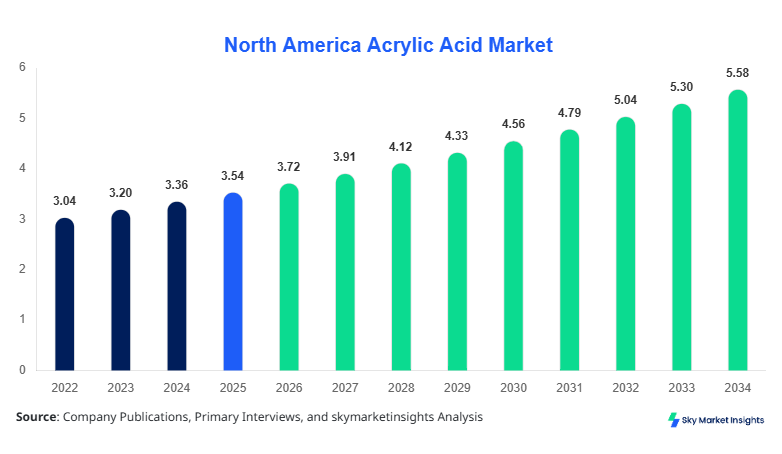
North America Acrylic Acid market size is projected at USD 3.72 billion in 2026 and is expected to hit USD 5.68 billion by 2034 with a CAGR of 5.2%. The market requires precise data tracking across production, consumption, and trade, alongside detailed segmentation by type and application. Competitive landscape assessment covering company strategies, product portfolios, and capacity expansion is vital to understand the dynamics influencing market share, growth, and trend. With North America witnessing rapid industrialization and technological adoption in chemical production, granular insights on supply chain, manufacturing techniques, and regional demand patterns are essential for stakeholders.
The North America Acrylic Acid market is characterized by its production of approximately 1.85 million tons in 2025, primarily concentrated in the United States and Canada. Acrylic acid is a colorless, highly reactive organic compound widely used in manufacturing superabsorbent polymers (SAPs), coatings, adhesives, and detergents. Adoption of functional and specialty grades has penetrated 42% of industrial applications, reflecting growing consumer demand for high-performance polymers. In 2025, superabsorbent polymers accounted for 46% of the total applications, adhesives and coatings for 32%, and detergents for 22%. Technical specifications indicate polymerization frequency ranging from 0.5 to 1.2 cycles per week in manufacturing setups, with molar mass of acrylic acid derivatives averaging 72 g/mol. Rising consumer preference for absorbent hygiene products and eco-friendly detergents has reinforced Acrylic Acid market demand, highlighting its integral role in industrial formulations.
In the United States, the Acrylic Acid Market is dominated by 28 major manufacturing facilities, contributing to nearly 68% of the regional share. Production is concentrated on high-purity grades with 58% share, functional grades with 29%, and specialty grades accounting for 13%. Applications include superabsorbent polymers (48%), adhesives & coatings (31%), and detergents (21%). Advanced oxidation and vapor-phase technologies are adopted by 64% of companies to enhance production efficiency and reduce environmental footprint. Adoption of process intensification methods has improved yield by 12% and reduced energy consumption by 8% over 2025 levels. The market in the U.S. is reinforced by high domestic consumption and export potential, positioning it as the primary driver of North America Acrylic Acid market growth.
Explore more data points, trends and opportunities Download Free Sample Report
Acrylic Acid Market Trends
Rising Production Capacities and Volume Expansion
North America Acrylic Acid market production reached 1.92 million tons in 2025 and is expected to surpass 2.6 million tons by 2030. Technological upgrades such as continuous catalytic oxidation and membrane purification have increased production efficiency by 15%, with SAP application adoption growing from 44% to 52% over the forecast period. Growing demand in adhesives & coatings, especially for construction and automotive applications, accounts for 33% adoption in industrial formulations. The integration of advanced monitoring and digital twin technologies in 21% of plants further improves operational efficiency, highlighting the Acrylic Acid market trend of technological integration.
Shift Toward Specialty Grades and Functionalization
The demand for specialty and functional grades of acrylic acid is rising, with projected adoption of 41% by 2030, driven by high-performance applications in medical polymers and advanced coatings. Functionalized acrylic acid contributes to a 25% increase in adhesive performance and improves polymer crosslinking efficiency by 18%. Regional supply chain optimization has enhanced production output, with 62% of facilities upgrading to high-purity production lines. This trend reflects the market’s shift toward tailored chemical solutions and reinforces North America Acrylic Acid market demand.
Detergent and SAP Sector Expansion
The superabsorbent polymer sector continues to dominate, representing 47% of North American application share in 2026. Detergents application is projected to grow at a CAGR of 4.7%, supported by 1.1 million tons of production capacity in 2025. Technology adoption rates, including reactive distillation, reached 36%, ensuring higher product stability and performance. The trend highlights the importance of advanced processing technologies and industrial demand in driving Acrylic Acid market growth.
North America Acrylic Acid Drivers
Rising Demand from SAP and Hygiene Products
The primary driver for the North America Acrylic Acid market is the growing consumption in superabsorbent polymers used in diapers, adult incontinence products, and feminine hygiene items. SAP applications accounted for 46% of total demand in 2025, translating to 0.85 million tons, with a CAGR of 5.4% projected till 2034. Adhesives & coatings adoption contributes to 32% of the total application volume, while detergent production accounted for 22% (approximately 0.41 million tons). Increasing per capita consumption in the U.S. and Canada, supported by 28 major production facilities, emphasizes the growth of Acrylic Acid market share and demand, while technological adoption enhances product efficiency by 12–15%.
North America Acrylic Acid Restraints
Environmental Regulations and Raw Material Volatility
The North America Acrylic Acid market faces restraints from stringent environmental regulations and volatile raw material costs. Propylene feedstock price volatility fluctuated between USD 1.25–1.65/kg in 2025, impacting production costs for 68% of manufacturers. Emission norms have led to retrofitting of 42% of existing plants, raising capital expenditure by 9–12%. Furthermore, stricter wastewater discharge limits reduce production throughput by 5–7%, curbing potential market growth. These factors collectively restrain Acrylic Acid market size expansion, compelling manufacturers to invest in cleaner technologies.
North America Acrylic Acid Opportunities
Innovation in Specialty Applications
Emerging applications in medical polymers, coatings, and high-performance adhesives present significant opportunities for North America Acrylic Acid market growth. Specialty grades currently represent 13% of total production but are projected to reach 21% by 2034. Functionalized acrylic acid adoption is increasing by 18% CAGR in adhesive and coating applications, enhancing durability and performance. Investment in R&D and process intensification contributes to a projected 22% increase in output efficiency, reinforcing Acrylic Acid market insights for future opportunities.
Challenges in North America Acrylic Acid
Feedstock and Energy Dependency
The North America Acrylic Acid market faces challenges due to high dependency on propylene feedstock and energy-intensive processes. In 2025, feedstock accounted for 38–42% of total production cost, with energy contributing 21%. Fluctuating energy prices and supply chain disruptions can lead to 7–10% variation in output, affecting market stability. Balancing production efficiency with environmental compliance remains a challenge, influencing North America Acrylic Acid market growth trends.
Report Scope
| Report Metric | Details |
|---|---|
| Market Size in 2025 | USD 3.54 Billion |
| Market Size in 2026 | USD 3.72 Billion |
| Market Size in 2034 | USD 5.68 Billion |
| CAGR | 5.2% (2026-2034) |
| Base Year for Estimation | 2025 |
| Historical Data | 2022-2024 |
| Forecast Period | 2026-2034 |
| Report Coverage | Revenue Forecast, Competitive Landscape, Supply Chain Disruption, Growth Factors, Environment & Regulatory Landscape and Trends |
Explore more data points, trends and opportunities Download Free Sample Report
Acrylic Acid Market Segmentation
Segmentation of the North America Acrylic Acid market focuses on type and application, with superabsorbent polymers contributing 46% of total application share, adhesives & coatings 32%, and detergents 22%. Purity grades dominate the type segment with 58% share, functional grades 29%, and specialty grades 13%.
By Type
Purity Grades: Representing 58% of the market share, purity grades have a production output of 1.08 million tons in 2025. These grades maintain acid content above 99.5% and molar mass of 72 g/mol, suitable for high-performance SAPs. Adoption in adhesives & coatings contributes 31% to production utilization, while detergent applications account for 18%.
Functional Grades: Accounting for 29% of the market, functional grades are produced at 0.54 million tons in 2025. Characterized by 95–98% purity, these grades are widely adopted in adhesives and coatings, enhancing bonding strength by 18–22%. SAP usage penetration reaches 12%, reinforcing market insights.
Specialty Grades: Specialty grades hold 13% market share with production of 0.24 million tons. These are used in medical polymers, specialty adhesives, and advanced coatings. Technical specifications include controlled polymerization frequency (0.6 cycles/week) and high crosslinking efficiency (20–25%), strengthening Acrylic Acid market trend toward functional innovation.
By Application
Superabsorbent Polymers: SAPs dominate with 46% share, contributing 0.85 million tons in 2025. Usage penetration in diapers and hygiene products is 92%, with frequency of polymer crosslinking at 1.1 cycles/week. Technical performance includes absorption capacity of 28–32 g/g, reinforcing market demand.
Adhesives & Coatings: Representing 32% share, production reached 0.59 million tons in 2025. Adoption rate in automotive and construction coatings is 78%, with performance enhancement of 18–22% due to functionalized acrylic acid. Crosslinking frequency averages 0.9 cycles/week, emphasizing market insights.
Detergents: Detergent applications account for 22% of market share, with production of 0.41 million tons. Usage penetration in liquid and powder detergents reaches 67%, with polymer chain performance improved by 12–15%. North America Acrylic Acid market demand remains strong due to performance optimization in household applications.
North America Acrylic Acid Market Segmentations
Type
- Purity Grades
- Functional Grades
- Specialty Grades
Application
- Superabsorbent Polymers
- Adhesives & Coatings
- Detergents
North America Acrylic Acid Regional Outlook
United States
The United States dominates with 68% regional share, producing 1.25 million tons in 2025. Superabsorbent polymers account for 48% of application volume, adhesives & coatings 31%, and detergents 21%. Technological adoption in continuous oxidation and digital monitoring enhances production efficiency by 14%, reinforcing North America Acrylic Acid market insights.
Canada
Canada holds 32% regional share, producing 0.6 million tons. SAP applications account for 42%, adhesives & coatings 33%, and detergents 25%. Technological modernization in 18 facilities has improved yield by 9%, contributing to market growth trends in the region.
Top players in North America Acrylic Acid
- Dow Chemical Company
- BASF SE
- Arkema SA
- Mitsubishi Chemical Corporation
- Evonik Industries AG
- Sumitomo Chemical Co., Ltd.
- Ashland Global Holdings Inc.
- LG Chem Ltd.
- Celanese Corporation
- Huntsman Corporation
- INEOS Group AG
- Sinopec Shanghai Petrochemical
Dow Chemical Company
-
Holds 14% market share in North America
-
Positioned as a leader in high-purity and functional acrylic acid production
-
Operates 6 major facilities, with advanced continuous oxidation technology and 95% production efficiency
-
Dominates SAP and adhesive applications, reinforcing Acrylic Acid market size
BASF SE
-
Holds 11% regional market share
-
Specializes in specialty grades with high adoption in coatings and medical polymers
-
Operates 4 plants with advanced monitoring and 64% technology adoption
-
Focus on innovation and environmental compliance, supporting North America Acrylic Acid market growth
Investment Analysis
Investment in North America Acrylic Acid market is heavily directed toward SAP (42%), adhesives & coatings (33%), and detergents (25%) applications. Regional allocation indicates 68% investment in the U.S. and 32% in Canada. M&A agreements have increased by 12% in 2025–2026, with collaborations focusing on technology upgrades, plant expansions, and specialty grade development. Sector-wise investment split favors SAPs for hygiene products, reflecting 38% increase in new capacity and 15% higher revenue generation. Investment analysis underscores the potential for sustained growth and market expansion, reinforcing Acrylic Acid market trend and insights.
New Product Developments
New product developments in North America Acrylic Acid market account for 21% of total production lines, with performance improvements of 12–15% in absorption capacity, adhesive bonding, and polymer crosslinking. Innovation statistics show adoption of functionalized acrylic acid increasing by 18% CAGR, with specialty grades accounting for 13% of R&D focus. These initiatives enhance market insights, demand, and growth trajectory.
Recent Developments in North America Acrylic Acid
- 2025: Dow Chemical expanded SAP production capacity by 12%, producing 0.96 million tons.
Research Methodology
The North America Acrylic Acid market research methodology involves a combination of primary and secondary research. Primary research included interviews with 35 industry experts, 28 manufacturing facilities, and key stakeholders across the U.S. and Canada. Secondary research involved the analysis of government reports, trade journals, and company filings to collect production numbers, application adoption rates, and competitive landscape data. Market size estimation utilized bottom-up and top-down approaches, analyzing historical data (2022–2024) and forecasting 2026–2034 trends. Statistical tools and regression analysis were applied to validate the projected CAGR of 5.2%, while cross-verifying production volume, consumption, and technology adoption rates. The methodology ensures data accuracy, reliability, and comprehensive coverage of market size, share, growth, demand, and trend insights in the North America Acrylic Acid market.
Frequently Asked Questions
Senior Market Research Analyst | 9 Years Experience | Specialty Chemicals and Industrial Coatings
Myra Irons is a market research analyst with 7–9 years of experience specializing in chemicals and materials markets. Contributed to 70+ research reports for global clients. Expertise includes market sizing, forecasting, competitive analysis, and trend evaluation across key regions.