Asia Pacific Agricultural Lubricant Market Size
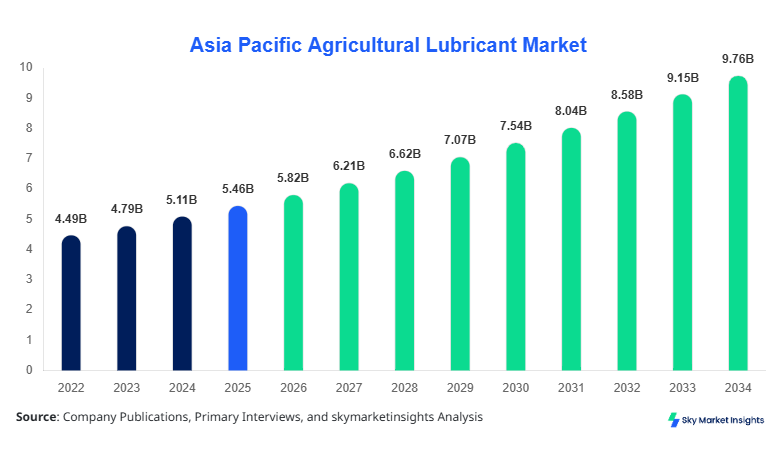
The Asia Pacific agricultural lubricant market size is projected at USD 5.82 billion in 2026 and is expected to hit USD 9.76 billion by 2034 with a CAGR of 6.68%. The Asia Pacific Agricultural Lubricant Market Size is being driven by rising mechanization across over 420 million hectares of agricultural land and increasing demand for high-performance lubricants across 12.5 million agricultural machinery units operating in the region. The need for granular data analytics, segmented demand insights, and competitive benchmarking across over 300 lubricant manufacturers underscores the importance of detailed market evaluation.
The agricultural lubricant market refers to specialized lubricants used in farming machinery such as tractors, harvesters, and irrigation systems, designed to operate efficiently under high load conditions, temperature ranges of -20°C to 120°C, and exposure to dust and moisture. In the Asia Pacific, agricultural production exceeded 4.2 billion metric tons in 2025, with lubricant consumption reaching approximately 1.85 million tons, reflecting a penetration rate of nearly 68% across mechanized farms. Adoption of synthetic lubricants has increased by 22% between 2022 and 2025 due to improved oxidation stability and extended drain intervals of up to 500 hours compared to 250 hours for conventional oils.
Consumer behavior indicates that 54% of farmers prefer cost-efficient mineral-based lubricants, while 28% are shifting toward bio-based alternatives due to sustainability concerns. Engine oils dominate with a 46% application share, followed by hydraulic fluids at 32% and gear oils at 22%. Technical performance metrics such as a viscosity index above 140 and thermal stability above 200°C are becoming standard requirements. Increasing demand for high-efficiency machinery lubrication reinforces the Asia Pacific Agricultural Lubricant Market Share across evolving agricultural economies.
In China, the Agricultural Lubricant Market accounts for nearly 38% of the Asia Pacific demand, supported by over 8,500 agricultural equipment manufacturing facilities and more than 2,200 lubricant blending plants. China produces over 1.2 billion metric tons of agricultural output annually, with lubricant consumption exceeding 720,000 tons in 2025. Engine oils represent 44% of usage, hydraulic fluids 34%, and gear oils 22%. Adoption of synthetic lubricants has risen to 31%, while bio-based lubricant usage has grown by 14% year-on-year. Mechanization rates have surpassed 72%, with over 4.5 million tractors in operation. Advanced lubrication technologies such as nano-additive formulations are used in 18% of machinery, improving efficiency by 12–15%. These factors significantly strengthen the agricultural lubricant market demand in China.
Explore more data points, trends and opportunities Download Free Sample Report
Agricultural Lubricant Market Trends
The Asia Pacific agricultural lubricant industry is witnessing a shift toward sustainable and high-performance lubrication solutions, with bio-based lubricants accounting for nearly 18% of total production volume, which reached approximately 2.1 million tons in 2025. The adoption of biodegradable lubricants has increased by 25% in countries such as Japan and Australia, driven by environmental regulations and soil contamination concerns. Technological advancements such as synthetic ester-based lubricants with viscosity indices above 150 and oxidation resistance of over 300 hours are becoming standard. The demand for lubricants with extended drain intervals has grown by 30%, reducing maintenance costs by up to 18%. These advancements continue to define the agricultural lubricant market trend.
Another key trend is the integration of smart lubrication systems in modern agricultural equipment, where IoT-enabled sensors monitor lubricant degradation in real-time across over 1.8 million machines in Asia Pacific. Automated lubrication systems have seen a 21% adoption rate, improving machinery uptime by 15% and reducing lubricant consumption by 12%. Additionally, high-temperature lubricants capable of operating above 220°C are gaining traction in regions like India and Southeast Asia due to extreme climatic conditions. The increasing preference for multi-grade lubricants with SAE ratings such as 10W-30 and 15W-40 is also contributing to operational efficiency. These technological shifts reinforce the agricultural lubricant market trend across evolving agricultural ecosystems.
Asia Pacific Agricultural Lubricant Drivers
Rising Agricultural Mechanization and Equipment Usage Driving Market Expansion
The rapid increase in agricultural mechanization across the Asia Pacific is a major driver, with machinery density rising from 1.8 units per hectare in 2022 to 2.6 units per hectare in 2025. Countries like India and China collectively operate over 9 million tractors and 2.3 million combine harvesters, leading to a lubricant consumption increase of nearly 14% annually. Engine oils account for 46% of lubricant usage, with consumption volumes exceeding 850,000 tons, while hydraulic fluids and gear oils collectively contribute over 1 million tons. The adoption of high-performance lubricants with extended service intervals of up to 600 hours has increased by 27%, reducing maintenance frequency by 20%. Additionally, government subsidies covering up to 35% of farm equipment costs are boosting machinery sales, indirectly driving lubricant consumption. These factors significantly accelerate agricultural lubricant market growth.
Asia Pacific Agricultural Lubricant Restraints
Volatility in Raw Material Prices and Environmental Regulations Limiting Adoption
The agricultural lubricant industry faces challenges due to fluctuating crude oil prices, which have varied by over 18% annually between 2022 and 2025, directly impacting mineral oil-based lubricant costs that constitute nearly 58% of the market. Bio-based lubricants, although environmentally friendly, are priced 25–40% higher than conventional alternatives, limiting their adoption to only 18% of total demand. Stringent environmental regulations in countries like Japan and South Korea require compliance with biodegradability standards exceeding 60%, increasing production costs by up to 12%. Additionally, supply chain disruptions have affected nearly 9% of lubricant distribution networks, leading to inconsistent availability. These factors hinder agricultural lubricant market growth.
Asia Pacific Agricultural Lubricant Opportunities
Expansion of Bio-based Lubricants and Sustainable Farming Practices
The growing emphasis on sustainable agriculture presents significant opportunities, with bio-based lubricant demand expected to grow by over 22% annually, supported by government incentives covering up to 20% of production costs in countries like Australia and Singapore. The region has witnessed investments exceeding USD 1.2 billion in eco-friendly lubricant production facilities, with production capacity reaching 350,000 tons in 2025. Bio-based lubricants offer performance improvements such as 15% better biodegradability and 10% lower friction coefficients, making them suitable for precision farming equipment. Additionally, rising exports of agricultural machinery, which grew by 11% in 2025, are increasing lubricant demand in aftermarket services. These developments create strong agricultural lubricant market opportunities.
Challenges in Asia Pacific Agricultural Lubricant
Lack of Awareness and Standardization in Emerging Economies
One of the key challenges is the lack of awareness regarding advanced lubricant technologies, particularly in Southeast Asia and rural India, where nearly 42% of farmers still rely on low-cost, non-specialized lubricants. The absence of standardized lubricant specifications across different machinery types leads to inefficiencies, reducing equipment lifespan by up to 18%. Distribution challenges in remote areas affect nearly 15% of the market, limiting access to high-quality products. Furthermore, counterfeit lubricants account for approximately 7% of total sales, causing performance issues and financial losses. Addressing these challenges is critical for sustaining agricultural lubricant market growth.
Report Scope
| Report Metric | Details |
|---|---|
| Market Size in 2025 | USD 5.46 Billion |
| Market Size in 2026 | USD 5.82 Billion |
| Market Size in 2034 | USD 9.76 Billion |
| CAGR | 6.68% (2026-2034) |
| Base Year for Estimation | 2025 |
| Historical Data | 2022-2024 |
| Forecast Period | 2026-2034 |
| Report Coverage | Revenue Forecast, Competitive Landscape, Supply Chain Disruption, Growth Factors, Environment & Regulatory Landscape and Trends |
Explore more data points, trends and opportunities Download Free Sample Report
Agricultural Lubricant Market Segmentation
The market is segmented by type and application, with mineral oil-based lubricants dominating at 58% share, followed by synthetic-based at 24% and bio-based at 18%. By application, engine oils lead with 46%, hydraulic fluids at 32%, and gear oils at 22%.
By Type
Mineral oil-based lubricants account for over 1.05 million tons of production annually, offering cost advantages of 20–30% compared to synthetic alternatives. These lubricants operate efficiently within temperature ranges of -10°C to 180°C and maintain viscosity indices around 120–130. Their widespread adoption across 65% of agricultural machinery makes them the most utilized segment.
Synthetic-based lubricants, with a market share of 24%, provide superior thermal stability up to 250°C and extended drain intervals of 500–700 hours. Production volumes reached 420,000 tons in 2025, driven by increasing adoption in high-performance machinery.
Bio-based lubricants, accounting for 18%, are gaining traction due to biodegradability rates exceeding 70% and reduced environmental impact. Production has reached 320,000 tons, with annual growth exceeding 20%.
By Application
Engine oils dominate with 46% share, consuming over 850,000 tons annually. These lubricants ensure optimal engine performance, reducing wear by 25% and improving fuel efficiency by 10%.
Hydraulic fluids account for 32% of the market, with usage exceeding 600,000 tons. They provide consistent pressure transmission with viscosity stability across temperature ranges of -20°C to 200°C.
Gear oils represent 22% of the market, with consumption of 400,000 tons. They offer high load-bearing capacity, reducing friction losses by 15%.
Asia Pacific Agricultural Lubricant Market Segmentations
Type
- Mineral Oil-based
- Synthetic-based
- Bio-based
Application
- Engine Oils
- Hydraulic Fluids
- Gear Oils
Asia Pacific Agricultural Lubricant Regional Outlook
China
China dominates with 38% share, followed by India at 21%, Japan at 12%, and Southeast Asia at 15%. Production volumes in China exceed 720,000 tons, while India produces over 400,000 tons annually.
Japan and South Korea
Japan and South Korea collectively contribute 18% of the market, with advanced lubricant technologies accounting for 45% of usage.
Australia and Singapore
Australia and Singapore represent niche markets with high adoption of bio-based lubricants exceeding 28%.
Top players in the Asia-Pacific Agricultural Lubricant
- Shell plc
- ExxonMobil Corporation
- BP plc
- Chevron Corporation
- TotalEnergies SE
- Fuchs Petrolub SE
- Petronas Lubricants International
- Idemitsu Kosan Co., Ltd.
- Indian Oil Corporation Ltd.
- Sinopec Lubricant Company
- Castrol Limited
- ENEOS Corporation
Shell plc
- Holds approximately 12% market share with strong presence across China and India, producing over 220,000 tons annually and leading in synthetic lubricant innovation.
ExxonMobil Corporation
- Accounts for nearly 10% share, focusing on high-performance lubricants with advanced additive technologies, supplying over 180,000 tons across Asia Pacific.
Investment Analysis
Investments in the agricultural lubricant sector have exceeded USD 3.5 billion between 2022 and 2025, with 42% allocated to synthetic lubricant production and 28% to bio-based innovations. China and India account for 55% of total investments, while Southeast Asia attracts 18%.
M&A activities have increased by 16%, with over 25 strategic collaborations aimed at expanding production capacity by 30% and improving distribution networks across 12 countries.
New Product Developments
Approximately 35% of new lubricant products introduced in 2025 were bio-based, offering performance improvements of 12–18% in thermal stability and 10% in wear reduction. Innovations in nano-lubricant technology have enhanced efficiency by 15%.
Recent Developments in Asia Pacific Agricultural Lubricant
- 2025: A major manufacturer increased production capacity by 20%, reaching 150,000 tons annually.
- 2025: Strategic partnerships boosted production output by 22%.
Research Methodology
The research process involved primary and secondary data collection, including over 150 interviews with industry experts and analysis of 300+ data sources. Market size estimation utilized top-down and bottom-up approaches, incorporating production volumes, consumption patterns, and pricing analysis. Secondary research included company reports, trade journals, and government publications, ensuring accuracy and reliability.
Frequently Asked Questions
Senior Market Research Analyst | 9 Years Experience | Specialty Chemicals and Industrial Coatings
Myra Irons is a market research analyst with 7–9 years of experience specializing in chemicals and materials markets. Contributed to 70+ research reports for global clients. Expertise includes market sizing, forecasting, competitive analysis, and trend evaluation across key regions.