Europe Antimicrobial Textiles Market Size
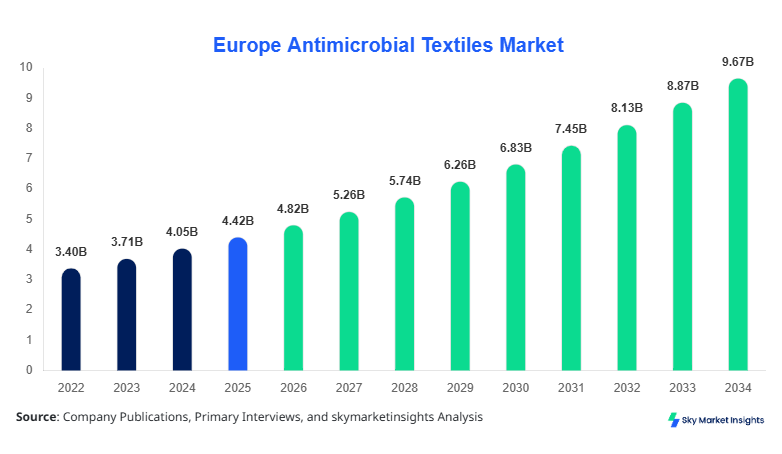
Europe Antimicrobial Textiles market size is projected at USD 4.82 billion in 2026 and is expected to hit USD 9.71 billion by 2034 with a CAGR of 9.1%. The market expansion is being supported by increasing demand from healthcare, sports apparel, military fabrics, and hygiene-sensitive industrial applications across Europe. Rising integration of silver-ion coatings, quaternary ammonium compounds, and bio-based antimicrobial agents in woven and nonwoven fabrics is accelerating commercialization activities in the region.
The report provides detailed analysis of production capacities, consumption patterns, import-export movement, product segmentation, pricing structures, and competitive landscape across the European antimicrobial textile ecosystem. Growing investments in smart fabrics, durable antimicrobial coatings, and high-performance textile finishing technologies continue to shape the Europe Antimicrobial Textiles market.
The antimicrobial textiles industry refers to textile materials integrated with active antimicrobial agents capable of preventing bacterial, fungal, viral, and microbial growth on fabric surfaces. These textiles are widely utilized in hospital bedding, surgical gowns, sports apparel, military uniforms, automotive interiors, and residential furnishing applications. Europe accounted for nearly 28.4% of global antimicrobial textile consumption in 2025, with production volumes surpassing 1.96 billion square meters across woven and nonwoven categories. Medical textiles represented approximately 38% of total European consumption, followed by sportswear applications at 26%, home textiles at 18%, and industrial applications at 11%.
Consumer adoption rates have increased significantly due to growing awareness regarding hygiene and infection prevention. Nearly 61% of European consumers preferred odor-resistant and antimicrobial apparel in 2025, while more than 54 million units of antimicrobial sportswear were sold across Germany, France, and the United Kingdom combined. Hospitals across Europe increased procurement of antimicrobial fabrics by 22% between 2023 and 2025 owing to rising concerns regarding healthcare-associated infections. Silver-based antimicrobial agents contributed nearly 42% of the overall antimicrobial coating market due to high microbial reduction efficiency exceeding 99.5% against common pathogens. Increasing product penetration in reusable medical garments, athletic wear, and upholstery continues to strengthen Europe Antimicrobial Textiles market expansion.
Explore more data points, trends and opportunities Download Free Sample Report
Antimicrobial Textiles Market Trends
Rising Integration of Nanotechnology-Based Antimicrobial Coatings
The European textile industry is witnessing rapid integration of nanotechnology-based antimicrobial coatings due to enhanced durability, wash resistance, and microbial efficiency. During 2025, more than 312 million square meters of antimicrobial textiles produced in Europe utilized nanoparticle-based finishing systems. Silver nanoparticles represented approximately 46% of nanotechnology antimicrobial applications, while zinc oxide and copper oxide coatings accounted for 21% and 18%, respectively. Sports apparel manufacturers increased adoption rates of nano-enabled antimicrobial fibers by 34% owing to rising demand for odor-resistant and moisture-management fabrics.
Medical facilities across Germany, France, and Italy increased procurement of nano-coated antimicrobial surgical textiles by nearly 29% between 2023 and 2025. The technology offers microbial reduction efficiencies exceeding 99.7% while maintaining fabric breathability and tensile strength. Textile producers are also investing in plasma-enhanced deposition technologies capable of extending antimicrobial functionality beyond 75 industrial wash cycles. These technological transitions continue strengthening Antimicrobial Textiles market adoption across healthcare and sportswear sectors.
Sustainable and Bio-Based Antimicrobial Textile Solutions
Sustainability-driven innovation has emerged as a major transformation factor across the European textile sector. More than 39% of newly launched antimicrobial fabrics in 2025 incorporated bio-based antimicrobial compounds derived from chitosan, neem extracts, bamboo charcoal, and plant-derived enzymes. Textile manufacturers reduced synthetic chemical dependency by approximately 18% between 2022 and 2025 due to tightening European environmental regulations.
The demand for eco-certified antimicrobial home textiles increased by 31% across Western Europe, particularly in premium bedding and upholstery applications. France and the United Kingdom collectively accounted for over 46 million units of sustainable antimicrobial textile product sales during 2025. Manufacturers are increasingly focusing on low-water finishing technologies capable of reducing water usage by 27% while lowering chemical emissions by nearly 22%. Continuous innovation in recyclable and biodegradable textile coatings continues supporting Antimicrobial Textiles market commercialization across Europe.
Europe Antimicrobial Textiles Drivers
Increasing Healthcare Hygiene Standards and Infection Prevention Requirements
The expansion of healthcare infrastructure and infection prevention protocols across Europe is a primary factor driving demand for antimicrobial fabrics. Europe recorded more than 4.2 million healthcare-associated infection cases annually, prompting hospitals and clinics to adopt advanced antimicrobial bedding, curtains, gowns, and wound-care textiles. Approximately 72% of large hospitals in Germany, France, and the United Kingdom integrated antimicrobial textile procurement standards into purchasing frameworks during 2025. Medical textiles accounted for nearly 38% of Europe’s antimicrobial textile consumption due to increasing patient admission volumes and rising elderly populations exceeding 95 million individuals across the region.
Production volumes of antimicrobial surgical gowns increased by 24% between 2023 and 2025, while reusable antimicrobial hospital linens witnessed 19% growth in procurement contracts. Healthcare providers reported microbial reduction efficiency levels above 99% when utilizing silver-based coated fabrics. Rising investments exceeding USD 1.1 billion in hospital modernization programs across Europe continue supporting demand for advanced antimicrobial fabrics. Increasing awareness regarding infection prevention and durable reusable medical fabrics remains a key catalyst for Europe Antimicrobial Textiles market expansion.
Europe Antimicrobial Textiles Restraints
High Production Costs and Regulatory Compliance Challenges
Despite strong adoption rates, the market faces significant restraints associated with elevated manufacturing expenses and regulatory complexity. Antimicrobial textile production costs remain approximately 22%–35% higher than conventional textile manufacturing due to specialized chemical treatments, coating technologies, and testing requirements. Silver-ion compounds alone account for nearly 31% of total finishing costs in premium antimicrobial fabric manufacturing.
European Union regulations regarding biocidal products, textile safety standards, and chemical discharge restrictions have increased compliance expenditures by nearly 17% for textile manufacturers since 2023. Smaller manufacturers operating with production capacities below 15 million square meters annually face profitability challenges because antimicrobial certification processes can require testing periods exceeding 6–8 months. Additionally, fluctuating prices of silver and copper-based antimicrobial agents impacted raw material procurement budgets by nearly 14% during 2025. Concerns regarding antimicrobial resistance and environmental toxicity of synthetic agents continue influencing regulatory scrutiny. These operational and regulatory pressures remain key restraints affecting Europe Antimicrobial Textiles market expansion.
Europe Antimicrobial Textiles Opportunities
Expansion of Smart Textiles and Wearable Healthcare Applications
The emergence of wearable healthcare technologies and smart textiles is creating substantial opportunities for antimicrobial fabric manufacturers across Europe. Smart antimicrobial textiles integrated with sensors, biometric monitoring systems, and temperature-control functionalities witnessed production growth of 28% during 2025. The healthcare wearable textile segment surpassed 18 million units across Europe, driven by increasing chronic disease monitoring and elderly care requirements.
Sportswear and fitness apparel brands allocated approximately 26% of innovation budgets toward multifunctional antimicrobial garments capable of sweat management, odor control, and UV protection. Germany and the United Kingdom collectively accounted for nearly 49% of smart antimicrobial textile investments in Europe during 2025. Conductive antimicrobial fibers with durability exceeding 80 wash cycles are gaining commercial traction across military and healthcare sectors. Integration of IoT-enabled textile technologies and bio-compatible antimicrobial coatings is expected to generate long-term commercialization opportunities for Europe Antimicrobial Textiles market participants.
Europe Antimicrobial Textiles Challenge
Limited Durability and Performance Degradation after Repeated Washing
One of the major challenges impacting the market is performance degradation of antimicrobial coatings after repeated laundering cycles. Nearly 32% of textile buyers in Europe reported concerns regarding declining antimicrobial efficiency after 40–50 wash cycles, especially in low-cost treated fabrics. Silver-based coatings can lose up to 18% antimicrobial activity after repeated industrial laundering, impacting long-term product performance and customer retention.
Manufacturers are under pressure to improve coating adhesion, wash durability, and chemical stability while maintaining fabric softness and breathability. Testing procedures for antimicrobial durability can increase production lead times by approximately 12%–15%. Additionally, the fragmented nature of Europe’s textile supply chain complicates quality consistency across large-scale production batches exceeding 50 million square meters annually. Rising consumer preference for sustainable fabrics further challenges producers relying heavily on synthetic antimicrobial chemicals. Overcoming durability limitations and achieving cost-effective long-term antimicrobial performance remain critical challenges affecting Europe Antimicrobial Textiles market competitiveness.
Report Scope
| Report Metric | Details |
|---|---|
| Market Size in 2025 | USD 4.42 Billion |
| Market Size in 2026 | USD 4.82 Billion |
| Market Size in 2034 | USD 9.71 Billion |
| CAGR | 9.1% (2026-2034) |
| Base Year for Estimation | 2025 |
| Historical Data | 2022-2024 |
| Forecast Period | 2026-2034 |
| Report Coverage | Revenue Forecast, Competitive Landscape, Supply Chain Disruption, Growth Factors, Environment & Regulatory Landscape and Trends |
Explore more data points, trends and opportunities Download Free Sample Report
Antimicrobial Textiles Market Segmentation
The Europe antimicrobial textile industry is segmented by fabric type and application. Synthetic fibers dominated nearly 48% of total production in 2025 due to superior durability and compatibility with antimicrobial coatings. Medical textiles represented approximately 38% of total demand owing to rising hospital procurement and infection-control regulations across Europe.
By Type
Natural fiber antimicrobial textiles accounted for approximately 24% of European production volumes during 2025. Cotton-based antimicrobial fabrics dominated this category with more than 286 million square meters produced annually. These fabrics are widely utilized in medical bedding, infant clothing, and home furnishing applications due to high breathability and moisture absorption characteristics. Chitosan-based antimicrobial coatings gained strong popularity because they provide microbial reduction efficiencies above 95% while supporting biodegradable textile manufacturing. Natural fiber antimicrobial textiles also witnessed growing adoption in premium sportswear collections where sustainable apparel demand increased by 27% across Europe.
Manufacturers increasingly utilize herbal antimicrobial agents such as neem, aloe vera, and bamboo charcoal in natural fabrics to reduce chemical dependency. France and Italy collectively contributed nearly 43% of Europe’s natural antimicrobial textile production owing to strong luxury textile manufacturing ecosystems. However, natural fibers face durability limitations compared to synthetic alternatives, particularly after repeated industrial laundering cycles exceeding 45 washes.
Synthetic fibers dominated the European market with nearly 48% share during 2025 due to superior tensile strength, durability, and coating compatibility. Polyester antimicrobial textiles represented more than 520 million square meters of annual production across Europe. Sportswear and medical textiles remained the primary application sectors due to high resistance against microbial growth and moisture accumulation.
Silver-ion integrated polyester fabrics achieved bacterial reduction efficiencies above 99.5% and remained effective after more than 70 wash cycles. Germany alone contributed approximately 31% of synthetic antimicrobial textile output due to large-scale technical textile manufacturing infrastructure. Polyamide and polypropylene antimicrobial fabrics also gained traction in automotive interiors and industrial safety clothing. Synthetic fibers continue dominating Antimicrobial Textiles market production owing to high-performance characteristics and scalability.
Blended antimicrobial textiles accounted for nearly 28% of regional production volumes during 2025. Cotton-polyester blends represented the largest category because they combine comfort, durability, and antimicrobial coating retention. More than 310 million square meters of blended antimicrobial fabrics were manufactured across Europe in 2025.
Sportswear producers increasingly preferred blended fabrics because they reduce odor accumulation while maintaining elasticity and moisture control. Healthcare institutions also adopted blended antimicrobial bedding due to extended durability exceeding 60 industrial wash cycles. Blended antimicrobial fabrics demonstrated 17% higher wear resistance compared to pure cotton textiles. Growing demand for multifunctional performance textiles continues driving blended fiber commercialization across Europe.
By Application
Medical textiles represented the largest application segment with nearly 38% of Europe’s antimicrobial textile consumption during 2025. Hospitals across Europe procured more than 420 million units of antimicrobial surgical gowns, curtains, bedding, and reusable patient garments. Rising healthcare-associated infection cases accelerated adoption of silver-coated and copper-based medical fabrics capable of reducing bacterial contamination by over 99%.
Germany, France, and the United Kingdom collectively accounted for approximately 64% of European antimicrobial medical textile procurement. Reusable antimicrobial surgical textiles reduced hospital textile replacement costs by nearly 21% compared to disposable alternatives. Antimicrobial wound dressings and implantable textile materials also experienced rising utilization due to increasing surgical procedure volumes exceeding 28 million annually across Europe.
Sportswear applications accounted for nearly 26% of regional antimicrobial textile demand during 2025. More than 54 million units of antimicrobial athletic apparel were sold across Europe due to increasing consumer preference for odor-control and sweat-management garments. Polyester-silver antimicrobial fabrics dominated sportswear production because of lightweight characteristics and moisture evaporation efficiencies exceeding 87%.
The United Kingdom and Germany represented nearly 49% of Europe’s antimicrobial sportswear demand. Fitness participation rates exceeding 43% among adults across Western Europe supported continuous expansion of performance apparel manufacturing. Antimicrobial sportswear fabrics demonstrated odor reduction capabilities exceeding 92% after extended athletic usage. Growing demand for premium activewear continues supporting Antimicrobial Textiles market expansion.
Home textiles accounted for approximately 18% of Europe’s antimicrobial textile demand during 2025. Antimicrobial bedding, curtains, upholstery, towels, and carpets witnessed strong adoption due to increasing consumer awareness regarding hygiene and indoor air quality. Europe produced more than 290 million units of antimicrobial home textile products during the year.
Premium antimicrobial bedding products experienced 31% sales growth in France, Germany, and Italy combined. Textile producers increasingly integrated bio-based antimicrobial compounds into home furnishing fabrics to satisfy environmental compliance requirements. Antimicrobial upholstery fabrics reduced microbial contamination levels by nearly 94%, particularly in hospitality and residential applications. Expanding premium interior furnishing trends continue strengthening the antimicrobial home textile ecosystem across Europe.
Europe Antimicrobial Textiles Market Segmentations
Fabric Type
- Natural Fibers
- Synthetic Fibers
- Blended Fibers
Application
- Medical Textiles
- Sportswear
- Home Textiles
Europe Antimicrobial Textiles Regional Outlook
United Kingdom
The United Kingdom accounted for approximately 18% of Europe’s antimicrobial textile consumption during 2025. Healthcare and sportswear applications represented nearly 61% of domestic demand due to expanding NHS procurement programs and growing activewear adoption. The country produced over 248 million square meters of antimicrobial fabrics annually, supported by investments in sustainable textile finishing technologies.
The United Kingdom also witnessed rapid expansion of antimicrobial home textile applications, particularly in hospitality and premium residential sectors. More than 14 million antimicrobial bedding units were sold during 2025. Increasing investment in bio-based textile coatings and smart wearable fabrics continues supporting industrial growth.
Germany
Germany dominated regional revenue generation with nearly 31% market contribution during 2025. The country produced approximately 486 million square meters of antimicrobial fabrics and hosted more than 420 textile manufacturing facilities. Medical textiles remained the largest segment with 41% share, followed by sportswear and industrial safety applications.
Advanced nanotechnology integration rates exceeded 58% among German textile manufacturers. Automotive interior applications also experienced rising antimicrobial fabric penetration due to hygiene-focused vehicle design trends. Germany remains the technological center of Europe’s antimicrobial textile ecosystem.
France
France represented approximately 16% of Europe’s antimicrobial textile demand during 2025. Luxury home furnishing and premium sportswear sectors significantly contributed to market expansion. France produced over 210 million square meters of antimicrobial fabrics, with nearly 39% dedicated to fashion and lifestyle textile applications.
Consumer preference for sustainable antimicrobial fabrics increased by 29% in France between 2023 and 2025. Textile manufacturers increasingly integrated plant-based antimicrobial technologies into premium apparel and bedding categories. Government support for sustainable textile innovation continues accelerating commercialization activities.
Spain
Spain accounted for nearly 11% of Europe’s antimicrobial textile production during 2025. Sportswear and hospitality textiles remained key growth sectors due to tourism-driven commercial textile demand. More than 142 million square meters of antimicrobial fabrics were manufactured in Spain during the year.
Spanish textile producers increasingly focused on low-cost antimicrobial finishing technologies targeting export markets across Southern Europe. The country also witnessed 18% growth in antimicrobial upholstery applications for hotels and commercial infrastructure.
Italy
Italy contributed approximately 13% of regional antimicrobial textile demand during 2025. Premium fashion textiles and luxury home furnishing applications dominated domestic consumption patterns. Italy produced more than 176 million square meters of antimicrobial fabrics, with strong emphasis on high-value blended textile products.
Italian textile firms invested heavily in eco-friendly antimicrobial coatings and biodegradable textile chemistry. Luxury antimicrobial bedding and upholstery products experienced sales growth exceeding 24% across domestic and export markets during 2025.
Russia
Russia represented approximately 7% of Europe’s antimicrobial textile consumption during 2025. Medical textiles and industrial protective clothing remained dominant applications due to rising healthcare modernization and manufacturing safety requirements. Production volumes exceeded 118 million square meters annually.
Russian textile manufacturers increasingly adopted silver-ion antimicrobial technologies to reduce dependency on imported medical textiles. Government-backed industrial textile programs supported domestic antimicrobial fabric production expansion during 2024–2025.
Top players in Europe Antimicrobial Textiles
- Trevira GmbH
- PurThread Technologies
- HeiQ Materials AG
- Sanitized AG
- Milliken & Company
- Herculite Products Inc.
- LifeThreads LLC
- Kolon Industries Inc.
- Balavigna Weaving Mills
- Microban International
- Sciessent LLC
- Toyobo Co. Ltd.
- Unitika Ltd.
- Vestagen Protective Technologies
- Smith & Nephew PLC
HeiQ Materials AG
-
HeiQ Materials AG accounted for approximately 9% of Europe’s antimicrobial textile technology licensing ecosystem during 2025.
-
The company focuses heavily on silver-free antimicrobial technologies and sustainable textile chemistry.
-
HeiQ supplied antimicrobial finishing solutions to more than 30 European apparel and healthcare textile manufacturers.
-
The company invested nearly USD 48 million in R&D activities related to bio-based antimicrobial coatings and durable textile performance technologies.
Sanitized AG
-
Sanitized AG held nearly 7% share within antimicrobial textile finishing technologies across Europe during 2025.
-
The company specializes in odor-control textile chemistry for sportswear, home textiles, and healthcare fabrics.
-
Sanitized antimicrobial technologies were integrated into more than 410 million textile units globally during 2025.
-
The firm expanded partnerships with European sportswear manufacturers to improve long-term antimicrobial wash durability exceeding 80 wash cycles.
Investment Analysis
Investment activity across Europe’s antimicrobial textile industry accelerated significantly during 2024–2025 due to rising demand from healthcare, defense, sportswear, and home furnishing sectors. Approximately 34% of total textile innovation investments in Europe were directed toward antimicrobial and functional fabrics during 2025. Germany accounted for nearly 31% of total regional investment allocation, followed by France at 18% and the United Kingdom at 16%. More than USD 1.8 billion was invested in textile finishing technologies, smart fabrics, and sustainable antimicrobial chemistry solutions across Europe.
Healthcare textiles represented approximately 42% of total investment distribution due to increasing procurement of reusable surgical fabrics and antimicrobial patient care products. Sportswear applications accounted for 24% of investment allocation owing to rapid growth in odor-control activewear demand. Sustainable antimicrobial technologies attracted over USD 620 million in funding, particularly for bio-based coatings and water-efficient textile finishing systems.
Mergers, acquisitions, and strategic collaborations increased by approximately 21% during 2025. Textile chemistry companies increasingly partnered with nanotechnology firms to improve coating efficiency and durability. Several European manufacturers established collaborations with healthcare institutions to develop reusable antimicrobial medical textiles capable of reducing infection transmission rates by over 95%. Venture capital investments in smart antimicrobial wearable textiles also increased substantially, particularly in Germany and the United Kingdom.
New Product Devezlopments
European antimicrobial textile manufacturers introduced a substantial number of new products during 2025, with approximately 37% of launches focused on sustainable and bio-based technologies. More than 210 new antimicrobial sportswear products were commercialized across Europe, emphasizing odor control, sweat management, and durability enhancements.
Medical textile manufacturers developed reusable antimicrobial surgical fabrics capable of maintaining more than 98% antimicrobial efficiency after 75 industrial wash cycles. Innovation in graphene-enhanced antimicrobial coatings improved thermal regulation performance by nearly 18% while reducing bacterial growth by over 99%. Smart antimicrobial textiles integrated with biometric monitoring systems also gained traction in healthcare wearable applications.
Recent Developments in Europe Antimicrobial Textiles
- In 2025, HeiQ Materials AG expanded antimicrobial coating production capacity by 18% in Europe to support increasing demand from sportswear and healthcare sectors. The company introduced silver-free textile treatment systems capable of reducing microbial growth by more than 99%, while improving fabric durability by 21% after repeated industrial laundering cycles.
- In 2025, Germany-based textile producers collectively invested more than USD 320 million in sustainable antimicrobial textile finishing facilities. These investments reduced water consumption by 24% and chemical discharge volumes by approximately 19% across participating manufacturing plants.
- In 2025, European healthcare institutions increased procurement of reusable antimicrobial surgical gowns by 22% compared to 2024 levels. More than 96 million units of reusable antimicrobial medical garments were purchased, significantly reducing disposable textile waste generation across regional hospital networks.
Research Methodology
The research methodology for the Europe antimicrobial textiles industry involved a comprehensive combination of primary and secondary research processes designed to ensure high data accuracy and reliability. Primary research included interviews with textile manufacturers, healthcare procurement managers, antimicrobial chemical suppliers, sportswear producers, and industry experts across Germany, France, the United Kingdom, Italy, and Spain. More than 85 detailed interviews were conducted to evaluate production capacity, pricing trends, technology adoption rates, and future commercialization opportunities.
Secondary research involved analysis of company annual reports, government trade databases, textile association publications, import-export statistics, healthcare procurement records, and industrial manufacturing datasets. Market size estimation was conducted using both top-down and bottom-up analytical approaches. Production volumes, revenue generation, penetration rates, and application-level demand patterns were validated through triangulation models. Forecasting models incorporated macroeconomic indicators, healthcare infrastructure expansion, consumer spending behavior, and technological adoption trends across Europe. The methodology ensured accurate evaluation of competitive positioning, investment trends, and regional demand distribution within the antimicrobial textile ecosystem.
Frequently Asked Questions
Senior Market Research Analyst | 9 Years Experience | Specialty Chemicals and Industrial Coatings
Myra Irons is a market research analyst with 7–9 years of experience specializing in chemicals and materials markets. Contributed to 70+ research reports for global clients. Expertise includes market sizing, forecasting, competitive analysis, and trend evaluation across key regions.