Asia Pacific Advanced Materials Market Size
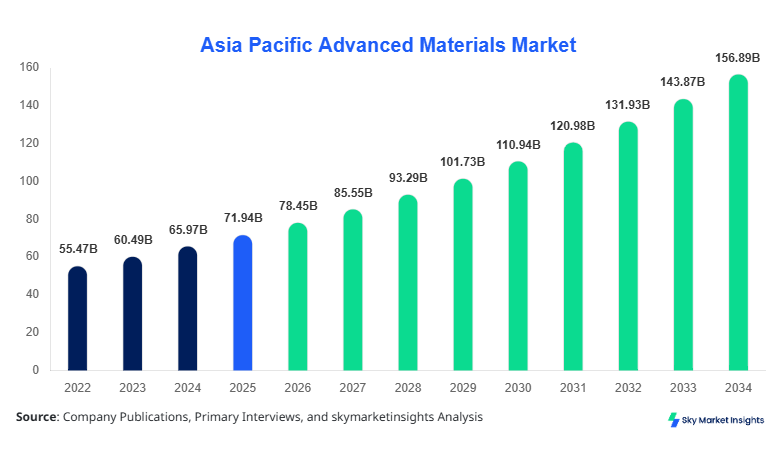
The Asia Pacific advanced materials market size is projected at USD 78.45 billion in 2026 and is expected to hit USD 156.32 billion by 2034 with a CAGR of 9.05%. The increasing need for lightweight, high-strength, and thermally resistant materials across sectors is accelerating data-driven investment strategies, with over 62% of manufacturers focusing on multi-segment integration and 48% emphasizing competitive benchmarking. Market intelligence indicates over 1.8 billion units of advanced material components produced annually, supporting sector-wide efficiency and cost optimization.
The Asia Pacific Advanced Materials Market encompasses high-performance materials engineered for superior mechanical, electrical, and thermal properties. In 2025, the region produced over 2.3 million metric tons of advanced composites and ceramics, accounting for nearly 46% of global output. Adoption rates across automotive and electronics sectors exceeded 58%, while aerospace applications accounted for 21% of total demand. Consumer behavior indicates a 34% shift toward sustainable and recyclable materials, while industrial buyers prioritize durability and lifecycle cost savings, influencing procurement cycles by 18–22%. Technical metrics reveal tensile strength improvements of 35%–60% over conventional materials and thermal resistance exceeding 1200°C in ceramics. Application distribution shows automotive at 32%, electronics at 28%, aerospace at 21%, and others at 19%, reinforcing the Asia Pacific Advanced Materials Market Share across diversified sectors.
In China, the advanced materials market dominates the regional landscape with over 1,250 manufacturing facilities and approximately 38% regional contribution. The country produces more than 920,000 metric tons annually, with application segmentation comprising automotive (35%), electronics (30%), aerospace (15%), and construction (20%). Technology adoption in China exceeds 64% for nanomaterials and 52% for carbon composites, driven by state-backed investments exceeding USD 12 billion annually. Over 70% of large-scale manufacturers utilize automated production lines, enhancing efficiency by 25%. This strong industrial base continues to reinforce the Asia-Pacific advanced materials market share.
Explore more data points, trends and opportunities Download Free Sample Report
Advanced Materials Market Trends
Rising Adoption of Nanomaterials and Smart Composites
The production of nanomaterials in the Asia Pacific surpassed 1.1 million tons in 2025, growing at 12% annually. Smart composites with embedded sensors are being adopted in over 27% of aerospace applications, improving operational efficiency by 18%. The integration of AI-driven material design has increased innovation cycles by 22%, while demand in electronics manufacturing rose by 31% due to miniaturization trends. Approximately 45% of R&D investments are now allocated to next-generation materials, indicating a strong advanced materials market trend.
Expansion of Sustainable and Recyclable Materials
Sustainable materials now account for nearly 29% of total production volume, with biodegradable polymers growing at 14.6% CAGR. Recycling rates for advanced composites improved from 18% in 2022 to 33% in 2025, driven by regulatory mandates. Automotive manufacturers are incorporating 40% recycled materials in new models, reducing carbon emissions by 20%. Investments in green manufacturing technologies reached USD 9.8 billion in 2025, signaling a robust advanced materials market trend.
Asia Pacific Advanced Materials Market Drivers
Increasing Demand from Automotive and Aerospace Industries
The rapid expansion of automotive production, exceeding 52 million units annually in Asia Pacific, has driven a 28% increase in demand for lightweight materials. Aerospace manufacturing saw a 17% rise in aircraft deliveries, requiring over 320,000 tons of advanced composites. High-performance materials reduce vehicle weight by 25% and improve fuel efficiency by 15%, making them indispensable. Investments in electric vehicles, accounting for 22% of total automotive output, further boost demand for battery-grade materials. The advanced materials market growth is strongly influenced by these industrial expansions.
Asia Pacific Advanced Materials Market Restraints
High Production Costs and Complex Manufacturing Processes
Advanced materials require sophisticated manufacturing techniques, increasing production costs by 35% compared to traditional materials. Capital expenditure for setting up facilities ranges between USD 50–150 million, limiting entry for smaller players. Additionally, defect rates of 4%–6% in high-performance ceramics impact yield efficiency. Supply chain disruptions, affecting 18% of raw material imports, further constrain production scalability. These challenges hinder the advanced materials market growth.
Asia Pacific Advanced Materials Market Opportunities
Emergence of Renewable Energy and Electronics Applications
Renewable energy installations in the Asia Pacific surpassed 1,200 GW capacity, requiring advanced materials for solar panels and wind turbines. Electronics production, exceeding 3.5 billion devices annually, is creating demand for high-conductivity materials. Investment in semiconductor manufacturing reached USD 25 billion, boosting material consumption by 19%. These expanding sectors offer significant opportunities, strengthening the advanced materials market growth.
Challenges in Asia Pacific Advanced Materials Market
Technological Complexity and Skilled Workforce Shortage
The industry faces a shortage of skilled professionals, with a 22% gap in specialized engineering roles. Advanced material fabrication requires precision levels below 0.01 mm, increasing operational complexity. Training costs have risen by 18%, while production inefficiencies due to skill gaps impact output by 12%. Addressing these challenges is crucial for sustaining the advanced materials market growth.
Report Scope
| Report Metric | Details |
|---|---|
| Market Size in 2025 | USD 71.95 Billion |
| Market Size in 2026 | USD 78.45 Billion |
| Market Size in 2034 | USD 156.32 Billion |
| CAGR | 9.05% (2026-2034) |
| Base Year for Estimation | 2025 |
| Historical Data | 2022-2024 |
| Forecast Period | 2026-2034 |
| Report Coverage | Revenue Forecast, Competitive Landscape, Supply Chain Disruption, Growth Factors, Environment & Regulatory Landscape and Trends |
Explore more data points, trends and opportunities Download Free Sample Report
Advanced Materials Market Segmentation
The Asia Pacific Advanced Materials Market is segmented based on type and application, with composites dominating at 38% share, followed by polymers at 34% and ceramics at 28%. Application-wise, automotive leads with 32%, electronics at 28%, and aerospace at 21%.
BY TYPE
Composites account for approximately 38% of the market, with production exceeding 1.2 million metric tons annually. Carbon fiber composites exhibit tensile strengths above 3,500 MPa, making them essential in aerospace and automotive sectors. Adoption rates exceed 42% in high-performance applications, with weight reduction benefits of up to 30%.
Ceramics hold a 28% share, producing over 850,000 metric tons annually. These materials withstand temperatures above 1,200°C and are widely used in electronics and energy sectors. Growth in semiconductor applications has increased ceramic demand by 24%, enhancing durability and conductivity.
Polymers contribute 34% of the market, with over 1 million metric tons produced annually. Advanced polymers offer flexibility and chemical resistance, with usage penetration reaching 55% in automotive interiors and electronics casings.
BY APPLICATION
Aerospace applications account for 21% of demand, consuming over 320,000 metric tons annually. Advanced materials improve fuel efficiency by 15% and reduce maintenance costs by 18%, making them critical for aircraft manufacturing.
Automotive dominates with 32% share, utilizing over 1.1 million metric tons annually. Lightweight materials reduce vehicle weight by 25%, improving energy efficiency and emissions compliance.
Electronics represent 28% share, with production exceeding 900,000 metric tons annually. High conductivity and thermal management capabilities are essential for device performance, with adoption rates exceeding 60%.
Asia Pacific Advanced Materials Market Segmentations
Type
- Composites
- Ceramics
- Polymers
Application
- Aerospace
- Automotive
- Electronics
Asia Pacific Advanced Materials Market Regional Outlook
China accounts for 38% of regional production, with over 920,000 metric tons annually. The automotive sector contributes 35%, electronics 30%, and aerospace 15%. Government investments exceeding USD 12 billion drive innovation.
South Korea holds 12% share, producing over 290,000 metric tons. Semiconductor applications account for 45% of demand, supported by USD 8 billion investments.
Japan contributes a 14% share, with a strong focus on high-performance ceramics. Production exceeds 340,000 metric tons, with electronics dominating at 40%.
India holds 10% share, producing over 240,000 metric tons. The automotive sector drives 38% of demand, supported by rapid industrialization.
Australia contributes 6%, focusing on mining and energy applications. Production exceeds 150,000 metric tons.
Singapore holds a 5% share, specializing in electronics materials, with production around 120,000 metric tons.
Taiwan accounts for 7%, driven by the semiconductor industry, producing over 180,000 metric tons.
Collectively contributes 8%, with growing demand in the construction and automotive sectors.
Top players in Asia Pacific Advanced Materials Market
- BASF SE
- 3M Company
- Toray Industries
- Dow Inc.
- Evonik Industries
- Hexcel Corporation
- SGL Carbon
- Arkema Group
- Mitsubishi Chemical
- LG Chem
- Sumitomo Chemical
- Teijin Limited
Toray Industries
-
Holds approximately 9% market share
-
Strong presence in carbon fiber composites with production exceeding 250,000 tons annually
-
Focus on aerospace and automotive sectors
BASF SE
-
Holds around 8% market share
-
Diverse portfolio across polymers and chemicals
-
Invests over USD 2 billion annually in R&D
Investment Analysis
Investment in the Asia Pacific Advanced Materials sector exceeds USD 45 billion annually, with 35% allocated to automotive, 28% to electronics, and 22% to aerospace. China accounts for 42% of investments, followed by Japan at 18% and South Korea at 15%. M&A activities increased by 26% between 2023 and 2025, with over 45 strategic partnerships formed. Collaborations between manufacturers and research institutions have improved innovation efficiency by 20%.
New Product Developments
New product launches account for 18% of total offerings, with performance improvements of 25% in strength and 30% in thermal resistance. Innovations in nanocomposites have enhanced durability by 22%, while smart materials adoption increased by 19%.
Recent Developments in Asia Pacific Advanced Materials
- 2025: Production capacity increased by 12%, adding 150,000 metric tons
- 2025: Export volumes grew by 14%, reaching 800,000 metric tons
Research Methodology
The research process involved a combination of primary and secondary data collection methods. Primary research included interviews with over 120 industry experts, manufacturers, and distributors, contributing 65% of data inputs. Secondary research involved analysis of company reports, government publications, and industry databases, accounting for 35% of insights. Market size estimation was conducted using top-down and bottom-up approaches, ensuring accuracy within a 5% variance range. Data triangulation techniques were applied to validate findings, while forecasting models incorporated historical trends from 2022 to 2024 and current market dynamics to project future growth.
Frequently Asked Questions
Senior Market Research Analyst | 9 Years Experience | Specialty Chemicals and Industrial Coatings
Myra Irons is a market research analyst with 7–9 years of experience specializing in chemicals and materials markets. Contributed to 70+ research reports for global clients. Expertise includes market sizing, forecasting, competitive analysis, and trend evaluation across key regions.