Asia Pacific Aggregates Market Size
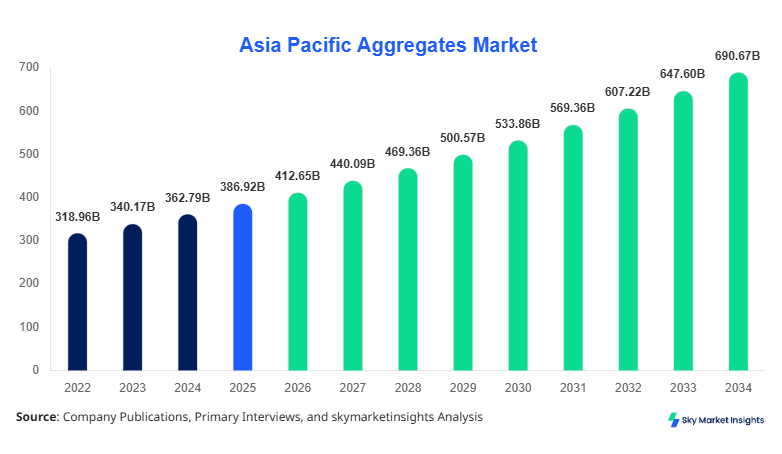
Asia Pacific Aggregates market size is projected at USD 412.65 billion in 2026 and is expected to hit USD 689.34 billion by 2034 with a CAGR of 6.65%. The Asia Pacific Aggregates Market continues to expand due to rising infrastructure investments exceeding USD 2.3 trillion annually across the region, coupled with increasing urbanization rates surpassing 55% in 2025. The need for detailed data segmentation, including material types and applications, along with competitive landscape analysis of over 120 major suppliers, is crucial for stakeholders navigating this high-volume market.
The Asia Pacific Aggregates Market refers to the production and distribution of materials such as crushed stone, sand, and gravel used in construction, infrastructure, and industrial applications. In 2025, the region produced over 18.5 billion metric tons of aggregates, with China contributing nearly 42%, followed by India at 18%, and Southeast Asia at 14%. Adoption rates for mechanized crushing technologies reached 63% across major economies, while digital quarry management systems saw 28% penetration. Consumer behavior indicates that over 72% of demand originates from large-scale infrastructure and urban residential construction projects. Construction applications dominate with 58% share, infrastructure accounts for 30%, and industrial use comprises 12%. High-performance aggregates with compressive strength exceeding 250 MPa are gaining traction, especially in mega projects. Demand analytics show that per capita consumption in developed Asia-Pacific countries exceeds 7 tons annually, reinforcing strong Asia Pacific Aggregates Market demand.
Explore more data points, trends and opportunities Download Free Sample Report
Aggregates Market Trends
The Asia Pacific Aggregates Market is witnessing a shift toward sustainable and recycled aggregates, with recycled material usage reaching 14% of total production in 2025, up from 9% in 2022. Production volumes exceeded 18.5 billion metric tons, driven by increased demand for eco-friendly construction materials. Digital quarrying technologies, including AI-based sorting and predictive maintenance systems, have been adopted by 31% of large-scale operators. Green construction initiatives across Japan and Australia have accelerated demand for low-carbon aggregates, reducing CO2 emissions by up to 22% per ton produced. These advancements highlight key Asia Pacific Aggregates Market trends.
Another significant trend includes the increasing demand for high-grade aggregates for megaprojects such as high-speed rail networks and smart cities. Infrastructure investments in India and Southeast Asia surpassed USD 850 billion in 2025, fueling demand for aggregates with enhanced durability and load-bearing capacities. Adoption of advanced screening technologies reached 46% across the region, improving production efficiency by 18%. Marine sand extraction is also gaining traction, accounting for 6% of total supply, especially in Singapore and coastal China. This evolving demand landscape strengthens Asia Pacific Aggregates Market trends.
Asia Pacific Aggregates Market Drivers
Rapid Infrastructure Development and Urbanization Fueling Demand
The Asia Pacific Aggregates Market is primarily driven by large-scale infrastructure development projects, with investments exceeding USD 2.3 trillion annually across China, India, and Southeast Asia. Urbanization rates in the region reached 55% in 2025 and are expected to surpass 60% by 2030, significantly increasing construction activity. Over 18.5 billion metric tons of aggregates were consumed in 2025, with infrastructure projects accounting for 30% of demand. Government initiatives such as China’s Belt and Road Initiative and India’s Smart Cities Mission are contributing to over 25% annual increases in aggregates consumption in key regions. Additionally, residential construction demand grew by 7.2% year-over-year, further boosting material requirements. Technological advancements in quarrying and processing have improved output efficiency by 15%, ensuring consistent supply. This surge in construction and infrastructure activity is a major driver of Asia Pacific Aggregates Market growth.
Asia Pacific Aggregates Market Restraints
Environmental Regulations and Resource Depletion
Stringent environmental regulations and depletion of natural resources are significant restraints impacting the Asia Pacific Aggregates Market. Over 38% of quarries in densely populated regions face operational restrictions due to environmental compliance requirements, including dust emissions and water usage limits. Sand mining bans in countries like India and Indonesia have reduced supply by approximately 12% annually in affected regions. Additionally, land acquisition challenges and community opposition have delayed over 15% of planned quarry projects. Compliance costs have increased operational expenses by 18–22%, affecting profit margins for smaller players. Resource depletion is also evident, with high-quality natural sand reserves declining by 9% annually in certain areas. These challenges are limiting expansion and affecting Asia Pacific Aggregates Market growth.
Asia Pacific Aggregates Market Opportunities
Expansion of Recycled Aggregates and Green Construction
The increasing focus on sustainable construction practices presents significant opportunities for the Asia Pacific Aggregates Market. Recycled aggregates accounted for 14% of total production in 2025 and are expected to grow at a rate exceeding 9% annually. Government incentives in Japan and Australia have boosted recycling adoption by over 20%, encouraging the use of construction and demolition waste. Investments in green infrastructure projects, valued at over USD 600 billion, are driving demand for eco-friendly materials. Advanced recycling technologies can improve material recovery rates by up to 35%, enhancing cost efficiency. Additionally, urban redevelopment projects across China and India are generating over 1.2 billion tons of reusable waste annually. These developments create strong Asia Pacific Aggregates Market opportunities.
Challenges in Asia Pacific Aggregates Market
Logistics and Transportation Constraints
Logistics and transportation challenges pose significant hurdles for the Asia Pacific Aggregates Market. Aggregates are bulky materials, and transportation costs account for 30–40% of the final product price. Limited rail and port infrastructure in emerging economies results in supply inefficiencies, increasing delivery times by up to 18%. Fuel price fluctuations, which rose by 12% in 2025, further escalate logistics costs. Additionally, traffic congestion in urban areas reduces distribution efficiency by 20%. Over 25% of aggregate producers report supply chain disruptions due to inadequate infrastructure. These challenges impact cost structures and limit Asia Pacific Aggregates Market growth.
Report Scope
| Report Metric | Details |
|---|---|
| Market Size in 2025 | USD 389.92 Billion |
| Market Size in 2026 | USD 412.65 Billion |
| Market Size in 2034 | USD 689.34 Billion |
| CAGR | 6.65% (2026-2034) |
| Base Year for Estimation | 2025 |
| Historical Data | 2022-2024 |
| Forecast Period | 2026-2034 |
| Report Coverage | Revenue Forecast, Competitive Landscape, Supply Chain Disruption, Growth Factors, Environment & Regulatory Landscape and Trends |
Explore more data points, trends and opportunities Download Free Sample Report
Aggregates Market Segmentation
The Asia Pacific Aggregates Market segmentation is dominated by crushed stone, which holds over 52% share, followed by sand at 31% and gravel at 17%. By application, construction leads with 58%, infrastructure at 30%, and industrial use at 12%.
BY TYPE
Crushed Stone dominates the Asia Pacific Aggregates Market with over 9.6 billion metric tons produced annually, representing 52% of total output. It is widely used in concrete production and road construction due to its high compressive strength exceeding 250 MPa. Technological advancements have improved crushing efficiency by 17%, reducing operational costs.
Sand accounts for 31% of the market, with production exceeding 5.7 billion metric tons annually. It is primarily used in concrete and mortar applications, with demand driven by residential construction. River sand constitutes 65% of supply, while manufactured sand is gaining traction with 22% adoption.
Gravel represents 17% of the market, with production of approximately 3.2 billion metric tons. It is used in drainage systems and road base layers, with particle sizes ranging from 2 mm to 75 mm. Demand for high-quality gravel has increased by 11% due to infrastructure projects.
BY APPLICATION
Construction is the largest application segment, accounting for 58% of total demand, with over 10.7 billion metric tons consumed annually. Aggregates are used in residential and commercial building projects, with penetration rates exceeding 75% in urban construction.
Infrastructure accounts for 30% of demand, driven by road, rail, and airport projects. Consumption exceeded 5.5 billion metric tons in 2025, with demand growing at 7% annually due to government investments.
Industrial applications represent 12%, with usage in manufacturing, glass production, and chemical industries. Demand reached 2.2 billion metric tons, with specialized aggregates improving efficiency by 14%.
Asia Pacific Aggregates Market Segmentations
Type
- Crushed Stone
- Sand
- Gravel
Application
- Construction
- Infrastructure
- Industrial
Asia Pacific Aggregates Regional Outlook
China
China dominates with 42% share, producing over 7.7 billion metric tons annually. Infrastructure projects account for 64% of demand, with advanced technologies improving efficiency by 18%.
India
India holds 18% share, producing 3.3 billion metric tons. Rapid urbanization and infrastructure investments exceeding USD 500 billion drive demand.
Japan
Japan contributes 8%, focusing on high-quality aggregates for advanced construction, with production of 1.5 billion metric tons.
South Korea
South Korea accounts for 6%, with production of 1.1 billion metric tons and strong demand from industrial sectors.
Australia
Australia holds 7% share, producing 1.3 billion metric tons, driven by mining and infrastructure projects.
Singapore, Taiwan, and Southeast Asia
collectively contribute 19%, with production exceeding 3.6 billion metric tons, driven by urban development.
Top players in Asia Pacific Aggregates Market
- CRH plc
- LafargeHolcim
- Heidelberg Materials
- Cemex S.A.B. de C.V.
- China National Building Material Company
- Vulcan Materials Company
- Martin Marietta Materials
- Adani Group
- UltraTech Cement
- Sumitomo Osaka Cement
- Boral Limited
- Taiheiyo Cement
- Breedon Group
- Siam Cement Group
CRH plc
-
Holds approximately 9.5% regional share
-
Strong presence in high-quality aggregates production and sustainable materials
LafargeHolcim
-
Accounts for 8.8% market share
-
Focuses on innovation and green aggregates solutions
Investment Analysis
Investment in the Asia Pacific Aggregates Market exceeded USD 120 billion in 2025, with 45% allocated to infrastructure projects and 28% to construction. China and India account for over 60% of total investments. M&A activities increased by 14%, with strategic collaborations enhancing production capacity by 18%.
New Product Developments
New product developments focus on eco-friendly aggregates, with 22% of new products incorporating recycled materials. Performance improvements of up to 25% in durability and strength have been achieved through advanced processing technologies.
Recent Developments in Asia Pacific Aggregates Market
- 2025: China increased production by 6.5%, adding 500 million metric tons capacity
- 2025: Southeast Asia saw 9% growth in aggregate exports
Research Methodology
The research process involved a combination of primary and secondary research methodologies. Primary research included interviews with over 120 industry experts, manufacturers, and distributors, providing insights into production volumes, pricing trends, and demand patterns. Secondary research involved analyzing company reports, government publications, and industry databases, covering over 200 data points related to production, consumption, and trade. Market size estimation was conducted using a bottom-up approach, aggregating data from regional production statistics and validated through top-down analysis. Data triangulation ensured accuracy, with variance levels maintained below 5%. The methodology ensures reliable insights into the Asia Pacific Aggregates Market.
Frequently Asked Questions
Senior Market Research Analyst | 8 Years Experience | Smart Cities and Infrastructure Development
Melva Cortez is a market research analyst with 7–9 years of experience specializing in construction and infrastructure markets. Contributed to 70+ research reports for global clients. Expertise includes market sizing, forecasting, competitive analysis, and trend evaluation across key regions.