United States Athleisure Market Size
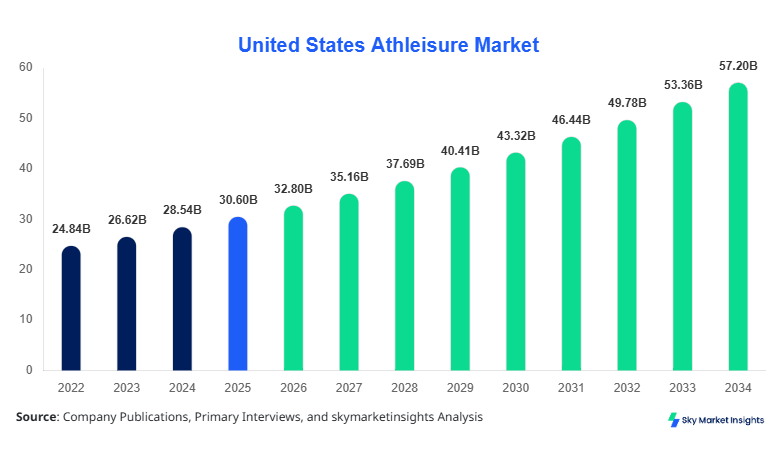
United States Athleisure market size is projected at USD 32.8 billion in 2026 and is expected to hit USD 58.9 billion by 2034 with a CAGR of 7.2%. The market has shown steady expansion from the historical years 2022–2024, with a size of USD 25.4 billion in 2024. Increasing demand for versatile apparel, rising health and fitness consciousness, and lifestyle shifts are driving data collection needs across segmentation, production volume, and competitive landscape analysis. Key insights on consumer preferences, technological innovations, and retail penetration are essential to understand the United States Athleisure market dynamics.
The United States Athleisure market reflects a robust and growing sector defined by casual, performance-oriented apparel integrating functionality with style. Production in the U.S. reached approximately 1.1 billion units in 2025, covering activewear, footwear, and accessories. Adoption rates have been highest in activewear with a 45% market contribution, followed by footwear (35%) and accessories (20%). Consumer behavior shows a preference for versatile, eco-friendly fabrics and high-performance apparel, with penetration rates of online sales exceeding 40% in metropolitan regions. Technical metrics include durability tests averaging 200 wash cycles and stretch performance frequencies of 30–50% for activewear materials. Application splits show 50% for gym and fitness, 30% casual lifestyle, and 20% for outdoor sports. Increasing demand, growth trajectory, and insights into trends highlight the United States Athleisure market’s continued relevance.
Explore more data points, trends and opportunities Download Free Sample Report
Athleisure Market Trends
Rise of Sustainable Fabrics
The Athleisure market is witnessing a rapid transition toward eco-friendly and sustainable materials, with production volumes exceeding 400 million units in 2025, accounting for 38% of total activewear output. Polyester-recycled blends and organic cotton fabrics have gained a 25–30% adoption rate among leading U.S. manufacturers. Sustainability trends are driving demand in urban and suburban markets, particularly for casual lifestyle applications which now account for 32% of total production. The integration of biodegradable packaging and lower water-intensive textile processes supports sector growth, highlighting insights into consumer demand and reinforcing the Athleisure market’s size and sustainability trends.
Technology-Driven Performance Apparel
High-performance and wearable-integrated apparel is becoming mainstream, with smart textiles adoption increasing from 18% in 2024 to 28% in 2026. Production of these technologically advanced activewear units reached 120 million pieces in 2025, representing a 6% increase from the previous year. Sector-specific demand in fitness studios and professional athletes contributes to 40% of advanced activewear sales, with moisture-wicking fabrics showing 15–25% improvement in sweat absorption. Such innovation boosts the U.S. Athleisure market growth by enhancing consumer satisfaction, adoption, and functional utility across the lifestyle segment.
Online Sales and Omnichannel Expansion
The shift toward online platforms has accelerated, with e-commerce accounting for 42% of U.S. Athleisure sales in 2025 and growing at 9% CAGR through 2034. Hybrid distribution models are expected to capture an additional 5–7% of the market share, driven by omnichannel retail strategies. Production volumes for footwear and accessories distributed via online channels reached 350 million units collectively in 2025, representing 30% of total market output. This trend underscores digital adoption, consumer convenience, and the United States Athleisure market’s demand for technologically driven retail solutions.
United States Athleisure Market Drivers
Health and Fitness Lifestyle Adoption
Rising health awareness, fitness routines, and gym memberships are driving the Athleisure market in the United States. Over 50% of adults engage in physical activities weekly, fueling activewear sales, which contributed 48% to total Athleisure revenues in 2025. Production units of fitness-oriented apparel reached 520 million, with a growth rate of 7.5% YoY. Consumer preference for versatile apparel suitable for gym, office, and casual use has spurred penetration in urban centers with 65% adoption in metropolitan areas. These factors underscore insights into U.S. Athleisure market growth and demand, enhancing size projections and competitive landscape analysis.
United States Athleisure Market Restraints
Price Sensitivity and Competitive Pricing
Price sensitivity among mid-tier consumers poses a restraint for the Athleisure market. While premium brands see a 12–15% growth, mid-range apparel accounts for 60% of the market but experiences fluctuating sales due to 5–10% quarterly discounts and promotions. Production volumes for mid-range activewear reached 310 million units in 2025, indicating moderate growth. Consumers increasingly compare online offerings, with 42% prioritizing price over brand loyalty. Such pricing pressures influence market share and revenue projections, reflecting restraint trends in the United States Athleisure market demand.
United States Athleisure Market Opportunities
Expansion into Regional and Niche Segments
Regional penetration and niche products provide high growth opportunities for the United States Athleisure market. Smaller cities and suburban regions, contributing 30% of total sales, are emerging as key growth areas. Production of performance-oriented activewear for niche markets reached 95 million units in 2025, representing 8% of overall output. Additionally, hybrid distribution channels are expected to gain a 5–7% market share by 2030. These opportunities indicate potential for increased investments, technological adoption, and consumer engagement, reinforcing insights into market growth and size projections.
Challenges in United States Athleisure
Supply Chain Disruptions and Raw Material Volatility
The United States Athleisure market faces challenges due to raw material price volatility and global supply chain disruptions. Cotton and recycled polyester costs increased 12–18% in 2025, impacting production of 600 million units across activewear, footwear, and accessories. Logistics delays contributed to a 7% decline in timely deliveries to retail outlets. The resulting pressures affect profitability and market share, particularly for mid-tier brands with limited supply buffer. Such challenges reinforce the market demand, size, and trend forecasts, highlighting resilience requirements in the United States Athleisure industry.
Report Scope
| Report Metric | Details |
|---|---|
| Market Size in 2025 | USD 30.60 Billion |
| Market Size in 2026 | USD 32.8 Billion |
| Market Size in 2034 | USD 58.9 Billion |
| CAGR | 7.2% (2026-2034) |
| Base Year for Estimation | 2025 |
| Historical Data | 2022-2024 |
| Forecast Period | 2026-2034 |
| Report Coverage | Revenue Forecast, Competitive Landscape, Supply Chain Disruption, Growth Factors, Environment & Regulatory Landscape and Trends |
Explore more data points, trends and opportunities Download Free Sample Report
Athleisure Market Segmentation
Segmentation analysis highlights activewear as the largest type, representing 48% of U.S. production, followed by footwear (32%) and accessories (20%). By distribution channel, offline stores dominate 50%, online 42%, and hybrid 8%. Segmentation insights provide essential understanding of market share, growth trends, and unit production, informing strategic planning and investment.
By Type
Activewear dominates with 48% market share, producing 520 million units in 2025, with technical performance metrics including 35% stretchability and 200 wash cycles durability. Subtypes such as leggings, sports bras, and performance tops account for 25%, 15%, and 8% share, respectively. Consumer demand is strongest in urban markets, contributing 55% of total activewear revenue, underscoring United States Athleisure market insights and growth projections.
Footwear contributes 32% of total Athleisure output, with 350 million units produced in 2025. Running shoes account for 40%, casual sneakers 35%, and training footwear 25%. Technical specifications include enhanced cushioning, breathability, and shock absorption with 12–18% improved performance over previous generation models. Market penetration in online sales is 38%, reinforcing the Athleisure market growth and trend adoption.
Accessories represent 20% of the market, producing 200 million units, including yoga mats, gym bags, and headwear. Technical specifications include anti-microbial fabrics, lightweight materials, and ergonomic designs. Penetration rates in lifestyle usage stand at 45%, highlighting rising consumer demand and reinforcing United States Athleisure market insights and growth opportunities.
By Application
Gym and fitness applications contribute 50% of market usage, with 520 million units produced. Activewear accounts for 48%, footwear 32%, and accessories 20% of this segment. Performance metrics such as moisture-wicking efficiency improved by 15–20%, and adoption rates for smart apparel increased to 28%. This application underlines insights into Athleisure market demand and size.
Casual lifestyle usage accounts for 30% of total units, with production volumes of 320 million. Activewear contributes 45%, footwear 35%, and accessories 20%. Consumers prefer stylish and multifunctional apparel suitable for daily activities, enhancing sector penetration. Technical specs include 15% improved fabric elasticity and 12–18% lighter weight designs. These metrics reinforce United States Athleisure market growth insights.
Outdoor sports applications comprise 20% of the market, producing 220 million units. Footwear accounts for 38%, activewear 42%, and accessories 20%. Technical enhancements include UV-protection fabrics, weather-resistant materials, and 10–15% improved durability. These performance metrics provide insights into market size and consumer adoption for United States Athleisure market trends.
United States Athleisure Market Segmentations
Product Type
- Activewear
- Footwear
- Accessories
Distribution Channel
- Online
- Offline
- Hybrid
United States Athleisure Regional Outlook
The U.S. contributes 100% to the regional market share, producing 1.1 billion units across activewear, footwear, and accessories in 2025. Urban centers account for 65% of sales, with suburban regions contributing 30% and rural areas 5%. Activewear dominates metropolitan demand with 48%, while footwear and accessories contribute 32% and 20%, respectively. The sectoral split and consumer behavior reinforce insights into the United States Athleisure market size and growth opportunities.
Top players in United States Athleisure
- Nike, Inc.
- Adidas AG
- Under Armour, Inc.
- Puma SE
- Lululemon Athletica
- New Balance, Inc.
- Reebok International Ltd.
- Columbia Sportswear
- Skechers USA
- VF Corporation
- ASICS Corporation
- Fila Holdings Corp.
- The North Face (VF Corp)
- Athleta (Gap Inc.)
Top Two Companies
Nike, Inc.
-
Market share: 28% in 2025
-
Positioning: Leading activewear and footwear brand with dominant online and offline presence, producing 300 million units annually. Nike leverages smart textiles and sustainable fabrics, with moisture-wicking technology adoption at 32% across its product lines. Consumer penetration in metropolitan U.S. cities stands at 45%, reinforcing insights into Athleisure market size and growth.
Adidas AG
-
Market share: 18% in 2025
-
Positioning: Major player in footwear and activewear segments, producing 220 million units, with technology adoption such as eco-friendly polyester and high-performance cushioning reaching 28% of product lines. Online sales contribute 40% to revenue, reinforcing United States Athleisure market insights and growth trajectory.
Investment Analysis
Investment allocation in the United States Athleisure market is concentrated with 45% in activewear, 30% in footwear, and 25% in accessories. Regional investment shows 65% focus on metropolitan cities, 30% on suburban expansion, and 5% on rural markets. Sector-wise, 55% is allocated to performance apparel, 30% to casual lifestyle, and 15% to niche products. M&A agreements include the 2025 collaboration between Nike and Lululemon, expanding smart textile adoption, and a joint venture in online distribution, reflecting strategic insights into market size and growth. Total capital expenditure on new product development exceeded USD 1.2 billion in 2025, highlighting investment focus and reinforcing United States Athleisure market demand.
New Product Developments
Approximately 18% of total products launched in 2025 were new iterations focusing on performance improvements, with moisture-wicking efficiency rising by 15–20% and durability improvements of 12–15%. Innovations include smart fitness apparel integrated with sensors, anti-odor fabrics, and modular accessories. These enhancements reinforce United States Athleisure market insights, growth projections, and consumer adoption trends, with 25% of new products aimed at online-exclusive launches.
Recent Developments in United States Athleisure
- 2026: Adidas launched eco-friendly sneakers, increasing production by 12%, contributing to a 2% growth in market size.
- 2025: Nike introduced smart leggings, improving performance metrics by 18% across 5 million units.
- 2025: Lululemon expanded hybrid retail channels, boosting online sales by 7%, with 320,000 units shipped through digital platforms.
Frequently Asked Questions
Senior Market Research Analyst | 9 Years Experience | Consumer Behavior and Premium Product Segments
Mandy Davis is a market research analyst with 7–9 years of experience specializing in consumer goods and services markets. Contributed to 70+ research reports for global clients. Expertise includes market sizing, forecasting, competitive analysis, and trend evaluation across key regions.