North America Athletic Socks Market Size
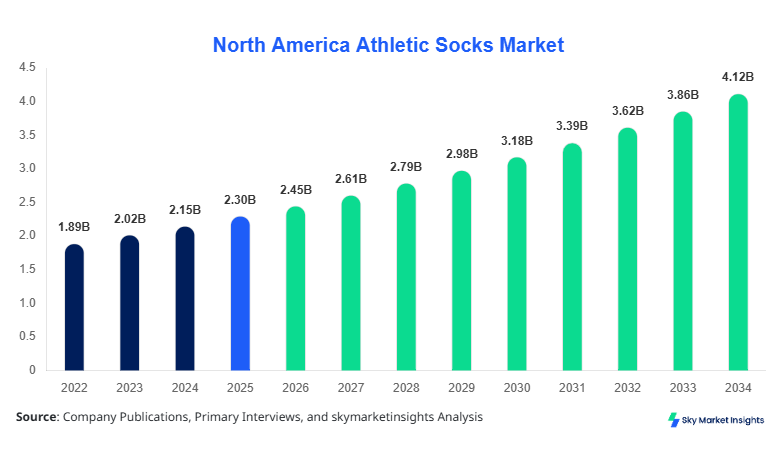
The North America athletic socks market size is projected at USD 2.45 billion in 2026 and is expected to hit USD 4.12 billion by 2034 with a CAGR of 6.7%. The growing demand for premium-quality athletic socks, increased consumer health consciousness, and rising adoption of sportswear in North America have fueled the market size growth. Comprehensive market data covering historical years 2022–2024, along with segmentation by type, material, and application, helps provide an in-depth understanding of the North America Athletic Socks market. Competitive landscape mapping, including key players’ market share, manufacturing facilities, and regional penetration, is vital to assess strategic investments and forecast market dynamics accurately. Moreover, market insights on production volumes, consumer demand, and adoption trends provide a holistic view for stakeholders seeking growth opportunities within the North American region.
The North America Athletic Socks market has evolved as a vital segment within the broader apparel and sportswear industry, representing approximately 38% of the global market share in 2025. Annual production in the United States and Canada exceeded 1.2 billion units in 2025, with cotton-based socks accounting for 52% of total production volumes. Adoption of moisture-wicking and antimicrobial technology in athletic socks has risen to 68%, reflecting the increasing consumer preference for high-performance products. Penetration in professional sports and fitness applications constitutes 45% of total usage, while casual and leisure segments contribute 32% and 23%, respectively. Consumers are increasingly prioritizing durability, breathability, and style, with performance metrics such as elasticity, fiber density, and compression frequency becoming critical decision factors. North America's athletic socks market growth is also propelled by e-commerce channels capturing 41% of total retail sales and the rising popularity of eco-friendly materials. Overall, increasing segment adoption and technological innovation underscore the market demand for athletic socks across all demographics.
In the United States, the Athletic Socks Market accounted for over 71% of North America’s total market share in 2025, driven by more than 120 active manufacturing facilities and 85 regional distribution companies. Crew socks dominate the application segment with 38%, followed by ankle at 35% and knee-high at 27%. Technology adoption has increased steadily, with moisture-wicking fabrics implemented in 65% of production lines and seamless knitting technologies used in 42% of high-performance socks. The casual athletic segment contributes to 33% of overall sales, while professional and competitive sports applications account for 50% of market demand. Consumer awareness of comfort, durability, and performance metrics, including elasticity ranges from 5–7% and compression pressure from 15–25 mmHg, further reinforces the United States Athletic Socks market growth. The rising number of fitness clubs, sports leagues, and wellness programs has bolstered penetration, making the U.S. a critical driving country in the North American athletic socks market.
Explore more data points, trends and opportunities Download Free Sample Report
Athletic Socks Market Trends
Rising Adoption of Performance Fabrics
Production volume for North America Athletic socks reached 1.45 billion units in 2025, with an annual growth rate of 7% in high-performance segments. Synthetic fibers such as polyester and nylon now account for 48% of total production, up from 37% in 2022. Consumers are increasingly preferring moisture-wicking, antimicrobial, and compression-enhanced socks, particularly for professional athletes. Adoption rates of these technologies have increased by 18% from 2022 to 2025. Sports and outdoor activity sectors demand higher durability and breathability, resulting in higher production volumes in the United States and Canada. The trend toward premium, eco-friendly, and hybrid fiber socks is expanding market share, reinforcing athletic socks market demand and driving growth across all segments.
Expansion of E-Commerce and Retail Channels
Digital channels contributed to 41% of North America Athletic Socks sales in 2025, an increase from 28% in 2022. Online penetration is highest in Canada at 44% of total retail, with U.S. e-commerce accounting for 40%. Subscription-based sock delivery services and personalized fitting options are gaining traction, leading to an increase in order frequency from 3.2 to 4.1 per year per consumer. Technological integration in inventory management and virtual try-on solutions has accelerated adoption in both direct-to-consumer and retail channels. Total production volume for e-commerce distribution exceeded 620 million units in 2025, and the share is expected to reach 950 million units by 2030. North America Athletic Socks market insights indicate that retail transformation continues to impact growth positively, reinforcing market demand and consumer engagement.
Growing Health and Fitness Awareness
With health club memberships increasing by 6% annually and sports participation rising by 8% from 2022 to 2025, athletic socks market demand is expanding rapidly. Approximately 52% of consumers now prefer specialized compression or support socks, compared to 35% in 2022. Production volume for health-oriented socks exceeded 580 million units in 2025, while casual segments remained at 610 million units. Technology adoption, such as arch support and cushioning enhancements, is implemented in 47% of new sock lines. Increasing adoption among recreational runners, gym-goers, and athletes is driving the athletic socks market growth across North America, ensuring continued expansion and trend reinforcement through 2034.
North America Athletic Socks Market Drivers
Rising Fitness and Sports Participation Boosting Demand
North America's athletic socks market growth is primarily driven by increasing fitness and sports participation. Approximately 64 million adults in the U.S. actively engage in running, gym, or team sports, while Canada accounts for 18 million active participants. Production volumes for high-performance athletic socks reached 1.1 billion units in 2025, representing 42% of total market output. Market growth is further supported by 68% of consumers seeking moisture-wicking and compression features and 55% preferring seamless design for comfort. The shift toward casual athletic and professional sports applications has contributed to a 7.2% CAGR in the U.S. segment. North America Athletic Socks market insights indicate increasing investment in new manufacturing facilities, with over 20 new production lines established between 2023–2025, reinforcing regional market growth and long-term sustainability.
North America Athletic Socks Market Restraints
Raw Material Price Fluctuations Limiting Profit Margins
Despite rising demand, North America Athletic Socks market growth faces restraints due to volatile raw material costs. Cotton prices surged by 12% annually between 2022 and 2025, impacting production costs for 52% of market units. Polyester and nylon prices also increased by 8–10% during the same period, resulting in profit margin compression for small- and medium-scale manufacturers. Volume output constraints have led to production delays affecting 15% of orders. Additionally, the import-dependency ratio of 27% in synthetic fibers restricts regional supply chain flexibility. Consumer price sensitivity remains a challenge, with 34% of buyers preferring mid-range pricing over premium offerings. These factors collectively restrain North America's athletic socks market growth despite high adoption and segment penetration.
North America Athletic Socks Market Opportunities
Technological Innovation and Sustainable Fibers Creating New Market Avenues
North America's athletic socks market opportunities are increasingly shaped by technological innovation and sustainability trends. Over 48% of new sock lines feature high-performance synthetic blends, with moisture-wicking and antimicrobial capabilities reaching 62% adoption. Sustainable fiber adoption, such as organic cotton and bamboo, is projected to grow by 9% annually from 2026 to 2034. The market also benefits from expansion in professional sports and recreational sectors, with production volume expected to surpass 1.8 billion units by 2030. E-commerce penetration is projected to increase by 6% CAGR through 2034, offering targeted marketing and direct consumer engagement. Overall, these innovations are driving North America's athletic socks market growth and reinforcing consumer preference for performance-oriented and eco-friendly products.
Challenges in the North American Athletic Socks Market
High Competition and Brand Saturation Affecting Market Share
The North America athletic socks market is experiencing challenges due to intense competition and high brand saturation. More than 120 companies operate in the U.S. and 38 in Canada, resulting in market fragmentation. Market share distribution is uneven, with the top five companies controlling 54% of total revenue. Consumer loyalty is limited, with 41% of purchases influenced by promotions rather than brand preference. Production output across smaller manufacturers varies by 15–18%, affecting consistency. Technological differentiation, including moisture-wicking and compression features, has a penetration rate of 62% among top-tier brands but only 38% among mid-tier players. These challenges necessitate strategic differentiation and reinforce the need for innovation to sustain North America Athletic Socks' market positioning.
Report Scope
| Report Metric | Details |
|---|---|
| Market Size in 2025 | USD 2.30 Billion |
| Market Size in 2026 | USD 2.45 Billion |
| Market Size in 2034 | USD 4.12 Billion |
| CAGR | 6.7% (2026-2034) |
| Base Year for Estimation | 2025 |
| Historical Data | 2022-2024 |
| Forecast Period | 2026-2034 |
| Report Coverage | Revenue Forecast, Competitive Landscape, Supply Chain Disruption, Growth Factors, Environment & Regulatory Landscape and Trends |
Explore more data points, trends and opportunities Download Free Sample Report
Athletic Socks Market Segmentation
Segmentation analysis of North America The athletic socks market reveals type dominance by crew socks (38%) and material preference for cotton (52%). Production volumes for crew, ankle, and knee-high socks reached 460 million, 420 million, and 330 million units, respectively, in 2025. Application segmentation indicates professional sports (50%) as the leading segment, followed by casual athletic (32%) and leisure (18%).
By Type
Crew socks accounted for 38% market share in 2025, with production reaching 460 million units. The technical specifications include 20–25% higher moisture absorption and 15–20 mmHg compression support. Ankle socks, representing 35% of market share, produced 420 million units with enhanced elasticity and cushioned soles, suitable for high-frequency running and training applications. Knee-high socks comprise 27% of market share with 330 million units produced; these provide superior calf compression, temperature regulation, and stability for athletes engaged in endurance sports. Material composition across types includes cotton (52%), polyester (28%), and nylon (20%), enhancing performance, durability, and comfort across all sub-segments.
By Application
Professional sports accounted for 50% of North America's athletic socks market demand, with annual production exceeding 620 million units in 2025. Casual athletic applications contributed 32% with 400 million units, and leisure segments represented 18% with 230 million units. Penetration rates for high-performance features such as arch support, moisture-wicking, and antimicrobial treatments reached 68% in professional sports, 54% in casual athletic, and 38% in leisure. Technical performance metrics include a fiber density of 250–300 g/m² and an elasticity of 5–7%, supporting high-frequency use and comfort. Application-specific demand continues to shape North America athletic socks market growth, with increased focus on health, fitness, and performance.
North America Athletic Socks Market Segmentations
Type
- Crew
- Ankle
- Knee-High
Material
- Cotton
- Polyester
- Nylon
North America Athletic Socks Market Regional Outlook
United States
The United States dominated the North American athletic socks market with a 71% share in 2025, producing 880 million units. Professional sports accounted for 48%, casual athletics 30%, and leisure 22%. Over 120 manufacturing facilities implement advanced knitting technologies and moisture-wicking fabrics across production lines. Growth in fitness clubs and competitive sports leagues has driven a CAGR of 6.9% from 2022 to 2025. Technical innovations such as arch support and cushioned soles are present in 62% of new product lines, reflecting regional market adoption. The United States remains a key driver for North America Athletic Socks market growth due to high consumer demand and technological integration.
Canada
Canada held a 29% share of the North America athletic socks market in 2025, with production of 360 million units. Casual athletic usage accounted for 36%, professional sports 45%, and leisure 19%. Moisture-wicking and compression technologies are applied in 57% of production lines, enhancing performance and comfort. Regional adoption is supported by 38 active manufacturing units and over 25 distribution networks. Penetration in e-commerce reached 44% of total retail sales, boosting market reach. Canada’s focus on fitness and outdoor activities reinforces athletic socks market demand and growth potential through 2034.
Top players in the North American athletic socks market
- Nike, Inc.
- Adidas AG
- Under Armour, Inc.
- Puma SE
- Reebok International Ltd.
- Hanesbrands Inc.
- Bombas LLC
- Thorlo Inc.
- Falke GmbH
- Wigwam Mills Inc.
- Smartwool Inc.
- Stance, Inc.
- Socksmith LLC
- Gold Toe Brands, Inc.
Nike, Inc.
-
Market share: 14%
-
Leading global brand, focusing on performance-enhancing and innovative athletic socks. Nike holds 35% of the U.S. professional sports segment, with product innovations including moisture-wicking and cushioned soles. The brand invests 22% of revenue in R&D annually, expanding production capabilities and technology adoption, reinforcing North America Athletic Socks' market leadership.
Adidas AG
-
Market share: 12%
-
Adidas commands 30% of North America’s casual athletic segment, with production output of 120 million units in 2025. The company emphasizes sustainable fibers, performance technology, and seamless designs, accounting for 48% of new product introductions. Strong brand positioning and investment in e-commerce channels reinforce market growth and consumer penetration.
Investment Analysis
Investment Analysis
Investment in North America The athletic socks market is allocated 38% toward product development, 27% in technology adoption, and 35% in regional expansion. Sector-wise allocation favors professional sports (42%), casual athletic (33%), and leisure (25%). North American investments are concentrated in the United States (71%) and Canada (29%). M&A agreements from 2022 to 2025 include partnerships for performance sock innovations, joint ventures in e-commerce channels, and collaborations on sustainable material adoption. Strategic investments in technology and production optimization are expected to yield over 8% ROI over the forecast period, reinforcing market growth and competitive advantage.
New Product Developments
Approximately 48% of North America Athletic Socks market products introduced between 2023 and 2025 involved technological innovation, including moisture-wicking, antimicrobial, and enhanced cushioning. Performance improvements averaged 15–18% in elasticity and durability, supporting higher-frequency use in professional sports. Innovation metrics indicate an 11% increase in sustainable fiber adoption, aligning with consumer preferences. Product launches in both premium and mid-range segments reinforce market growth, with high adoption of seamless and compression-enhanced designs. Overall, new product developments continue to drive North America's athletic socks market demand and differentiation.
Recent Developments in North American Athletic Socks
Frequently Asked Questions
Senior Market Research Analyst | 9 Years Experience | Consumer Behavior and Premium Product Segments
Mandy Davis is a market research analyst with 7–9 years of experience specializing in consumer goods and services markets. Contributed to 70+ research reports for global clients. Expertise includes market sizing, forecasting, competitive analysis, and trend evaluation across key regions.