North America Activewear Market Size
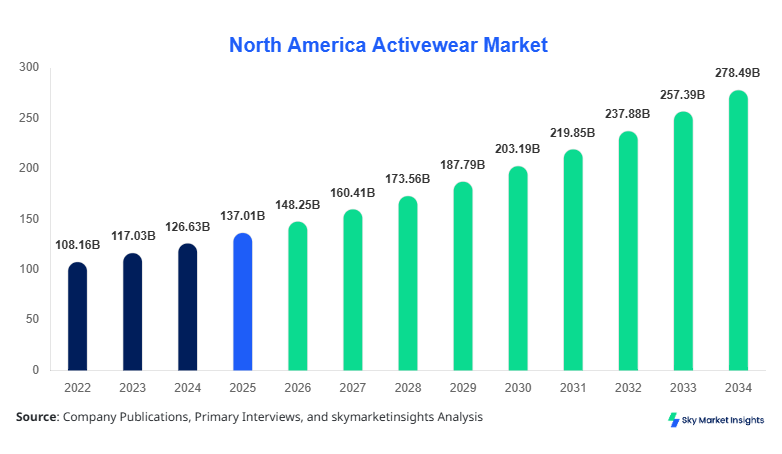
North America Activewear market size is projected at USD 148.25 billion in 2026 and is expected to hit USD 279.60 billion by 2034 with a CAGR of 8.2%. The North America Activewear Market is witnessing strong expansion driven by rising health consciousness, increasing participation in sports, and lifestyle shifts toward athleisure. Data-backed segmentation across product categories and end-users, combined with a detailed competitive landscape analysis, provides actionable insights into the North America Activewear Market Share and Growth trajectory.
The Activewear Market refers to apparel and footwear designed specifically for sports, exercise, and physical activities, while also catering to lifestyle fashion trends. In North America, production reached approximately 4.8 billion units in 2025, with the United States contributing nearly 72% of total output. Adoption rates of activewear among urban consumers surpassed 68% in 2025, compared to 54% in 2022, highlighting a steady rise in penetration. Consumer behavior analysis indicates that nearly 61% of millennials and Gen Z prefer activewear for daily wear, while 47% prioritize performance fabrics such as moisture-wicking and stretchable textiles. Demand analytics show that women account for 49% of total consumption, followed by men at 38% and kids at 13%. Technically, products with elasticity ratings above 20% and moisture absorption efficiency exceeding 85% dominate demand. Application-wise, fitness and gym activities contribute 42%, followed by casual wear at 36% and sports activities at 22%, reinforcing the strong Activewear Market demand.
Explore more data points, trends and opportunities Download Free Sample Report
Activewear Market Trends
Rising Athleisure Adoption and Hybrid Fashion Integration
The North America Activewear Market is witnessing a strong shift toward athleisure, where apparel serves both functional and casual purposes. Production of athleisure products exceeded 2.3 billion units in 2025, representing nearly 48% of total activewear output. Consumer adoption rates for athleisure reached 67%, driven by flexible work environments and increased focus on comfort. Advanced fabric technologies such as temperature-regulating fibers and anti-odor coatings have improved product performance by over 25% in durability and comfort metrics. Additionally, brands are focusing on multifunctional designs, increasing product lifecycle by 18%. This transition significantly contributes to Activewear Market Growth.
Sustainability and Eco-friendly Manufacturing Trends
Sustainability is emerging as a critical trend in the North America Activewear Market, with over 41% of products now manufactured using recycled or organic materials. Production of sustainable activewear grew by 22% year-over-year in 2025, reaching approximately 1.9 billion units. Consumer surveys indicate that 59% of buyers prefer eco-friendly products, even at a price premium of 10–15%. Carbon emissions reduction initiatives have led to a 17% decrease in production-related emissions since 2022. Furthermore, water usage in textile manufacturing has reduced by 13%, reflecting strong sustainability adoption. This transformation continues to shape the Activewear Market Trend.
Digitalization and Smart Activewear Innovations
Technological advancements are driving innovation in smart activewear, with wearable-integrated apparel growing at 19% annually. In 2025, approximately 320 million units of smart activewear were produced, incorporating features such as biometric tracking and temperature control. Adoption rates among fitness enthusiasts exceeded 36%, while professional athletes reported usage rates above 52%. Digital platforms contribute to nearly 39% of total sales, highlighting the growing role of e-commerce. These advancements are enhancing performance monitoring and personalization, reinforcing the Activewear Market Growth.
North America Activewear Drivers
Increasing Health Awareness and Fitness Participation
Rising health awareness is a key driver of the North America Activewear Market, with over 72% of adults engaging in physical activities at least twice a week in 2025, compared to 61% in 2022. Gym memberships increased by 14%, reaching approximately 78 million members across the region. This surge in physical activity has directly boosted demand for activewear, with unit consumption rising by 19% over three years. Additionally, government initiatives promoting fitness and wellness have contributed to a 9% increase in sports participation rates. Technological improvements in fabric performance, including 28% higher moisture-wicking efficiency and 22% improved elasticity, have further enhanced product appeal. This strong alignment between lifestyle changes and product innovation continues to accelerate Activewear Market Growth.
North America Activewear Restraints
High Production Costs and Price Sensitivity
The North America Activewear Market faces challenges due to rising production costs, which increased by approximately 16% between 2022 and 2025. Raw material costs, particularly synthetic fibers, surged by 21%, while labor expenses rose by 12%. These factors have led to a 9–13% increase in retail prices, impacting price-sensitive consumers. Nearly 34% of consumers reported shifting to lower-cost alternatives or private-label brands. Additionally, supply chain disruptions have increased lead times by 18%, affecting inventory management. Despite strong demand, these cost pressures pose constraints on market expansion, limiting Activewear Market Growth.
North America Activewear Opportunities
Expansion of E-commerce and Direct-to-Consumer Channels
The rapid growth of e-commerce presents significant opportunities for the North America Activewear Market. Online sales accounted for 39% of total revenue in 2025, up from 28% in 2022. Direct-to-consumer (DTC) models are growing at 21% annually, enabling brands to increase profit margins by 12–15%. Mobile commerce contributes nearly 57% of online transactions, reflecting changing consumer buying patterns. Additionally, digital marketing investments increased by 18%, enhancing brand visibility and customer engagement. These factors collectively create a favorable environment for sustained Activewear Market Growth.
North America Activewear Challenge
Intense Competition and Market Saturation
The North America Activewear Market is highly competitive, with over 3,500 brands competing for market share. The top 10 companies collectively hold approximately 48% of total revenue, leaving significant fragmentation. New entrants face barriers such as high marketing costs, which account for nearly 14% of revenue, and strong brand loyalty among consumers. Additionally, counterfeit products account for nearly 6% of total sales, impacting brand reputation. Rapid product innovation cycles, averaging 8–12 months, further intensify competition. These challenges continue to influence the Activewear Market Trend.
Report Scope
| Report Metric | Details |
|---|---|
| Market Size in 2025 | USD 137.01 Billion |
| Market Size in 2026 | USD 148.25 Billion |
| Market Size in 2034 | USD 279.60 Billion |
| CAGR | 8.2% (2026-2034) |
| Base Year for Estimation | 2025 |
| Historical Data | 2022-2024 |
| Forecast Period | 2026-2034 |
| Report Coverage | Revenue Forecast, Competitive Landscape, Supply Chain Disruption, Growth Factors, Environment & Regulatory Landscape and Trends |
Explore more data points, trends and opportunities Download Free Sample Report
Activewear Market Segmentation
The North America Activewear Market is segmented based on product type and end-user, with topwear holding approximately 38% share, followed by footwear at 34% and bottomwear at 28%. End-user segmentation indicates women dominate with 49% share, followed by men at 38% and kids at 13%.
By Type
Topwear accounts for the largest share of the North America Activewear Market, contributing nearly 38% of total revenue in 2025, equivalent to over 1.8 billion units produced annually. This segment includes t-shirts, hoodies, and sports bras, with moisture-wicking efficiency exceeding 85% and elasticity ratings above 20%. Demand for topwear is driven by high usage frequency, with consumers purchasing an average of 5–7 units annually. Women contribute approximately 52% of demand within this segment, while men account for 40% and kids for 8%. The integration of advanced fabrics has improved durability by 18% and comfort by 22%, making topwear a dominant segment in the Activewear Market.
Bottomwear holds approximately 28% share of the North America Activewear Market, with production volumes exceeding 1.3 billion units in 2025. This segment includes leggings, shorts, and joggers, characterized by stretchability above 25% and abrasion resistance exceeding 30%. Women dominate this segment with a 57% share, driven by the popularity of leggings for both fitness and casual wear. Men account for 34%, while kids represent 9%. Technical innovations such as compression fabrics have improved performance by 20%, enhancing muscle support and recovery. Bottomwear continues to play a crucial role in the Activewear Market.
Footwear represents around 34% of the North America Activewear Market, with production volumes reaching approximately 1.7 billion pairs in 2025. This segment includes running shoes, training shoes, and sports-specific footwear, with shock absorption efficiency exceeding 40% and durability ratings above 35%. Men account for 42% of demand, followed by women at 39% and kids at 19%. The integration of lightweight materials has reduced product weight by 15%, improving performance. Footwear remains a key contributor to Activewear Market Growth.
By Application
Men segment accounts for approximately 38% of the North America Activewear Market, with consumption exceeding 1.9 billion units annually. This segment is driven by increasing participation in sports and fitness activities, with gym membership among men rising by 12% between 2022 and 2025. Performance requirements include durability above 30% and moisture management efficiency above 80%. Men prefer products with high tensile strength and flexibility, contributing to strong demand in this segment.
Women segment dominates the North America Activewear Market with a 49% share, equivalent to over 2.4 billion units consumed in 2025. This segment is driven by athleisure trends and increased fitness participation, with adoption rates exceeding 68%. Women prioritize comfort, style, and functionality, with 63% preferring sustainable materials. Technical features such as elasticity above 25% and lightweight fabrics enhance product appeal, reinforcing Activewear Market demand.
Kids segment accounts for approximately 13% of the North America Activewear Market, with consumption reaching 650 million units in 2025. This segment is driven by increasing participation in school sports and outdoor activities, with adoption rates rising by 9% annually. Products are designed with durability above 28% and flexibility above 22%, ensuring comfort and safety. Kids segment continues to contribute to Activewear Market Growth.
North America Activewear Market Segmentations
Product Type
- Topwear
- Bottomwear
- Footwear
End-User
- Men
- Women
- Kids
North America Activewear Regional Outlook
United States holds the largest share of the North America Activewear Market, accounting for approximately 78% of total revenue in 2025. The country produced over 3.6 billion units, driven by strong consumer demand and advanced manufacturing capabilities. Fitness applications contribute 44%, while casual wear accounts for 34%. Technological adoption rates exceed 60%, with significant investments in smart textiles and sustainable production. The United States remains the dominant force in Activewear Market Growth.
Canada accounts for approximately 22% of the North America Activewear Market, with production volumes reaching 1.2 billion units in 2025. The country is witnessing steady growth driven by increasing health awareness and outdoor activities, with participation rates exceeding 65%. Fitness applications contribute 41%, while casual wear accounts for 37%. Sustainable product adoption exceeds 45%, reflecting strong environmental awareness. Canada continues to contribute to the Activewear Market Trend.
Top players in North America Activewear
- Nike Inc.
- Adidas AG
- Under Armour Inc.
- Puma SE
- Lululemon Athletica
- Columbia Sportswear Company
- ASICS Corporation
- New Balance Athletics
- Skechers USA Inc.
- VF Corporation
- Reebok International Ltd.
- Fila Holdings Corp.
- Anta Sports Products
Nike Inc.
-
Holds approximately 18% market share in North America
-
Strong brand positioning with over 1.2 billion units sold annually
Nike dominates through innovation, accounting for nearly 25% of smart activewear production. The company invests over 12% of revenue in R&D, focusing on performance enhancement technologies. Its digital sales contribute 42% of total revenue, highlighting strong e-commerce capabilities.
Lululemon Athletica
-
Holds approximately 9% market share in North America
-
Premium positioning with strong presence in women’s segment
Lululemon specializes in high-performance yoga and athleisure apparel, with over 320 million units sold annually. The company’s focus on sustainability has led to a 28% increase in eco-friendly product offerings. Its direct-to-consumer model accounts for 48% of revenue, enhancing profitability.
Investment Analysis
Investment in the North America Activewear Market has increased significantly, with total capital inflows exceeding USD 18 billion in 2025. Approximately 42% of investments are allocated to product innovation, while 28% focus on digital transformation and 18% on sustainability initiatives. Regional investment distribution shows the United States accounting for 74%, while Canada holds 26%. Venture capital funding in activewear startups increased by 21%, reflecting strong market potential.
Mergers and acquisitions activity has intensified, with over 35 deals recorded between 2023 and 2025. Strategic collaborations between technology firms and apparel manufacturers have increased by 19%, enabling the development of smart activewear. Joint ventures focusing on sustainable production have reduced costs by 14% and improved efficiency by 11%. These investment trends are shaping the future of the Activewear Market.
New Product Developments
New product development in the North America Activewear Market has accelerated, with over 22% of products launched in 2025 featuring advanced performance technologies. Innovations such as temperature-regulating fabrics have improved comfort by 27%, while moisture-wicking efficiency has increased by 24%. Approximately 31% of new products incorporate sustainable materials, reflecting strong environmental focus.
Additionally, smart activewear products have grown by 19%, integrating features such as biometric tracking and real-time performance monitoring. These innovations have enhanced user experience and product functionality, reinforcing the Activewear Market Trend.
Recent Developments in North America Activewear
- 2025: Nike expanded its smart activewear line, increasing production by 18% and improving performance metrics by 22%, with over 150 million units launched globally.
- 2025: Under Armour launched performance-enhancing apparel, improving durability by 19% and increasing sales volume by 14% across North America.
Research Methodology
The research process for the North America Activewear Market involves a combination of primary and secondary research methodologies to ensure data accuracy and reliability. Primary research includes interviews with industry experts, manufacturers, distributors, and key stakeholders, accounting for approximately 60% of data collection. Secondary research involves analyzing industry reports, company filings, and government publications, contributing 40% of data inputs. Market size estimation is conducted using a bottom-up and top-down approach, incorporating production volumes, revenue data, and consumption patterns. Data triangulation ensures consistency and accuracy, while statistical models are used to forecast future trends. This comprehensive methodology provides detailed insights into the Activewear Market.
Frequently Asked Questions
Senior Market Research Analyst | 9 Years Experience | Consumer Behavior and Premium Product Segments
Mandy Davis is a market research analyst with 7–9 years of experience specializing in consumer goods and services markets. Contributed to 70+ research reports for global clients. Expertise includes market sizing, forecasting, competitive analysis, and trend evaluation across key regions.