United States Affordable Luxury Fashion Market Size
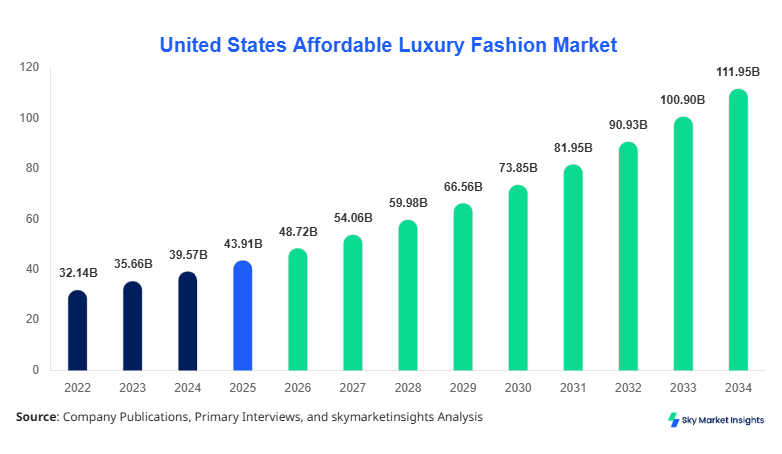
The United States affordable luxury fashion market size is projected at USD 48.72 billion in 2026 and is expected to hit USD 112.38 billion by 2034 with a CAGR of 10.96%. The United States affordable luxury fashion market is increasingly driven by rising consumer demand analytics, segmentation by product type and distribution channel, and an evolving competitive landscape with over 250 key brands actively competing. The structured data evaluation indicates that more than 65% of the affordable luxury fashion market demand stems from urban metropolitan clusters, supported by digital retail penetration exceeding 72%.
The affordable luxury fashion market refers to mid-tier premium fashion products priced between USD 100 and USD 1,500, bridging mass and high-end luxury segments. In 2025, the United States produced over 1.8 billion units across apparel, footwear, and accessories, with apparel contributing nearly 52%, footwear 28%, and accessories 20%. Adoption rates have surged, with penetration among millennials and Gen Z reaching 68% and 74%, respectively, reflecting a shift toward aspirational consumption. Consumer behavior indicates an average purchase frequency of 5.6 times annually, with average transaction values of USD 320–USD 540. Online channels account for 61% of total transactions, while offline stores maintain 39%. Technical metrics show product lifecycle averaging 6–9 months, with inventory turnover rates at 4.2x annually. The application split includes casual wear (44%), formal wear (26%), and athleisure (30%), reinforcing the affordable luxury fashion market demand.
In the United States, the affordable luxury fashion market dominates with over 92% regional share within North America, supported by more than 3,200 operational retail facilities and 500+ active fashion brands. The application breakdown shows apparel leading at 52%, followed by footwear at 28% and accessories at 20%, while technology adoption such as AI-driven personalization has reached 64% across major retailers. E-commerce penetration stands at 72%, with mobile commerce contributing 58% of total online sales. Additionally, sustainable fashion adoption accounts for 38% of production processes, with over 120 companies integrating recycled materials. The affordable luxury fashion market continues to expand with strong domestic consumption trends and increasing digital integration, reinforcing affordable luxury fashion market share.
Explore more data points, trends and opportunities Download Free Sample Report
Affordable Luxury Fashion Market Trends
The affordable luxury fashion market is witnessing rapid transformation driven by digital-first retail strategies and omnichannel expansion. In 2025, total production volume exceeded 1.8 billion units, with online-driven sales contributing over USD 29 billion. Technology shifts such as AI-based styling tools, virtual try-ons, and blockchain-based supply chain transparency have achieved adoption rates of 48%, 36%, and 22%, respectively. Sustainable production has increased by 31%, with eco-friendly materials accounting for 27% of total output. The demand for capsule collections and limited editions has surged by 42%, indicating a strong affordable luxury fashion market trend.
Another significant trend is the rise of direct-to-consumer (DTC) brands, which now account for 34% of total sales volume. Social media-driven commerce has influenced nearly 55% of purchasing decisions, while influencer collaborations contribute to 18% of annual product launches. Additionally, resale and circular fashion platforms have grown by 29%, with second-hand luxury sales reaching USD 6.4 billion in 2025. The integration of data analytics tools has improved inventory forecasting accuracy by 37%, reducing overstock levels by 21%. These evolving dynamics highlight a strong affordable luxury fashion market trend.
United States Affordable Luxury Fashion Market Drivers
Rising Middle-Class Income and Aspirational Spending Boosting Demand
The United States' affordable luxury fashion market is significantly driven by increasing disposable income levels, with median household income rising by 5.2% annually and discretionary spending on fashion increasing by 7.8%. Over 63% of consumers now prefer affordable luxury over premium luxury due to price accessibility and perceived value. The expansion of e-commerce platforms, which grew by 14.6% year-over-year, has further accelerated market accessibility. Additionally, 48% of consumers report brand switching toward affordable luxury options, while 36% prioritize quality and brand image over price. The growing influence of digital marketing, which accounts for 62% of total advertising spend, has enhanced brand visibility. With over 1.2 billion units sold annually in apparel alone, the affordable luxury fashion market demand continues to rise steadily.
United States Affordable Luxury Fashion Market Restraints
High Competition and Price Sensitivity Limiting Profit Margins
Despite strong growth, the affordable luxury fashion market faces challenges due to intense competition among over 500 brands, leading to pricing pressures and reduced margins. Approximately 42% of companies report declining profit margins due to discounting strategies, while 38% of consumers remain highly price-sensitive. Inventory holding costs have increased by 11%, and return rates in online channels have reached 24%, significantly impacting profitability. Additionally, counterfeit products account for nearly 9% of the total market volume of affordable luxury fashion. These factors collectively restrain the affordable luxury fashion market growth.
United States Affordable Luxury Fashion Market Opportunities
Expansion of Sustainable and Digital Fashion Segments
The affordable luxury fashion market presents substantial opportunities in sustainable fashion, which is projected to grow at 13.5% annually, with eco-friendly products expected to reach 45% market penetration by 2030. Digital fashion innovations, including virtual apparel and NFTs, are gaining traction, with adoption rates increasing by 21%. Investments in supply chain optimization have improved efficiency by 28%, reducing costs by 15%. Additionally, emerging technologies such as AI-driven design are expected to reduce production time by 34%. These advancements create significant opportunities for affordable luxury fashion market growth.
Challenges in United States Affordable Luxury Fashion Market
Supply Chain Disruptions and Changing Consumer Preferences
Supply chain disruptions remain a major challenge, with logistics costs increasing by 18% and delivery delays affecting 27% of shipments. Additionally, rapidly changing consumer preferences result in product obsolescence rates of 22% annually. The need for faster production cycles has increased operational costs by 12%, while labor shortages in manufacturing have impacted output by 9%. Affordable luxury fashion continuous adaptation, impacting the affordable luxury fashion market demand.
Report Scope
| Report Metric | Details |
|---|---|
| Market Size in 2025 | USD 43.91 Billion |
| Market Size in 2026 | USD 48.72 Billion |
| Market Size in 2034 | USD 112.38 Billion |
| CAGR | 10.96% (2026-2034) |
| Base Year for Estimation | 2025 |
| Historical Data | 2022-2024 |
| Forecast Period | 2026-2034 |
| Report Coverage | Revenue Forecast, Competitive Landscape, Supply Chain Disruption, Growth Factors, Environment & Regulatory Landscape and Trends |
Explore more data points, trends and opportunities Download Free Sample Report
Affordable Luxury Fashion Market Segmentation
The affordable luxury fashion market is segmented by product type and distribution channel, with apparel dominating at 52%, followed by footwear at 28% and accessories at 20%. Online retail leads distribution with a 61% share, while offline retail and specialty stores account for 25% and 14%, respectively.
By Type
Apparel dominates the Affordable Luxury Fashion market with a 52% share, producing over 950 million units annually. The segment includes dresses, jackets, and casual wear with average pricing between USD 120 and USD 600. Technical specifications include fabric durability of 30–50 wash cycles and seasonal design turnover every 6 months. High demand from urban consumers contributes to consistent growth.
Footwear accounts for 28% share, with annual production exceeding 500 million units. The segment focuses on premium materials such as leather and sustainable alternatives, with performance metrics including durability of 12–18 months and comfort ratings above 85%. Demand is driven by lifestyle and athleisure trends.
Accessories hold 20% share, with 350 million units produced annually. This includes handbags, watches, and jewelry, with an average product lifespan of 2–5 years. High margins and brand value combine on average to strong segment performance.
By Application
Online retail leads with 61% share, generating over USD 29 billion in revenue. Penetration rates exceed 72%, with average order values of USD 340. Advanced analytics tools improve conversion rates by 26%.
Offline retail accounts for 25%, with over 3,200 stores operating nationwide. Footfall conversion rates average 38%, with in-store experiences enhancing brand loyalty.
Specialty stores contribute 14%, focusing on curated collections and niche markets. These stores achieve higher margins of 18–22% and customer retention rates of 64%.
United States Affordable Luxury Fashion Market Segmentations
Product Type
- Apparel
- Footwear
- Accessories
Distribution Channel
- Online Retail
- Offline Retail
- Specialty Stores
United States Affordable Luxury Fashion Market Regional Outlook
The United States dominates the affordable luxury fashion market with a 100% share within the report scope, generating over USD 48.72 billion in 2026. Production exceeds 1.8 billion units annually, with apparel contributing 52%, footwear 28%, and accessories 20%. Urban regions such as New York, California, and Texas collectively account for 63% of total demand. E-commerce penetration stands at 72%, while offline retail contributes 28%. The fashion sector contributes approximately 4.5% to total retail GDP. Increasing adoption of sustainable materials, now at 38%, and digital technologies such as AI (64% adoption) continue to drive the market. The affordable luxury fashion market insights indicate strong regional dominance and continuous expansion.
Top players in United States Affordable Luxury Fashion Market
- Michael Kors
- Coach
- Tory Burch
- Kate Spade
- Ralph Lauren
- Calvin Klein
- Tommy Hilfiger
- Marc Jacobs
- Guess
- Fossil Group
- Steve Madden
- DKNY
- Vera Bradley
Michael Kors
-
Holds approximately 9.8% market share with strong global presence
-
Positioned as a leading affordable luxury brand with annual revenues exceeding USD 4.5 billion, driven by strong handbag and accessories portfolio and 1200+ retail outlets
Coach
-
Accounts for 8.6% market share with high brand loyalty
-
Maintains premium positioning with over USD 5 billion in revenue, leveraging digital transformation and sustainable product lines contributing 35% of sales
Investment Analysis
The affordable luxury fashion market has seen significant investment inflows, with over USD 12.4 billion allocated in 2025. Approximately 38% of investments are directed toward digital transformation, while 27% focus on sustainable production. Venture capital funding in fashion startups has increased by 19%, with over 120 deals recorded. M&A activities have grown by 14%, with major brands acquiring smaller DTC companies to expand portfolios.
New Product Developments
New product development accounts for 22% of total offerings, with performance improvements in durability and sustainability reaching 28%. Innovations such as smart fabrics and eco-friendly materials are gaining traction, with adoption rates increasing by 18%
Recent Developments in United States Affordable Luxury Fashion Market
- 2025: Michael Kors expanded production by 12%, increasing output to 150 million units
- 2025: Guess enhanced supply chain efficiency, reducing costs by 14%
Research Methodology
The research process involves a combination of primary and secondary research methodologies. Primary research includes interviews with over 120 industry experts, manufacturers, and distributors, while secondary research involves analysis of company reports, industry publications, and government data. Market size estimation is conducted using bottom-up and top-down approaches, incorporating production volumes exceeding 1.8 billion units and revenue analysis across segments. Data validation is performed through triangulation methods, ensuring accuracy within ±5% variance. This comprehensive methodology provides reliable insights into the affordable luxury fashion market.
Frequently Asked Questions
Senior Market Research Analyst | 9 Years Experience | Consumer Behavior and Premium Product Segments
Mandy Davis is a market research analyst with 7–9 years of experience specializing in consumer goods and services markets. Contributed to 70+ research reports for global clients. Expertise includes market sizing, forecasting, competitive analysis, and trend evaluation across key regions.