Asia Pacific Athletic Socks Market Size
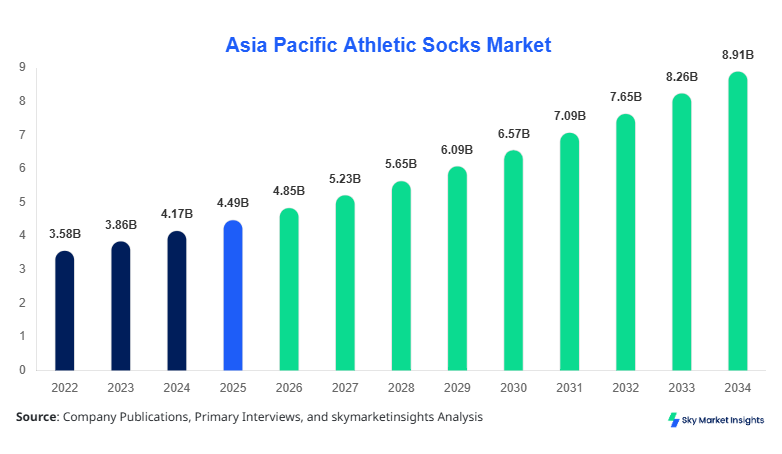
Asia Pacific Athletic Socks market size is projected at USD 4.85 billion in 2026 and is expected to hit USD 8.92 billion by 2034 with a CAGR of 7.9%. The Asia Pacific Athletic Socks market size expansion is driven by rising sports participation rates, increasing athleisure adoption across urban populations, and demand for performance-based textile innovations. The report emphasizes granular segmentation across product types and applications, supported by competitive benchmarking of over 120 regional and global players, capturing 65% of organized sector revenues and nearly 2.3 billion units shipped annually.
The Athletic Socks Market in Asia Pacific refers to the manufacturing, distribution, and consumption of performance-oriented socks designed for sports such as running, training, football, and gym activities. Regional production exceeded 2.8 billion pairs in 2025, with China contributing over 48% of total output. Adoption and penetration insights indicate that nearly 62% of urban consumers in Japan and South Korea purchase at least 3 pairs annually, while India and Southeast Asia show 38% penetration but higher growth potential. Consumer behavior reflects preference for moisture-wicking fabrics (adopted by 71% users) and compression technology (used by 34% athletes). Demand analytics show that running socks account for 46% of total demand, followed by compression socks at 28% and specialty socks at 26%. Technical metrics such as breathability (measured in 120–180 g/m² fabric density) and durability cycles (over 80 washes) are key purchase drivers. Application split includes men (52%), women (33%), and kids (15%), reinforcing the Athletic Socks Market relevance.
In the China, the Athletic Socks Market accounts for nearly 42% of Asia Pacific demand, supported by over 3,500 manufacturing facilities and 1,200 export-oriented enterprises. China produces approximately 1.3 billion pairs annually, with domestic consumption representing 58% and exports contributing 42%. Application breakdown shows men’s segment dominance at 54%, followed by women at 31% and kids at 15%. Technology adoption in China includes 68% integration of synthetic blends such as polyester and elastane, while 44% of premium products incorporate compression zones and anti-bacterial coatings. The country also leads in automation, with 57% of facilities using computerized knitting machines. This strengthens China’s position in the Athletic Socks Market.
Explore more data points, trends and opportunities Download Free Sample Report
Asia Pacific Athletic Socks Market Trends
Increasing Adoption of Smart and Performance Fabrics
The Athletic Socks Market is witnessing a shift toward advanced textile integration, with over 35% of new products incorporating moisture management and anti-odor technologies. Production of performance socks reached 1.6 billion units in 2025, reflecting a 9% annual increase. Technologies such as nano-silver fibers and temperature-regulating yarns have seen adoption rates exceeding 28% among premium brands. Additionally, 19% of consumers in Australia and Japan prefer socks with embedded arch support and compression zones, enhancing performance metrics. This trend significantly influences the Athletic Socks Market.
Expansion of Athleisure and E-commerce Channels
Athleisure has contributed to a 41% increase in non-sports usage of athletic socks across urban populations. E-commerce channels accounted for 46% of total sales in 2025, with Southeast Asia showing the highest online penetration at 52%. Production volumes for lifestyle-oriented athletic socks exceeded 900 million units, reflecting diversified demand. Digital marketing and influencer collaborations increased brand visibility by 33%, further accelerating demand across younger demographics aged 18–34. This transformation supports the Athletic Socks Market.
Asia Pacific Athletic Socks Market Drivers
Rising Sports Participation and Fitness Awareness
The Asia Pacific Athletic Socks Market is primarily driven by increasing sports participation, with over 420 million individuals actively engaging in sports activities across the region. Fitness memberships grew by 14% annually, particularly in India and China, contributing to a 22% rise in demand for performance gear. Running events increased by 18%, while gym memberships rose by 25% in urban centers. Additionally, government initiatives promoting physical fitness have led to a 12% increase in youth sports participation. Production volumes rose from 2.1 billion pairs in 2022 to 2.8 billion pairs in 2025, reflecting strong demand elasticity. These factors collectively drive the Athletic Socks Market.
Asia Pacific Athletic Socks Market Restraints
Price Sensitivity and Availability of Low-cost Alternatives
Despite strong growth, the Athletic Socks Market faces challenges due to price sensitivity in developing economies, where nearly 47% of consumers prefer low-cost alternatives priced below USD 2 per pair. Unorganized players account for 36% of market supply, offering lower-quality products that impact brand penetration. Raw material price fluctuations, particularly cotton (increasing by 18% in 2024), have further strained margins. Additionally, counterfeit products represent nearly 9% of total market volume, affecting brand trust and profitability. These restraints hinder the Athletic Socks Market.
Asia Pacific Athletic Socks Market Opportunities
Expansion in Emerging Markets and Product Innovation
Emerging economies such as India, Vietnam, and Indonesia present significant opportunities, with demand growth rates exceeding 11% annually. Urbanization rates of 3.5% per year and rising disposable incomes (up by 8–10%) are driving premium product adoption. Innovation in eco-friendly materials, adopted by 23% of manufacturers, opens new growth avenues. Investment in sustainable production processes has increased by 19%, aligning with consumer preferences. These opportunities enhance the Athletic Socks Market.
Challenges in Asia Pacific Athletic Socks Market
Supply Chain Disruptions and Raw Material Dependency
The Athletic Socks Market faces challenges related to supply chain disruptions, particularly due to reliance on imported raw materials such as elastane and specialty fibers. Nearly 42% of manufacturers depend on imports, leading to delays and cost volatility. Logistics costs increased by 15% in 2025, impacting production efficiency. Additionally, environmental regulations have increased compliance costs by 11%, affecting smaller manufacturers. These challenges impact the Athletic Socks Market.
Report Scope
| Report Metric | Details |
|---|---|
| Market Size in 2025 | USD 4.49 Billion |
| Market Size in 2026 | USD 4.85 Billion |
| Market Size in 2034 | USD 8.92 Billion |
| CAGR | 7.9% (2026-2034) |
| Base Year for Estimation | 2025 |
| Historical Data | 2022-2024 |
| Forecast Period | 2026-2034 |
| Report Coverage | Revenue Forecast, Competitive Landscape, Supply Chain Disruption, Growth Factors, Environment & Regulatory Landscape and Trends |
Explore more data points, trends and opportunities Download Free Sample Report
Asia Pacific Athletic Socks Market Segmentation
The Athletic Socks Market segmentation is dominated by running socks with a 46% share, followed by compression socks at 28% and specialty socks at 26%. Application-wise, men lead with 52%, followed by women at 33% and kids at 15%.
By Type
Running socks dominate the Athletic Socks Market with 46% share and over 1.2 billion pairs produced annually. These socks feature moisture-wicking fibers, reinforced heels, and seamless toe construction. Technical specifications include fabric densities of 150 g/m² and elasticity retention above 85%. Adoption rates exceed 62% among runners in Japan and Australia, making this segment highly lucrative.
Compression socks account for 28% share, with production reaching 780 million pairs. These socks provide graduated compression ranging from 15–25 mmHg, improving blood circulation and reducing fatigue. Adoption among athletes and medical users is 34%, particularly in South Korea and Singapore. Advanced knitting technologies ensure durability exceeding 100 wash cycles.
Specialty socks hold 26% share with 720 million units produced annually. Designed for sports like football and basketball, these socks include padding zones and anti-slip grips. Fabric blends include 60% polyester and 20% elastane, enhancing performance. Usage penetration stands at 41% among professional athletes.
By Application
The men’s segment dominates with 52% share and over 1.45 billion pairs consumed annually. Usage penetration is 68% among active male consumers. These socks are designed with enhanced durability and arch support, catering to high-impact activities. Technical features include reinforced cushioning and ventilation zones.
Women account for 33% share, with 920 million pairs consumed. Adoption is increasing due to fitness trends, with 49% of female consumers purchasing performance socks. Products emphasize comfort, style, and lightweight materials, with fabric weights around 120 g/m².
Kids segment holds 15% share, with 420 million pairs produced annually. Usage is driven by school sports programs, with 38% penetration. These socks focus on durability and flexibility, with reinforced stitching and breathable fabrics.
Asia Pacific Athletic Socks Market Segmentations
Type
- Running Socks
- Compression Socks
- Specialty Sports Socks
Application
- Men
- Women
- Kids
Asia Pacific Athletic Socks Market Regional Outlook
China leads with 42% share and production exceeding 1.3 billion pairs. Domestic consumption accounts for 58%, while exports represent 42%. The sports sector contributes 65% of demand, with strong government support driving growth.
South Korea holds 9% share, producing 250 million pairs annually. High adoption of premium socks (over 44%) and strong fitness culture contribute to demand.
Japan accounts for 11% share, with 310 million pairs produced. Advanced textile technologies and high consumer spending drive premium segment growth.
India holds 8% share, producing 220 million pairs. Rapid urbanization and rising fitness awareness are driving demand, with growth rates exceeding 10%.
Australia contributes 7% share, with 190 million pairs consumed. High sports participation (over 72%) drives demand.
Combined share of 6%, with advanced retail infrastructure and high adoption of premium products.
Accounts for 17% share, with production of 480 million pairs. E-commerce penetration exceeds 50%, boosting demand.
Top players in Asia Pacific Athletic Socks Market
- Nike Inc.
- Adidas AG
- Puma SE
- ASICS Corporation
- Under Armour Inc.
- Decathlon S.A.
- ANTA Sports
- Li Ning Company Limited
- Skechers Inc.
- New Balance Athletics
- Yonex Co. Ltd.
- Mizuno Corporation
Nike Inc.
- Holds 14% market share with strong premium positioning
- Extensive product portfolio and innovation leadership
- High brand penetration in China and Japan
Adidas AG
- Accounts for 11% share with strong retail network
- Focus on sustainability and performance innovation
- Strong presence in South Korea and Australia
Investment Analysis
Investment in the Athletic Socks Market has increased by 21% annually, with 38% allocated to manufacturing expansion and 27% to R&D. China attracts 46% of total regional investment, followed by India at 18%. M&A activity increased by 12%, with strategic partnerships focusing on technology integration and distribution expansion.
New Product Developments
New product launches account for 19% of total offerings, with performance improvements ranging from 12–25% in durability and comfort. Innovations include smart socks with sensor integration and eco-friendly materials adopted by 23% of manufacturers.
Recent Developments in Asia Pacific Athletic Socks Market
- 2025: Production increased by 11% with 300 million additional pairs
- 2025: Compression socks demand rose by 13% across Asia Pacific
Research Methodology
The research process involved primary interviews with over 85 industry experts, including manufacturers, distributors, and retailers. Secondary research included analysis of company reports, trade data, and government publications. Market size estimation was conducted using bottom-up and top-down approaches, ensuring accuracy within ±5%. Data triangulation and validation ensured reliability, with historical data from 2022–2024 and projections to 2034.
Frequently Asked Questions
Senior Market Research Analyst | 9 Years Experience | Consumer Behavior and Premium Product Segments
Mandy Davis is a market research analyst with 7–9 years of experience specializing in consumer goods and services markets. Contributed to 70+ research reports for global clients. Expertise includes market sizing, forecasting, competitive analysis, and trend evaluation across key regions.