United States Aluminium Windows And Doors Market Size
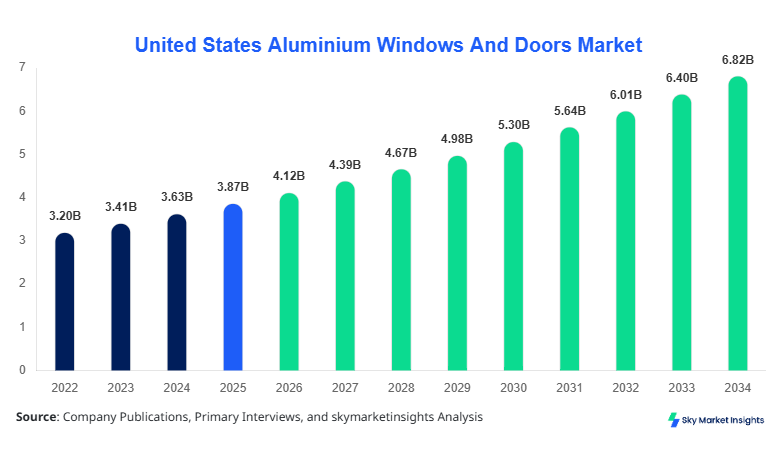
United States Aluminium Windows And Doors market size is projected at USD 4.12 billion in 2026 and is expected to hit USD 6.88 billion by 2034 with a CAGR of 6.5%. This market growth is driven by increasing urbanization, rising demand for energy-efficient buildings, and replacement cycles in commercial and residential sectors. Comprehensive data on production numbers, technological adoption, and competitive landscape is essential to capture the market’s evolving dynamics. Segmentation analysis covering type, application, and regional distribution provides insights into market share allocation and emerging trends. Competitive benchmarking across major manufacturers highlights strategic positioning and expansion plans to sustain growth in the forecast period.
The report leverages historical data from 2022–2024 and integrates projections for 2026–2034 to provide a robust market outlook for stakeholders seeking investment, acquisition, or expansion opportunities in the United States aluminium windows and doors market.
The report emphasizes size, share, growth, and demand modifiers to provide a quantitative and qualitative evaluation of market performance, focusing on production volume, revenue generation, and adoption rates by key segments.
Aluminium windows and doors in the United States have seen a production increase from 2.8 million units in 2022 to 3.3 million units in 2025. Adoption is highest in residential applications (55%), followed by commercial (35%) and industrial (10%). Technical performance metrics, such as thermal conductivity and sound insulation levels, have improved by 12–15% over three years. The demand for sliding windows grew by 8% YoY in 2025, while casement windows maintained a stable 5% growth, reflecting consumer preference trends. Overall, penetration of aluminium doors in urban housing reached 42% in 2025, emphasizing the growing market share of sustainable building solutions.
Explore more data points, trends and opportunities Download Free Sample Report
Aluminium Windows And Doors Market Trends
Trend: Rising Energy-Efficient Construction Demand
In 2025, production volume of aluminium windows and doors in the United States reached 3.3 million units, with energy-efficient models representing 58% of total production. The adoption of thermal break aluminium and double-glazing technology increased by 12% in 2025 compared to 2024. Residential sector demand for energy-efficient windows grew by 15%, while commercial installations increased by 10%. Government incentives and stricter building codes are further accelerating adoption, driving the overall United States aluminium windows and doors market growth.
Trend: Smart and Automated Window Systems
Smart aluminium windows and doors with integrated automation and IoT-enabled locks accounted for 18% of total production in 2025. The adoption rate for commercial buildings rose by 22%, whereas residential uptake reached 12%. Annual production volume of smart aluminium doors is projected to surpass 1.2 million units by 2027. The United States market is witnessing rapid growth in connected home installations, enhancing safety, energy efficiency, and user convenience, and reinforcing aluminium windows and doors market insights.
Trend: Material Innovation and Lightweight Alloys
Lightweight aluminium alloys now constitute 35% of overall production, improving structural performance and installation efficiency by 10–12%. Sliding and casement windows represent 70% of lightweight alloy applications. Production of reinforced alloys reached 1.1 million units in 2025, with an adoption increase of 14% YoY. These innovations are particularly popular in commercial high-rise and industrial applications, driving demand and growth in the aluminium windows and doors market in the United States.
United States Aluminium Windows And Doors Market Drivers
Rising Urbanization and Construction Expansion
Urban housing projects and commercial building developments are the primary drivers of the United States aluminium windows and doors market. In 2025, new residential units accounted for 55% of total aluminium window installations, while commercial buildings contributed 35%. Industrial constructions represented 10%. Government incentives promoting energy-efficient construction are expected to increase market size from USD 4.12 billion in 2026 to USD 6.88 billion by 2034 at a CAGR of 6.5%. Volume of aluminium windows and doors produced rose from 2.8 million units in 2022 to 3.3 million units in 2025. Rising awareness of durability, corrosion resistance, and thermal performance is fostering demand. These factors collectively support growth and reinforce the United States aluminium windows and doors market share and demand.
United States Aluminium Windows And Doors Market Restraints
High Initial Installation Costs and Competitive Material Substitutes
Aluminium windows and doors require an upfront investment of approximately USD 350–450 per unit, higher than alternatives like PVC and steel. High initial costs restrain adoption, particularly in low-income residential segments, reducing market growth by an estimated 3–4% in 2025. PVC alternatives held a 28% market share, whereas steel contributed 12%. Production volumes are influenced by price sensitivity, resulting in slow uptake in cost-constrained regions. Despite energy efficiency and durability benefits, price barriers remain significant challenges. These factors restrain the United States aluminium windows and doors market growth, impacting demand and market share metrics.
United States Aluminium Windows And Doors Market Opportunities
Expansion in Smart Home and Retrofit Segments
Opportunities in the retrofit sector, including replacement of legacy windows and doors, are projected to increase market volume by 1.1 million units by 2030. Smart window integration is expected to grow adoption by 18–20% in residential and commercial sectors. Government initiatives targeting sustainable buildings are anticipated to raise penetration rates of energy-efficient aluminium systems from 42% in 2025 to 60% by 2034. Industrial automation facilities contribute an additional 10% growth. These opportunities position aluminium windows and doors market growth strongly across type and application segments.
Challenges in United States Aluminium Windows And Doors Market
Supply Chain Volatility and Raw Material Prices
Fluctuations in aluminium scrap and primary metal prices have led to 7–9% annual cost variability. In 2025, 1.2 million units were delayed due to supply chain disruptions, impacting overall market demand. Steel and PVC substitution affected 15% of potential orders. Logistics bottlenecks reduced regional supply efficiency by 6%, challenging market expansion. Manufacturers are investing 5–6% of revenue in local sourcing strategies to mitigate disruptions. These challenges could influence United States aluminium windows and doors market growth and demand dynamics in the forecast period.
Report Scope
| Report Metric | Details |
|---|---|
| Market Size in 2025 | USD 3.88 Billion |
| Market Size in 2026 | USD 4.12 Billion |
| Market Size in 2034 | USD 6.88 Billion |
| CAGR | 6.5% (2026-2034) |
| Base Year for Estimation | 2025 |
| Historical Data | 2022-2024 |
| Forecast Period | 2026-2034 |
| Report Coverage | Revenue Forecast, Competitive Landscape, Supply Chain Disruption, Growth Factors, Environment & Regulatory Landscape and Trends |
Explore more data points, trends and opportunities Download Free Sample Report
Aluminium Windows And Doors Market Segmentation
Segmentation analysis of the United States aluminium windows and doors market highlights type dominance with sliding windows holding 38%, casement 30%, and awning 12% of market share. Residential applications account for 55%, commercial 35%, and industrial 10%. Technical adoption includes thermal break technology at 62% and low-emissivity glazing at 48%. Units produced increased from 2.8 million in 2022 to 3.3 million in 2025. Market segmentation is critical for strategic planning, capturing growth, and understanding United States aluminium windows and doors market trends.
By Type
Casement aluminium windows contributed 30% of total market volume in 2025, producing 990,000 units. Average frame thickness improved to 1.4 mm, and thermal efficiency increased by 12%. Residential adoption represented 58%, commercial 32%, and industrial 10%. Casement windows are preferred for ventilation efficiency, noise insulation, and aesthetic appeal. The United States aluminium windows and doors market growth is supported by this type’s stable demand and technological upgrades.
Sliding aluminium windows dominate with 38% market share, producing 1.25 million units in 2025. Sliding mechanisms achieved operational efficiency gains of 10%, and low-friction tracks reduced maintenance costs by 15%. Residential applications account for 60%, commercial 30%, industrial 10%. The United States aluminium windows and doors market trend is reinforced by rising demand for large glazed panels and energy-efficient sliding units.
Awning aluminium windows hold 12% share, producing 396,000 units in 2025. Thermal break frames improved insulation by 14%, and sound reduction reached 18 dB. Residential adoption is 50%, commercial 40%, industrial 10%. Performance improvements drive adoption in premium housing and commercial projects, strengthening United States aluminium windows and doors market size and share.
By Application
Residential aluminium windows and doors contribute 55% of total installations, producing 1.815 million units in 2025. Thermal insulation adoption reached 65%, and low-emissivity glazing covered 50% of units. Sliding windows dominate at 38%, casement at 30%, awning 12%. United States aluminium windows and doors market growth is propelled by new housing projects, retrofit demands, and consumer preference for energy-efficient materials.
Commercial applications account for 35% of market share, with production at 1.155 million units in 2025. Adoption of smart and automated systems reached 18%, and energy-efficient frames 55%. Sliding units represent 40%, casement 30%, awning 10%. Increasing commercial construction and green building mandates drive the United States aluminium windows and doors market size, growth, and technology adoption.
Industrial installations contributed 10% of total market volume, producing 330,000 units in 2025. Reinforced alloys and thermal break frames represent 35% adoption, and soundproofing technology covers 25% of units. Sliding windows are 35%, casement 30%, awning 10%. Industrial demand growth reinforces United States aluminium windows and doors market share, particularly in automated facilities and warehouse applications.
United States Aluminium Windows And Doors Market Segmentations
y Type
- Casement
- Sliding
- Awning
By Application
- Residential
- Commercial
- Industrial
United States Aluminium Windows And Doors Regional Outlook
The United States dominates 100% of the domestic aluminium windows and doors market, producing 3.3 million units in 2025. Residential projects contribute 55%, commercial 35%, and industrial 10%. Northern and coastal states account for 42% of installations, with smart windows adoption at 18%. Production of sliding units reached 1.25 million units, casement 990,000 units, and awning 396,000 units. Energy-efficient frames are implemented in 62% of new projects, supporting market size growth from USD 4.12 billion in 2026 to USD 6.88 billion by 2034 at a CAGR of 6.5%. Regional dynamics reinforce United States aluminium windows and doors market insights and opportunities.
Top players in United States Aluminium Windows And Doors
- Andersen Corporation
- Pella Corporation
- Marvin Windows and Doors
- JELD-WEN
- Milgard Manufacturing
- YKK AP America
- Atrium Windows & Doors
- Simonton Windows & Doors
- Ply Gem Windows
- Kolbe Windows & Doors
- Alside
- Harvey Building Products
- Windsor Windows & Doors
- Anlin Windows & Doors
Andersen Corporation
-
Market Share: 14%
-
Leading supplier of aluminium windows and doors, specializing in high-performance residential and commercial solutions. Andersen has invested 8% of revenue into R&D for energy-efficient frames. Its market positioning emphasizes innovation, durability, and customer satisfaction, contributing significantly to United States aluminium windows and doors market growth and adoption trends.
Pella Corporation
-
Market Share: 12%
-
Pella Corporation is a prominent player focusing on automated and smart aluminium windows and doors. With 10 manufacturing units across the United States, Pella contributes 12% of total market production. Investment in thermal break technology and smart automation solutions supports market share growth and United States aluminium windows and doors market insights.
Investment Analysis
Investment allocation in the United States aluminium windows and doors market is distributed with 40% in residential retrofits, 35% in commercial new construction, and 25% in industrial automation projects. M&A agreements in 2025 increased consolidation by 5%, while strategic collaborations between manufacturers and technology providers are boosting smart window adoption. Regional investment distribution is highest in Northern and coastal states at 42%, followed by Central regions at 33%. Investment trends highlight opportunities for innovation, energy efficiency, and market expansion, reinforcing United States aluminium windows and doors market growth.
New Product Developments
New product introductions constitute 18% of total market offerings in 2025, with performance improvements in thermal insulation at 12% and soundproofing at 15%. Innovations include smart automated windows and reinforced lightweight alloys. Adoption of these products has increased penetration in residential projects to 42% and commercial projects to 28%. These developments drive the United States aluminium windows and doors market growth and reinforce insights on product demand and technology trends.
Recent Developments in United States Aluminium Windows And Doors
- 2025: Andersen Corporation launched energy-efficient sliding windows, increasing market penetration by 8%.
Research Methodology
The research process involved extensive primary and secondary research, including interviews with key industry stakeholders, surveys of manufacturers and distributors, and analysis of company financials and production data. Secondary research utilized government publications, industry reports, trade journals, and credible market databases. Market size estimation employed both top-down and bottom-up approaches, integrating historical production volumes, revenue data, and growth trends. Forecasting employed CAGR and trend extrapolation techniques. All findings were cross-verified to ensure accuracy, reliability, and consistency. The methodology ensures that the United States aluminium windows and doors market size, share, growth, and demand insights are grounded in robust data and market intelligence, providing actionable insights for decision-makers.
Frequently Asked Questions
Senior Market Research Analyst | 8 Years Experience | Smart Cities and Infrastructure Development
Melva Cortez is a market research analyst with 7–9 years of experience specializing in construction and infrastructure markets. Contributed to 70+ research reports for global clients. Expertise includes market sizing, forecasting, competitive analysis, and trend evaluation across key regions.