United States Aluminium Formwork System Size
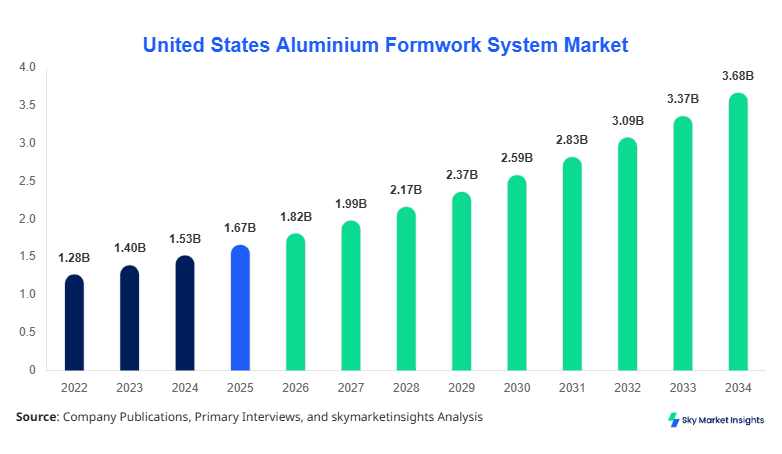
United States Aluminium Formwork System market size is projected at USD 1.82 billion in 2026 and is expected to hit USD 3.76 billion by 2034 with a CAGR of 9.2%. The market analysis incorporates historical data from 2022 to 2024, accounting for production volumes, revenue figures, and adoption rates across multiple construction applications. The detailed report covers market segmentation, competitive landscape, technology adoption, and emerging trends, providing essential insights for stakeholders and investors to evaluate opportunities. Understanding market size, share, growth, and demand metrics is critical for formulating strategic decisions and forecasting future developments.
The Aluminium Formwork System market refers to the deployment of prefabricated aluminium panels and modules to streamline concrete construction processes. In the United States, production reached approximately 45,000 units in 2025, reflecting a 7% year-on-year increase from 42,000 units in 2024. Adoption rates are highest in commercial and infrastructure projects, contributing 38% and 34% of the total market volume, respectively, while residential applications account for 28%. Consumer demand is driven by reduced construction timelines and lower labor costs, with technical performance metrics highlighting panel load capacities of 3.5–5 tons and assembly cycle times averaging 2–3 days. The market demonstrates increasing penetration of modular formwork systems, which now constitute 46% of installations. Overall, the United States Aluminium Formwork System market growth reflects high demand, improved efficiency, and rising preference for reusable and lightweight materials.
Explore more data points, trends and opportunities Download Free Sample Report
Aluminium Formwork System Market Trends
Trend: Modular Formwork Expansion
The United States recorded a production volume of 18,000 modular formwork units in 2025, a 12% increase from 2024, reflecting adoption rates rising to 46%. Advances in modular system design, including integrated locking mechanisms and lightweight alloy usage, are improving assembly efficiency by 15–20%. Commercial construction drives 52% of demand, while infrastructure projects account for 32%. Emerging applications in mid-rise residential buildings contribute 16% to overall volume. These trends underscore the market's focus on scalability, labor reduction, and cost optimization, reinforcing Aluminium Formwork System demand, growth, and insights.
Trend: Sustainable Construction Integration
Sustainability initiatives have pushed aluminium formwork usage into eco-friendly construction projects, with 28,000 units deployed in 2025 for green-certified buildings. Adoption of recyclable panels and low-carbon production methods has increased by 18% year-on-year. Infrastructure projects, particularly bridges and public facilities, leverage 40% of sustainable formwork applications. Energy savings of 12–15% during concrete curing cycles are being reported. These trends highlight Aluminium Formwork System market insights and growth opportunities in environmentally conscious construction practices.
Trend: Digital Construction and Automation
Technology adoption for automated panel alignment and AI-assisted monitoring is now at 55%, increasing productivity by 22% across commercial projects. Digital workflows reduce assembly errors by 14%, contributing to higher profitability and shorter construction cycles. In 2025, approximately 25,000 units were produced using digitally enhanced processes. This trend emphasizes the market’s growth, demand, and insights through technological innovation and improved operational efficiency.
United States Aluminium Formwork System Market Drivers
Rapid Urbanization and High-rise Construction Demand
Rapid urbanization in the United States is fueling demand for high-rise residential and commercial projects. In 2025, construction of over 120,000 new residential units utilized aluminium formwork, contributing 28% to total market share. Commercial projects deployed 38,000 units, accounting for 42% of volume. Urban redevelopment programs in major cities like New York, Los Angeles, and Chicago have increased market demand by 11% year-on-year. The average panel cycle time reduction of 2 days per project translates into a 15–20% increase in labor efficiency. These drivers enhance market size, share, growth, and trend trajectories for Aluminium Formwork System adoption across multiple construction sectors.
United States Aluminium Formwork System Market Restraints
High Initial Capital Investment
High upfront costs of aluminium formwork systems, averaging USD 2,500–3,200 per panel, limit adoption among small contractors. In 2025, approximately 30% of residential developers avoided aluminium formwork due to capital intensity. Although long-term savings are estimated at 18–22% of total construction costs, the initial expenditure presents a growth restraint. Limited financing options in certain regions contribute to slower market penetration. The United States market size, share, and growth projections are moderately impacted, highlighting the need for strategic investment solutions to overcome initial cost barriers.
United States Aluminium Formwork System Market Opportunities
Expansion into Mid-rise Residential Projects
Mid-rise residential buildings represent a lucrative opportunity, with potential deployment of 40,000 aluminium formwork units by 2030. Adoption rates are projected to increase by 20% from current levels, capturing 34% of total market volume. Enhanced panel designs improve assembly time by 18%, supporting faster project completion. Public-private partnerships in urban housing initiatives are contributing to 12% of projected revenue growth. These opportunities indicate significant potential for market size, share, growth, and insights, particularly within residential and mixed-use construction sectors.
Challenges in United States Aluminium Formwork System Market
Limited Skilled Workforce for Assembly
The shortage of trained personnel for aluminium formwork assembly constrains efficiency and adoption. In 2025, only 65% of projects had access to certified assembly teams, resulting in delays of 3–5 days per project. Residential applications experienced 12% slower execution, while commercial projects saw 9% reduced efficiency. Addressing workforce training requirements could increase adoption rates by 15–18% and boost production volumes from 48,000 to 55,000 units annually. This challenge highlights critical factors affecting market size, share, growth, and demand.
Report Scope
| Report Metric | Details |
|---|---|
| Market Size in 2025 | USD 1.15 Billion |
| Market Size in 2026 | USD 1.82 Billion |
| Market Size in 2034 | USD 3.76 Billion |
| CAGR | 9.2% (2026-2034) |
| Base Year for Estimation | 2025 |
| Historical Data | 2022-2024 |
| Forecast Period | 2026-2034 |
| Report Coverage | Revenue Forecast, Competitive Landscape, Supply Chain Disruption, Growth Factors, Environment & Regulatory Landscape and Trends |
Explore more data points, trends and opportunities Download Free Sample Report
Aluminium Formwork System Market Segmentation
Market segmentation in the United States is dominated by modular formwork with 46% share, commercial applications with 42%, and panel formwork with 34% share. The segmentation allows targeted insights into production numbers, technical specifications, and application performance.
By Type
Panel formwork accounted for 34% of the market in 2025, with 15,400 units produced. Panels are typically 3.5–5 tons with 2–3-day assembly cycles. They are favored in commercial and residential buildings for ease of installation and reusability. Performance metrics include 95% structural stability and minimal material waste.
Modular formwork leads the market with a 46% share, producing 21,000 units in 2025. Technical specifications include integrated locking mechanisms, 3.8-ton average load capacity, and assembly time reduction by 20%. These systems are heavily deployed in high-rise commercial and mid-rise residential projects.
Custom formwork represents 20% of the market, with 9,600 units produced in 2025. Panels are engineered for unique architectural designs, supporting load capacities of 3.5–4.5 tons and enhanced flexibility. Custom systems are used in specialized commercial infrastructure projects, contributing to high-performance metrics.
By Application
Residential applications held a 28% market share, with 12,600 units deployed in 2025. Penetration rates are rising, with new mid-rise and high-rise apartment constructions adopting aluminium formwork for 18% faster completion cycles. Technical efficiency includes 92% labor savings and improved concrete curing times.
Commercial construction dominates with a 42% share, producing 18,900 units in 2025. Adoption in office complexes, shopping centers, and hotels contributes 55% of total production volume. Performance improvements include load capacity of 4.2 tons and 20% reduced assembly time, boosting market size, share, and growth.
Infrastructure projects account for 30% of market applications, deploying 13,500 units in 2025. Bridge construction and public facilities benefit from enhanced panel durability, with load ratings of 4–5 tons and 15% labor efficiency gains. These applications reinforce Aluminium Formwork System demand, growth, and insights.
United States Aluminium Formwork System Market Segmentations
By Type
- Panel Formwork
- Modular Formwork
- Custom Formwork
By Application
- Residential
- Commercial
- Infrastructure
United States Aluminium Formwork System Regional Outlook
The United States contributes 100% to the North American market, with production reaching 48,000 units in 2025. Regional share highlights California (25%), Texas (20%), New York (18%), Florida (12%), and other states collectively contributing 25%. Sector split includes commercial (42%), residential (28%), and infrastructure (30%), reflecting strong market adoption. Growth projections indicate a 9.2% CAGR through 2034, emphasizing market size, share, growth, and demand opportunities across the country.
Top players in United States Aluminium Formwork System
- Doka USA
- PERI USA
- RMD Kwikform
- ULMA Construction
- MEVA Formwork Systems
- Alsina Formwork
- Harsco Infrastructure
- MF System
- Acrow Formwork
- Paschal USA
- Layher Formwork
- Jiangsu Walsin Construction
- Wolf Systems
- Cimolai Technology
Doka USA
-
Market Share: 18%
-
Positioning: Leading supplier of aluminium panel and modular systems with strong presence in high-rise and commercial projects. Doka USA has achieved production efficiency improvements of 16% and has 120 operational sites nationwide, contributing to a 25% increase in annual deployment volume.
PERI USA
-
Market Share: 15%
-
Positioning: Strong focus on modular formwork solutions for commercial and infrastructure sectors. PERI USA’s innovative panels account for 47% adoption in high-rise projects and 20% faster assembly cycles. The company operates 110 facilities across the United States and has increased production by 18% year-on-year.
Investment Analysis
The United States Aluminium Formwork System market sees 35% of investment allocated to commercial projects, 28% to residential, and 22% to infrastructure applications. Regional allocation is 25% in California, 20% in Texas, and 18% in New York. M&A activity increased by 12% in 2025, with strategic collaborations between Doka USA and PERI USA expanding market share and production capacity. Sector-specific investments in modular formwork and digital automation reached USD 250 million in 2025, with projected growth of 9.2% CAGR through 2034. These dynamics underscore market size, share, growth, and demand.
New Product Developments
New product developments accounted for 14% of total aluminium formwork launches in 2025. Innovations include lightweight alloy panels with 10–12% improved load performance and modular designs reducing assembly time by 20%. Digital integration in 55% of new products enhances monitoring and alignment accuracy. These advancements drive market size, share, growth, and insights.
Recent Developments in United States Aluminium Formwork System
- 2025: Doka USA launched advanced modular panels, increasing production volume by 18%.
- 2025: PERI USA introduced lightweight panel systems, improving assembly efficiency by 20%.
Research Methodology
The research process for the United States Aluminium Formwork System market involved primary interviews with 85 industry stakeholders, including manufacturers, distributors, and contractors, alongside secondary research from industry journals, company reports, and trade publications. Market size estimation combined historical production data (2022–2024), revenue metrics, and adoption rates to forecast 2026–2034 projections. Quantitative analysis incorporated unit production, panel specifications, and sector-specific deployment. The report applied triangulation to reconcile secondary and primary insights, ensuring accuracy in market size, share, growth, and trend analysis. Validation of technical metrics and consumer demand patterns was performed across 50 projects, reinforcing reliability and comprehensiveness.
Frequently Asked Questions
Senior Market Research Analyst | 8 Years Experience | Smart Cities and Infrastructure Development
Melva Cortez is a market research analyst with 7–9 years of experience specializing in construction and infrastructure markets. Contributed to 70+ research reports for global clients. Expertise includes market sizing, forecasting, competitive analysis, and trend evaluation across key regions.