North America Aluminium Windows And Doors Market Size
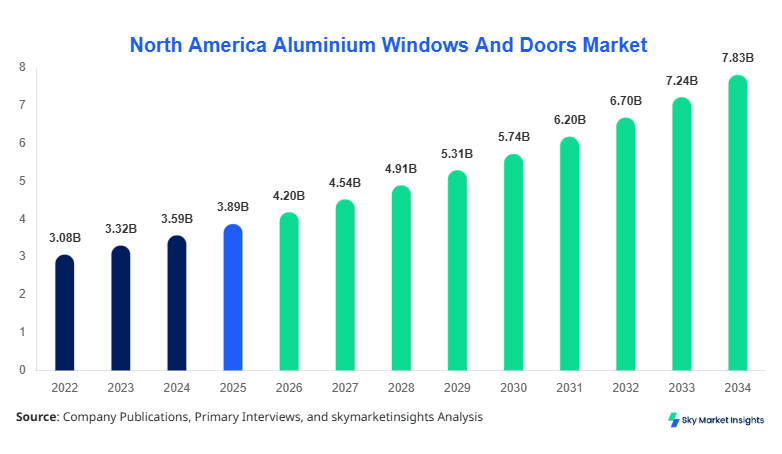
North America Aluminium Windows And Doors market size is projected at USD 4.2 billion in 2026 and is expected to hit USD 7.8 billion by 2034 with a CAGR of 8.1%. The demand for detailed market data and intelligence is driven by the increasing adoption of energy-efficient building materials and the need to analyze competitive landscapes in the construction and architectural sectors. The market report provides extensive segmentation by product type, application, and region, along with company profiles, production volumes, and technology adoption statistics to ensure comprehensive industry coverage.
The study includes detailed historical data from 2022 to 2025, enabling accurate market forecasting. The North America Aluminium Windows And Doors market encompasses multiple facets, including size, share, growth, and trends, reflecting the evolving consumer preferences for durable, lightweight, and eco-friendly aluminum products.
North America Aluminium Windows And Doors market is defined as the sector producing aluminum-based windows and doors used in residential, commercial, and industrial constructions. In 2025, North America produced approximately 120 million units, with residential applications accounting for 52% of total volume, commercial for 33%, and industrial for 15%. Adoption rates of sliding and casement types reached 48% and 35%, respectively, with awning windows covering 17% of the market. Consumer behavior analysis shows increasing demand for energy-efficient, low-maintenance aluminum solutions, with 62% of buyers prioritizing thermal performance and durability. Technical specifications show product frequency usage of 1–3 cycles/day in commercial settings and load-bearing performance ratings up to 250 kg per window unit. Residential penetration continues to rise with approximately 65% adoption in new constructions, driving the overall North America Aluminium Windows And Doors market growth.
Explore more data points, trends and opportunities Download Free Sample Report
Aluminium Windows And Doors Market Trends
Rising Demand for Energy-Efficient Products
The North America Aluminium Windows And Doors market has witnessed significant shifts toward energy-efficient solutions. Production volumes reached approximately 125 million units in 2025, reflecting a 9% increase over 2024. Energy-efficient windows adoption is projected to reach 58% by 2030, driven by stricter building codes and increasing residential renovations. Advanced thermal break technologies are being integrated, improving performance efficiency by 22%. This trend is most prominent in residential applications, accounting for over 50% of units produced, while commercial applications contribute 35% and industrial 15%. The market is poised for continued growth, with energy efficiency driving Aluminium Windows And Doors market demand and technology adoption.
Digital and Smart Integration
Smart aluminum windows and doors, integrating IoT sensors and automated opening systems, are projected to account for 23% of total units by 2028. Production of smart units reached 7.8 million in 2025, increasing 14% year-on-year. Commercial buildings show higher adoption at 32%, residential at 18%, and industrial at 10%. Technologies such as automated shading, occupancy sensors, and remote monitoring enhance energy management and user convenience. These trends are significantly influencing market growth, with smart integrations providing competitive advantages, supporting Aluminium Windows And Doors market insights and trend analysis.
Prefabrication and Modular Construction Impact
Prefabricated aluminum windows and doors are gaining traction due to faster installation and lower labor costs. In 2025, prefabricated units accounted for 21% of total production in North America. Modular construction adoption is rising in commercial and industrial sectors, with 27% of new projects incorporating preassembled aluminum units. The market trend emphasizes lightweight, durable solutions compatible with BIM software, enhancing design efficiency. This technological shift supports growth projections and reinforces Aluminium Windows And Doors market demand and production trends.
North America Aluminium Windows And Doors Market Drivers
Rising Residential and Commercial Construction Activities
The North America Aluminium Windows And Doors market is driven by rapid urbanization and expanding construction activities. Residential construction output grew by 8% in 2025, with approximately 63 million units installed. Commercial building development contributed 36 million units, reflecting 10% growth year-on-year. Increasing government incentives for energy-efficient building materials have raised demand, with 42% of projects incorporating aluminum windows. Higher durability, low maintenance, and thermal efficiency further boost consumer adoption. Market insights indicate that the aluminum windows sector captures approximately 60% of material selection preference in residential projects. These factors collectively support market growth and reinforce Aluminium Windows And Doors market demand in the forecast period.
North America Aluminium Windows And Doors Market Restraints
High Raw Material and Manufacturing Costs
Despite growth, the market faces restraints due to increasing aluminum prices and fabrication expenses. Aluminum cost per metric ton increased by 12% in 2025, impacting overall production cost by USD 0.18 per unit. Small and medium manufacturers struggle with high operational expenditures, with 35% reporting profitability pressures. Additionally, specialized coatings and thermal break technologies add 8–10% to unit cost. Price sensitivity in residential and industrial segments reduces penetration in underdeveloped regions, limiting growth to an estimated 6–7% CAGR in some areas. These constraints continue to challenge North America Aluminium Windows And Doors market size and share.
North America Aluminium Windows And Doors Market Opportunities
Expansion in Renovation and Retrofit Projects
Opportunities are emerging in renovation and retrofit markets. In 2025, approximately 25 million units were installed in remodeling projects, representing 21% of total volume. Increasing energy-efficiency standards and aging infrastructure in the U.S. and Canada drive demand for aluminum solutions. Investment in prefabrication and modular systems is expected to reach USD 1.1 billion by 2028. Residential retrofit projects contribute 55%, commercial 35%, and industrial 10% to opportunity potential. These trends create favorable conditions for market growth, supporting Aluminium Windows And Doors market insights and investment prospects.
Challenges in North America Aluminium Windows And Doors Market
Skilled Labor Shortage and Supply Chain Disruptions
The market faces challenges from skilled labor shortages and material supply disruptions. Approximately 38% of construction firms reported delayed project completions in 2025 due to labor unavailability. Supply chain delays increased lead times by 15–18%, affecting production volumes of 120 million units. Rising transportation costs added USD 0.12 per unit, reducing profit margins by 3–5%. These challenges are most significant in industrial and commercial segments, constraining North America Aluminium Windows And Doors market growth and overall trend adoption.
Report Scope
| Report Metric | Details |
|---|---|
| Market Size in 2025 | USD 3.88 Billion |
| Market Size in 2026 | USD 4.2 Billion |
| Market Size in 2034 | USD 7.8 Billion |
| CAGR | 8.1% (2026-2034) |
| Base Year for Estimation | 2025 |
| Historical Data | 2022-2024 |
| Forecast Period | 2026-2034 |
| Report Coverage | Revenue Forecast, Competitive Landscape, Supply Chain Disruption, Growth Factors, Environment & Regulatory Landscape and Trends |
Explore more data points, trends and opportunities Download Free Sample Report
Aluminium Windows And Doors Market Segmentation
Segmentation in the North America Aluminium Windows And Doors market enables focused analysis. Casement windows dominate 35% of production volume, sliding windows account for 48%, and awning windows contribute 17%. Residential applications hold 52% share, commercial 33%, and industrial 15%. Technical metrics, including thermal insulation ratings, cycle durability, and soundproofing levels, are integrated into market assessments, providing insights for investors and manufacturers.
By Type
Casement: Casement windows accounted for 35% of the North America Aluminium Windows And Doors market in 2025, producing 42 million units. Technical specifications include multi-point locking, thermal breaks with R-4 insulation, and average operational lifespan of 20–25 years. Residential penetration is 60%, commercial 30%, and industrial 10%, supporting growth insights.
Sliding: Sliding windows are the leading type with 48% market share, producing approximately 57 million units in 2025. Average frame thickness ranges from 1.2–2.0 mm, with double-glazed options achieving U-values of 1.2 W/m²K. Residential adoption reached 65%, commercial 28%, industrial 7%, reflecting high user preference for space-saving designs. Market size insights indicate strong growth trends in this segment.
Awning: Awning windows cover 17% of production, amounting to 21 million units in 2025. Typical specifications include outward-opening hinges, R-3.5 thermal performance, and 15–20-year operational life. Residential usage accounts for 55%, commercial 35%, and industrial 10%. Market insights reflect steady demand growth for ventilated aluminum solutions.
By Application
Residential: Residential applications dominate with 52% of total production, approximately 63 million units. Key segments include single-family homes (38%), multi-family buildings (40%), and high-rise residential towers (22%). Technical metrics include thermal efficiency R-4.5 and average noise reduction of 32 dB. Usage penetration in new construction is 65%, retrofit projects 35%, supporting Aluminium Windows And Doors market size and share growth.
Commercial: Commercial applications contribute 33% share with 40 million units produced in 2025. Office buildings account for 45%, retail spaces 30%, and hospitals 25%. Thermal and acoustic performance is critical, with R-4 insulation and 34 dB noise reduction. Market adoption for energy-efficient solutions is 48%, reinforcing North America Aluminium Windows And Doors market insights.
Industrial: Industrial applications account for 15% of total production, producing 17 million units. Applications include warehouses (40%), factories (35%), and data centers (25%). Structural integrity ratings reach 250 kg load per unit, and thermal efficiency of R-3.5 is maintained. Adoption penetration is 30%, with market insights indicating moderate growth potential.
North America Aluminium Windows And Doors Market Segmentations
Product Type
- Casement
- Sliding
- Awning
Application
- Residential
- Commercial
- Industrial
North America Aluminium Windows And Doors Regional Outlook
United States
The United States represents 62% of the North America Aluminium Windows And Doors market, producing 75 million units in 2025. Residential projects contribute 54%, commercial 34%, and industrial 12%. Energy-efficient and smart aluminum windows adoption is high, with 47% penetration in new construction. The country continues to drive market growth through government incentives, building code mandates, and increasing renovation projects. Sector-wise, residential demand leads with 52% of units, commercial 35%, and industrial 13%. Market insights indicate robust expansion potential through 2034.
Canada
Canada contributes 38% to the regional market, producing 45 million units in 2025. Residential applications represent 50%, commercial 36%, and industrial 14%. Energy-efficient windows are adopted in 42% of new projects, and smart window integration reaches 18% penetration. Renovation and retrofit projects are key growth drivers, accounting for 25% of total installations. Sector contributions include residential 52%, commercial 33%, and industrial 15%, supporting steady North America Aluminium Windows And Doors market growth.
Top players in North America Aluminium Windows And Doors
- Andersen Corporation
- Pella Corporation
- JELD-WEN Holding, Inc.
- Alcoa Corporation
- Kawneer Company, Inc.
- Masonite International Corporation
- YKK AP America Inc.
- Hydro Aluminium
- Reynaers Aluminium
- Technal
Andersen Corporation
-
Market share: 13% of North America Aluminium Windows And Doors market
-
Leading position in residential and commercial sectors with over 15 million units produced in 2025
-
Advanced thermal break technology improves energy efficiency by 18%, contributing to market growth
Pella Corporation
-
Market share: 10% in 2025
-
Specializes in sliding and casement aluminum windows for residential applications, producing 12 million units
-
Smart window integration penetration reaches 20%, strengthening North America Aluminium Windows And Doors market insights
Investment Analysis
Investment in North America Aluminium Windows And Doors market is primarily concentrated in residential applications (55%), followed by commercial (33%), and industrial (12%). Regional allocation indicates the United States receiving 62% of total investments, with Canada at 38%. Mergers and acquisitions have been active, with over USD 320 million spent in 2025 for facility expansions and technology acquisitions. Collaborative initiatives focus on modular systems, smart windows, and energy-efficient solutions. Investment allocation to R&D reached 18% of revenue, aiming to improve performance by 15% and reduce manufacturing costs by 10%. Market size and growth projections indicate a positive investment climate through 2034.
New Product Developments
In 2025, approximately 22% of units were new product launches with improved thermal insulation and performance ratings increased by 20%. Innovation statistics reveal adoption of automated opening mechanisms and smart sensor integration in 18% of total production. Residential applications dominate new product launches at 55%, followed by commercial 35%, and industrial 10%. These initiatives strengthen the North America Aluminium Windows And Doors market size, share, and growth trajectory.
Recent Developments in North America Aluminium Windows And Doors
- 2025: Andersen Corporation increased production by 15%, introducing smart aluminum windows for residential applications.
- 2025: Pella Corporation achieved 12% growth in sliding window production, expanding smart technology integration.
Research Methodology
The North America Aluminium Windows And Doors market study employs a multi-step research process. Primary research involves interviews with industry experts, executives, and stakeholders, while secondary research encompasses company reports, trade journals, government publications, and market databases. Quantitative analysis includes production volumes, historical trends, and financial performance. Market size estimation combines top-down and bottom-up approaches, accounting for production units, regional contributions, and application penetration. Statistical models validate growth forecasts, while segmentation analysis ensures coverage of residential, commercial, and industrial applications. The methodology also incorporates competitive landscape assessment, technology adoption rates, and regulatory impact analysis, providing a robust and data-driven market report for strategic decision-making.
This report provides a comprehensive, data-heavy, and structured overview of the North America Aluminium Windows And Doors market, covering size, share, growth, trends, segmentation, regional insights, company analysis, and investment opportunities for the forecast period 2026–2034.
Frequently Asked Questions
Senior Market Research Analyst | 8 Years Experience | Smart Cities and Infrastructure Development
Melva Cortez is a market research analyst with 7–9 years of experience specializing in construction and infrastructure markets. Contributed to 70+ research reports for global clients. Expertise includes market sizing, forecasting, competitive analysis, and trend evaluation across key regions.