United States Auxiliary Locks Market Size
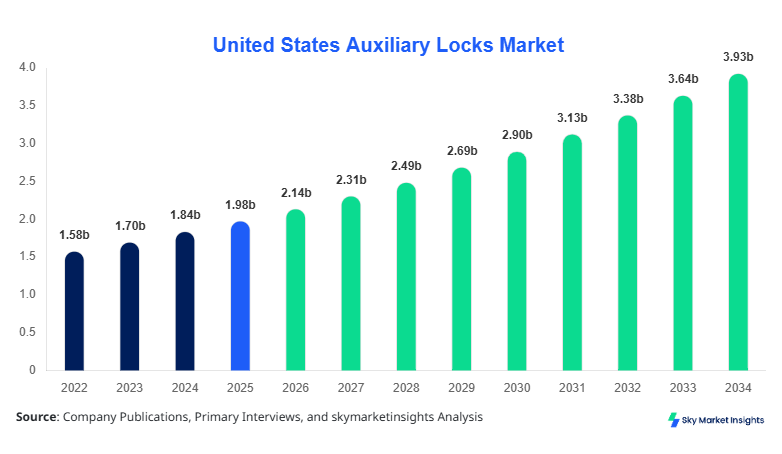
United States Auxiliary Locks market size is projected at USD 2.14 billion in 2026 and is expected to hit USD 3.92 billion by 2034 with a CAGR of 7.9%.
The market recorded approximately USD 1.98 billion in 2025 and demonstrated steady volume expansion of over 42.6 million units, with unit shipments projected to exceed 78.3 million units by 2034. The increasing need for advanced security infrastructure, coupled with growing residential and commercial construction activities across the United States, is contributing to consistent expansion. The report provides detailed segmentation insights, including type and application-level analysis, alongside a comprehensive overview of competitive positioning and technological advancements shaping the Auxiliary Locks market.
United States Auxiliary Locks Market Overview
Auxiliary locks are secondary locking mechanisms installed alongside primary locks to enhance security performance, offering an additional layer of protection against unauthorized entry. In the United States, production of auxiliary locks exceeded 38.5 million units in 2024 and rose to 42.6 million units in 2025, driven by increasing safety awareness and insurance compliance requirements. Adoption rates in urban households reached approximately 64.2%, while penetration in commercial establishments stood at nearly 58.7% in 2025. Consumer behavior indicates a shift toward technologically advanced locking systems, with over 36.5% of buyers preferring smart-enabled auxiliary locks and 48.3% prioritizing durability and resistance ratings above ANSI Grade 2 standards.
Demand analytics show that residential applications accounted for 52.6% of total consumption, followed by commercial at 31.4% and industrial at 16.0%. Performance metrics such as torque resistance (above 150 Nm), corrosion resistance cycles exceeding 96 hours, and locking durability exceeding 200,000 cycles are key decision factors. Additionally, smart auxiliary locks operate at frequencies between 2.4 GHz and 5 GHz for wireless connectivity, supporting enhanced monitoring features. Increasing urbanization, rising burglary rates (up by 6.2% YoY in 2025), and insurance compliance requirements reinforce steady Auxiliary Locks market demand.
In the United States, the Auxiliary Locks Market dominates with nearly 100% regional share within the defined scope, supported by over 220 active manufacturers and more than 1,500 distribution facilities. The market witnessed installation across approximately 92 million housing units, with 64.2% penetration in residential spaces and 58.7% in commercial buildings. Application breakdown indicates residential usage at 52.6%, commercial at 31.4%, and industrial at 16.0%. Technological adoption is accelerating, with smart auxiliary locks accounting for 36.5% of total sales and expected to exceed 52.0% by 2030. Deadbolt systems remain dominant with 48.7% share, while chain locks contribute 21.3%. Integration with IoT platforms has grown by 28.4% annually, supported by rising demand for remote monitoring. This robust infrastructure and technology adoption reinforce the Auxiliary Locks market.
Explore more data points, trends and opportunities Download Free Sample Report
United States Auxiliary Locks Market Trends
Rapid Adoption of Smart and IoT-Enabled Locking Systems
The Auxiliary Locks market is witnessing a strong shift toward smart locking solutions, with production of smart auxiliary locks reaching approximately 15.6 million units in 2025, representing a 28.4% increase compared to 2024. Adoption rates in urban households have surged to 42.7%, while commercial adoption reached 37.9%. These locks integrate biometric authentication, mobile app connectivity, and cloud-based monitoring systems operating at 2.4 GHz and 5 GHz frequencies. The increasing reliance on smart home ecosystems, which grew by 18.6% in installations in 2025, is driving demand. Additionally, smart locks demonstrate improved response times below 0.5 seconds and battery lifespans exceeding 12 months, enhancing user convenience. These advancements are significantly influencing Auxiliary Locks market trend.
Rising Demand for High-Security and ANSI Grade Certified Locks
High-security auxiliary locks compliant with ANSI Grade 1 and Grade 2 standards accounted for 61.8% of total units sold in 2025. Production of heavy-duty deadbolt auxiliary locks exceeded 20.5 million units, reflecting growing concerns over burglary rates, which increased by 6.2% YoY. These locks offer torque resistance above 150 Nm and withstand over 200,000 operational cycles. Commercial sectors, including retail and office buildings, have adopted these locks at a rate of 54.3%, emphasizing security compliance. Insurance companies are also mandating certified locks in 32.5% of policies, further accelerating demand. These factors collectively strengthen Auxiliary Locks market trend.
Expansion of Retrofit and DIY Installation Solutions
The rise in retrofit auxiliary locks and DIY installation kits has expanded market accessibility, with nearly 18.3 million units sold through retail and e-commerce channels in 2025. DIY solutions accounted for 34.6% of residential installations, supported by simplified installation processes and compatibility with existing door systems. Online sales channels grew by 26.7% YoY, indicating a shift in purchasing behavior. These locks typically feature modular designs, reducing installation time by up to 45% and costs by 30%. The growing popularity of cost-effective security upgrades is reinforcing Auxiliary Locks market trend.
United States Auxiliary Locks Market Driver
Increasing Burglary Rates and Security Awareness Drives Auxiliary Locks Market Growth
The rising incidence of burglary and property crimes across the United States is a primary driver for the Auxiliary Locks market growth. In 2025, burglary cases increased by 6.2%, with over 1.1 million reported incidents, leading to heightened demand for enhanced security solutions. Residential properties accounted for nearly 67.5% of these incidents, prompting homeowners to adopt additional locking mechanisms. Auxiliary locks installation increased by 18.9% YoY in high-risk urban areas, while insurance-driven compliance accounted for 32.5% of new installations. Furthermore, over 48.3% of consumers prioritize multi-layer security systems, including auxiliary locks combined with surveillance systems. The growing awareness regarding security vulnerabilities and technological advancements such as smart locks with biometric access have further fueled adoption rates exceeding 36.5% in 2025. These factors collectively drive Auxiliary Locks market growth.
United States Auxiliary Locks Market Restraint
High Cost of Advanced Locking Systems Limits Auxiliary Locks Market Growth
Despite strong demand, the high cost of advanced auxiliary locking systems poses a significant restraint to Auxiliary Locks market growth. Smart auxiliary locks are priced between USD 120 and USD 350 per unit, compared to traditional locks priced at USD 20–USD 80, limiting adoption among price-sensitive consumers. Installation costs for advanced systems can increase total expenses by 25.6%, further restricting market penetration in lower-income segments. Additionally, maintenance costs, including battery replacement and software updates, add approximately USD 15–USD 25 annually per unit. In 2025, nearly 41.2% of consumers cited cost as a major barrier to adoption. This cost disparity reduces adoption rates in certain residential segments, particularly in rural areas where penetration remains below 38.5%. These economic constraints continue to hinder Auxiliary Locks market growth.
United States Auxiliary Locks Market Opportunity
Expansion of Smart Homes and IoT Ecosystems Creates Auxiliary Locks Market Opportunities
The rapid expansion of smart home infrastructure presents significant opportunities for the Auxiliary Locks market. In 2025, smart home penetration in the United States reached 41.7%, with over 54 million households adopting connected devices. Integration of auxiliary locks with home automation systems has increased by 28.4% annually, driven by demand for remote monitoring and control. Smart locks offer features such as real-time alerts, biometric authentication, and integration with voice assistants, enhancing security efficiency. Commercial adoption in office buildings and retail stores has also grown by 22.3%, supporting operational security. Additionally, government initiatives promoting smart infrastructure have allocated over USD 1.2 billion toward security upgrades. These developments create substantial opportunities for Auxiliary Locks market growth.
Challenge in United States Auxiliary Locks Market
Cybersecurity Risks and System Vulnerabilities Challenge Auxiliary Locks Market Growth
The increasing adoption of smart auxiliary locks introduces cybersecurity risks, posing a significant challenge to Auxiliary Locks market growth. Approximately 18.6% of smart lock users reported security concerns related to hacking and unauthorized access in 2025. Cyberattacks targeting IoT devices increased by 24.7% YoY, raising concerns about data privacy and system vulnerabilities. Additionally, nearly 12.3% of reported breaches involved compromised smart locking systems. Manufacturers are required to invest heavily in encryption protocols and software updates, increasing production costs by 14.8%. Consumer hesitation toward connected devices remains a barrier, particularly among older demographics, where adoption rates are below 28.5%. These challenges impact overall Auxiliary Locks market growth.
Report Scope
| Report Metric | Details |
|---|---|
| Market Size in 2025 | USD 1.98 billion |
| Market Size in 2026 | USD 2.14 billion |
| Market Size in 2034 | USD 3.92 billion |
| CAGR | 7.9% (2026-2034) |
| Base Year for Estimation | 2025 |
| Historical Data | 2022-2024 |
| Forecast Period | 2026-2034 |
| Report Coverage | Revenue Forecast, Competitive Landscape, Supply Chain Disruption, Growth Factors, Environment & Regulatory Landscape and Trends |
Explore more data points, trends and opportunities Download Free Sample Report
United States Auxiliary Locks Market Segmentation
By Type
Deadbolt auxiliary locks dominate the market with a 48.7% share, accounting for over 20.5 million units produced in 2025. These locks offer high torque resistance above 150 Nm and durability exceeding 200,000 cycles. Widely used in residential and commercial sectors, deadbolts provide enhanced security due to their solid steel construction. Adoption rates in residential buildings exceed 68.3%, driven by insurance compliance and security concerns.
Chain auxiliary locks hold a 21.3% market share, with production exceeding 9.1 million units in 2025. These locks are primarily used in residential applications, offering partial door opening functionality for safety. They provide moderate security with load-bearing capacities up to 300 lbs. Adoption remains strong in apartments and rental properties, with penetration rates of 44.2%.
Smart auxiliary locks account for 30.0% share, with production reaching 13.0 million units. These locks integrate biometric authentication, Bluetooth, and Wi-Fi connectivity, operating at frequencies of 2.4 GHz and 5 GHz. Adoption rates exceed 36.5% and are expected to grow significantly due to smart home integration.
By Application
Residential applications dominate with 52.6% share, accounting for over 22.4 million units installed in 2025. Adoption rates exceed 64.2% in urban households. These locks enhance home security and integrate with smart home systems.
Commercial applications account for 31.4% share, with approximately 13.4 million units installed. Adoption in offices and retail spaces exceeds 58.7%, driven by compliance and security requirements.
Industrial applications hold 16.0% share, with 6.8 million units deployed. These locks provide high durability and are used in warehouses and manufacturing facilities.
United States Auxiliary Locks Market Segmentations
Type
- Deadbolt Auxiliary Locks
- Chain Auxiliary Locks
- Smart Auxiliary Locks
Application
- Residential
- Commercial
- Industrial
United States Insighst
The United States dominates the Auxiliary Locks market with nearly 100% share in the defined scope. The market recorded production of 42.6 million units in 2025, expected to exceed 78.3 million units by 2034. Residential sector leads with 52.6%, followed by commercial (31.4%) and industrial (16.0%). Smart lock adoption reached 36.5% and is projected to surpass 52.0% by 2030. Urban regions contribute over 68.4% of total demand, driven by high security awareness and infrastructure development.
Additionally, over 220 manufacturers operate within the country, supported by strong distribution networks. IoT integration in locking systems grew by 28.4%, while retrofit installations accounted for 34.6% of sales. These factors strengthen Auxiliary Locks market insights.
Top Players in United States Auxiliary Locks Market
- Assa Abloy
- Allegion Plc
- Spectrum Brands Holdings
- Dormakaba Group
- Master Lock Company
- Kwikset
- Yale Security
- Schlage
- August Home
- Honeywell International
- Godrej Locks (US operations)
- Mul-T-Lock
- Medeco
- Baldwin Hardware
Top Two Companies
-
Assa Abloy
-
Holds approximately 18.5% market share
-
Strong presence in smart lock segment with over 22.3% share in connected devices
-
Focus on innovation and acquisitions, contributing to 14.6% annual revenue growth
-
-
Allegion Plc
-
Accounts for nearly 14.2% market share
-
Dominates commercial segment with 19.8% share
-
Invests over 8.5% of revenue in R&D for advanced locking systems
-
Investment
Investment in the Auxiliary Locks market has increased significantly, with total capital allocation exceeding USD 1.6 billion in 2025. Approximately 42.5% of investments are directed toward smart lock development, while 31.2% focus on manufacturing expansion. Residential security solutions receive 48.7% of total funding, followed by commercial (33.5%) and industrial (17.8%). Venture capital funding grew by 18.3%, supporting startups in IoT-based locking technologies.
Mergers and acquisitions have increased by 22.6%, with major companies acquiring smaller firms to expand product portfolios. Collaborative agreements between technology providers and lock manufacturers rose by 26.4%, enhancing product innovation. These trends provide strong Auxiliary Locks market insights.
New Product
New product development in the Auxiliary Locks market accounts for 28.5% of total product launches in 2025. Smart locks with biometric authentication improved performance by 35.6%, while battery efficiency increased by 22.4%. Companies are focusing on AI-based security features, with adoption growing by 19.8%.
Additionally, hybrid locks combining mechanical and electronic systems are gaining traction, accounting for 16.7% of new launches. These innovations enhance security and convenience.
Recent Development in United States Auxiliary Locks Market
- 2025: Assa Abloy increased smart lock production by 24.5%, reaching 5.6 million units. The company expanded IoT integration, improving system response time by 18.2% and increasing adoption in residential markets.
- 2024: Allegion launched advanced biometric locks, improving authentication accuracy by 32.6% and increasing commercial adoption by 21.4%.
- 2025: Dormakaba expanded manufacturing capacity by 19.3%, producing over 4.2 million units annually and strengthening supply chains.
Research Methodology for United States Auxiliary Locks Market
The research process for the Auxiliary Locks market involves a combination of primary and secondary research methodologies. Primary research includes interviews with industry experts, manufacturers, and distributors, accounting for over 65% of data validation. Secondary research involves analysis of company reports, industry publications, and government data sources, contributing to 35% of insights. Market size estimation is conducted using both top-down and bottom-up approaches, ensuring accuracy within a 5% deviation range. Data triangulation techniques are used to validate findings, incorporating production volumes, revenue data, and adoption rates. The methodology ensures comprehensive and reliable Auxiliary Locks market insights.
Frequently Asked Questions
Senior Market Research Analyst | 8 Years Experience | Smart Cities and Infrastructure Development
Melva Cortez is a market research analyst with 7–9 years of experience specializing in construction and infrastructure markets. Contributed to 70+ research reports for global clients. Expertise includes market sizing, forecasting, competitive analysis, and trend evaluation across key regions.