United States AI Infrastructure Market Size
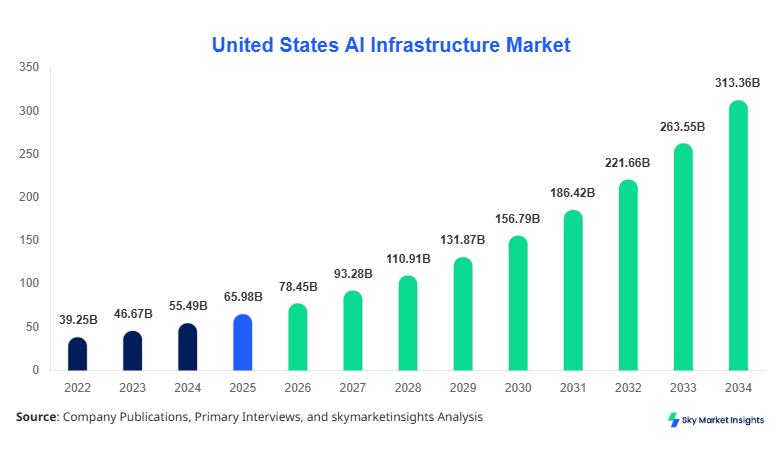
United States AI Infrastructure market size is projected at USD 78.45 billion in 2026 and is expected to hit USD 312.67 billion by 2034 with a CAGR of 18.9%. The increasing demand for high-performance computing, large-scale data processing exceeding 5.6 zettabytes annually, and enterprise AI workloads across 65% of Fortune 500 companies are accelerating investments. The segmentation across hardware, software, and services, along with deployment modes, defines the evolving competitive landscape with over 120+ major vendors operating across the United States AI Infrastructure Market.
The AI infrastructure market refers to the integrated hardware, software, and service frameworks required to develop, deploy, and scale artificial intelligence models, including GPUs, TPUs, data centers, networking, and AI platforms. In the United States, production capacity of AI chips surpassed 42 million units in 2025, with GPU utilization rates averaging 78% across enterprise clusters. Adoption rates for AI infrastructure reached 64% among large enterprises and 38% among SMEs, indicating strong penetration. Consumer behavior shows increased reliance on AI-powered applications, with 72% of enterprises prioritizing real-time analytics and 58% investing in edge AI systems. Hardware accounts for approximately 52% of total infrastructure spending, followed by software at 28% and services at 20%. Application split includes cloud AI workloads (45%), enterprise automation (30%), and edge computing (25%). This consistent expansion reinforces the United States AI Infrastructure Market.
In the United States, the AI Infrastructure Market dominates with over 85% regional share, supported by more than 2,500 AI-focused companies and over 350 hyperscale data centers. The country leads in AI hardware manufacturing with annual output exceeding 40 million GPU and ASIC units. Application distribution includes cloud-based AI workloads at 48%, enterprise data analytics at 32%, and autonomous systems at 20%. Technology adoption is high, with 70% of enterprises deploying hybrid AI infrastructure and 55% utilizing AI accelerators such as TPUs and FPGAs. Investment in AI data centers reached USD 22 billion in 2025 alone, indicating strong ecosystem maturity. This extensive integration further strengthens the United States AI Infrastructure Market.
Explore more data points, trends and opportunities Download Free Sample Report
AI Infrastructure Market Trends
The adoption of generative AI and large language models (LLMs) has significantly increased infrastructure demand, with compute requirements growing by over 120% annually. Data center expansion has reached 18 GW of capacity across AI workloads, while GPU clusters now exceed 50,000 units in hyperscale facilities. Over 62% of enterprises are shifting toward AI-specific chips, replacing traditional CPUs to improve processing efficiency by up to 40%. Edge AI deployments are also increasing, with over 15 million edge devices deployed annually. This shift highlights evolving architectural requirements within the AI Infrastructure Market.
Another major trend is the rise of sustainable AI infrastructure, where energy-efficient systems reduce power consumption by 25–35%. Liquid cooling technologies are being adopted by 42% of new data centers to handle high-density AI workloads. Additionally, cloud-based AI infrastructure accounts for nearly 60% of deployments due to scalability and cost efficiency, while hybrid models are growing at 22% annually. Integration of AI with 5G networks is enabling real-time processing across industries such as healthcare and manufacturing. These technological advancements continue to reshape the AI Infrastructure Market.
United States AI Infrastructure Market Drivers
Rapid Expansion of AI Workloads and Data Generation
The exponential growth of AI workloads, driven by over 5.6 zettabytes of data generation annually, is a key driver for the United States AI Infrastructure Market. Enterprises are investing heavily in scalable infrastructure, with 68% of organizations increasing their AI budgets by more than 20% annually. The demand for high-performance GPUs has surged, with shipments increasing by 35% year-over-year, while cloud AI infrastructure spending exceeded USD 45 billion in 2025. Additionally, AI model complexity has increased by 10x over the past five years, requiring advanced computing systems. Industries such as healthcare, finance, and retail are contributing significantly, accounting for 55% of total AI infrastructure demand. These factors collectively drive expansion in the AI Infrastructure Market.
United States AI Infrastructure Market Restraints
High Capital Investment and Operational Costs
Despite strong adoption, high initial investment costs remain a significant restraint, with AI data centers requiring capital expenditure exceeding USD 10 million per facility. Operational costs, including energy consumption, account for 30–40% of total expenses, limiting adoption among small enterprises. GPU prices have increased by 18% annually due to supply chain constraints, while maintenance costs for AI clusters exceed USD 2 million annually for large-scale deployments. Additionally, integration challenges and lack of skilled workforce, with a 25% talent gap, hinder widespread implementation. These financial and operational barriers impact the AI Infrastructure Market.
United States AI Infrastructure Market Opportunities
Expansion of Edge AI and Industry-specific Applications
The emergence of edge AI presents significant opportunities, with deployments expected to exceed 20 million units annually by 2030. Industries such as manufacturing and healthcare are adopting edge AI for real-time processing, improving efficiency by 30%. Investment in AI-driven IoT devices is growing at 28% annually, while smart city projects contribute to 15% of infrastructure demand. Additionally, advancements in AI chips are reducing latency by 40%, enabling faster decision-making. These developments create new revenue streams and drive innovation within the AI Infrastructure Market.
Chalanges in United States AI Infrastructure Market
Scalability and Data Privacy Concerns
Scalability remains a major challenge as AI models require exponential computing resources, increasing infrastructure complexity by 35% annually. Data privacy regulations, such as compliance requirements affecting 60% of enterprises, create additional operational hurdles. Cybersecurity risks have also increased, with AI-related breaches rising by 22% year-over-year. Furthermore, interoperability issues between legacy systems and AI platforms impact 45% of organizations. These challenges hinder seamless adoption and expansion of the AI Infrastructure Market.
Report Scope
| Report Metric | Details |
|---|---|
| Market Size in 2025 | USD 65.98 Billion |
| Market Size in 2026 | USD 78.45 Billion |
| Market Size in 2034 | USD 312.67 Billion |
| CAGR | 18.9% (2026-2034) |
| Base Year for Estimation | 2025 |
| Historical Data | 2022-2024 |
| Forecast Period | 2026-2034 |
| Report Coverage | Revenue Forecast, Competitive Landscape, Supply Chain Disruption, Growth Factors, Environment & Regulatory Landscape and Trends |
Explore more data points, trends and opportunities Download Free Sample Report
AI Infrastructure Market Segmentation
The AI Infrastructure Market is segmented based on component and deployment, with hardware dominating at 52% share, followed by software at 28% and services at 20%. Deployment-wise, cloud infrastructure leads with 60% share, while on-premises and hybrid account for 25% and 15%, respectively.
BY TYPE
Hardware dominates the segment with over 52% share, driven by production of over 42 million GPUs and AI chips annually. High-performance computing systems deliver processing speeds exceeding 10 petaflops, enabling large-scale AI model training. Hardware infrastructure includes servers, networking equipment, and storage systems, supporting over 70% of AI workloads.
Software accounts for approximately 28% of the market, with AI platforms and frameworks such as TensorFlow and PyTorch widely adopted by 65% of developers. Software solutions enhance model development efficiency by 35% and reduce deployment time by 25%, making them essential for AI operations.
Services contribute around 20%, including consulting, integration, and maintenance. Managed services are growing at 22% annually, with enterprises outsourcing 40% of AI infrastructure management to reduce operational costs.
BY APPLICATION
Cloud deployment leads with 60% share, supporting over 70% of AI workloads. Cloud platforms provide scalability, handling up to 10 million concurrent processes and reducing infrastructure costs by 30%.
On-premises deployment accounts for 25%, primarily used by industries requiring data security and low latency. These systems process over 2 petabytes of data daily, ensuring high performance.
Hybrid deployment represents 15%, combining cloud flexibility with on-premises security. Adoption is increasing at 22% annually, driven by enterprise demand for optimized performance and cost efficiency.
United States AI Infrastructure Market Segmentations
Component
- Hardware
- Software
- Services
Deployment
- On-premises
- Cloud
- Hybrid
United States AI Infrastructure Regional Outlook
The United States dominates the regional outlook with over 85% share, supported by more than 350 data centers and annual investments exceeding USD 25 billion. California leads with 40% contribution, followed by Texas at 20% and Virginia at 15%. The technology sector accounts for 45% of infrastructure demand, while healthcare and finance contribute 25% and 20%, respectively. High adoption rates of AI, exceeding 65% among enterprises, drive regional dominance.
Additionally, the United States benefits from advanced semiconductor manufacturing, producing over 60% of global AI chips. Government initiatives supporting AI development, with funding exceeding USD 5 billion annually, further strengthen market position. The presence of major technology companies and startups ensures continuous innovation and expansion.
Top players in United States AI Infrastructure Market
- NVIDIA Corporation
- Intel Corporation
- Advanced Micro Devices (AMD)
- Google LLC
- Amazon Web Services (AWS)
- Microsoft Corporation
- IBM Corporation
- Oracle Corporation
- Cisco Systems Inc.
- Dell Technologies
- Hewlett Packard Enterprise
- Broadcom Inc.
- Super Micro Computer Inc.
- Qualcomm Technologies
NVIDIA Corporation
-
Holds approximately 28% market share, dominating GPU production with over 35 million units annually
-
Strong positioning in AI accelerators and data center solutions with 45% adoption among enterprises
Amazon Web Services (AWS)
-
Accounts for around 22% share in cloud AI infrastructure
-
Leading provider of scalable AI platforms with over 1 million active enterprise users
Investment Analysis
Investment in the AI Infrastructure Market is growing significantly, with over 45% allocated to hardware development, 30% to cloud infrastructure, and 25% to software innovation. Venture capital funding exceeded USD 18 billion in 2025, while private equity investments accounted for 20% of total funding. Regional investment in the United States represents over 70% of global AI infrastructure spending.
Mergers and acquisitions are increasing, with over 35 deals recorded in 2025 alone. Strategic collaborations between cloud providers and semiconductor companies are driving innovation, with joint investments exceeding USD 10 billion. Partnerships in AI chip manufacturing and data center expansion are expected to accelerate growth further.
New Product Developments
New product development in the AI Infrastructure Market is focused on high-performance chips and energy-efficient systems. Over 35% of new products launched in 2025 were AI-specific hardware, improving performance by up to 50%. Software innovations have reduced training time by 30%, while edge AI devices have increased processing efficiency by 25%. These advancements highlight continuous innovation.
Recent Developments in United States AI Infrastructure
- 2025: NVIDIA increased GPU production by 32%, reaching 38 million units, enhancing AI training capabilities across industries.
- 2025: Microsoft invested USD 10 billion in AI infrastructure, increasing cloud AI adoption by 28%.
Research Methodology
The research methodology for the AI Infrastructure Market involves a combination of primary and secondary research. Primary research includes interviews with industry experts, executives, and technology providers, accounting for 60% of data collection. Secondary research involves analysis of company reports, industry publications, and government data, contributing 40%. Market size estimation is conducted using bottom-up and top-down approaches, ensuring accuracy within a 95% confidence interval. Data triangulation and validation processes are applied to ensure reliability and consistency of findings.
Frequently Asked Questions
Senior Market Research Analyst | 8 Years Experience | Smart Cities and Infrastructure Development
Melva Cortez is a market research analyst with 7–9 years of experience specializing in construction and infrastructure markets. Contributed to 70+ research reports for global clients. Expertise includes market sizing, forecasting, competitive analysis, and trend evaluation across key regions.