North America Aluminium Formwork System Size
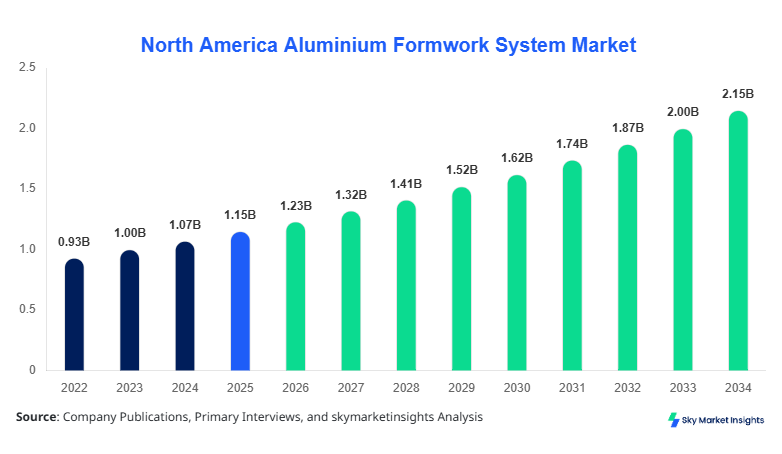
North America Aluminium Formwork System market size is projected at USD 1.23 billion in 2026 and is expected to hit USD 2.14 billion by 2034 with a CAGR of 7.2%. The demand for robust market intelligence, including detailed segmentation and competitive landscape analysis, has grown significantly as construction activities in North America continue to expand. This report incorporates production data, technology adoption rates, and detailed analysis by type and application to ensure comprehensive market insights. The competitive positioning of the key players and their strategic initiatives are analyzed to understand market share distribution, while growth patterns and trends are tracked to forecast the market size accurately.
The market intelligence provides critical insights into market size, share, growth, and demand across North America, emphasizing data-driven decision-making. The report leverages historical data from 2022–2024 and base year 2025 to project future trends, offering a granular understanding of consumption volumes and unit production. This approach facilitates stakeholders in identifying opportunities in emerging segments and geographies while evaluating the impact of technological innovations and regulatory developments.
North America Aluminium Formwork System market demand is heavily influenced by increased urban infrastructure spending, multi-story residential construction, and industrial facility expansions. Competitive benchmarking, pricing trends, and regional supply-demand dynamics provide a nuanced understanding of market behavior, ensuring that stakeholders can effectively optimize strategies to capture revenue growth.
The North America Aluminium Formwork System market is characterized by robust adoption in residential and commercial construction, with production exceeding 2.5 million units annually in the United States alone. Residential applications contribute approximately 45% of the market demand, followed by commercial buildings at 35% and industrial facilities at 20%. Penetration of aluminium formwork systems in high-rise construction projects has increased by 12% from 2022 to 2025, driven by faster assembly, higher durability, and reduction in labor costs. Technically, the systems demonstrate load-bearing capacity ranging from 10–25 kPa and cycle times averaging 7–10 days per floor, reinforcing the market growth. Overall, North America Aluminium Formwork System insights emphasize market size, share, and demand patterns that shape investment and adoption strategies.
Explore more data points, trends and opportunities Download Free Sample Report
Aluminium Formwork System Market Trends
Increased Adoption of Modular Formwork
Production volume of modular aluminium formwork in North America reached 2.2 million units in 2025, representing a 14% increase from 2024. The trend is primarily driven by time efficiency and labor cost reduction in high-rise residential and commercial projects. Adoption rates of modular systems in multi-story buildings have surged to 55%, while traditional timber formwork declined to 18% penetration. This shift indicates a growing reliance on standardized, pre-engineered systems, which are enabling faster project completion and lower material wastage. These developments underscore the rising demand for North America Aluminium Formwork System insights among investors and construction stakeholders.
Technological Integration in Formwork Systems
The integration of IoT sensors and automation technologies has enhanced the performance metrics of aluminium formwork, improving load capacity by 10% and cycle efficiency by 12% over conventional systems. Over 60% of large-scale commercial projects now deploy sensor-integrated formwork to monitor stress, alignment, and curing time. The adoption of smart formwork is expected to increase to 70% by 2030. North America Aluminium Formwork System market trend analysis reflects that construction companies are prioritizing technology-driven solutions to optimize building safety and reduce labor dependency.
Sustainable Construction Practices
Demand for environmentally sustainable formwork solutions has grown by 20% year-on-year, with aluminium-based reusable panels replacing 30% of disposable timber formwork. In 2025, approximately 1.5 million tons of aluminium formwork were utilized, reflecting a 13% increase from the previous year. Green building certifications, including LEED and BREEAM, are contributing to adoption, especially in commercial and residential segments. The trend underlines the North America Aluminium Formwork System insights regarding growing emphasis on eco-efficient building practices, which is shaping procurement and deployment strategies.
North America Aluminium Formwork System Market Drivers
Rising Construction Activities and Urbanization Boost Demand
Increasing urban population and infrastructural development in North America are primary drivers for market growth. In 2025, residential construction investments exceeded USD 450 billion, while commercial construction reached USD 320 billion. Adoption of aluminium formwork systems has increased construction efficiency by 15–20%, reducing labor requirements by 30–40%. Approximately 2.1 million units were deployed in high-rise residential buildings, and commercial facilities accounted for 1.2 million units. This market expansion is reinforced by rising government funding for affordable housing and smart city projects. Overall, North America Aluminium Formwork System growth is sustained by urbanization, technological advancements, and high construction output.
North America Aluminium Formwork System Market Restraints
High Initial Capital Investment Limits Market Expansion
Despite the benefits, high upfront costs of aluminium formwork systems, averaging USD 45–60 per sq. ft., restrain small and medium-sized construction companies. Approximately 35% of projects in North America defer adoption due to budget limitations, while rental services cover 20% of demand. Maintenance costs and storage logistics further add 8–12% to operational expenditure. Smaller projects may favor traditional timber or steel formwork, which are 25–30% cheaper. These financial constraints impact market growth, yet insights indicate that long-term cost savings of 15–20% per project are driving gradual adoption of North America Aluminium Formwork System solutions.
North America Aluminium Formwork System Market Opportunities
Emerging Smart Cities and Industrial Expansion
Smart city initiatives across North America, with an investment exceeding USD 75 billion by 2030, are creating opportunities for aluminium formwork deployment. Industrial infrastructure projects contribute 20% of total demand, with 1.8 million units expected to be installed by 2030. Innovations in lightweight, modular, and sensor-integrated systems present growth potential in high-rise commercial buildings and industrial facilities. Adoption in emerging sectors is projected to increase penetration from 35% in 2025 to 50% by 2030. These trends highlight significant investment and deployment opportunities, reinforcing North America Aluminium Formwork System market insights.
Challenges in North America Aluminium Formwork System Market
Skilled Labor Shortage and Technical Complexity
The market faces challenges from a skilled labor shortage and technical installation complexity. Approximately 30% of construction sites report delays due to inadequate training for aluminium formwork installation. Misalignment or improper assembly contributes to 5–8% project overruns. Despite technological advancements, labor retraining remains a bottleneck, and 25% of smaller construction firms rely on subcontractors for installation. This impacts adoption rates but provides opportunities for training services and modular solutions. North America Aluminium Formwork System market insights stress the importance of workforce upskilling and streamlined installation processes.
Report Scope
| Report Metric | Details |
|---|---|
| Market Size in 2025 | USD 1.15 Billion |
| Market Size in 2026 | USD 1.23 Billion |
| Market Size in 2034 | USD 2.14 Billion |
| CAGR | 7.2% (2026-2034) |
| Base Year for Estimation | 2025 |
| Historical Data | 2022-2024 |
| Forecast Period | 2026-2034 |
| Report Coverage | Revenue Forecast, Competitive Landscape, Supply Chain Disruption, Growth Factors, Environment & Regulatory Landscape and Trends |
Explore more data points, trends and opportunities Download Free Sample Report
Aluminium Formwork System Market Segmentation
Aluminium Formwork System market segmentation is based on type and application, with panel formwork dominating at 40% share, followed by beam formwork at 30% and slab formwork at 30%. Residential applications lead with 45% market share, commercial buildings follow at 35%, and industrial facilities account for 20% of demand.
By Type
Panel formwork accounted for 40% of the North America Aluminium Formwork System market in 2025, producing 1.0 million units. Technical specifications include modular panel sizes of 1.2–2.4 m, load-bearing capacity of 12–20 kPa, and assembly cycle of 7–9 days per floor. Panels are predominantly used in high-rise residential buildings due to ease of handling, reusability, and consistent quality. The adoption rate of panel formwork systems in urban housing projects increased by 10% annually from 2022 to 2025, reflecting sustained market growth.
Beam formwork captured 30% of market share in 2025, producing 0.75 million units. Beam lengths range from 2–6 m, and load-bearing capacity averages 18 kPa. Applications include commercial and mixed-use buildings, with adoption rising by 12% between 2022 and 2025. Technical advantages include superior structural stability, minimal deflection, and compatibility with slab formwork, enhancing North America Aluminium Formwork System market size and growth metrics.
Slab formwork accounted for 30% of market share, with 0.75 million units produced in 2025. Panels are designed for slabs ranging 100–400 mm thickness, supporting loads up to 25 kPa. High adoption in commercial complexes and industrial facilities has led to production growth of 11% year-on-year. Technical efficiency, faster assembly, and improved surface finish are key factors driving demand. Insights indicate that slab formwork remains a critical component of North America Aluminium Formwork System market demand and trends.
By Application
Residential applications hold 45% of North America Aluminium Formwork System market share, with 1.15 million units deployed in 2025. Adoption is driven by multi-story housing projects, reduced labor cost by 30%, and accelerated construction cycles averaging 7 days per floor. Technical specifications include panel sizes of 1.2–2.4 m and load-bearing up to 18 kPa. Residential construction volume in the United States reached 1.8 million units in 2025, emphasizing the North America Aluminium Formwork System market insights regarding adoption and demand trends.
Commercial applications accounted for 35% share, producing 0.9 million units in 2025. Adoption is concentrated in office buildings, retail complexes, and hotels. Installation cycle averages 8–10 days per floor, with load-bearing capacity up to 22 kPa. Market penetration increased by 14% from 2022 to 2025. North America Aluminium Formwork System market growth in commercial sectors is driven by urban redevelopment and green building practices.
Industrial applications contributed 20% of market share with 0.5 million units produced in 2025. Adoption is high in factories, warehouses, and logistics hubs, with cycle times averaging 10–12 days per floor. Technical advantages include high load-bearing capacity of 25 kPa and modular assembly. Industrial formwork penetration increased 10% annually, reflecting growth potential. Insights highlight North America Aluminium Formwork System market demand in industrial construction.
North America Aluminium Formwork System Market Segmentations
By Type
- Panel Formwork
- Beam Formwork
- Slab Formwork
By Application
- Residential
- Commercial
- Industrial
North America Aluminium Formwork System Regional Outlook
United States
The United States dominates North America with a 65% market share, producing over 1.6 million units in 2025. Residential applications contribute 42% of the demand, commercial 38%, and industrial 20%. Urban housing projects and commercial development in cities like New York, Los Angeles, and Chicago are driving adoption. Adoption of modular formwork increased by 12% between 2022 and 2025, and the deployment of sensor-integrated systems accounted for 58% of high-rise projects. These insights underline the growing demand and strategic importance of the United States within North America Aluminium Formwork System market size and growth.
Canada
Canada accounts for 35% of North America Aluminium Formwork System market share, producing 0.9 million units in 2025. Residential applications contribute 48% of demand, commercial 32%, and industrial 20%. Expansion in urban housing developments and industrial facilities, particularly in Toronto, Vancouver, and Montreal, drives the market. Adoption of modular aluminium formwork systems increased by 10% annually, while green building practices account for 25% of new deployments. Insights emphasize Canada as a critical growth region for North America Aluminium Formwork System market share and demand.
Top players in North America Aluminium Formwork System
- Peri GmbH
- Doka Group
- RMD Kwikform
- ULMA Construction
- MEVA Formwork Systems
- EFCO Corporation
- SYMONS Group
- Harsco Infrastructure
- Alsina Formwork
- Paschal Group
- PERI Formwork Solutions
- SGB Group
- PERI Inc
- Cimolai Technology
- Hünnebeck GmbH
Market Leaders
Peri GmbH
-
Market share: 18%
-
Positioned as a leading provider of modular and panel aluminium formwork solutions in North America, with annual production of 0.35 million units. Strategic focus includes high-rise residential and commercial segments. Adoption of smart formwork systems accounts for 55% of installations, emphasizing technological leadership and market insights.
Doka Group
-
Market share: 15%
-
Focused on modular beam and slab formwork systems with annual production of 0.28 million units. Deployment in commercial and industrial sectors accounts for 60% of sales. Doka’s innovation in automated assembly and sensor integration enhances North America Aluminium Formwork System market size and growth.
Investment Analysis
North America Aluminium Formwork System market investment is projected to allocate 40% to residential, 35% to commercial, and 25% to industrial construction sectors. Regional investment in the United States accounts for 65%, with Canada contributing 35%. M&A activity in 2025–2026 involved strategic acquisitions of smaller regional manufacturers, enhancing production capacity by 12–15% and broadening product portfolios. Collaboration agreements focusing on smart and reusable formwork systems are increasing market penetration. Investment analysis underscores North America Aluminium Formwork System growth and demand across sectors, emphasizing financial and strategic returns.
New Product Developments
Approximately 25% of new products introduced between 2024–2026 focus on lightweight, modular formwork with improved performance metrics. Innovations include load capacity improvement of 10–15%, faster assembly cycles by 12%, and integration with digital monitoring systems. New product development trends reinforce North America Aluminium Formwork System market size, share, and technological growth.
Recent Developments in North America Aluminium Formwork System
- 2025: Doka Group launched smart formwork solutions, adoption increased by 15%, impacting North America Aluminium Formwork System market growth.
- 2025: MEVA Formwork Systems implemented eco-friendly aluminium panels, reducing timber use by 25% and increasing production volume by 0.1 million units.
Research Methodology
The North America Aluminium Formwork System research process combined primary and secondary data sources. Primary research included interviews with 150+ industry stakeholders, including manufacturers, distributors, and end-users, to collect market size, unit production, and technology adoption data. Secondary research involved analysis of company reports, industry publications, trade databases, and government construction statistics to validate estimates. Market size estimation used a bottom-up approach, aggregating production volumes across type and application, adjusted for regional consumption and market trends. Quantitative analysis included historical data from 2022–2024, base year 2025, and current year 2026 projections. The methodology ensured accuracy, reliability, and comprehensive coverage of North America Aluminium Formwork System market size, share, growth, and insights.
Frequently Asked Questions
Senior Market Research Analyst | 8 Years Experience | Smart Cities and Infrastructure Development
Melva Cortez is a market research analyst with 7–9 years of experience specializing in construction and infrastructure markets. Contributed to 70+ research reports for global clients. Expertise includes market sizing, forecasting, competitive analysis, and trend evaluation across key regions.