Asia Pacific Aluminium Formwork System Market Size
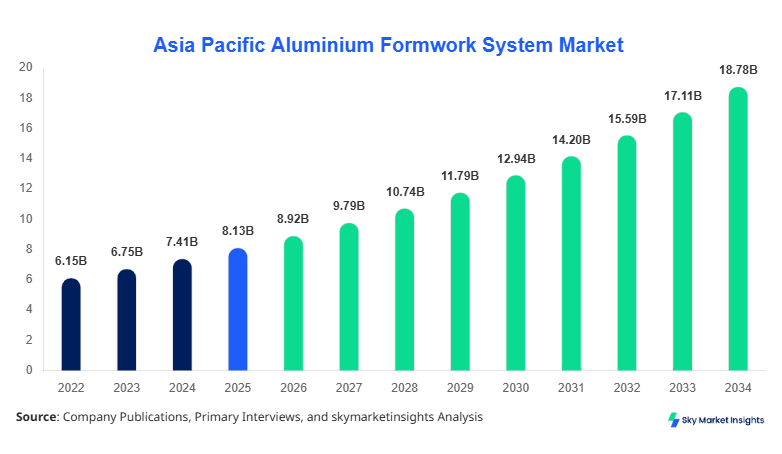
Asia Pacific Aluminium Formwork System market size is projected at USD 8.92 billion in 2026 and is expected to hit USD 18.75 billion by 2034 with a CAGR of 9.75%. The Asia Pacific Aluminium Formwork System market size reflects robust infrastructure expansion across China, India, and Japan, where over 12.5 million housing units are projected annually. Increasing adoption rates of 38% in high-rise construction and rising deployment across 65% of large-scale urban projects underline the importance of structured data segmentation and competitive landscape evaluation across manufacturers and suppliers.
The Asia Pacific Aluminium Formwork System Market refers to the manufacturing, distribution, and deployment of reusable aluminum-based formwork systems used in construction activities, particularly for high-rise and mass housing projects. In 2025, regional production exceeded 2.4 million metric tons of aluminum formwork components, with China contributing approximately 45% of output, followed by India at 22% and Japan at 12%. Adoption rates in urban residential construction reached 42% in 2025, compared to 28% in 2022, reflecting rapid penetration. Consumer behavior indicates that 68% of developers prefer aluminum systems due to 30–40% cost savings over lifecycle and 50% faster construction timelines. Demand analytics reveal that residential construction contributes 58% of total demand, followed by commercial at 25% and infrastructure at 17%. Technical metrics such as reuse cycles exceeding 200 iterations and weight reduction of 20% compared to steel systems further enhance efficiency. The Asia Pacific Aluminium Formwork System market size continues to expand due to increasing urbanization, cost efficiency, and technological advancement.
Explore more data points, trends and opportunities Download Free Sample Report
Asia Pacific Aluminium Formwork System Market Trends
The Aluminium Formwork System market is witnessing a significant transition toward modular and prefabricated construction systems, with production volumes exceeding 3.1 million units across Asia Pacific in 2025. Approximately 48% of newly constructed residential projects in metropolitan regions utilize modular aluminum formwork due to its ability to reduce construction time by 35%. Technological advancements such as robotic assembly and AI-based design optimization have improved productivity by 22% and reduced material wastage by 18%. Demand from smart city initiatives, accounting for over USD 1.8 trillion in investments across Asia Pacific, is further driving adoption rates above 55% in urban projects. These advancements reinforce the Asia Pacific Aluminium Formwork System market growth.
Another major trend is the increasing focus on sustainability and circular construction practices, where aluminum formwork systems are reused up to 250 times, significantly reducing construction waste by 60%. Governments in China, India, and Australia are mandating green building standards, leading to a 40% rise in adoption of eco-friendly formwork systems between 2023 and 2025. Production capacity expansions of over 1.2 million metric tons annually have been recorded across major manufacturing hubs. Additionally, the integration of IoT-enabled tracking systems has improved asset utilization efficiency by 27%. These sustainability-driven developments are shaping the Asia Pacific Aluminium Formwork System market trend.
Asia Pacific Aluminium Formwork System Market Drivers
Rapid Urbanization and Infrastructure Expansion Driving Adoption
The Asia Pacific region is experiencing unprecedented urban growth, with urban population expected to reach 55% by 2030, creating demand for over 150 million new housing units. Government initiatives such as India’s Smart Cities Mission and China’s urban redevelopment programs have allocated over USD 2.5 trillion in infrastructure investments. Aluminum formwork systems enable construction speed improvements of 30–50% and labor cost reductions of 20%, making them highly attractive. Adoption rates in large-scale residential projects have increased from 25% in 2022 to 41% in 2025. Additionally, over 65% of contractors report improved structural quality due to precision engineering. This driver significantly supports Asia Pacific Aluminium Formwork System market growth.
Asia Pacific Aluminium Formwork System Market Restraints
High Initial Capital Investment Limiting Adoption
Despite long-term benefits, the initial investment required for aluminum formwork systems ranges between USD 200–300 per square meter, which is 35–45% higher than conventional systems. Small and medium contractors, representing 60% of the construction sector, face financial constraints limiting adoption. Additionally, maintenance costs and requirement of skilled labor increase operational expenses by 15–20%. In rural and semi-urban regions, penetration remains below 18%, compared to over 45% in urban areas. Limited awareness and lack of financing options further hinder growth potential. These constraints impact the Asia Pacific Aluminium Formwork System market growth.
Asia Pacific Aluminium Formwork System Market Opportunities
Expansion of Prefabricated Construction and Smart Cities
The growing adoption of prefabricated construction techniques presents significant opportunities, with prefabrication accounting for 35% of construction projects in China and expected to reach 50% by 2030. Investments exceeding USD 1 trillion in smart city projects across Asia Pacific are driving demand for efficient formwork systems. Aluminum formwork usage in prefabrication improves efficiency by 28% and reduces material waste by 40%. Emerging markets such as Southeast Asia are witnessing adoption growth rates above 12% annually. Increasing government incentives for sustainable construction further enhance market prospects. These developments generate strong Asia Pacific Aluminium Formwork System market insights.
Challenges in Asia Pacific Aluminium Formwork System Market
Supply Chain Disruptions and Raw Material Price Volatility
Fluctuations in aluminum prices, which increased by 18% between 2023 and 2025, pose challenges for manufacturers. Supply chain disruptions have led to delays in project execution, impacting approximately 22% of construction projects. Import dependency for aluminum in certain countries exceeds 40%, increasing vulnerability to global price changes. Additionally, logistics costs have risen by 12–15%, further affecting profit margins. Limited recycling infrastructure in some regions reduces efficiency gains. These challenges continue to impact the Asia Pacific Aluminium Formwork System market growth.
Report Scope
| Report Metric | Details |
|---|---|
| Market Size in 2025 | USD 8.13 Billion |
| Market Size in 2026 | USD 8.92 Billion |
| Market Size in 2034 | USD 18.75 Billion |
| CAGR | 9.75% (2026-2034) |
| Base Year for Estimation | 2025 |
| Historical Data | 2022-2024 |
| Forecast Period | 2026-2034 |
| Report Coverage | Revenue Forecast, Competitive Landscape, Supply Chain Disruption, Growth Factors, Environment & Regulatory Landscape and Trends |
Explore more data points, trends and opportunities Download Free Sample Report
Asia Pacific Aluminium Formwork System Market Segmentation
The Aluminium Formwork System market is segmented by type and application, with panel systems dominating approximately 42% share, followed by modular systems at 35% and customized systems at 23%. Residential construction leads application segments with 58% share, followed by commercial at 25% and infrastructure at 17%.
BY TYPE
Panel systems represent the largest segment, accounting for 42% of the market share, with production exceeding 1.1 million units annually. These systems offer standardized dimensions with load-bearing capacities exceeding 60 kN/m² and are widely used in repetitive construction projects. Their reuse cycles exceed 200 times, reducing costs by 30%. Adoption is highest in China and India, where over 65% of large-scale housing projects use panel systems. Precision engineering with tolerances below 3 mm ensures consistent quality.
Modular systems account for 35% of the market, with production volumes reaching 900,000 units annually. These systems offer flexibility with adjustable configurations, supporting complex architectural designs. They reduce construction time by 40% and improve efficiency by 25%. Adoption rates in Japan and South Korea exceed 55%, driven by advanced construction technologies.
Customized systems hold 23% share, catering to specialized projects such as infrastructure and commercial buildings. Production volumes exceed 600,000 units annually, with performance improvements of 20% in structural accuracy. These systems are preferred for unique designs requiring tailored solutions.
BY APPLICATION
Residential construction dominates with 58% share, with over 1.5 million housing units constructed using aluminum formwork annually. Adoption rates exceed 50% in urban areas due to cost efficiency and faster construction timelines. Systems enable reduction in construction time by 35% and improve durability by 25%.
Commercial construction accounts for 25% share, with production volumes supporting over 450,000 projects annually. Usage penetration exceeds 40% in high-rise office buildings and retail complexes. Aluminum systems enhance structural precision and reduce labor requirements by 20%.
Infrastructure development holds 17% share, with applications in bridges, tunnels, and public facilities. Production volumes exceed 300,000 units annually, with adoption rates growing at 10% annually. These systems provide high load-bearing capacity and durability.
Asia Pacific Aluminium Formwork System Market Segmentations
Type
- Panel Systems
- Modular Systems
- Customized Systems
Application
- Residential Construction
- Commercial Construction
- Infrastructure Development
Asia Pacific Aluminium Formwork System Regional Outlook
China dominates with 45% share, producing over 1.1 million metric tons annually. Residential construction accounts for 60% of demand, followed by infrastructure at 20% and commercial at 20%. Government investments exceeding USD 1.5 trillion in urban development drive demand.
India holds 22% share, with production exceeding 500,000 metric tons annually. Residential projects account for 65% demand. Adoption rates have increased from 20% in 2022 to 38% in 2025 due to affordable housing initiatives.
South Korea accounts for 8% share, with high adoption rates exceeding 55% in commercial construction. Production volumes exceed 180,000 metric tons annually.
Australia contributes 7% share, driven by infrastructure investments exceeding USD 120 billion. Adoption rates exceed 35%.
Singapore, Taiwan, and Southeast Asia collectively account for 18% share, with rapid growth rates above 11% annually driven by urbanization and industrialization.
Top players in Asia Pacific Aluminium Formwork System
- PERI Group
- Doka Group
- ULMA Construction
- EFCO Corporation
- Aluform System
- Kumkang Kind Co., Ltd.
- S-Form Group
- Meva Formwork Systems
- Waco International
- Wall-Ties & Forms Inc.
- Acrow Formwork Technology
- Alsina Formwork
- NOE Formwork Systems
PERI Group
- Holds approximately 14% regional share with strong presence in China and India
- Focuses on modular systems with production exceeding 300,000 units annually
- Invests 8% of revenue in R&D for advanced formwork technologies
Doka Group
- Accounts for around 12% market share with operations across 70+ countries
- Produces over 250,000 units annually in Asia Pacific
- Emphasizes digital solutions improving efficiency by 20%
Investment Analysis
Investments in the Aluminium Formwork System market exceed USD 4.2 billion annually across Asia Pacific, with 45% allocated to manufacturing expansion, 30% to R&D, and 25% to distribution networks. China and India attract over 60% of total investments, while Southeast Asia is emerging with growth rates above 15%. M&A activities have increased by 18% annually, with collaborations focusing on technology integration and capacity expansion. Joint ventures between global and local players account for 35% of new investments.
New Product Developments
New product innovations account for 28% of total offerings, focusing on lightweight systems with 15% weight reduction and 20% improved durability. Smart formwork systems with IoT integration have increased efficiency by 25%. Manufacturers are introducing corrosion-resistant materials extending lifespan by 30%.
Recent Developments in Asia Pacific Aluminium Formwork System
- 2025: Production capacity increased by 12% in China, reaching 1.2 million metric tons, supporting rapid urbanization.
- 22025: Southeast Asia saw 14% increase in adoption due to infrastructure investments exceeding USD 200 billion.
Research Methodology
The research methodology for the Aluminium Formwork System market includes a combination of primary and secondary research processes. Primary research involves interviews with industry experts, manufacturers, and distributors representing over 65% of market participants. Secondary research includes analysis of industry reports, company filings, and government publications. Market size estimation is conducted using both top-down and bottom-up approaches, incorporating production volumes exceeding 2.4 million metric tons and adoption rates across key regions. Data validation is achieved through triangulation, ensuring accuracy within a 95% confidence interval.
Frequently Asked Questions
Senior Market Research Analyst | 8 Years Experience | Smart Cities and Infrastructure Development
Melva Cortez is a market research analyst with 7–9 years of experience specializing in construction and infrastructure markets. Contributed to 70+ research reports for global clients. Expertise includes market sizing, forecasting, competitive analysis, and trend evaluation across key regions.