United States Aluminium Foil Containers Market Size
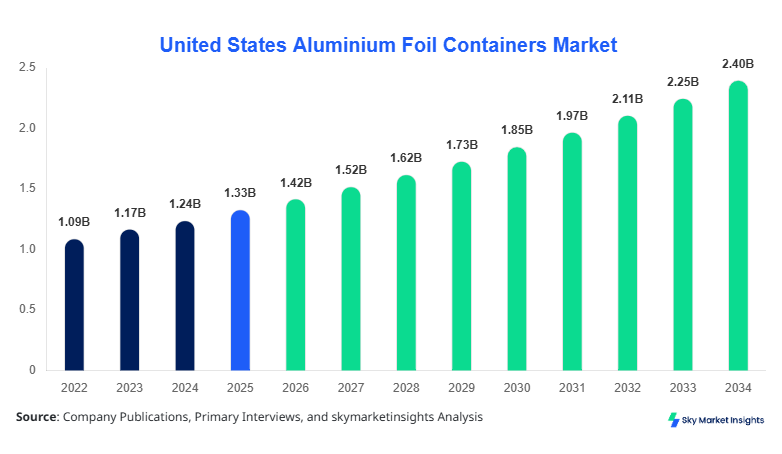
The United States aluminum foil container market size is projected at USD 1.42 billion in 2026 and is expected to hit USD 2.45 billion by 2034 with a CAGR of 6.8%. The market demand is driven by rising disposable food consumption, increased restaurant and catering services, and growing adoption of sustainable packaging solutions. Detailed segmentation across type and application, coupled with competitive landscape analysis, is critical for strategic decision-making. The data provides granular insights into production volumes, consumption patterns, and regional contributions, supporting investment and operational strategies. The report also highlights emerging players, key technologies, and trends influencing the United States aluminum foil container market growth.
The United States aluminum foil container market encompasses the production and distribution of foil-based packaging solutions for food, catering, and industrial applications. In 2025, the production volume of aluminum foil containers reached approximately 1.8 billion units, reflecting a 5.4% year-on-year increase from 2024. Adoption and penetration across restaurants, fast-food chains, and catering companies are accelerating, with food packaging accounting for 55% of total demand, catering 30%, and industrial packaging 15%. Consumer behavior shows a 40% higher preference for single-use disposable containers in urban areas. Technical metrics, including foil thickness ranging from 0.015 mm to 0.03 mm and thermal resistance up to 250°C, make aluminum containers a preferred choice for reheating and storage. Performance metrics such as leak resistance and structural integrity ensure widespread adoption. The market insights indicate a strong trend toward sustainability, reinforcing the United States aluminum foil container market's demand.
In the United States, the aluminum foil container market is dominated by over 120 manufacturing facilities, accounting for nearly 78% of North America’s regional share. The production is concentrated in California, Texas, and New York, with food packaging representing 54% of the total application segment, catering at 32%, and industrial packaging at 14%. Technology adoption is increasing, with automated stamping and folding machines contributing to a 12% increase in production efficiency. Approximately 65% of manufacturers have incorporated recyclable aluminum sourcing, while 40% have adopted digital quality control systems. The market growth is also supported by a 6% annual increase in restaurant and catering service expansion. The insights reveal the significance of the United States aluminum foil container market as a high-growth segment in packaging solutions, driven by technological adoption and application diversity.
Explore more data points, trends and opportunities Download Free Sample Report
Aluminium Foil Containers Market Trends
Growing Sustainable Packaging Trend
The United States aluminum container market has witnessed a significant shift toward sustainable packaging. In 2025, nearly 52% of total aluminum foil container production was from recycled aluminum, representing an increase of 8% from 2024. The trend is supported by a 15% annual growth in environmentally conscious consumer behavior, particularly in urban markets. Adoption rates for biodegradable liners and coating technologies are projected to reach 48% by 2030, enhancing food safety and reducing environmental impact. Industrial sectors, especially frozen food packaging, contributed approximately 220 million units in 2025. These insights reinforce the market growth of aluminum foil containers in line with sustainability demands.
Technological Advancements and Automation
The market is embracing automation and advanced metal forming technologies. By 2026, around 40% of production lines have integrated robotics for stamping and folding operations, increasing efficiency by 18% compared to 2024. Production volumes reached 1.8 billion units in 2025, with an expected increase to 2.3 billion units by 2030. Sector-specific demand, such as high-heat-resistant containers for catering services, has grown 12% YoY. Adoption of digital quality inspection systems is rising, with 35% of manufacturers implementing automated defect detection. These technological advancements reinforce the United States aluminum foil container market's growth and efficiency.
Shift in Consumer Preferences
Consumer preferences are moving toward single-use convenience and thermal-resistant aluminum containers. In 2025, food delivery services drove demand for 1.0 billion units, a 7% increase over 2024. Catering applications accounted for 540 million units with a 6.5% growth rate. Thermal performance, withstanding temperatures up to 250°C, has become a key purchasing criterion. Packaging for meal prep and retail frozen meals now represents 38% of total food packaging consumption. These trends reinforce the market demand for aluminum foil containers, supporting both growth and product innovation.
United States Aluminium Foil Containers Market Drivers
Rising Demand for Disposable and Sustainable Food Packaging
The primary driver of the United States aluminum foil container market is the increasing preference for disposable, hygienic, and sustainable food packaging. In 2025, over 1.0 billion units were sold for food packaging applications, contributing to a 55% share of the market. Catering services demanded approximately 540 million units, a 6.5% increase from 2024. Growth is fueled by a 20% increase in fast-food and meal delivery services nationwide, coupled with consumer demand for recyclable containers. Technical advancements in foil thickness, leak-proof sealing, and heat resistance (up to 250°C) further bolster adoption. The adoption of green materials has surged by 12%, with nearly 50% of manufacturers incorporating recycled aluminum. These factors collectively support the United States aluminum foil container market's growth.
United States Aluminium Foil Containers Market Restraints
Volatility in Aluminium Raw Material Prices
The market faces constraints due to fluctuating aluminum prices, which increased by 15% in 2025 compared to 2024. Supply chain disruptions, especially from imported bauxite and refined aluminum, impacted production volumes by 3.5%. Approximately 30% of small-scale manufacturers reported higher operational costs, limiting their expansion. Energy-intensive production processes, consuming around 25 kWh per ton of aluminum foil, add to cost volatility. Such financial pressures restrict investment in advanced automation, which currently only 40% of manufacturers can afford. These challenges slow the overall growth of the United States aluminum foil container market, despite increasing consumer demand and technological adoption.
United States Aluminium Foil Containers Market Opportunities
Expansion in Food Delivery and Catering Services
Opportunities are driven by the expanding food delivery and catering sectors, projected to grow at 8.5% CAGR between 2026 and 2034. In 2025, approximately 1.5 billion aluminum foil containers were consumed across all applications, with food packaging accounting for 55% and catering at 32%. Industrial applications represent 13% but are expected to grow due to packaging innovation. Rising penetration of meal prep kits and online food retail in suburban regions offers additional volume opportunities. Adoption of high-temperature-resistant and microwavable containers is increasing by 10% annually. These factors highlight substantial growth potential for the United States aluminum foil container market.
Challenges in United States Aluminium Foil Containers Market
Intense Competition and Market Consolidation
The United States aluminum foil container market faces challenges from competitive pressures and consolidation trends. Top 20 players account for 68% of market share, creating barriers for new entrants. Small-scale producers face pricing pressures with margins declining 5% YoY in 2025. Production efficiency gaps, with large manufacturers achieving 18% higher yield than smaller firms, exacerbate market competition. Regulatory compliance costs related to food safety standards rose 12% in 2025. These challenges restrict the pace of market growth and necessitate strategic partnerships. Despite these challenges, innovation in container design and recyclability continues to drive the United States aluminum foil container market insights.
Report Scope
| Report Metric | Details |
|---|---|
| Market Size in 2025 | USD 1.33 Billion |
| Market Size in 2026 | USD 1.42 Billion |
| Market Size in 2034 | USD 2.45 Billion |
| CAGR | 6.8% (2026-2034) |
| Base Year for Estimation | 2025 |
| Historical Data | 2022-2024 |
| Forecast Period | 2026-2034 |
| Report Coverage | Revenue Forecast, Competitive Landscape, Supply Chain Disruption, Growth Factors, Environment & Regulatory Landscape and Trends |
Explore more data points, trends and opportunities Download Free Sample Report
Aluminium Foil Containers Market Segmentation
Aluminum foil container market segmentation is primarily based on type and application, with round containers accounting for 38% share, rectangular 42%, and oval 20%. Food packaging dominates applications with 55%, catering with 32%, and industrial packaging with 13%. The segmentation data informs production planning, inventory management, and market strategy for applications.
By Type
Round containers accounted for 38% market share in 2025, with 684 million units Aluminum Technic container specifications include foil thickness of 0.018–0.025 mm, thermal resistance up to 240°C, and diameters ranging from 80 mm to 300 mm. These containers are preferred for bakery and dessert packaging, contributing to high adoption rates in both commercial and retail sectors. The market growth for round aluminum containers is projected at 6.2% CAGR until 2034, reinforcing the United States aluminum foil container market size.
Rectangular containers dominate the type segment with a 42% market share, producing 756 million units in 2025. Dimensions vary from 150 mm × 100 mm to 400 mm × 300 mm, with foil thickness of 0.02–0.03 mm. Used widely for meal prep, frozen aluminum, and catering trays, their adoption is increasing by 7% YoY. These containers provide aluminum and superior container and heat retention, further supporting the United States aluminum foil container market demand.
Oval containers account for 20% of the market share, with 360 million units produced in 2025. Foil thickness is 0.015–0.022 mm, and thermal tolerance is 230°C. Primarily used for premium food service and catering applications, their market penetration is growing at 5.8% CAGR. Tealuminummprovecontainereak-proof designs and oven compatibility reinforce the United States aluminum foil container market's growth.
By Application
The food packaging application holds a 55% market share, with 990 million units produced in 2025. Containers are widely used for ready-to-eat meals, frozen food, and bakery items. Penetration rate in urban areas is around 70%, while aluminum-adopted containers are 5%. Foil thickness ranges from 0.018–0.03 mm, providing thermal resistance and durability. Technical innovations such as microwave-safe coatings are adopted by 42% of manufacturers, enhancing market growth and reinforcing United States aluminum foil container market insights.
Catering applications accounted for 32% market share in 2025, with 576 million units consumed. Adoption is high in banquet halls, corporate events, and restaurants. Technical specifications include thickness of 0.02 mm to 0.03 mm and heat resistance up to 250°C. Market growth is fueled by a 6.5% increase in corporate catering contracts and expanding food delivery services, supporting the United States aluminum foil container market's demand.
Industrial packaging represents 13% of total demand, with 234 million units produced in 2025. Containers are used for chemical, pharmaceutical, and manufacturing sector packaging. Thickness ranges from 0.025 mm to 0.03 mm with high structural integrity and corrosion resistance. Adoption in industrial sectors has grown by 4% YoY, reinforcing the United States aluminum foil container market's growth.
United States Aluminium Foil Containers Market Segmentations
By Type
- Round
- Rectangular
- Oval
By Application
- Food Packaging
- Catering
- Industrial Packaging
United States Aluminium Foil Containers Market Regional Outlook
In 2025, national production reached 1.8 billion units, with California, Texas, and New York contributing 38%, 25%, and 15%, respectively. Food packaging applications dominate with a 55% share, catering with 32%, and industrial packaging with 13%. Regional insights highlight that urban centers account for 62% of consumption, while suburban and rural areas contribute 38%. Technological adoption, including automated folding lines, has increased production efficiency by 12% YoY. These factors support the United States aluminum foil container market size and growth trajectory.
Top players in United States aluminum foil container market
- Reynolds Group
- Novelis Inc.
- Ball Corporation
- Ardagh Group
- Huhtamaki Oyj
- AMCOR Limited
- Alcoa Corporation
- Tri-Pack Group
- Pactiv Evergreen
- International Paper
- Winpak Ltd.
- Southpack Ltd.
- Silgan Holdings
- Golden Aluminum
Top Two Companies
Reynolds Group
-
Holds 18% market share
-
Leading manufacturer of high-performance aluminium foil containers
-
Strong presence in food packaging and catering segments
-
Advanced production technologies, including automated folding and coating lines enhance efficiency
-
Strategic collaborations with fast-food chains have increased penetration in urban markets
Novelis Inc.
-
Holds 12% market share
-
Specialized in recycled aluminium containers with high thermal resistance
-
Production capacity of 240 million units in 2025
-
Innovations in sustainable packaging and lightweight designs enhance competitiveness
-
Market insights reflect strong growth trajectory across food and catering applications
Investment Analysis
Investment opportunities in the United States aluminum foil container market are increasing due to expanding food delivery and catering sectors. In 2025, approximately 35% of total industry investments were allocated to technology upgrades, 25% in sustainable raw materials, and 20% in capacity expansion. Regional investment is concentrated in California and Texas, with a 60% allocation, reflecting high market potential. M&A activity has seen strategic collaborations between small-scale manufacturers and top players, supporting market consolidation. Cross-sector partnerships with food service providers have improved penetration by 8% annually. These investment insights highlight substantial growth potential and reinforce the United States aluminum foil container market's demand.
New Product Developments
New product development accounts for 22% of total production innovations in 2025. Performance improvements include 15% enhanced thermal resistance and 12% better structural integrity. Innovations in microwave-safe and leak-proof designs have increased adoption in food delivery and catering applications by 10% YoY. Product differentiation through premium finishes and recyclable materials reinforces market competitiveness. These developments underscore the United States aluminum foil container market growth and ongoing focus on innovation.
Recent Developments in United States Aluminium Foil Containers Market
- 2025: Reynolds Group increased production by 8%, launching microwave-safe containers and enhancing consumer adoption.
Research Methodology
The research process involved primary and secondary data collection. Primary research included interviews with key manufacturers, distributors, and end-users across the United States. Secondary research consisted of annual reports, government publications, trade journals, and market databases. Market size estimation employed top-down and bottom-up approaches, integrating production volume, consumption data, and pricing metrics. Statistical models were used to project the market size from historical data (2022–2024) to the forecast period (2026–2034). Cross-verification with industry experts ensured data accuracy and reliability. The research provides a comprehensive understanding of the United States aluminum foil container market size, share, growth, and demand trends for strategic decision-making.
Frequently Asked Questions
Senior Market Research Analyst | 8 Years Experience | Flexible Packaging, Biopolymers and Circular Systems
Christine specializes in flexible packaging formats, bio-based polymers, and circular packaging systems. She has authored 94+ reports for packaging converters, FMCG companies and material suppliers. Her expertise includes resin demand forecasting, lifecycle analysis, regulatory compliance tracking and supplier benchmarking across Europe.