Europe Aerosol Cans Market Size
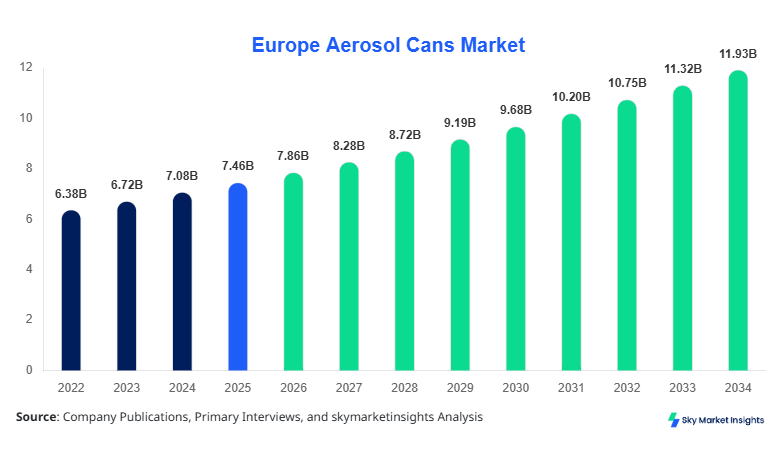
Europe Aerosol Cans market size is projected at USD 7.86 billion in 2026 and is expected to hit USD 11.92 billion by 2034 with a CAGR of 5.35%.The Europe Aerosol Cans industry continues to witness strong momentum due to rising demand across personal care, pharmaceuticals, food packaging, and industrial spray applications. The increasing requirement for lightweight packaging, enhanced shelf-life solutions, and recyclable metal containers is strengthening production across the United Kingdom, Germany, France, Spain, Italy, and Russia. The report evaluates detailed segmentation patterns, production capacities, consumption ratios, import-export trends, and competitive benchmarking across Europe. The industry landscape also highlights strategic investments in aluminum recycling, sustainable coatings, and automated filling technologies that are reshaping the Europe Aerosol Cans industry.
The aerosol cans industry refers to the manufacturing and commercialization of pressurized metal containers used for dispensing liquids, foams, gels, powders, and sprays through controlled valve systems. Europe produced approximately 6.9 billion aerosol cans in 2025, with aluminum-based cans accounting for nearly 58% of total production while steel cans contributed around 34%. Personal care applications represented nearly 42% of total aerosol consumption, followed by household products at 28%, food & beverage at 14%, pharmaceutical applications at 9%, and industrial sprays at 7%. Adoption rates across premium cosmetic brands exceeded 73% due to improved spray precision, corrosion resistance, and sustainability compliance.Consumer behavior across Europe increasingly favors convenient and hygienic packaging systems. More than 64% of urban consumers preferred spray-packaged deodorants and personal care products in 2025, while nearly 49% of food preservation sprays and cooking sprays utilized aerosol can technologies. Penetration of recyclable aluminum aerosol cans crossed 61% in Western Europe owing to environmental directives and circular economy initiatives. Technical advancements including pressure tolerance above 18 bar, valve efficiency improvements of 24%, and dispensing precision accuracy exceeding 96% are driving wider industrial utilization. Household cleaning sprays contributed nearly 22% of annual unit demand, while automotive lubricants accounted for 11% of industrial aerosol applications, reinforcing strong Europe Aerosol Cans industry expansion.
Explore more data points, trends and opportunities Download Free Sample Report
Aerosol Cans Market Trends
Sustainable Aluminum Packaging Adoption
The transition toward sustainable aluminum aerosol packaging has emerged as one of the most influential developments across Europe. In 2025, aluminum aerosol can production surpassed 4 billion units, increasing by nearly 14% compared with 2023 levels. More than 62% of manufacturers introduced lightweight aluminum containers weighing below 25 grams to reduce raw material consumption and transportation costs. Germany and the United Kingdom collectively accounted for over 39% of Europe’s sustainable aerosol packaging investments, while France and Spain significantly increased recycled aluminum sourcing capacities. Advanced barrier coating technologies enhanced corrosion resistance by 27% and improved shelf stability for food-grade applications. Rising demand from cosmetic and pharmaceutical industries pushed adoption of mono-material recyclable aerosol cans beyond 58%, reinforcing Aerosol Cans market trends.
Smart Dispensing and Valve Technology Integration
Technological innovation in valve systems and spray mechanisms is transforming aerosol packaging efficiency across Europe. In 2025, nearly 48% of newly installed aerosol filling lines incorporated smart pressure calibration systems capable of reducing leakage rates by 21%. Fine mist dispensing technologies improved spray precision by approximately 33%, especially in premium skincare and pharmaceutical applications. Household disinfectant spray demand expanded by 17% annually, encouraging manufacturers to invest in multi-angle dispensing valves and low-residue spray systems. Industrial lubricant aerosols using high-pressure steel can technology recorded production growth of 11%, particularly in automotive maintenance sectors. Adoption of digital production monitoring systems rose above 52% among leading manufacturers, accelerating Aerosol Cans market trends.
Expansion of Food-grade Aerosol Applications
Food and beverage companies across Europe increasingly adopted aerosol packaging for cooking sprays, whipped cream dispensers, and edible oil products. In 2025, food-grade aerosol packaging volume crossed 920 million units, increasing by nearly 13% from 2024. Italy, Spain, and France represented over 57% of food aerosol demand due to strong culinary and hospitality industries. Enhanced food-safe linings improved contamination resistance by 29%, while oxygen barrier efficiency increased by nearly 18%. Consumers preferred convenient dispensing formats, with aerosol cooking spray penetration reaching 44% across urban retail chains. Manufacturers also introduced BPA-free interior coatings and lightweight dispensing valves to improve product shelf life and sustainability performance, strengthening Aerosol Cans market trends.
Europe Aerosol Cans Drivers
Rapid Expansion of Personal Care and Cosmetic Packaging
The rapid growth of Europe’s personal care sector is a major driver supporting aerosol can production. In 2025, personal care aerosol consumption exceeded 2.8 billion units, accounting for nearly 42% of total regional demand. Deodorants represented approximately 51% of personal care aerosol applications, followed by hair sprays at 24%, shaving foams at 13%, and skincare sprays at 12%. Premium cosmetic companies increased aerosol-based product launches by 19% between 2023 and 2025 due to consumer preference for hygienic and convenient dispensing systems. More than 69% of millennials across Western Europe preferred spray-based grooming products because of portability and dosage precision. Technological advancements including low-emission valves and controlled atomization systems improved product utilization efficiency by 23%. Manufacturers also enhanced aluminum recycling rates to above 72% for personal care aerosol packaging, aligning with EU sustainability regulations. Growing urbanization, rising disposable income, and expansion of e-commerce distribution channels continue to stimulate Europe Aerosol Cans industry development.
Europe Aerosol Cans Restraints
Volatility in Raw Material Prices and Energy Costs
The Europe aerosol packaging industry faces substantial challenges from fluctuating aluminum and steel prices. During 2025, aluminum prices increased by nearly 16% year-over-year, while industrial electricity costs across Europe rose by approximately 21%. These cost pressures significantly affected small and medium-sized aerosol manufacturers operating with limited profit margins. More than 37% of aerosol can producers reported reduced operating profitability due to rising transportation and raw material procurement expenses. Steel-based aerosol cans experienced production cost increases of nearly 13%, particularly in Eastern Europe. Additionally, stricter EU carbon emission regulations elevated compliance expenditures by approximately 9% for filling and manufacturing facilities. Supply chain disruptions associated with geopolitical uncertainties also affected tinplate imports and specialty valve components. These financial constraints are slowing capacity expansion and limiting price competitiveness, particularly among low-volume manufacturers, thereby affecting Europe Aerosol Cans industry expansion.
Europe Aerosol Cans Opportunities
Increasing Investments in Recyclable and Low-Emission Packaging
The growing focus on circular economy initiatives creates substantial opportunities for aerosol packaging manufacturers across Europe. In 2025, sustainability-oriented investments represented nearly 34% of total aerosol packaging capital expenditure in the region. More than 58% of large-scale manufacturers introduced recycled aluminum integration programs to reduce carbon footprints by approximately 28%. Adoption of low-VOC propellant technologies increased by 17%, especially in household and pharmaceutical applications. Europe’s advanced recycling infrastructure enabled aerosol metal recovery rates exceeding 76%, encouraging manufacturers to develop mono-material recyclable can systems. Spain and Italy expanded sustainable packaging facilities by nearly 12% during 2025, while Germany invested over USD 420 million in aluminum recycling and automated sorting technologies. Growing consumer awareness regarding environmentally friendly packaging and regulatory support for recyclable containers are expected to create long-term opportunities for the Europe Aerosol Cans industry.
Europe Aerosol Cans Challenge
Stringent Environmental Regulations and Waste Management Compliance
Environmental regulations across Europe continue to impose operational challenges on aerosol can manufacturers. More than 61% of aerosol producers reported increased compliance costs linked to emissions monitoring, waste management, and recycling standards. EU directives regarding volatile organic compounds required approximately 43% of manufacturers to redesign propellant systems and modify production infrastructure between 2023 and 2025. Waste disposal costs for industrial aerosol products increased by 14%, while hazardous residue management expenses rose nearly 11%. Manufacturers also faced challenges related to sourcing BPA-free coatings and low-carbon aluminum due to limited supplier availability. Russia and Eastern European regions experienced slower adoption of advanced recycling systems, resulting in recycling efficiency gaps of nearly 18% compared with Western Europe. Balancing sustainability mandates with cost efficiency remains a significant challenge impacting Europe Aerosol Cans industry competitiveness.
Report Scope
| Report Metric | Details |
|---|---|
| Market Size in 2025 | USD 7.46 Billion |
| Market Size in 2026 | USD 7.86 Billion |
| Market Size in 2034 | USD 11.92 Billion |
| CAGR | 5.35% (2026-2034) |
| Base Year for Estimation | 2025 |
| Historical Data | 2022-2024 |
| Forecast Period | 2026-2034 |
| Report Coverage | Revenue Forecast, Competitive Landscape, Supply Chain Disruption, Growth Factors, Environment & Regulatory Landscape and Trends |
Explore more data points, trends and opportunities Download Free Sample Report
Aerosol Cans Market Segmentation
The Europe aerosol packaging industry is segmented based on material type and application. Aluminum-based cans dominated the market with nearly 58% share in 2025 due to lightweight properties and superior recyclability, while personal care applications represented approximately 42% of total demand. Steel and tinplate variants maintained strong industrial utilization because of higher pressure resistance and durability characteristics.
BY TYPE
Aluminum aerosol cans represented nearly 58% of Europe’s total aerosol production in 2025, with output surpassing 4 billion units annually. Lightweight construction reduced transportation costs by approximately 17%, while corrosion resistance enhanced shelf life performance by 22% compared with traditional steel containers. More than 68% of premium cosmetic and personal care products utilized aluminum aerosol packaging because of improved aesthetic appearance and recyclability advantages. Germany, the United Kingdom, and France collectively accounted for over 61% of Europe’s aluminum aerosol manufacturing capacity. Technical specifications including pressure tolerance above 18 bar and seamless body structures improved product integrity and dispensing precision. Recycled aluminum utilization exceeded 47% across leading European manufacturers, significantly lowering carbon emissions. Demand from pharmaceutical sprays and food-grade aerosol products also increased by 14% year-over-year due to superior hygiene characteristics and lightweight handling benefits.
Steel aerosol cans accounted for nearly 34% of regional production volume in 2025, particularly dominating industrial lubricants, automotive sprays, and paint applications. Europe manufactured approximately 2.3 billion steel aerosol cans annually, supported by strong industrial demand across Germany, Italy, and Russia. Steel containers offer pressure tolerance exceeding 21 bar, making them suitable for high-pressure industrial formulations and chemical sprays. Automotive maintenance sprays represented nearly 31% of steel aerosol utilization, while industrial coatings contributed approximately 24%. Manufacturers increasingly adopted anti-corrosion interior coatings and improved seam welding technologies to enhance durability and reduce leakage rates by nearly 19%. Steel recycling rates across Europe exceeded 74%, supporting sustainability objectives despite higher material weight compared with aluminum alternatives. Demand for industrial-grade aerosol packaging continues to expand due to growth in automotive maintenance and construction sectors.
Tinplate aerosol cans maintained approximately 8% share of Europe’s aerosol packaging industry in 2025, primarily serving niche industrial and food-related applications. Production volume exceeded 550 million units annually, with strong adoption across Eastern Europe and Russia. Tinplate structures provided excellent chemical resistance and enhanced barrier protection for specialty formulations. More than 37% of tinplate aerosol usage came from industrial paints and coating applications due to superior structural stability. Improved electroplating technologies increased corrosion resistance by 16% and extended storage durability beyond 24 months for specific formulations. Manufacturers also integrated BPA-free coatings and food-safe lining materials to comply with European safety regulations. Although aluminum continues to dominate sustainability initiatives, tinplate remains important for specialized aerosol products requiring higher structural rigidity and extended storage stability.
BY APPLICATION
Personal care applications dominated Europe’s aerosol packaging consumption with approximately 42% market contribution in 2025. Production volume exceeded 2.8 billion aerosol units, including deodorants, hair sprays, shaving foams, and body sprays. Deodorants alone accounted for nearly 51% of personal care aerosol utilization. Consumer preference for hygienic dispensing systems and portability significantly accelerated adoption rates across urban populations. More than 73% of premium skincare and grooming brands introduced aerosol-based products with enhanced atomization technologies for fine mist delivery. Aluminum cans dominated this segment with nearly 71% share because of lightweight design and superior branding aesthetics. Advanced valve systems improved product dispensing efficiency by approximately 24%, while leak reduction technologies lowered wastage by nearly 18%. The rapid expansion of men’s grooming products and travel-sized cosmetics continues to stimulate personal care aerosol packaging demand across Europe.
Household products represented approximately 28% of aerosol can demand in Europe during 2025, with production surpassing 1.9 billion units. Cleaning sprays, disinfectants, air fresheners, and insect repellents were the major contributors to segment expansion. Household disinfectant sprays recorded annual demand growth of nearly 15% following increased consumer emphasis on hygiene and sanitation. More than 54% of urban households across Western Europe regularly utilized aerosol cleaning products due to convenience and rapid surface coverage capabilities. Manufacturers integrated multi-angle spray valves and fine mist technologies that improved cleaning efficiency by approximately 21%. Steel aerosol containers accounted for nearly 46% of household applications because of higher pressure tolerance and durability. Rising demand for eco-friendly formulations also accelerated adoption of low-VOC propellant systems and recyclable aerosol packaging formats.
Food and beverage applications contributed nearly 14% of Europe’s aerosol packaging consumption in 2025, supported by increasing demand for cooking sprays, whipped cream dispensers, edible oils, and beverage foams. Total production exceeded 920 million units annually, with Italy, France, and Spain accounting for approximately 57% of segment demand. BPA-free coatings and food-grade internal linings improved contamination resistance by nearly 29%, enhancing product safety standards. More than 44% of urban consumers preferred aerosol cooking sprays due to portion control and convenience benefits. Aluminum aerosol cans dominated food applications with approximately 66% share because of superior corrosion resistance and lightweight handling. Manufacturers also improved oxygen barrier performance by 18%, significantly extending shelf stability for edible products. The hospitality and restaurant sectors remain major contributors to food aerosol packaging consumption across Europe.
Europe Aerosol Cans Market Segmentations
Material Type
- Aluminum
- Steel
- Tinplate
Application
- Personal Care
- Household Products
- Food & Beverage
Europe Aerosol Cans Regional Outlook
United Kingdom
The United Kingdom represented approximately 24% of Europe’s aerosol packaging production volume in 2025, manufacturing nearly 1.65 billion aerosol cans annually. Personal care applications accounted for 46% of UK demand, followed by household products at 27% and food-grade aerosols at 12%. More than 85 aerosol manufacturing and filling facilities operated across the country, supported by advanced automation and recycling infrastructure. Aluminum cans represented approximately 63% of domestic production due to sustainability initiatives and premium cosmetic demand. Investments in AI-based quality inspection systems increased by nearly 22% between 2023 and 2025, improving production efficiency and reducing defect rates. The UK also emerged as a leading exporter of personal care aerosol products to Western Europe.
Germany
Germany accounted for nearly 21% of Europe’s aerosol packaging output in 2025, producing more than 1.45 billion units annually. Industrial sprays and automotive applications represented approximately 34% of domestic demand due to the country’s strong automotive manufacturing sector. Aluminum recycling rates exceeded 78%, among the highest in Europe, while automated filling systems improved production efficiency by nearly 29%. Germany invested over USD 420 million in sustainable packaging technologies and smart manufacturing systems. Household cleaning sprays and industrial lubricants remained major demand contributors. More than 58% of manufacturers adopted digital monitoring systems to reduce energy consumption and production waste.
France
France contributed approximately 16% of Europe’s aerosol packaging demand in 2025, with annual production exceeding 1.1 billion units. Cosmetic and skincare aerosol products represented nearly 49% of domestic consumption because of France’s globally recognized beauty industry. Aluminum aerosol packaging adoption crossed 69% among luxury cosmetic brands. Household disinfectants and food aerosol products also expanded significantly, supported by urban retail growth. Sustainable packaging initiatives increased recycled material integration by nearly 24% between 2022 and 2025. France also expanded low-VOC aerosol propellant production to support environmental compliance and premium packaging innovation.
Spain
Spain represented nearly 11% of Europe’s aerosol packaging production in 2025, generating approximately 760 million aerosol units. Food-grade aerosol applications accounted for nearly 28% of national demand due to strong olive oil and culinary industries. Tourism and hospitality sectors significantly increased demand for cooking sprays and hygiene products. More than 52% of Spanish aerosol manufacturers expanded recyclable aluminum production capacities during 2025. Household cleaning products and insect repellent sprays also maintained strong consumption levels across urban regions. Spain invested substantially in automated filling technologies and sustainable packaging infrastructure to improve export competitiveness.
Italy
Italy contributed approximately 13% of regional aerosol can demand, producing more than 890 million units in 2025. Food and beverage aerosol applications represented nearly 31% of domestic consumption due to extensive culinary product manufacturing. Cosmetic aerosol products also maintained strong demand, accounting for approximately 26% of total utilization. Italian manufacturers increasingly adopted BPA-free coatings and lightweight aluminum structures to improve sustainability performance. More than 48% of aerosol producers integrated automated pressure testing systems to improve quality assurance and reduce leakage rates. Italy remains a major exporter of food-grade aerosol products within Europe.
Russia
Russia accounted for nearly 9% of Europe’s aerosol packaging volume in 2025, with annual production exceeding 620 million units. Industrial sprays, lubricants, and automotive maintenance products represented approximately 43% of national demand due to strong industrial utilization. Steel aerosol cans maintained dominant share because of higher structural durability and lower production costs. Recycling infrastructure remains less advanced compared with Western Europe, with metal recovery rates averaging nearly 52%. However, domestic aerosol manufacturing investments increased by approximately 14% between 2023 and 2025. Russia also expanded industrial coating and lubricant aerosol production capacities to support infrastructure and automotive sectors.
Top players in Europe Aerosol Cans
- Ball Corporation
- Crown Holdings Inc.
- Trivium Packaging
- Ardagh Group
- Nussbaum Matzingen AG
- TUBEX GmbH
- DS Containers
- Euro Asia Packaging
- Massilly Holding
- Montebello Packaging
- Envases Group
- Exal Corporation
- Colep Packaging
- Linhardt GmbH
- CCL Container
Ball Corporation
-
Ball Corporation accounted for approximately 17% of Europe’s aerosol packaging production capacity in 2025.
-
The company operates multiple advanced aluminum can manufacturing facilities across Germany, France, and the United Kingdom.
-
Ball invested significantly in lightweight aluminum technology, reducing material usage by nearly 14% while maintaining pressure tolerance standards above 18 bar.
-
Over 61% of the company’s European aerosol output utilized recycled aluminum content exceeding 50%.
-
Ball Corporation also strengthened partnerships with premium cosmetic brands and household product manufacturers, reinforcing its leadership position in sustainable aerosol packaging solutions.
Crown Holdings Inc.
-
Crown Holdings Inc. maintained approximately 13% share of Europe’s aerosol packaging industry in 2025.
-
The company expanded steel and aluminum aerosol production capacities across Spain and Italy to support increasing demand from food and industrial applications.
-
Crown’s smart filling and inspection technologies improved manufacturing efficiency by nearly 26% between 2023 and 2025.
-
More than 48% of its aerosol product portfolio incorporated low-emission valve systems and recyclable coatings.
-
The company also focused heavily on food-grade aerosol packaging innovation, particularly for edible oils and whipped cream applications across Southern Europe.
Investment Analysis
Investment activity across Europe’s aerosol packaging industry accelerated substantially during 2025, with sustainability projects accounting for nearly 34% of total sector investments. Germany, the United Kingdom, and France collectively attracted over 58% of capital expenditure directed toward automated filling systems, aluminum recycling, and low-emission propellant technologies. More than USD 1.2 billion was allocated toward smart manufacturing systems and lightweight packaging innovations between 2023 and 2025. Personal care applications attracted approximately 41% of total investment allocation due to strong demand from cosmetic and grooming product manufacturers. Household products represented 29% of investment activity, while food-grade aerosol packaging captured nearly 18%.
Mergers, acquisitions, and strategic collaborations increased significantly as companies sought technological integration and regional expansion. Nearly 23 cross-border agreements involving aerosol packaging suppliers and recycling firms were recorded across Europe during 2025. Ball Corporation expanded partnerships with cosmetic manufacturers to improve sustainable packaging supply chains, while Crown Holdings invested heavily in food-grade aerosol innovations. Spain and Italy experienced increased joint ventures focused on recyclable aluminum packaging facilities and automated filling technologies. More than 37% of regional investments targeted low-carbon manufacturing infrastructure and energy-efficient production lines. Russia and Eastern Europe also witnessed rising industrial aerosol investments to support automotive and infrastructure sectors. Growing regulatory support for recyclable packaging and expanding demand for lightweight metal containers continue to strengthen investment opportunities throughout the Europe aerosol packaging ecosystem.
New Product Developments
Manufacturers across Europe accelerated new aerosol packaging product launches during 2025, with nearly 31% of total product introductions focused on sustainable and recyclable packaging solutions. Lightweight aluminum aerosol cans with reduced wall thickness improved material efficiency by approximately 16% while maintaining pressure resistance standards above 18 bar. Advanced dispensing technologies also enhanced spray precision by nearly 24%, particularly in personal care and pharmaceutical applications. BPA-free coatings and low-VOC propellant systems gained rapid adoption among food-grade and household product manufacturers.
More than 44% of newly launched aerosol products incorporated smart valve systems designed to reduce leakage and improve dosage control. Cosmetic companies introduced fine-mist dispensing technologies capable of improving atomization efficiency by 28%, supporting premium skincare applications. Food aerosol packaging innovations also increased significantly, with oxygen barrier enhancements extending product shelf life by nearly 18%. Industrial spray manufacturers launched high-pressure steel aerosol containers with improved corrosion resistance and enhanced storage durability for automotive lubricants and industrial coatings.
Recent Developments in Europe Aerosol Cans
- 2025: Ball Corporation expanded its recyclable aluminum aerosol can production capacity in Germany by approximately 18%, increasing annual output by nearly 220 million units. The expansion focused on lightweight personal care packaging systems with recycled aluminum content above 50%. Advanced automated inspection technologies reduced manufacturing defects by nearly 21%, while production efficiency improved by approximately 17% across the upgraded facilities.
- 2025: Crown Holdings launched a new low-emission aerosol valve system across Spain and Italy that reduced volatile organic compound emissions by nearly 14%. The company also increased food-grade aerosol packaging production by approximately 11% to support growing demand for cooking sprays and whipped cream products. Enhanced oxygen barrier coatings improved shelf-life stability by nearly 19%.
Research Methodology
The research process for the Europe aerosol cans industry involved comprehensive evaluation of production capacities, consumption trends, technological developments, raw material pricing patterns, and regulatory frameworks across the United Kingdom, Germany, France, Spain, Italy, and Russia. Primary research included direct interviews with aerosol can manufacturers, distributors, packaging engineers, cosmetic companies, food product manufacturers, and recycling specialists to obtain quantitative and qualitative industry insights. More than 120 industry participants contributed data related to production volume, investment trends, application demand, and sustainability initiatives.
Secondary research involved detailed assessment of annual reports, trade publications, industrial databases, import-export records, packaging association statistics, government publications, and sustainability compliance reports. Market size estimation was conducted using bottom-up and top-down analytical approaches, integrating production volume analysis, pricing benchmarks, application-level demand assessment, and regional consumption mapping. Forecast modeling incorporated macroeconomic indicators, industrial output growth, technological adoption rates, recycling infrastructure expansion, and regulatory developments influencing aerosol packaging demand across Europe between 2026 and 2034.
Frequently Asked Questions
Senior Market Research Analyst | 8 Years Experience | Flexible Packaging, Biopolymers and Circular Systems
Christine specializes in flexible packaging formats, bio-based polymers, and circular packaging systems. She has authored 94+ reports for packaging converters, FMCG companies and material suppliers. Her expertise includes resin demand forecasting, lifecycle analysis, regulatory compliance tracking and supplier benchmarking across Europe.