Europe Aluminum Rolled Products Market Size
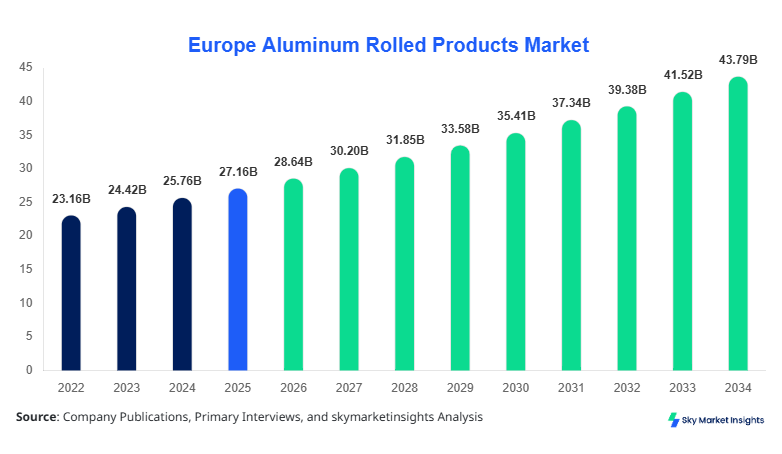
Europe Aluminum Rolled Products market size is projected at USD 28.64 billion in 2026 and is expected to hit USD 43.81 billion by 2034 with a CAGR of 5.45%. The market recorded an estimated shipment volume of 8.7 million metric tons in 2025, supported by rising industrial manufacturing activities, electric vehicle production, and high penetration of lightweight materials across transportation and packaging industries. Increasing investment in recyclable aluminum processing technologies, coupled with advanced rolling mill automation, is strengthening production capabilities across Europe. The competitive landscape remains moderately consolidated, with major producers accounting for more than 58% of regional production capacity and continuously expanding high-performance alloy portfolios.
The Aluminum Rolled Products Market comprises flat-rolled aluminum materials manufactured through hot rolling and cold rolling processes for applications in automotive, aerospace, packaging, industrial machinery, and construction industries. Europe produced approximately 9.1 million metric tons of rolled aluminum products in 2025, with Germany contributing nearly 31% of regional production output. Adoption rates of lightweight aluminum body sheets in electric vehicles exceeded 62% across Europe, while beverage can sheet penetration reached 78% in food and beverage packaging applications. Consumer demand for sustainable packaging materials increased by 18.4% year-on-year in 2025 due to tightening carbon emission regulations and recycling targets imposed by the European Union. Automotive applications accounted for nearly 34% of total consumption volume, followed by packaging at 29%, construction at 18%, industrial machinery at 11%, and aerospace applications at 8%. Aluminum rolled sheets with tensile strength ranging from 140 MPa to 450 MPa are increasingly preferred for high-performance manufacturing applications due to improved corrosion resistance and thermal conductivity. Continuous demand from transportation and sustainable packaging sectors is accelerating Europe Aluminum Rolled Products Market expansion.
Explore more data points, trends and opportunities Download Free Sample Report
Aluminum Rolled Products Market Trends
Rising Adoption of Lightweight Materials in Electric Vehicles
European automotive manufacturers consumed more than 2.9 million metric tons of rolled aluminum products in 2025, reflecting a 16.8% increase compared with 2023 levels. Electric vehicle manufacturers across Germany, France, and the United Kingdom increased utilization of aluminum body sheets by nearly 28% to reduce vehicle weight by 15%–20% and improve battery efficiency. Advanced heat-treatable aluminum alloys with yield strengths above 300 MPa are gaining traction for chassis systems, battery enclosures, and structural reinforcements. Approximately 61% of newly commissioned rolling lines in Europe now incorporate digital process automation and predictive maintenance systems to minimize production defects and energy consumption. Manufacturers are increasingly investing in closed-loop recycling systems capable of reducing carbon emissions by nearly 40% compared with primary aluminum processing. These developments continue to influence Aluminum Rolled Products Market expansion across transportation applications.
Expansion of Sustainable Packaging Applications
Demand for aluminum foil and can stock products exceeded 2.3 million metric tons in Europe during 2025, supported by rising consumer preference for recyclable packaging materials. Beverage manufacturers increased aluminum packaging adoption by 19%, while pharmaceutical blister packaging demand grew by 12.6% due to stricter product safety regulations. Approximately 74% of European consumers preferred recyclable packaging formats in 2025, accelerating investments in high-speed foil rolling technologies. Rolling mills equipped with energy-efficient induction heating systems reduced operational electricity consumption by 11%–14% annually. Additionally, smart surface coating technologies improved corrosion resistance performance by nearly 22%, enhancing shelf life for food and pharmaceutical products. Sustainable packaging initiatives and regulatory pressure on plastic reduction continue strengthening Aluminum Rolled Products Market penetration across Europe.
Digitalization and Smart Manufacturing in Rolling Mills
The integration of Industry 4.0 technologies within aluminum rolling facilities increased substantially across Europe, with nearly 53% of large-scale plants deploying AI-driven process monitoring systems in 2025. Smart sensors installed across rolling lines improved thickness precision by 18% and reduced production waste by approximately 13%. Robotics adoption in coil handling and finishing operations increased by 26% between 2023 and 2025, while automated quality inspection systems reduced rejection rates below 2.8%. Investments in digital twin technologies surpassed USD 740 million across European metal processing industries in 2025, supporting predictive maintenance and production optimization. These technological advancements are improving operational productivity, enhancing product consistency, and strengthening Europe Aluminum Rolled Products Market competitiveness.
Europe Aluminum Rolled Products Drivers
Growing Electric Vehicle Production Across Europe
Electric vehicle production across Europe exceeded 5.4 million units in 2025, representing a 21% increase from 2024 levels. Aluminum rolled sheets and plates are increasingly utilized in EV battery enclosures, structural frames, and crash management systems because of their lightweight and corrosion-resistant characteristics. Automotive manufacturers reduced average vehicle body weight by nearly 18% through aluminum-intensive designs, contributing to improved energy efficiency and driving range. Germany, France, and the United Kingdom collectively accounted for over 67% of aluminum demand generated from EV manufacturing applications. Investments in dedicated automotive sheet rolling capacity exceeded USD 3.1 billion between 2023 and 2025, while recycling-based aluminum feedstock usage increased by 32%. Advanced 6xxx and 7xxx series aluminum alloys with tensile strengths above 350 MPa are witnessing rising adoption for structural vehicle components. Increasing demand for lightweight transportation solutions continues supporting Aluminum Rolled Products Market expansion.
Europe Aluminum Rolled Products Restraints
Volatility in Raw Material and Energy Prices
The aluminum rolling industry remains highly exposed to fluctuations in primary aluminum prices, electricity tariffs, and natural gas costs. European electricity prices increased by nearly 14% during 2025, significantly impacting operational expenses for energy-intensive rolling mills. Primary aluminum prices fluctuated between USD 2,250 and USD 2,780 per metric ton during the same period, creating uncertainty in procurement and pricing strategies. Approximately 48% of manufacturers reported margin pressure due to unstable energy costs and supply chain disruptions associated with imported bauxite and alumina. Small and medium-sized processors faced production cost increases exceeding 11%, limiting profitability and expansion opportunities. Additionally, stricter environmental compliance requirements increased capital expenditure for emission control systems and recycling infrastructure. These economic pressures continue restraining Aluminum Rolled Products Market profitability across Europe.
Europe Aluminum Rolled Products Opportunities
Increasing Demand for Sustainable Packaging Solutions
The transition toward recyclable and low-carbon packaging materials presents substantial opportunities for aluminum rolled product manufacturers across Europe. Beverage can production surpassed 82 billion units in 2025, with aluminum accounting for nearly 74% of total packaging material usage in premium beverage categories. Food packaging companies increased procurement of high-barrier aluminum foil products by 15.8% to improve product preservation and sustainability compliance. The European Union’s circular economy initiatives are encouraging investments in recycled-content packaging materials, with recycled aluminum utilization rates projected to exceed 78% by 2030. Investments exceeding USD 2.4 billion were allocated toward foil rolling expansion and recycling infrastructure development between 2024 and 2025. Manufacturers are also introducing ultra-thin foil technologies capable of reducing material usage by 9% while maintaining mechanical integrity. Rising sustainability initiatives continue generating strong opportunities for Aluminum Rolled Products Market participants.
Europe Aluminum Rolled Products Challenge
Competition from Alternative Lightweight Materials
Despite strong demand growth, aluminum rolled product manufacturers face rising competition from carbon fiber composites, advanced plastics, and high-strength steel alternatives. Automotive manufacturers increasingly evaluate multi-material vehicle architectures, reducing aluminum penetration in selected structural components. High-strength steel usage increased by 8.3% in European passenger vehicle production during 2025 because of lower material costs and established supply chains. Composite materials demonstrated weight reduction benefits exceeding 25% in aerospace and industrial applications, intensifying competitive pressure on aluminum suppliers. Additionally, capital investment requirements for advanced rolling facilities remain substantial, with a modern hot rolling mill costing between USD 800 million and USD 1.4 billion. Environmental permitting complexities and fluctuating recycling economics also create operational barriers for new entrants. These factors continue challenging long-term Aluminum Rolled Products Market competitiveness.
Report Scope
| Report Metric | Details |
|---|---|
| Market Size in 2025 | USD 27.16 Billion |
| Market Size in 2026 | USD 28.64 Billion |
| Market Size in 2034 | USD 43.81 Billion |
| CAGR | 5.45% (2026-2034) |
| Base Year for Estimation | 2025 |
| Historical Data | 2022-2024 |
| Forecast Period | 2026-2034 |
| Report Coverage | Revenue Forecast, Competitive Landscape, Supply Chain Disruption, Growth Factors, Environment & Regulatory Landscape and Trends |
Explore more data points, trends and opportunities Download Free Sample Report
Aluminum Rolled Products Market Segmentation
The Europe Aluminum Rolled Products Market is segmented by product type and end-use industry. Sheets accounted for approximately 46% of total regional demand in 2025 due to strong automotive and industrial applications, while packaging represented nearly 29% of end-use consumption. Increasing demand for lightweight transportation materials and recyclable packaging products is driving technological advancements across all market segments.
By Type
Aluminum sheets represented the largest product category, contributing nearly 46% of total Europe consumption volume in 2025. Production exceeded 4.1 million metric tons, primarily driven by automotive body panels, industrial machinery, and transportation equipment manufacturing. Sheet thickness generally ranges from 0.2 mm to 6 mm, while tensile strength varies between 140 MPa and 420 MPa depending on alloy composition and heat treatment. Automotive manufacturers increased procurement of 6xxx-series aluminum sheets by approximately 22% for EV battery enclosures and lightweight body structures. Germany and France collectively accounted for over 58% of regional sheet production capacity due to advanced rolling infrastructure and strong automotive manufacturing ecosystems. Adoption of automated continuous annealing technologies improved surface quality consistency by 17% and reduced rejection rates below 3.1%. Demand for corrosion-resistant aluminum sheets in renewable energy infrastructure and industrial equipment applications also increased by 13.7% during 2025. Strong industrial utilization continues supporting Aluminum Rolled Products Market expansion in the sheet segment.
Aluminum plates accounted for approximately 28% of regional market consumption and exceeded 2.3 million metric tons in production volume during 2025. These products are extensively utilized in aerospace, marine, rail transportation, and heavy industrial machinery applications due to their high structural strength and durability. Plate thickness typically ranges between 6 mm and 250 mm, with advanced aerospace-grade alloys demonstrating yield strengths above 450 MPa. Aerospace applications represented nearly 31% of total aluminum plate demand, while rail transportation contributed 19%. Manufacturers across Germany and Italy invested heavily in precision plate rolling technologies capable of maintaining thickness tolerances below 0.25 mm. Heat-treated aluminum plate products with enhanced fatigue resistance recorded a 14% increase in adoption across infrastructure and transportation sectors. Additionally, demand for thick-gauge plates in offshore renewable energy installations increased significantly as wind turbine manufacturers sought corrosion-resistant structural materials. The growing use of high-performance structural alloys is strengthening Aluminum Rolled Products Market development within the plate category.
Aluminum foil products accounted for nearly 26% of regional consumption and surpassed 2.1 million metric tons in production during 2025. Packaging applications dominated foil demand with a 68% share, followed by pharmaceutical blister packaging at 14% and insulation materials at 9%. Foil thickness ranges from 0.006 mm to 0.2 mm depending on end-use requirements, while barrier performance capabilities significantly improve moisture resistance and product preservation. Beverage packaging manufacturers increased usage of ultra-thin aluminum foils by approximately 16% due to sustainability targets and consumer preference for recyclable packaging. Pharmaceutical foil demand rose by 11.4% as healthcare product safety regulations tightened across Europe. Advanced foil rolling technologies improved production speeds by 13% while reducing scrap generation by nearly 8%. Increasing investments in sustainable flexible packaging solutions continue accelerating Aluminum Rolled Products Market demand within the foil segment.
By Application
The automotive industry represented the largest application segment, accounting for approximately 34% of total Europe aluminum rolled product consumption in 2025. Demand exceeded 2.9 million metric tons due to rapid electric vehicle production growth and stringent emission reduction targets. Aluminum rolled sheets and plates are widely utilized in body panels, chassis systems, battery housings, and crash structures because they can reduce vehicle weight by 15%–20% compared with conventional steel components. Germany contributed nearly 43% of automotive-related aluminum demand in Europe due to its dominant vehicle manufacturing sector. Advanced high-strength aluminum alloys with yield strengths above 320 MPa are increasingly preferred for structural EV components. Automotive manufacturers also increased recycled aluminum usage by 27% to achieve sustainability objectives and reduce lifecycle emissions. Continuous innovation in joining technologies and lightweight design strategies continues strengthening Aluminum Rolled Products Market penetration within transportation applications.
Packaging applications accounted for nearly 29% of total consumption volume, with demand surpassing 2.4 million metric tons in 2025. Beverage cans, food containers, flexible packaging foils, and pharmaceutical blister packs represented the primary demand categories. Aluminum beverage cans achieved recycling rates above 76% across Europe, supporting widespread adoption among beverage producers and sustainability-focused consumers. Foil-based food packaging products improved shelf life performance by nearly 20% compared with alternative materials, while pharmaceutical packaging demand increased by 12% because of stringent product protection requirements. High-speed rolling and coating technologies enabled manufacturers to reduce foil thickness by 9% without compromising mechanical performance. France, Spain, and the United Kingdom collectively contributed more than 48% of regional packaging demand due to expanding food processing industries and premium beverage consumption trends. The transition toward recyclable packaging solutions continues supporting Aluminum Rolled Products Market expansion in packaging applications.
Construction applications represented approximately 18% of total Europe market demand in 2025, with consumption exceeding 1.5 million metric tons. Aluminum rolled products are increasingly utilized in roofing systems, façade cladding, insulation panels, doors, and window frames because of superior corrosion resistance and lightweight properties. Architectural aluminum panels reduced structural load requirements by nearly 25% compared with steel-based alternatives, while thermal reflective coatings improved energy efficiency performance by 14%. Italy and Spain together contributed around 36% of construction-related demand due to expanding commercial infrastructure and sustainable building projects. Demand for pre-painted aluminum sheets increased by 11.8% owing to growing adoption in modern architectural designs and energy-efficient construction systems. Government investments in green building initiatives and renewable energy infrastructure continue accelerating Aluminum Rolled Products Market utilization within construction applications.
Europe Aluminum Rolled Products Market Segmentations
Product Type
- Sheets
- Plates
- Foils
End-use Industry
- Automotive
- Packaging
- Construction
Europe Aluminum Rolled Products Regional Outlook
United Kingdom
The United Kingdom accounted for approximately 14% of Europe aluminum rolled product consumption in 2025, with demand reaching nearly 1.2 million metric tons. Packaging and automotive applications represented 33% and 28% of national demand respectively, supported by increasing EV production and food packaging requirements. Beverage can manufacturing facilities expanded production capacity by 9.6% during 2025 due to rising consumption of recyclable packaging formats. Investments in lightweight rail transportation projects also increased aluminum sheet procurement by 12%. Advanced recycling facilities processed over 640,000 metric tons of aluminum scrap annually, improving domestic supply chain efficiency and sustainability performance.
Germany
Germany remained the largest regional contributor with nearly 31.6% market share and production volumes exceeding 2.8 million metric tons in 2025. Automotive applications dominated domestic demand with a 42% share due to the presence of leading vehicle manufacturers and EV production facilities. More than 65 rolling and processing facilities operate across the country, supported by automation adoption rates exceeding 47%. Germany also recorded recycled aluminum utilization rates above 72%, strengthening sustainable manufacturing capabilities and reducing operational emissions.
France
France represented approximately 15% of regional demand in 2025, supported by aerospace, automotive, and packaging industries. Aluminum plate consumption increased by 13% because of expanding aerospace manufacturing activities, while packaging demand grew by 11.2%. National production exceeded 1.3 million metric tons, with more than 38% allocated toward transportation applications. Investments in low-carbon rolling technologies and recycling systems surpassed USD 420 million between 2024 and 2025, enhancing domestic manufacturing competitiveness.
Spain
Spain accounted for nearly 10% of Europe aluminum rolled product consumption and produced approximately 840,000 metric tons during 2025. Construction applications represented 31% of domestic demand due to rising commercial infrastructure projects and energy-efficient building initiatives. Packaging foil demand also increased by 14% owing to growth in food processing and beverage industries. Spanish manufacturers invested heavily in energy-efficient rolling systems capable of reducing electricity consumption by 10%–12% annually.
Italy
Italy contributed approximately 12% of regional market revenue in 2025 and produced over 980,000 metric tons of rolled aluminum products. Construction and industrial machinery applications accounted for nearly 44% of domestic demand. Investments in decorative architectural aluminum panels and façade systems increased significantly due to growing sustainable building projects. Italian rolling facilities improved production efficiency by 15% through deployment of automated surface inspection technologies and smart manufacturing systems.
Russia
Russia accounted for around 9% of regional demand, with annual production exceeding 760,000 metric tons during 2025. Industrial machinery and transportation sectors represented more than 52% of national consumption volume. Domestic producers focused heavily on expanding export-oriented plate and sheet manufacturing capacity, while investments in aerospace-grade aluminum alloys increased by 17%. Adoption of energy-efficient rolling technologies also improved operational productivity and reduced waste generation across major manufacturing plants.
Top players in Europe Aluminum Rolled Products
- Novelis Inc.
- Hydro Aluminium
- Constellium SE
- AMAG Austria Metall AG
- Speira GmbH
- ElvalHalcor
- Arconic Corporation
- Alcoa Corporation
- Kaiser Aluminum
- Aleris International
- Norsk Hydro ASA
- Hindalco Industries Ltd.
- JW Aluminum
- Gränges AB
- UACJ Corporation
Novelis Inc.
-
Estimated regional market share: 18%–20%
-
Strong presence in automotive and beverage can sheet production
-
Operates advanced recycling and rolling facilities across Germany and the United Kingdom
Novelis Inc. remains one of the leading manufacturers in the Europe aluminum rolled products industry due to its extensive production capacity and strategic focus on recycled aluminum processing. The company produced more than 2 million metric tons of rolled aluminum products globally during 2025, with Europe representing a significant operational base. Automotive sheet products account for approximately 39% of its regional sales portfolio, while beverage packaging contributes nearly 33%. The company invested over USD 600 million in recycling infrastructure modernization and digital manufacturing systems between 2023 and 2025. Advanced closed-loop recycling systems improved scrap recovery rates by 24%, strengthening sustainability positioning and operational efficiency.
Hydro Aluminium
-
Estimated regional market share: 14%–16%
-
Strong focus on low-carbon aluminum solutions and renewable energy integration
-
Significant penetration in industrial and construction applications
Hydro Aluminium maintains a dominant position in Europe due to integrated aluminum production and renewable-energy-supported manufacturing operations. The company operates multiple rolling facilities across Germany, Norway, and other European countries with annual rolled product capacity exceeding 1.5 million metric tons. Construction and industrial applications collectively account for nearly 48% of its regional sales volume. Hydro invested heavily in low-carbon aluminum technologies capable of reducing emissions by up to 30% compared with conventional production systems. Automated process optimization and AI-enabled monitoring improved production consistency and reduced operational waste by nearly 11% during 2025.
Investment Analysis
Investment activity across the Europe aluminum rolled products industry accelerated substantially during 2024–2026 due to increasing demand for lightweight transportation materials and recyclable packaging solutions. More than USD 8.7 billion was allocated toward rolling mill expansion, recycling infrastructure, and low-carbon manufacturing technologies during this period. Automotive applications attracted nearly 38% of total investment expenditure, followed by packaging at 27%, construction at 18%, and aerospace at 11%. Germany accounted for approximately 34% of regional capital allocation owing to strong electric vehicle manufacturing activity and advanced industrial infrastructure.
Mergers, acquisitions, and strategic collaborations also increased significantly as companies pursued technological integration and capacity expansion. Nearly 19 major collaboration agreements were announced between aluminum producers and automotive OEMs during 2025 to support electric vehicle lightweighting initiatives. Recycling-focused investments represented almost 29% of total capital expenditure, driven by rising recycled-content requirements and carbon neutrality targets across Europe. Companies increasingly adopted AI-enabled process optimization systems, automated quality inspection technologies, and digital twin manufacturing platforms to improve efficiency and reduce operational costs. Cross-border partnerships between packaging manufacturers and aluminum processors also expanded to strengthen supply chain integration and accelerate sustainable packaging innovation.
New Product Developments
Manufacturers across Europe introduced multiple high-performance aluminum rolled products during 2025 to address growing demand for lightweight, sustainable, and corrosion-resistant materials. Approximately 23% of newly launched products focused on automotive-grade high-strength aluminum sheets designed for electric vehicle battery enclosures and crash-resistant structural systems. These advanced alloys improved tensile performance by nearly 18% while reducing component weight by approximately 12%. Packaging foil innovations with ultra-thin gauge technology reduced material consumption by 9%–11% while maintaining barrier performance and recyclability standards.
In addition, smart-coated aluminum sheets with enhanced thermal reflectivity and corrosion resistance gained popularity in construction and renewable energy applications. Surface treatment technologies improved weather durability by nearly 20%, supporting long-term infrastructure applications. More than 31% of new product launches incorporated recycled aluminum content above 70%, reflecting the industry’s shift toward circular manufacturing practices and low-carbon material solutions.
Recent Developments in Europe Aluminum Rolled Products
- 2025: Novelis expanded automotive sheet production capacity in Germany by 14%, adding approximately 320,000 metric tons annually to support electric vehicle manufacturing demand. The facility integrated advanced AI-enabled rolling technologies that improved defect detection accuracy by 19% and reduced production downtime by 11%.
- 2025: Hydro Aluminium announced a USD 420 million investment in low-carbon rolling technologies and renewable energy integration across European facilities. The modernization program reduced operational emissions by nearly 16% while increasing production efficiency by approximately 9%.
- 2025: ElvalHalcor expanded sustainable packaging foil capacity in Southern Europe by nearly 18%, supported by increasing demand from food and pharmaceutical industries. Recycled aluminum utilization rates at the facility surpassed 68%, significantly improving environmental performance.
Research Methodology
The research process for the Europe Aluminum Rolled Products Market involved extensive primary and secondary data collection methodologies designed to ensure high statistical accuracy and industry validation. Primary research included interviews with aluminum producers, rolling mill operators, automotive manufacturers, packaging companies, distributors, and technology suppliers across Germany, France, the United Kingdom, Italy, Spain, and Russia. More than 120 industry participants were consulted to assess production capacity, pricing trends, technology adoption rates, and demand forecasts.
Secondary research involved analysis of company annual reports, trade journals, European Union industrial statistics, aluminum association databases, import-export records, and manufacturing investment reports. Market size estimation was conducted using bottom-up and top-down analytical approaches, integrating production volume analysis, revenue mapping, and application-wise demand forecasting models. Data triangulation techniques were applied to validate shipment volume, regional production share, investment allocation, and consumption statistics. Forecast projections for 2026–2034 were derived through macroeconomic modeling, industrial production trends, automotive manufacturing outlooks, recycling adoption patterns, and technological innovation assessments to ensure comprehensive market evaluation accuracy.
Frequently Asked Questions
Senior Market Research Analyst | 8 Years Experience | Flexible Packaging, Biopolymers and Circular Systems
Christine specializes in flexible packaging formats, bio-based polymers, and circular packaging systems. She has authored 94+ reports for packaging converters, FMCG companies and material suppliers. Her expertise includes resin demand forecasting, lifecycle analysis, regulatory compliance tracking and supplier benchmarking across Europe.