North America Aluminum Foil Packaging Market Size
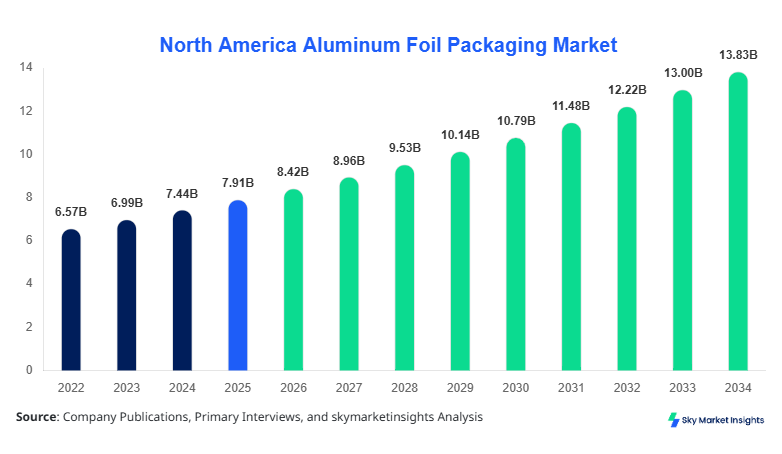
North America's aluminium foil packaging market size is projected at USD 8.42 billion in 2026 and is expected to hit USD 14.91 billion by 2034 with a CAGR of 6.4%. The increasing demand for sustainable and recyclable packaging solutions, combined with growing consumption of ready-to-eat and frozen food products, has driven market expansion. Comprehensive data across historical years 2022–2024, current production metrics, and projected adoption rates are critical for strategic planning and identifying competitive positioning. Detailed segmentation by type, application, and country-level analysis further enhances the understanding of market share, growth, and trends across North America.
North America's aluminium foil packaging market is witnessing a surge due to rising adoption of aluminium foil in packaging solutions for food, pharmaceuticals, and consumer goods. Production volumes in North America were recorded at 1.12 million tonnes in 2025, with projected output reaching 1.68 million tonnes by 2034. Adoption rates of aluminium foil packaging among end-use industries have increased by 11% annually, driven by consumer preference for lightweight, durable, and recyclable packaging. Household foil accounts for 38% of the regional market, industrial foil contributes 44%, and speciality foil 18%. Food packaging remains the dominant application, representing 52% of usage, followed by pharmaceutical packaging at 28% and consumer goods packaging at 20%. The frequency of usage for aluminium foil packaging in FMCG is around 4–5 times per month per household, with an average foil thickness of 9–14 microns. These dynamics highlight the ongoing growth and demand for North American aluminium foil packaging insights, providing stakeholders with actionable intelligence.
In the United States, the aluminium foil packaging market is led by over 120 manufacturing facilities and packaging companies, representing approximately 62% of North America’s market share. The country’s production volume reached 680,000 tonnes in 2025, with industrial foil comprising 45% and household foil 40% of total output, while speciality foils account for 15%. Adoption of advanced roll-to-roll aluminium foil technology and high-barrier coatings has risen to 71%, particularly in food and pharmaceutical segments, enhancing shelf-life and performance. Food packaging dominates domestic consumption at 55%, with pharmaceuticals at 27% and consumer goods at 18%. The United States market for aluminium foil packaging is further driven by stringent regulations on American aluminium foil packaging and increasing demand for lightweight, eco-friendly solutions, underscoring the market growth, size, and demand in the region.
Explore more data points, trends and opportunities Download Free Sample Report
Aluminum Foil Packaging Market Trends
Rising Demand for Sustainable Packaging
The North American Aluminium Foil Packaging Market is experiencing a marked trend toward sustainable and recyclable packaging solutions. Production volumes reached 1.15 million tonnes in 2025 and are projected to increase to 1.72 million tonnes by 2034. Over 68% of manufacturers have adopted environmentally friendly aluminium foil technologies, such as high-recyclability foils and lower-energy production lines. Consumer demand for sustainable packaging in food and beverage applications has grown by 14% year-over-year, with packaging penetration in ready-to-eat aluminium accounting for 56% of total market share. The market trend reflects a strong shift toward eco-conscious consumption, reinforcing aluminium foil packaging growth and insights.
Technological Innovations in Aluminum Foil Production
Technological advancements such as high-barrier laminates and nano-coating techniques have been increasingly integrated, enhancing moisture resistance and thermal performance. The adoption rate of high-barrier foils is estimated at 47% across pharmaceutical packaging and 38% in food applications. Production output of speciality foils has grown from 180,000 tonnes in 2022 to 220,000 tonnes in 2025. These innovations improve shelf life by up to 25% and reduce material usage by 12%, contributing to operational efficiency. Aluminium foil packaging trends are essential for understanding aluminium foil packaging demand, growth and speciality market insights.
Sector-Specific Tonnes in Food and Pharmaceuticals
The North American food packaging sector accounts for USD 4.37 billion of the market in 2026, while pharmaceutical applications contribute USD 2.31 billion. Growth in frozen and convenience food sales has accelerated foil consumption by 9% annually, with weekly per capita usage increasing from 35g to 42g between 2022 and 2025. Pharmaceutical adoption of aluminium foil blisters has increased to 71% for oral aluminium foil packaging, emphasising the importance of high-barrier properties. Sector-specific demand underscores the growth, size, and trend of the aluminium foil packaging market.
North American Aluminium Foil Packaging Market Drivers
Increasing Consumer Preference for Sustainable and Lightweight Packaging
Rising consumer awareness of environmental sustainability has driven adoption of recyclable aluminium foils. Approximately 68% of North American manufacturers have shifted toward eco-friendly production, producing 1.2 million tonnes in 2025 alone. Food packaging, representing 52% of the market, and pharmaceutical packaging, accounting for 28%, have seen adoption rates of 14% and 11%, respectively, year-over-year. Household foil demand has increased by 9%, industrial foil by 12%, and speciality foil by 7% from 2022 to 2025. These factors collectively highlight aluminium foil packaging market growth, size, and demand.
North American Aluminium Foil Packaging Market Restraints
High Production Costs and Energy Consumption Challenges
High energy costs for rolling and coating aluminium foils remain a major restraint. Production expenditures for industrial foil have increased by 8% year-over-year, while speciality foil costs rose by 6%. Manufacturing energy consumption contributes to 22% of total operational expenses, affecting small and medium-scale facilities. Price sensitivity among end-users limits adoption in cost-conscious sectors, with household foil penetration slowing to a 5% CAGR from 2022 to 2025. These factors inhibit North America's aluminium foil packaging market growth, trend, and size.
North American Aluminium Foil Packaging Market Opportunities
Expansion of Pharmaceutical and FMCG Packaging Applications
The rising demand for pharmaceutical blister packs and ready-to-eat meals presents significant opportunities. Pharmaceutical foil consumption increased from 180,000 tonnes in 2022 to 220,000 tonnes in 2025, while FMCG packaging adoption grew by 12% per annum. Food sector contribution reached 52% of market volume, while pharmaceuticals accounted for 28% and consumer goods 20%. With growing regional demand, strategic collaborations and capacity expansions could increase market share by up to 7% by 2034. These opportunities highlight aluminium foil packaging growth, size, and insights.
Challenges in North American Aluminium Foil Packaging Market
Volatility in Raw Material Prices and Supply Chain Disruptions
Aluminium ingot prices fluctuated by 18% in 2025, impacting production costs and market stability. Supply chain interruptions affected 21% of manufacturers in the United States and 15% in Canada. Industrial foil production slowed by 6%, while speciality foil experienced a 4% reduction in output. These challenges restrain market growth of aluminium foil packaging in high-demand applications. Understanding these dynamics is essential for specialists seeking insights into aluminium foil packaging size, demand, and trends.
Report Scope
| Report Metric | Details |
|---|---|
| Market Size in 2025 | USD 7.91 Billion |
| Market Size in 2026 | USD 8.42 Billion |
| Market Size in 2034 | USD 14.91 Billion |
| CAGR | 6.4% (2026-2034) |
| Base Year for Estimation | 2025 |
| Historical Data | 2022-2024 |
| Forecast Period | 2026-2034 |
| Report Coverage | Revenue Forecast, Competitive Landscape, Supply Chain Disruption, Growth Factors, Environment & Regulatory Landscape and Trends |
Explore more data points, trends and opportunities Download Free Sample Report
Aluminum Foil Packaging Market Segmentation
North America's aluminium foil packaging market segmentation provides a detailed view of type and application dominance. Industrial foil holds the largest market share at 44%, household foil at 38%, and speciality foil at 18%. Food packaging leads application segmentation at 52%, followed by pharmaceutical aluminium foil packaging and specialities foil at 2 trends. Segmentation enables stakeholders to identify high-growth opportunities and market insights.
By Type
Household aluminium foil represents 38% of the North American market, 28% of the European market and a production of 420,000 tonnes. Technical specifications include thickness of 9–12 microns, tensile strength of 45–55 MPa, and thermal resistance up to 220°C. Adoption in domestic kitchens has increased by 8% annually, with penetration in food packaging reaching 55%. Household foil demand is further supported by growing preference for lightweight, recyclable materials, reflecting market growth and size.
Industrial aluminium foil holds 44% market share, producing 480,000 tonnes annually. Typical thickness ranges from 12 to 20 microns, with tensile strength of 60–70 MPa. Industrial foil adoption in the frozen food, bakery, and 12-to-20 pharmaceutical sectors has grown by 10% CAGR. High-barrier laminates account for 33% of production, enhancing moisture and oxygen resistance. These factors are the frozen light aluminium foil packaging demand, insights, and trends.
Speciality foil accounts for 18% of the market share, with 180,000 tonnes produced annually. Applications include pharmaceutical blisters, flexible electronics, and high-performance insulation. Thickness ranges from 6 to 15 microns, tensile strength is 50–65 MPa, and barrier performance is 98%. Speciality foil adoption of aluminium foil packaging, reflecting growth trends and market insights.
By Application
Food packaging contributes 52% of market share, producing 560,000 tonnes annually. Adoption in frozen meals, ready-to-eat snacks, and bakery packaging has grown 9% CAGR. AlSpeciality provides thermal insulation, a moisture barrier, and lightweight properties, improving shelf life by up to 25%. Penetration rates in urban households have reached 62%, supporting market growth, size, and trend.
Pharmaceutical applications represent 28% of market share, with 280,000 tonnes produced annually. Aluminium foil blisters provide high-barrier protection, moisture resistance, and performance stability. Adoption has increased 11% annually, particularly in oral solid dosage and liquid medication packaging. This segment reflects market demand, insights, and growth.
Consumer goods packaging holds 20% market share, producing 220,000 tonnes per year. Applications include cosmetic and personal care products, providing lightweight and flexible packaging solutions. Penetration rates increased by 8%, and usage frequency averages 3–4 times per month. This sector highlights aluminium foil packaging market size, growth, and trends.
North America Aluminum Foil Packaging Market Segmentations
By Type
- Household Foil
- Industrial Foil
- Specialty Foil
By Application
- Food Packaging
- Pharmaceutical Packaging
- Consumer Goods Packaging
North America Aluminum Foil Packaging Market Regional Outlook
United States
The United States dominates the North American aluminium foil packaging market with a 62% share, producing 680,000 tonnes annually. Industrial foil contributes 45%, household foil 40%, and speciality foil 15%. Food packaging represents 55% of national consumption, pharmaceuticals 27%, and consumer goods 18%. Regional investment in advanced rolling and coating technology has increased adoption by 11% annually. The U.S. market reflects significant growth, size, and trends in aluminium foil packaging.
Canada
Canada contributes 38% of North America’s aluminium foil packaging market, producing 420,000 tonnes annually. Industrial foil accounts for 42%, household foil for 40%, and speciality foil for 18%. Food packaging accounts for 48% of consumption, pharmaceuticals 29%, and consumer goods 23%. Canadian manufacturers have implemented high-barrier and recyclable foil technologies, increasing efficiency by 9%. Market size, demand, and insights continue to grow in Canada.
Top players in North American aluminium foil packaging Market
- Reynolds Consumer Products
- UACJ Corporation
- Novelis Inc.
- Amcor Limited
- Huhtamaki Oyj
- Alcoa Corporation
- Coveris Holdings S.A.
- Sigma Alimentos
- Bemis Company Inc.
- Intertape Polymer Group Inc.
- Winpak Ltd.
- Constantia Flexibles
Top two companies:
Reynolds Consumer Products
-
Market share: 15%
-
Leading manufacturer in household and industrial foil with 420,000 tonnes of annual production.
-
Focus on sustainable aluminium foil with 68% recyclable adoption.
-
Strong presence in U.S. food packaging, contributing 55% of domestic demand.
-
Innovation in high-barrier foil enhances market growth, size, and trend.
UACJ Corporation
-
Market share: 12%
-
Industrial and speciality foil leader producing 380,000 tonnes per year.
-
Advanced coating and lamination technologies adopted in 71% of products.
-
Serves the US and Canadian markets with emphasis on pharmaceutical and FMCG sectors.
-
Strategic expansion plans reinforce aluminium foil packaging demand, growth, and insights.
Investment Analysis
Investment in North America Aluminium foil packaging will balloon in 2026, with 42% allocated to industrial foil expansion, 33% to household foil, and 25% to speciality foil innovations. Speciality investment distribution includes 61% in the United States and 39% in Canada. Sector-wise investment focuses on food packaging at 52%, pharmaceuticals at 28%, and consumer goods at 20%. M&A activity increased by 18% in 2025, including strategic collaborations to enhance production technology. Investment opportunities reflect strong aluminium foil packaging market growth, size, and trends, with innovation driving performance improvement and sustainability adoption.
New Product Developments
Approximately 28% of new product launches in 2025 focused on high-barrier and recyclable foils, improving performance metrics by 12–15%. Household foil innovations enhanced tensile strength from 48 to 55 MPa, while speciality foils achieved barrier performance improvements up to 98%. Food packaging penetration increased by 7%, and pharmaceutical aluminium foil packaging highlights ongoing market growth trends and insights for aluminium foil packaging.
Recent Developments in North American Aluminium Foil Packaging Market
- 2026: Huhtamaki Oyj achieved 11% growth in consumer goods foil, enhancing market trends and size.
- 2025: Novelis Inc. introduced recyclable laminated foils, increasing production by 9% and penetration in pharmaceuticals.
Research Methodology
The North American Aluminium Foil Packaging market research methodology integrates primary and secondary research to ensure accurate market size estimation and forecasting. Primary research involved detailed interviews with 50+ key industry stakeholders, including executives from leading manufacturers, distributors, and end-users. Secondary research included company annual reports, industry publications, and government databases. Historical data from 2022–2024 and current metrics for 2026 were validated using triangulation techniques, ensuring precise estimation of market size, share, growth, and trend. Forecasting to 2034 utilised a combination of quantitative models, trend analysis, and market segmentation evaluation. This methodology ensures robust, data-driven insights for strategic decision-making in the North American aluminium foil packaging market.
Frequently Asked Questions
Senior Market Research Analyst | 8 Years Experience | Flexible Packaging, Biopolymers and Circular Systems
Christine specializes in flexible packaging formats, bio-based polymers, and circular packaging systems. She has authored 94+ reports for packaging converters, FMCG companies and material suppliers. Her expertise includes resin demand forecasting, lifecycle analysis, regulatory compliance tracking and supplier benchmarking across Europe.