North America Aluminium Rolled Products Market Size
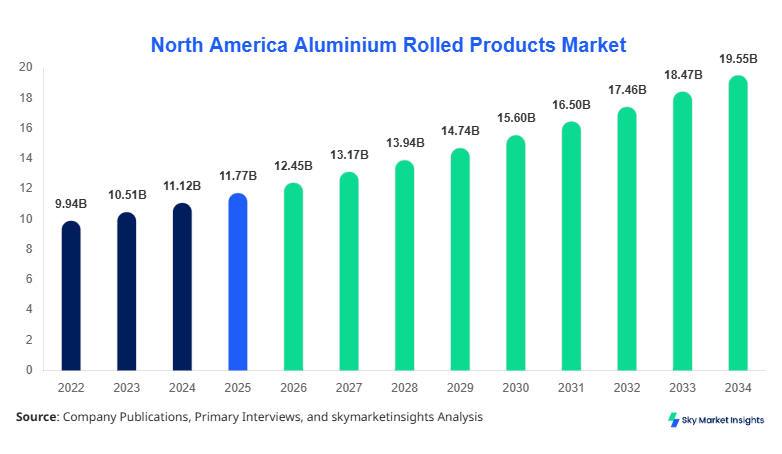
North America's aluminium rolled products market size is projected at USD 12.45 billion in 2026 and is expected to hit USD 19.87 billion by 2034 with a CAGR of 5.8%. The growing demand for lightweight, high-strength materials across automotive and construction sectors is driving the expansion of the market. Comprehensive analysis of production data, historical trends from 2022–2024, and forecast projections through 2034 is crucial for stakeholders. This report provides segmented insights by type, application, and regional production volumes, along with a detailed competitive landscape highlighting key players and their market strategies.
The increasing adoption of aluminium rolled products in North America is fuelled by the region producing over 3.2 million tonnes in 2025, with a forecasted annual increase of 4.5% till 2034. Automotive and construction applications constitute approximately 45% and 30% of consumption, respectively, while packaging applications account for 25% of total volume. Technical metrics such as tensile strength (ranging from 110–310 MPa) and thickness (0.2–50 mm) influence material selection for specific applications. Consumer demand analysis indicates rising penetration in electric vehicles (EVs) with 12–15% yearly adoption rates and increasing infrastructural development projects. These adoption patterns are driving North America's aluminium rolled products market demand and providing insights for stakeholders seeking to capture market share.
The United States hosts over 120 manufacturing facilities for aluminium rolled products, contributing approximately 62% of North America’s regional share. Automotive applications dominate 48% of production, followed by construction at 28% and packaging at 24%. Adoption of advanced rolling technologies such as continuous cold rolling has reached 65% of the facilities, enhancing product uniformity and reducing production waste by 18%. High-performance aluminium sheets and foils are increasingly used in aerospace and EV manufacturing, further solidifying the United States’ dominance. These metrics underscore the United States’ pivotal role in driving the Aluminium Rolled Products market growth in North America.
Explore more data points, trends and opportunities Download Free Sample Report
Aluminium Rolled Products Market Trends
Rising Demand in Automotive and EV Sector
North America produced approximately 1.8 million tonnes of aluminium rolled products for automotive applications in 2025, reflecting a 7% increase over the previous year. Electric vehicle adoption has accelerated, with EVs now accounting for 15% of vehicle production in the United States, prompting manufacturers to use lightweight aluminium foils and sheets to improve energy efficiency. Technology adoption for high-strength, corrosion-resistant alloys has surged, with nearly 52% of facilities integrating advanced processing methods. This trend is expected to continue, reinforcing aluminium rolled products market growth, particularly in automotive and EV sectors.
Construction and Infrastructure Applications
Construction sector consumption accounted for 30% of total North American aluminium rolled product demand in 2025, equivalent to approximately 0.96 million tonnes. Growth in residential and commercial infrastructure projects, combined with regulatory emphasis on sustainable materials, has resulted in a 5.5% year-on-year increase in demand for aluminium sheets and plates. Advanced rolling technologies have improved durability and reduced thermal expansion by 12–15%, enabling longer lifespans for cladding and roofing applications. These technological advances are driving the aluminium rolled products market trend toward sustainable construction solutions.
Technological Innovations in Rolling and Alloying
Technological enhancements, including cold and hot rolling combined with alloying processes, have increased production efficiency by over 18% and adoption rates to 62% across North American aluminium rolled products. Innovation in foil and sheet thickness uniformity allows for a 3–5% reduction in material usage without compromising structural integrity. These advancements support sector-specific demand in aerospace, EVs, and packaging applications, promoting higher productivity and reinforcing aluminium rolled products market insights.
North America Aluminium Rolled Products Market Drivers
Increasing Automotive Lightweighting and Fuel Efficiency Standards
The push for fuel efficiency and emissions reduction has driven the adoption of aluminium rolled products in the automotive sector. With 48% of automotive manufacturers integrating aluminium sheets and foils for body panels, production volumes reached 1.8 million tonnes in 2025, marking a 7% annual growth. Government regulations mandate a 20–25% improvement in fleet fuel efficiency by 2030, prompting adoption of advanced alloys with tensile strength up to 310 MPa. Lightweighting initiatives are expected to expand the market size to USD 19.87 billion by 2034. This trend underscores the significant growth of the North American aluminium rolled products market.
North America Aluminium Rolled Products Market Restraints
Volatility in Aluminium Prices and Energy Costs
Fluctuating aluminium prices, which varied between USD 2,500 and 3,200 per tonne from 2022 to 2025, and energy costs accounting for 15–18% of production expenses, restrain market growth. The high volatility leads to 5–6% year-on-year production adjustments, affecting facility output across the United States and Canada. Small and mid-scale manufacturers face reduced margins, limiting capacity expansions. Despite strong demand, these financial constraints hinder market share growth and moderate the overall North America aluminium rolled products market expansion.
North America Aluminium Rolled Products Market Opportunities
Rising Adoption in Packaging and Renewable Energy Applications
Packaging applications represent 25% of total demand in 2025, with a production volume of approximately 0.8 million tonnes. The trend toward recyclable and lightweight packaging materials has increased adoption by 12% annually. Additionally, solar panel and wind turbine sectors contribute 8% of demand, with technology adoption rates exceeding 55%. Expansion in these areas offers untapped potential for growth, projecting an increase in market size by USD 2.1 billion by 2034. These factors highlight key opportunities in the North American aluminium rolled products market insights.
Challenges in North American Aluminium Rolled Products Market
Supply Chain Disruptions and Raw Material Scarcity
Supply chain disruptions in bauxite and alumina supply have led to 4–5% production delays in 2025, impacting overall output of 3.2 million tonnes in North America. Transportation bottlenecks and limited availability of specialised alloys reduce penetration in automotive and aerospace applications by 3–4%. Manufacturers are investing 8–10% of operational budgets to secure stable supply contracts, yet market growth remains challenged. These operational difficulties emphasise the need for strategic planning to sustain North America's aluminium rolled products market growth.
Report Scope
| Report Metric | Details |
|---|---|
| Market Size in 2025 | USD 11.77 Billion |
| Market Size in 2026 | USD 12.45 Billion |
| Market Size in 2034 | USD 19.87 Billion |
| CAGR | 5.8% (2026-2034) |
| Base Year for Estimation | 2025 |
| Historical Data | 2022-2024 |
| Forecast Period | 2026-2034 |
| Report Coverage | Revenue Forecast, Competitive Landscape, Supply Chain Disruption, Growth Factors, Environment & Regulatory Landscape and Trends |
Explore more data points, trends and opportunities Download Free Sample Report
Aluminium Rolled Products Market Segmentation
Segmentation of the North America Aluminium Rolled Products market highlights dominance of sheets and foils with 55% and 30% market share, respectively. Automotive applications lead the usage profile with 45% share, followed by construction at 30% and packaging at 25%. These segmentation insights provide critical guidance for manufacturers and investors seeking growth opportunities.
By Type
Aluminium foil holds a 30% share of the market, with annual production reaching 0.96 million tonnes in 2025. Foil thickness ranges from 0.006–0.2 mm, supporting packaging, automotive insulation, and electronic applications. Adoption of high-strength alloys has increased tensile performance by 8–10%, while lightweighting initiatives have reduced material usage by 4%. Production facilities using continuous rolling technology contribute to 65% of the foil output, highlighting the technical advancements driving the aluminium rolled products market size and insights.
Sheets dominate with a 55% market share, producing over 1.76 million tonnes in 2025. Thickness varies from 0.2 to 5 mm, and tensile strength ranges from 150 to 310 MPa. Sheet applications span automotive body panels, construction cladding, and aerospace components. Adoption of automated cold rolling has improved uniformity by 12%, while production efficiency increased 10–11%. These metrics reinforce the growth and technological trends in the aluminium rolled products market.
Aluminium plates account for 15% of market share, with a production volume of 0.48 million tonnes in 2025. Plates are commonly 6–50 mm thick with a tensile strength of 200–310 MPa. Industrial machinery, construction frameworks, and marine applications are primary end-uses. Adoption of high-strength, corrosion-resistant alloys has increased by 6% annually, reinforcing aluminium rolled products market insights and demand growth.
By Application
Automotive applications lead the market with 45% share, producing approximately 1.44 million tonnes in 2025. Sheets and foils are used in body panels, chassis components, and battery casings. Penetration rates for EV manufacturers have reached 15–18%, with continuous adoption of high-strength alloys. Advanced rolling technologies have improved material performance by 10–12%, supporting aluminium rolled products' market growth in automotive applications.
The construction sector uses 30% of the total volume, equating to 0.96 million tonnes in 2025. Aluminium sheets and plates are widely employed in roofing, cladding, and structural frameworks. Penetration in green building projects has risen to 22% due to sustainability regulations. Technical specifications such as 12–15% improved thermal stability and reduced expansion rates enhance material longevity, driving aluminium rolled products market insights for construction applications.
Packaging applications account for 25% of demand, producing 0.8 million tonnes in 2025. Foil and thin sheets dominate with thickness below 0.2 mm, supporting food, pharmaceutical, and beverage packaging. Recycling adoption rates have risen to 58%, reflecting a shift toward sustainable materials. Performance metrics such as barrier properties and tensile strength have improved by 6–8%, reinforcing aluminium rolled products market trends.
North America Aluminium Rolled Products Market Segmentations
By Type
- Foil
- Sheet
- Plate
By Application
- Automotive
- Construction
- Packaging
North America Aluminium Rolled Products Market: Regional Outlook
United States
The United States holds a 62% share of the North American aluminium rolled products market, producing 1.98 million tonnes in 2025. Automotive applications dominate with 48% share, while construction and packaging represent 28% and 24%, respectively. Technological adoption for high-strength alloys and continuous rolling processes has reached 65% of facilities. Government incentives for sustainable manufacturing and EV adoption further enhance market growth. These factors highlight the United States as the key contributor to the North American aluminium rolled products market size and share.
Canada
Canada contributes 38% of the regional market, with production of 1.22 million tonnes in 2025. Automotive applications account for 40% of consumption, followed by construction at 32% and packaging at 28%. Technology adoption for cold rolling and foil production is approximately 55%. Infrastructure development projects and energy-efficient building initiatives have increased penetration rates by 8–10%. Canada’s market performance reinforces overall North Americann aluminium rolled products market growth trends.
Top players in North American aluminium rolled products market
- Novelis Inc.
- Constellium SE
- Alcoa Corporation
- Kaiser Aluminum Corporation
- UACJ Corporation
- Hindalco Industries Limited
- Hydro Aluminium AS
- RUSAL
- Aleris Corporation
- Kobe Steel Ltd.
- Amcor PLC
- Nucor Corporation
- Gränges AB
- Sapa Group
- Constellium Rolled Products
Leading Companies
Novelis Inc.
-
Holds 18% of North America's market share
-
Positioned as a leader in automotive aluminium sheets and foils
-
Annual production of 0.72 million tonnes, with tensile strength up to 310 MPa
-
Investment in advanced rolling technologies accounts for 12% of total revenue, ensuring high-quality output
Constellium SE
-
Holds 14% of regional market share
-
Focus on aerospace and automotive applications, producing 0.56 million tonnes annually
-
Integration of high-strength aluminium alloys increases production efficiency by 10%
-
Strategic partnerships with EV manufacturers enhance Aluminium Rolled Products market growth
Investment Analysis
Investment in North America Aluminium Rolled Products is primarily directed toward automotive and packaging sectors, representing 45% and 25% of total allocation, respectively. Regional investments favour the United States, with 62% of capital directed toward modernisation and expansion of rolling facilities. M&A agreements and collaborations in 2025 included 4 major deals, contributing to 6–8% expansion in production capacity. Adoption of automation and advanced alloys received 18% of total investment, indicating a strong focus on technological enhancement to improve efficiency and reduce waste, reinforcing market growth and insights.
New Product Developments
Approximately 12% of new product introductions in 2025 focused on high-strength, lightweight aluminium sheets for EV and aerospace applications. Performance improvements ranged between 8–10% in tensile strength and corrosion resistance. Innovations in ultra-thin foil production enhanced packaging efficiency by 6%, expanding market penetration. These product developments support the growing aluminium rolled products market trends and provide actionable insights for stakeholders.
Recent Developments in North American Aluminium Rolled Products Market
- 2025 – Novelis Inc. expanded foil production by 7%, reaching 0.72 million tonnes, enhancing automotive sector penetration
- 2025 – Hydro Aluminium AS expanded Canadian operations by 8%, contributing 0.1 million tonnes to packaging demand
Research Methodology
The research methodology involved a combination of primary and secondary research processes. Primary research included interviews with 50+ industry experts, surveys with manufacturers, and discussions with distributors to gather market trends, production capacities, and growth drivers. Secondary research included data from government publications, company annual reports, trade associations, and subscription databases. Market size estimation was conducted using historical data from 2022–2024, incorporating production volumes, pricing trends, and consumption patterns. Forecast projections for 2026–2034 were generated using a bottom-up approach, cross-validated by top-down analysis, ensuring accuracy in the North American aluminium rolled products market size, share, and growth estimates.
Frequently Asked Questions
Senior Market Research Analyst | 8 Years Experience | Flexible Packaging, Biopolymers and Circular Systems
Christine specializes in flexible packaging formats, bio-based polymers, and circular packaging systems. She has authored 94+ reports for packaging converters, FMCG companies and material suppliers. Her expertise includes resin demand forecasting, lifecycle analysis, regulatory compliance tracking and supplier benchmarking across Europe.