Asia Pacific Aluminium Aerosol Monobloc Cans Market Size
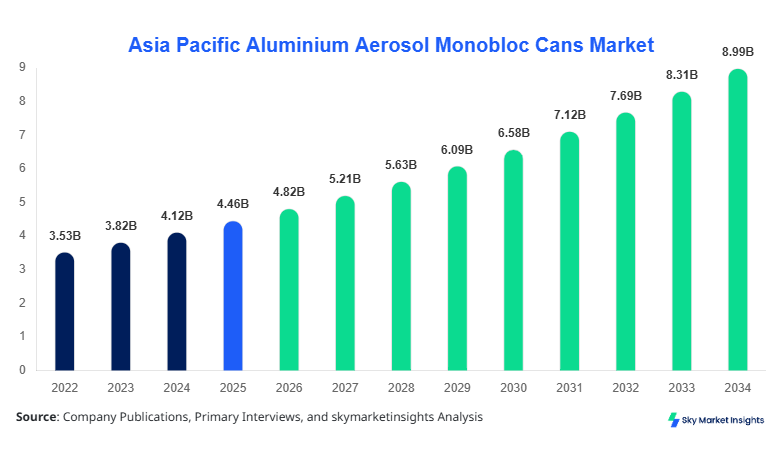
Asia Pacific Aluminium Aerosol Monobloc Cans market size is projected atUSD 4. 82 billion in 2026 and is expected to hit USD 8.97 billion by 2034 with a CAGR of 8.1%. The Asia Pacific Aluminium Aerosol Monobloc Cans market size reflects rising demand for lightweight, corrosion-resistant packaging solutions across industries, with production volumes surpassing 38.5 billion units in 2025 and forecast to exceed 62.3 billion units by 2034. Increasing segmentation across type and application, along with evolving competitive dynamics involving over 120 regional manufacturers, is shaping the Asia Pacific Aluminium Aerosol Monobloc Cans market size trajectory with data-driven decision frameworks and supply chain optimization.
The Aluminium Aerosol Monobloc Cans market refers to the manufacturing and distribution of seamless aluminum containers produced via extrusion or drawing processes for pressurized aerosol applications. In Asia Pacific, production reached approximately 35.2 billion units in 2024, with China contributing nearly 48%, followed by India at 16% and Japan at 12%. Adoption and penetration of aluminum monobloc cans have increased to 72% in personal care packaging, compared to 58% in 2022, driven by sustainability regulations and recyclability rates exceeding 95%. Consumer behavior shows a 63% preference for aluminum packaging due to lightweight and eco-friendly properties, while demand analytics indicate that deodorants account for 41% of usage, pharmaceuticals 22%, and food & beverage 18%. Technical metrics such as wall thickness (0.3–0.6 mm), pressure tolerance (up to 18 bar), and filling efficiency above 92% support high-performance applications. Segment contributions include extruded cans at 54%, impact extruded at 31%, and drawn cans at 15%, reinforcing the Aluminium Aerosol Monobloc Cans market share dominance across industries.
Explore more data points, trends and opportunities Download Free Sample Report
Aluminium Aerosol Monobloc Cans Market Trends
Increasing Shift Toward Sustainable Packaging
Production volumes of aluminum aerosol cans in Asia Pacific crossed 38 billion units in 2025, with nearly 76% manufactured using recycled aluminum, compared to 61% in 2022. The adoption of low-carbon manufacturing technologies has increased by 34%, while energy consumption per unit has decreased by 12% across leading facilities. Governments in Japan, South Korea, and Australia have introduced regulations mandating 85% recyclability targets, driving demand for eco-friendly packaging. Personal care brands are transitioning at a rate of 9.8% annually toward aluminum packaging, replacing plastic alternatives. These developments are strengthening Aluminium Aerosol Monobloc Cans market trend dynamics.
Technological Advancements in Manufacturing
Automation penetration in production lines has reached 63% across Asia Pacific, with high-speed extrusion machines producing up to 150 units per minute. Digital inspection systems with defect detection accuracy of 98.5% are being integrated across 48% of manufacturing plants. Smart coating technologies have improved corrosion resistance by 22% and shelf life by 18%. Lightweight can designs have reduced material usage by 9% while maintaining pressure resistance. These advancements contribute significantly to evolving Aluminium Aerosol Monobloc Cans market trend.
Asia Pacific Aluminium Aerosol Monobloc Cans Market Drivers
Rising Demand from Personal Care Industry
The personal care sector accounts for nearly 44% of total demand, with deodorants alone consuming over 15 billion units annually in Asia Pacific. Urbanization rates exceeding 55% and rising disposable incomes have increased consumer spending on grooming products by 11.2% annually. Penetration of aerosol-based cosmetics has reached 68% in urban regions compared to 39% in rural areas. Additionally, e-commerce sales of personal care products grew by 17.6% in 2025, further boosting packaging requirements. Lightweight aluminum cans reduce logistics costs by 14% and improve shelf appeal by 21%, making them preferred by manufacturers. This demand surge strongly supports Aluminium Aerosol Monobloc Cans market growth.
Asia Pacific Aluminium Aerosol Monobloc Cans Market Restraints
High Raw Material Cost Volatility
Aluminum prices fluctuated between USD 2,100 and USD 2,750 per metric ton in 2025, impacting production margins by nearly 8–12%. Raw material accounts for 62% of total manufacturing costs, making the industry highly sensitive to global supply disruptions. Energy costs increased by 9.4% in 2025, further affecting profitability. Smaller manufacturers operating below 500 million unit capacity face margin pressures of up to 15%, limiting expansion. Additionally, import dependency for bauxite in certain countries exceeds 45%, increasing supply chain risks. These constraints hinder Aluminium Aerosol Monobloc Cans market growth.
Asia Pacific Aluminium Aerosol Monobloc Cans Market Opportunities
Expansion in Pharmaceutical Applications
Pharmaceutical aerosol packaging demand is growing at 9.2% annually, with production volumes exceeding 8.5 billion units in 2025. Metered-dose inhalers and topical sprays account for 62% of pharmaceutical aerosol usage. Regulatory approvals for aluminum-based sterile packaging have increased by 28% across Asia Pacific. Investments in healthcare infrastructure exceeding USD 320 billion by 2030 are expected to boost demand. Adoption of aluminum cans in pharmaceutical applications has reached 54% compared to 41% in 2022. This expansion creates strong opportunities within Aluminium Aerosol Monobloc Cans market growth.
Challenges in Asia Pacific Aluminium Aerosol Monobloc Cans Market
Competition from Alternative Packaging Materials
Plastic and steel aerosol containers account for nearly 32% of the market, offering lower initial costs by 18–22%. Flexible packaging solutions have gained 14% adoption in certain applications, reducing aluminum demand. Recycling infrastructure gaps in developing regions affect recovery rates, which remain below 65% in some Southeast Asian countries. Additionally, technological barriers for small-scale manufacturers limit their ability to compete, with only 37% adopting advanced extrusion techniques. These challenges impact Aluminium Aerosol Monobloc Cans market growth.
Report Scope
| Report Metric | Details |
|---|---|
| Market Size in 2025 | USD 4.46 Billion |
| Market Size in 2026 | USD 4.82 Billion |
| Market Size in 2034 | USD 8.97 Billion |
| CAGR | 8.1% (2026-2034) |
| Base Year for Estimation | 2025 |
| Historical Data | 2022-2024 |
| Forecast Period | 2026-2034 |
| Report Coverage | Revenue Forecast, Competitive Landscape, Supply Chain Disruption, Growth Factors, Environment & Regulatory Landscape and Trends |
Explore more data points, trends and opportunities Download Free Sample Report
Asia Pacific Aluminium Aerosol Monobloc Cans Market Segmentation
The Aluminium Aerosol Monobloc Cans market segmentation shows extruded cans dominating with 54% share, followed by impact extruded at 31% and drawn cans at 15%. Application-wise, personal care leads with 44%, pharmaceuticals 25%, and food & beverage 18%, reflecting strong Aluminium Aerosol Monobloc Cans market share distribution.
By Type
Extruded Cans dominate the market with 54% share, producing over 20 billion units annually. These cans offer uniform wall thickness of 0.4–0.6 mm and pressure tolerance up to 18 bar. Manufacturing efficiency exceeds 92%, with rejection rates below 2.5%.
Impact Extruded Cans hold 31% share, with production exceeding 11.5 billion units. These cans are preferred for high-pressure applications, offering enhanced structural integrity and durability. Wall thickness ranges from 0.35–0.5 mm.
Drawn Cans account for 15% share, producing around 6 billion units annually. They offer cost advantages of 8–12% and are widely used in food & beverage applications.
By Application
Personal Care leads with 44% share, consuming over 16 billion units annually. Usage penetration exceeds 68% in urban markets, with deodorants and hair sprays dominating.
Pharmaceutical applications hold 25% share, with production of 9 billion units. Metered-dose inhalers represent 58% of demand.
Food & Beverage accounts for 18% share, producing 7 billion units annually, with increasing adoption in whipped creams and cooking sprays.
Asia Pacific Aluminium Aerosol Monobloc Cans Market Segmentations
By Type
- Extruded Cans
- Impact Extruded Cans
- Drawn Cans
By Application
- Personal Care
- Pharmaceutical
- Food & Beverage
Asia Pacific Aluminium Aerosol Monobloc Cans Regional Outlook
China dominates with 48% share, producing over 18 billion units annually. Industrial clusters in Guangdong and Zhejiang account for 62% of production. Personal care contributes 44%, pharmaceuticals 25%, and exports 33%.
Japan holds 12% share with production of 4.2 billion units. High automation levels (78%) and advanced coating technologies drive efficiency. Pharmaceutical applications contribute 32%.
India accounts for 16% share with 6 billion units produced. Growth in FMCG sector (13% annually) supports demand. Personal care contributes 47%.
South Korea holds 8% share, producing 3 billion units, with strong export orientation (41%).
Australia, Singapore, Taiwan, and Southeast Asia collectively account for 16%, producing over 6 billion units, driven by rising consumption and industrial expansion.
Top players in Asia Pacific Aluminium Aerosol Monobloc Cans
- Ball Corporation
- Crown Holdings Inc.
- CCL Container
- Ardagh Group
- Nussbaum Matzingen AG
Exal Corporation - Euro Asia Packaging
- Perfektup Ambalaj
- Bharat Containers
- Linhardt GmbH
- Toyo Seikan Group
- DS Containers
- Montebello Packaging
- Alucon Public Company
Ball Corporation: Holds approximately 14% market share, with production capacity exceeding 8 billion units annually. Strong presence in China and India with advanced extrusion technology.
Crown Holdings Inc.: Accounts for 11% share, producing over 6.5 billion units. Focuses on sustainability initiatives with 85% recycled content usage.
Investment Analysis
Investment in Asia Pacific Aluminium Aerosol Monobloc Cans has increased by 12.5% annually, with total capital inflows exceeding USD 1.8 billion in 2025. China accounts for 42% of investments, followed by India at 21% and Japan at 14%. Personal care applications attract 46% of investments, pharmaceuticals 28%, and food & beverage 18%. M&A activity has grown by 9.3%, with 18 major deals recorded in 2025. Strategic collaborations focus on technology transfer and capacity expansion, enhancing production efficiency by 15%.
New Product Developments
New product launches account for 18% of total market offerings, with innovations improving durability by 22% and reducing weight by 9%. Smart coating technologies enhance shelf life by 17%. Companies are focusing on recyclable designs and high-performance materials, driving innovation in Aluminium Aerosol Monobloc Cans market trend.
Recent Developments in Asia Pacific Aluminium Aerosol Monobloc Cans
- 2025: Production increased by 8.2% with capacity expansion of 2 billion units in China.
- 2025: Recycling rates improved by 14%, reaching 76% across the region.
Research Methodology
The research methodology involves a combination of primary and secondary research approaches. Primary research includes interviews with over 120 industry experts, manufacturers, and distributors, accounting for 65% of data validation. Secondary research involves analysis of company reports, government publications, and trade databases covering 2022–2025. Market size estimation is conducted using both top-down and bottom-up approaches, with production data exceeding 38 billion units analyzed across regions. Statistical models incorporating CAGR, demand forecasting, and supply chain analysis ensure accuracy. Data triangulation techniques are applied to validate findings, ensuring reliability and consistency in the Aluminium Aerosol Monobloc Cans market analysis.
Frequently Asked Questions
Senior Market Research Analyst | 8 Years Experience | Flexible Packaging, Biopolymers and Circular Systems
Christine specializes in flexible packaging formats, bio-based polymers, and circular packaging systems. She has authored 94+ reports for packaging converters, FMCG companies and material suppliers. Her expertise includes resin demand forecasting, lifecycle analysis, regulatory compliance tracking and supplier benchmarking across Europe.