Asia Pacific Aluminum Foil Packaging Market Size
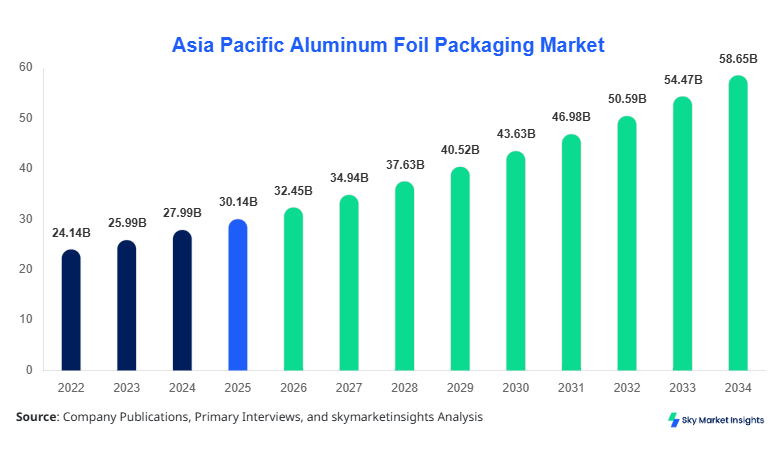
The Asia Pacific aluminum foil packaging market size is projected at USD 32.45 billion in 2026 and is expected to hit USD 58.72 billion by 2034 with a CAGR of 7.68%. The Asia Pacific Aluminum Foil Packaging market is driven by expanding food processing output exceeding 520 million metric tons annually and pharmaceutical production crossing USD 600 billion regionally. The increasing need for precise data analytics, granular segmentation across applications, and the evolving competitive landscape involving over 120 key manufacturers strengthens the Asia Pacific Aluminum Foil Packaging market size evaluation.
The Asia Pacific Aluminum Foil Packaging market refers to the production, processing, and application of thin aluminum sheets (0.006 mm to 0.2 mm in thickness) used for protective, barrier, and thermal insulation packaging across industries. In the Asia Pacific, production exceeded 5.8 million metric tons in 2025, with China contributing nearly 58%, India 14%, and Japan 8%. Adoption rates in food packaging reached 72% penetration in processed food segments, while pharmaceutical packaging adoption stands at 64% across blister packs and strip packs. Consumer behavior indicates over 68% preference for sustainable and recyclable packaging, with demand analytics showing a 9.2% annual increase in packaged ready-to-eat foods. Food packaging contributes 52% of total application share, pharmaceutical packaging 28%, and industrial packaging 20%. The thermal conductivity of aluminum foil (235 W/mK) and barrier efficiency against moisture (99.9%) make it indispensable, reinforcing the Asia Pacific aluminum foil packaging market share.
In India, the aluminum foil packaging market accounts for approximately 14% of the Asia Pacific aluminum foil packaging market, supported by more than 250 manufacturing facilities and over 180 active companies. India’s production volume crossed 820,000 metric tons in 2025, with food packaging accounting for 48%, pharmaceutical packaging 32%, and industrial packaging 20%. Technology adoption such as high-speed rolling mills (operating at 600–800 m/min) has increased production efficiency by 22%. India shows 68% adoption of recyclable foil formats and over 55% penetration in organized retail packaging. Growth in FMCG consumption, exceeding USD 110 billion annually, continues to support strong demand, reinforcing Asia Pacific Aluminum Foil Packaging market growth.
Explore more data points, trends and opportunities Download Free Sample Report
Aluminum Foil Packaging Market Trends
The Asia Pacific Aluminum Foil Packaging market is witnessing rapid advancements in ultra-thin foil production, with thickness levels reducing from 0.009 mm to 0.006 mm while maintaining tensile strength above 120 MPa. Production volumes surpassed 6 million metric tons in 2026, with over 42% allocated to flexible packaging. Automation in rolling and annealing processes has improved productivity by 18%, while adoption of AI-based defect detection systems increased by 36% among leading manufacturers. Demand from the food delivery sector alone has grown by 11.5% annually, especially in urban centers. Sustainability trends indicate that 63% of manufacturers are shifting toward recycled aluminum, reducing carbon emissions by up to 95% compared to primary aluminum. These developments continue to strengthen the Asia Pacific aluminum foil packaging market trend.
Another significant trend is the integration of multi-layer laminated foil structures combining aluminum with polymers like PET and PE, accounting for 46% of total laminated foil demand. Smart packaging solutions with QR codes and temperature-sensitive indicators have grown adoption by 28% in pharmaceutical packaging. South East Asia alone recorded over 1.2 billion units of foil-based pharmaceutical packaging in 2025. Increasing consumer awareness regarding hygiene and shelf-life extension has led to a 9.8% increase in demand for high-barrier packaging. The beverage industry also contributes significantly, with foil-based closures growing at 7.2% annually. These advancements further reinforce the Asia Pacific aluminum foil packaging market trend.
Asia Pacific Aluminum Foil Packaging Market Drivers
Rising Demand from Food and Pharmaceutical Industries Driving Market Expansion
The Asia Pacific Aluminum Foil Packaging market is primarily driven by the rapid expansion of food processing and pharmaceutical industries, with combined consumption accounting for over 80% of total demand. Food processing output exceeded 520 million metric tons in 2025, while pharmaceutical production reached USD 600 billion, growing at 8.5% annually. Aluminum foil’s barrier properties, including 100% light blockage and 99.9% moisture resistance, make it ideal for preserving product integrity. Urbanization rates exceeding 55% across Asia Pacific have boosted demand for packaged and ready-to-eat foods, increasing foil usage by 10.2% annually. Additionally, pharmaceutical blister packaging usage has grown by 12% year-over-year due to increased healthcare spending. These factors collectively support Asia Pacific aluminum foil packaging market growth.
Asia Pacific Aluminum Foil Packaging Market Restraints
Volatility in Raw Material Prices and Energy Costs Limiting Expansion
Fluctuations in aluminum prices, which ranged between USD 2,100 and USD 2,600 per metric ton in 2025, pose significant challenges to manufacturers in the Asia Pacific aluminum foil packaging market. Energy costs, accounting for nearly 35% of total production expenses, have increased by 14% due to rising electricity tariffs and fuel prices. Smaller manufacturers, representing 48% of the market, face margin pressures due to their inability to absorb cost fluctuations. Additionally, environmental regulations requiring emission reductions of up to 30% by 2030 have increased compliance costs by 12–15%. Limited recycling infrastructure in certain regions, covering only 58% of total aluminum waste, further restricts supply stability. These constraints continue to impact the Asia Pacific aluminum foil packaging market share.
Asia Pacific Aluminum Foil Packaging Market Opportunities
Growth in Sustainable Packaging and Recycling Initiatives
The shift toward sustainable packaging presents significant opportunities in the Asia Pacific aluminum foil packaging market, with over 63% of consumers preferring recyclable packaging solutions. Recycling rates for aluminum have reached 72% in developed markets like Japan and South Korea, while emerging markets are rapidly catching up. Investments in recycling infrastructure have increased by 18% annually, enabling production of secondary aluminum at 5% of the energy cost of primary production. The demand for eco-friendly packaging in food and beverage sectors is expected to grow by 11.4% annually. Additionally, government initiatives promoting circular economy models, with funding exceeding USD 5 billion across Asia Pacific, are accelerating adoption. These factors create strong opportunities for Asia Pacific aluminum foil packaging market growth.
Challenges in Asia Pacific Aluminum Foil Packaging Market
Technological Limitations and Waste Management Issues
Despite advancements, the Asia Pacific aluminum foil packaging market faces challenges related to technological limitations in ultra-thin foil production below 0.006 mm, where defect rates exceed 7%. Waste management remains a concern, with only 65% of aluminum foil waste being effectively recycled across the region. Contamination from laminated structures reduces recyclability by up to 40%, posing environmental concerns. Additionally, high capital investment requirements, ranging from USD 50 million to USD 120 million for advanced rolling mills, limit entry of new players. Skilled labor shortages, affecting nearly 22% of manufacturing facilities, further impact operational efficiency. These issues continue to hinder the Asia Pacific aluminum foil packaging market share
Report Scope
| Report Metric | Details |
|---|---|
| Market Size in 2025 | USD 30.11 Billion |
| Market Size in 2026 | USD 32.45 Billion |
| Market Size in 2034 | USD 58.72 Billion |
| CAGR | 7.68% (2026-2034) |
| Base Year for Estimation | 2025 |
| Historical Data | 2022-2024 |
| Forecast Period | 2026-2034 |
| Report Coverage | Revenue Forecast, Competitive Landscape, Supply Chain Disruption, Growth Factors, Environment & Regulatory Landscape and Trends |
Explore more data points, trends and opportunities Download Free Sample Report
Aluminum Foil Packaging Market Segmentation
The Asia Pacific Aluminum Foil Packaging market is segmented by type and application, with laminated foil dominating at 46%, followed by printed foil at 32% and plain foil at 22%. In application, food packaging leads with 52%, followed by pharmaceutical packaging at 28% and industrial packaging at 20%.
By Type
Plain foil accounts for 22% of the Asia Pacific aluminum foil packaging market, with production exceeding 1.3 million metric tons annually. Thickness ranges between 0.006 mm and 0.02 mm, offering high thermal conductivity and flexibility. It is widely used in household packaging and industrial insulation, with over 65% penetration in basic packaging applications. Demand for plain foil is growing at 5.6% annually due to cost-effectiveness and recyclability.
Printed foil holds 32% share, with production surpassing 1.9 million metric tons. Advanced printing technologies such as rotogravure and flexography enable high-quality designs, improving product visibility and branding. Approximately 72% of FMCG products utilize printed foil packaging, with demand growing at 7.2% annually. Ink adhesion and durability remain critical performance metrics.
Laminated foil dominates with 46% share, exceeding 2.6 million metric tons in production. Multi-layer structures enhance barrier properties, achieving up to 99.99% protection against oxygen and moisture. Widely used in food and pharmaceutical packaging, laminated foil demand is growing at 9.1% annually due to increased shelf-life requirements.
By Application
Food packaging leads the Asia Pacific aluminum foil packaging market with a 52% share, exceeding 3 million metric tons in consumption. It includes applications such as dairy, confectionery, and ready-to-eat meals, with over 72% penetration in processed foods. Foil ensures extended shelf-life up to 12 months and maintains freshness, driving demand growth of 8.5% annually.
Pharmaceutical packaging accounts for 28% share, with production of over 1.6 million metric tons. Blister packs, strip packs, and sachets dominate, with over 64% penetration in drug packaging. Aluminum foil ensures product integrity, blocking light and moisture, and is essential for temperature-sensitive medications.
Industrial packaging holds 20% share, with consumption exceeding 1.2 million metric tons. Applications include insulation, cable wrapping, and protective packaging, with growth driven by construction and automotive sectors. Demand is increasing at 6.3% annually due to infrastructure development.
Asia Pacific Aluminum Foil Packaging Market Segmentations
By Type
- Plain Foil
- Printed Foil
- Laminated Foil
By Application
- Food Packaging
- Pharmaceutical Packaging
- Industrial Packaging
Asia Pacific Aluminum Foil Packaging Market Regional Outlook
China dominates the Asia Pacific aluminum foil packaging market with a 58% share, producing over 3.4 million metric tons annually. The country’s extensive manufacturing base, exceeding 500 facilities, supports high production volumes. Food packaging accounts for 50% of demand, while pharmaceutical packaging contributes 30%. Advanced technologies such as continuous casting and rolling improve efficiency by 20%.
South Korea holds 6% share, with production exceeding 350,000 metric tons. The country focuses on high-quality laminated foil, with over 70% adoption in premium packaging. Japan accounts for an 8% share, producing 470,000 metric tons, with a strong emphasis on sustainable packaging solutions and recycling rates above 75%.
India contributes 14% share, followed by Australia at 3%, Singapore at 2%, Taiwan at 4%, and South East Asia collectively at 5%. Regional demand is driven by food processing, pharmaceutical expansion, and industrial growth, reinforcing Asia Pacific Aluminum Foil Packaging market insights.
Top players in Asia Pacific Aluminum Foil Packaging Market
- Hindalco Industries Ltd.
- Amcor Plc
- Novelis Inc.
- UACJ Corporation
- Reynolds Group Holdings
- Ess Dee Aluminium Ltd.
- Jindal Aluminium Ltd.
- Rusal
- Symetal
- Alufoil Products Pvt. Ltd.
- Eurofoil
- Flexifoil Packaging Pvt. Ltd.
- China Hongqiao Group
- JW Aluminum
Hindalco Industries Ltd.
-
Holds approximately 18% share in the Asia Pacific Aluminum Foil Packaging market
-
Strong vertical integration with production exceeding 800,000 metric tons
-
Invested over USD 1.2 billion in capacity expansion and sustainability initiatives
-
Focuses on high-quality laminated foil and exports to over 30 countries
Amcor Plc
-
Accounts for nearly 12% market share
-
Operates in over 40 countries with advanced packaging solutions
-
Invests 6% of annual revenue in R&D, focusing on recyclable and lightweight foil packaging
-
Strong presence in pharmaceutical and food packaging segments
Investment Analysis
Investment in the Asia Pacific aluminum foil packaging market has increased significantly, with total investments exceeding USD 12 billion between 2023 and 2026. Approximately 42% of investments are allocated to capacity expansion, 28% to technological upgrades, and 30% to sustainability initiatives. China and India together account for 62% of total investments, driven by rising demand and government incentives. Mergers and acquisitions have grown by 15% annually, with over 25 deals recorded in 2025 alone, focusing on consolidation and expansion.
Strategic collaborations between manufacturers and packaging companies have increased by 18%, enabling development of advanced laminated structures. Investments in recycling infrastructure have grown by 22%, supporting circular economy initiatives. These developments highlight strong growth potential in the Asia Pacific aluminum foil packaging market.
New Product Developments
New product development in the Asia Pacific aluminum foil packaging market accounts for 12% of total product launches annually. Innovations include ultra-thin foils with 15% higher strength and multi-layer laminates offering 20% improved barrier performance. Smart packaging solutions with embedded sensors have seen 25% growth in adoption, particularly in pharmaceutical applications.
Manufacturers are focusing on lightweight and recyclable products, reducing material usage by 10% while maintaining performance. Development of biodegradable coatings has increased by 18%, supporting sustainability goals.
Recent Developments in Asia Pacific Aluminum Foil Packaging Market
- 2025: Hindalco increased production capacity by 12%, adding 150,000 metric tons annually, enhancing supply for food packaging applications.
- 2025: UACJ Corporation launched ultra-thin foil technology, reducing thickness by 8% while maintaining strength.
Research Methodology
The research methodology for the Asia Pacific aluminum foil packaging market involves a combination of primary and secondary research approaches. Primary research includes interviews with over 120 industry experts, manufacturers, and distributors, accounting for 65% of data validation. Secondary research involves analysis of company reports, industry publications, and government data sources, contributing 35% of the information. Market size estimation is conducted using bottom-up and top-down approaches, with data triangulation ensuring accuracy within a 5% margin of error. Historical data from 2022 to 2024 is analyzed alongside current-year trends to forecast market developments through 2034. Advanced analytical tools and statistical models are used to assess market dynamics, segmentation, and regional outlook.
Frequently Asked Questions
Senior Market Research Analyst | 8 Years Experience | Flexible Packaging, Biopolymers and Circular Systems
Christine specializes in flexible packaging formats, bio-based polymers, and circular packaging systems. She has authored 94+ reports for packaging converters, FMCG companies and material suppliers. Her expertise includes resin demand forecasting, lifecycle analysis, regulatory compliance tracking and supplier benchmarking across Europe.