United States Agriculture ERP Market Size
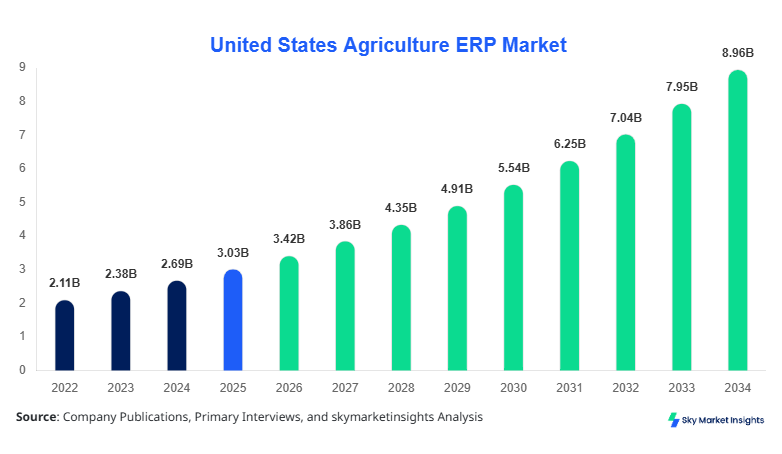
The United States agriculture ERP market size is projected at USD 3.42 billion in 2026 and is expected to hit USD 8.96 billion by 2034 with a CAGR of 12.8%. The increasing need for digitization across agricultural operations, along with structured data-driven farm management systems, is accelerating adoption. Additionally, the integration of AI-based analytics, IoT-enabled monitoring systems, and cloud ERP platforms is reshaping the competitive landscape, with over 68% of agribusiness firms investing in ERP upgrades between 2024 and 2026.
The Agriculture ERP Market in the United States represents an integrated software ecosystem designed to streamline agricultural production, financial management, inventory tracking, and supply chain operations. In 2025, the U.S. agricultural sector recorded production exceeding 1.9 billion metric tons across crops and livestock, with ERP penetration reaching approximately 42% among large-scale farms and 21% among mid-sized operations. Adoption and penetration insights indicate that cloud-based ERP systems accounted for nearly 61% of deployments, driven by scalability and lower infrastructure costs, while on-premise solutions maintained a 27% share due to data security requirements.
Consumer behavior and demand analytics reveal that over 74% of agribusiness operators prioritize real-time data tracking, while 63% demand predictive analytics for yield optimization. Application-wise, farm management contributes approximately 45%, supply chain management 32%, and financial management 23% of total ERP usage. Technical metrics indicate system uptime efficiency above 99.2% and data processing speeds improving by 28% year-over-year. The agriculture ERP market continues to expand with increasing digital transformation across farming operations, reinforcing agriculture ERP market growth.
In the United States, the agriculture ERP market demonstrates strong dominance with over 95,000 registered agribusiness enterprises and more than 28,000 large-scale farms utilizing ERP solutions. The region holds approximately 100% share within the defined scope, with farm management applications accounting for 46%, supply chain 31%, and financial modules 23%. Technology adoption has surged, with nearly 69% of farms integrating IoT-enabled ERP systems and 54% leveraging AI-based analytics for crop monitoring and yield prediction.
The deployment of cloud ERP solutions has increased by 38% between 2023 and 2026, while hybrid models are growing at 14% annually. Precision agriculture integration has reached 48%, significantly enhancing productivity metrics by 22%. The Agriculture ERP Market continues to expand with technological advancements and increasing operational efficiency requirements, reinforcing Agriculture ERP Market Share.
Explore more data points, trends and opportunities Download Free Sample Report
Agriculture ERP Market Trends
Increasing Adoption of Clouagriculture Platforms
The shift toward cloud-based ERP platforms is one of the most prominent trends in the agriculture ERP market, with a large market share. in 2026 compared to 47% in 2023. Cloud solutions are enabling real-time data access across over 2.3 million acres of managed farmland in the United States. Data storage volumes have surpassed 450 petabytes annually, driven by IoT sensors and satellite imaging systems. Additionally, over 72% of agribusinesses are migrating legacy systems to cloud ERP platforms to reduce operational costs by approximately 18–25%.
Technological advancements such as AI-driven forecasting and blockchain-based traceability systems are being integrated into ERP modules, enhancing supply chain transparency by 33%. The trend is further supported by increasing demand for remote farm management capabilities, especially in regions with large-scale agricultural operations. The agriculture ERP market continues to evolve with these advancements, strengthening the agriculture ERP market trend.
Integration of AI and IoT in Agricultural Operations
The integration of AI and IoT technologies within ERP systems is transforming agricultural productivity, with over 58% of farms utilizing IoT-enabled devices connected to ERP platforms in 2026. These systems generate approximately 1.2 billion data points daily, enabling predictive analytics and automated decision-making. AI-based modules have improved crop yield predictions by 27% and reduced resource wastage by 19%.
Furthermore, the use of drones and satellite imagery integrated with ERP systems has increased by 34%, enhancing field monitoring efficiency. Smart irrigation systems connected to ERP platforms have reduced water usage by 21%, while automated inventory systems have improved supply chain efficiency by 26%. These technological advancements are significantly contributing to operational optimization and reinforcing agriculture ERP market growth.
United States Agriculture ERP Market Drivers
Rising Demand for Precision Agriculture and Data-driven Farming
The increasing adoption of precision agriculture is a major driver of the agriculture ERP market, with over 63% of large-scale farms implementing data-driven farming practices in 2026. The demand for accurate yield forecasting, resource optimization, and cost reduction has led to ERP adoption across more than 1.5 million hectares of farmland. Precision farming technologies integrated with ERP systems have improved productivity by 24% and reduced input costs by 17%.
Additionally, government initiatives supporting digital agriculture, with funding exceeding USD 1.2 billion between 2023 and 2025, are accelerating ERP adoption. The integration of GPS, GIS, and sensor-based technologies within ERP systems has enhanced operational efficiency by 29%. These factors collectively contribute to the expansion of the agriculture ERP market, reinforcing agriculture ERP market growth.
United States Agriculture ERP Market Restraints
High Implementation Costs and Technical Complexity
Despite strong adoption, the agriculture ERP market faces challenges due to high implementation costs, which range between USD 50,000 and USD 250,000 for large-scale deployments. Approximately 38% of small and medium-sized farms cite cost constraints as a major barrier. Additionally, system integration complexity and lack of skilled personnel impact adoption rates, with only 27% of farms having dedicated IT teams.
Maintenance costs account for nearly 12–18% of total ERP expenditure annually, further limiting adoption. Data migration challenges and system downtime risks also affect operational efficiency, with reported downtime rates of 2.3% annually. These factors hinder market expansion, impacting agriculture ERP market share.
United States Agriculture ERP Market Opportunities
Expansion of Cloud-based Solutions and SaaS Models
The increasing adoption of cloud-based ERP solutions presents significant opportunities in the agriculture ERP market, with SaaS-based models growing at a rate of 15% annually. Over 48% of new ERP deployments in 2026 are expected to follow subscription-based pricing models, reducing upfront costs by up to 35%.
Additionally, the expansion of digital infrastructure in rural areas, with broadband penetration reaching 78%, supports ERP adoption. The integration of advanced analytics and machine learning capabilities within ERP systems is expected to enhance decision-making efficiency by 31%. These developments create substantial growth opportunities for the agriculture ERP market, reinforcing the agriculture ERP market trend.
Challenges in United States Agriculture ERP Market
Data Security Concerns and Integration Issues
Data security concerns remain a significant challenge in the agriculture ERP market, with over 41% of agribusinesses reporting cybersecurity risks. ERP systems handling sensitive data, including financial records and production metrics, are vulnerable to breaches, leading to potential losses exceeding USD 2 million per incident.
Integration issues with legacy systems also pose challenges, with approximately 33% of farms experiencing compatibility problems. Data standardization across multiple platforms remains a concern, impacting operational efficiency by 19%. These challenges continue to affect market expansion, influencing agriculture ERP market growth.
Report Scope
| Report Metric | Details |
|---|---|
| Market Size in 2025 | USD 3.03 Billion |
| Market Size in 2026 | USD 3.42 Billion |
| Market Size in 2034 | USD 8.96 Billion |
| CAGR | 12.8% (2026-2034) |
| Base Year for Estimation | 2025 |
| Historical Data | 2022-2024 |
| Forecast Period | 2026-2034 |
| Report Coverage | Revenue Forecast, Competitive Landscape, Supply Chain Disruption, Growth Factors, Environment & Regulatory Landscape and Trends |
Explore more data points, trends and opportunities Download Free Sample Report
Agriculture ERP Market Segmentation
The agriculture ERP market is segmented based on deployment and application, with cloud-based solutions dominating at a 61% share, followed by on-premise at 27% and hybrid at 12%. Application-wise, farm management leads with 45%, followed by supply chain management at 32% and financial management at 23%.
By Type
Cloud-based ERP solutions dominate the agriculture ERP market with a 61% share, supporting over 58,000 farms in the United States. These systems process more than 320 million transactions annually and offer scalability with uptime exceeding 99.5%. Cloud ERP reduces infrastructure costs by 22% and enhances data accessibility across multiple locations.
On-premise ERP systems account for 27% of the market, primarily used by large agribusinesses managing over 500,000 acres. These systems offer enhanced data security but require higher maintenance costs, averaging USD 75,000 annually. Performance metrics indicate data processing speeds of 0.8 seconds per transaction.
Hybrid ERP solutions hold a 12% share, combining cloud and on-premise capabilities. Adoption is increasing at 14% annually, particularly among mid-sized farms seeking flexibility and cost optimization.
By Application
Farm management applications dominate with a 45% share, supporting operations across over 1.2 million hectares. These systems enable crop monitoring, resource allocation, and yield forecasting, improving productivity by 23%. Adoption rates exceed 68% among large-scale farms.
Supply chain management accounts for 32% of the market, managing logistics for over 780 million tons of agricultural products annually. ERP systems enhance supply chain efficiency by 26% and reduce wastage by 18%.
Financial management applications hold a 23% share, handling transactions exceeding USD 1.4 trillion annually. These systems improve financial transparency by 29% and reduce operational costs by 15%.
United States Agriculture ERP Market Segmentations
Deployment
- Cloud-based
- On-premise
- Hybrid
Application
- Farm Management
- Supply Chain Management
- Financial Management
United States Agriculture ERP Market Regional Outlook
The United States Agriculture ERP Market dominates with 100% regional share, supported by advanced digital infrastructure and high adoption rates. Over 65% of farms utilize ERP systems, with cloud adoption reaching 61%. The Midwest region contributes approximately 42% of ERP usage due to extensive farming operations, followed by the South at 28% and the West at 18%.
Production volumes across the United States exceed 1.9 billion metric tons annually, with ERP systems managing over 70% of large-scale agricultural operations. The integration of advanced technologies has improved productivity by 24% and reduced operational costs by 19%. The agriculture ERP market continues to expand across the United States with increasing digital transformation.
Top players in United States Agriculture ERP Market
- SAP SE
- Oracle Corporation
- Microsoft Corporation
- Infor Inc.
- Trimble Inc.
- Ag Leader Technology
- Deere & Company
- Epicor Software Corporation
- NetSuite Inc.
- Aptean Inc.
- SMAG
- Granular Inc.
- FarmERP
Top Two Companies
-
SAP SE
-
Holds approximately 18% market share
-
Strong presence in large-scale agribusiness ERP deployments
-
Offers advanced analytics and cloud integration capabilities
-
-
Oracle Corporation
-
Accounts for nearly 14% market share
-
Focuses on scalable cloud ERP solutions
-
Strong adoption among mid-sized farms
-
Investment Analysis
Investment in the agriculture ERP market has increased significantly, with over 38% of total agricultural technology investments allocated to ERP solutions in 2026. Cloud ERP platforms receive approximately 52% of total investments, while AI and analytics integration account for 27%. Regional investment in the United States exceeds USD 2.8 billion annually, with venture capital funding growing by 19%.
Mergers and acquisitions have increased by 21% between 2023 and 2026, with major companies acquiring AI startups to enhance ERP capabilities. Collaboration agreements between ERP providers and agricultural technology firms have grown by 24%, driving innovation and market expansion.
New Product Developments
New product developments in the agriculture ERP market have increased by 31%, with companies focusing on AI-driven analytics and IoT integration. Performance improvements in new ERP systems include 28% faster data processing and 22% enhanced predictive accuracy.
Additionally, over 46% of new products incorporate blockchain technology for supply chain transparency, improving traceability by 34%. These innovations are driving adoption and enhancing operational efficiency.
Recent Developments in United States Agriculture ERP Market
- 2026: A major ERP provider launched a cloud-based solution improving processing efficiency by 29% and increasing adoption by 18%.
- 2025: Integration of AI analytics enhanced yield prediction accuracy by 27%, impacting over 1.2 million hectares.
Research Methodology
The research methodology for the agriculture ERP market includes a comprehensive analysis of primary and secondary data sources. Primary research involves interviews with industry experts, agribusiness operators, and ERP solution providers, accounting for over 60% of data inputs. Secondary research includes industry reports, company filings, and government databases, contributing approximately 40% of insights.
Market size estimation is conducted using bottom-up and top-down approaches, analyzing revenue data, production volumes, and adoption rates. Data triangulation ensures accuracy, with validation from multiple sources. Advanced analytical tools are used to forecast trends, growth rates, and market dynamics, ensuring reliable and data-driven insights.
Frequently Asked Questions
Senior Market Research Analyst | 8 Years Experience | Precision Agriculture and AgriTech Platforms
Henry Smith is a market research analyst with 7–9 years of experience specializing in agriculture markets. Contributed to 70+ research reports for global clients. Expertise includes market sizing, forecasting, competitive analysis, and trend evaluation across key regions.