North America Agricultural Microbials Market Size
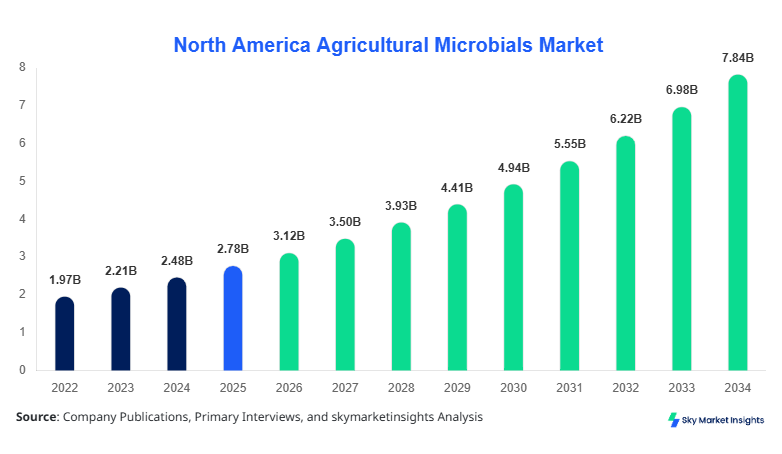
North America's agricultural microbials market size is projected at USD 3.12 billion in 2026 and is expected to hit USD 7.85 billion by 2034 with a CAGR of 12.2%. The report provides detailed insights into demand-supply dynamics, technological adoption rates, and evolving regulatory frameworks influencing the agricultural microbials market. Increasing demand for sustainable crop inputs and precision agriculture is accelerating segmentation analysis, while competitive benchmarking highlights key players capturing over 65% of the regional agricultural microbials market.
The agricultural microbials market refers to biologically derived microorganisms such as bacteria, fungi, and viruses used to enhance crop productivity and soil health. In North America, agricultural microbial production exceeded 185 million liters in 2025, with over 72% adoption among large-scale commercial farms. Penetration rates reached 58% across row crops and 46% in horticulture segments, driven by increasing awareness regarding chemical residue reduction. Consumer demand analytics indicate that over 63% of farmers prefer bio-based inputs due to a 15–25% improvement in yield efficiency and 18% reduction in chemical fertilizer usage. Crop protection accounts for approximately 41% of applications, followed by soil amendment at 34% and seed treatment at 25%. Technical performance metrics show microbial formulations improving nutrient uptake efficiency by 22% and pest resistance by 17%, reinforcing agricultural microbials' market demand.
In the United States, the agricultural microbials market accounts for approximately 78% of the North America region, supported by over 320 manufacturing facilities and 150+ biotechnology firms. The U.S. contributes nearly USD 2.4 billion in 2026, with application breakdown including 43% crop protection, 32% soil amendment, and 25% seed treatment. Technology adoption has reached 69% among large-scale farms and 52% among mid-sized farms, driven by regulatory support and sustainability mandates. Precision agriculture integration has improved microbial efficacy rates by 21%, while digital farming tools are used by 48% of growers to optimize application timing. The United States remains the primary driver of agricultural microbial market expansion.
Explore more data points, trends and opportunities Download Free Sample Report
Agricultural Microbials Market Trends
Rising Adoption of Bio-Based Inputs
The agricultural microbials market is witnessing a surge in production volumes exceeding 210 million liters annually by 2026, reflecting a 14% year-on-year increase. Bio-based inputs are replacing synthetic agrochemicals, with adoption rates climbing from 45% in 2022 to 68% in 2026. Advanced fermentation technologies have improved microbial shelf life by 30% and field performance by 18%. Demand from organic farming has grown by 22%, particularly in high-value crops such as fruits and vegetables, which account for 37% of microbial usage. This transformation is reinforcing the agricultural microbials market trend.
Integration with Precision Agriculture
Technological shifts toward precision agriculture have increased the use of microbial solutions integrated with IoT sensors and AI-driven analytics. Approximately 55% of farms in North America are now using digital tools to optimize microbial application rates, resulting in 19% higher yield efficiency and 12% cost savings. Drone-based application systems have grown by 26%, enabling uniform distribution of microbial formulations across large acreages exceeding 1.5 million hectares. These innovations are accelerating agricultural microbial market trend adoption.
North American Agricultural Microbials Market Drivers
Increasing Demand for Sustainable Agriculture Solutions
The agricultural microbials market is primarily driven by the growing demand for sustainable farming practices, with over 74% of North American farmers prioritizing eco-friendly inputs. Regulatory restrictions on chemical pesticides have increased by 28% since 2022, pushing adoption of microbial alternatives. Production volumes have surged from 150 million liters in 2022 to over 210 million liters in 2026, reflecting a 40% increase. Yield improvements of 15–25% and cost reductions of 10–18% have further incentivized adoption. Additionally, government subsidies covering up to 20% of microbial input costs have boosted usage across 65% of farms. The expanding organic farming sector, growing at 11% annually, is also a major contributor, reinforcing agricultural microbial market growth.
North American Agricultural Microbials Market Restraints
Limited Shelf Life and Storage Challenges
Despite strong demand, the agricultural microbials market faces challenges related to limited shelf life and storage conditions. Approximately 32% of microbial products require refrigeration below 10°C, increasing logistics costs by 14%. Product degradation rates can reach 18% under suboptimal conditions, impacting efficacy and farmer confidence. Distribution inefficiencies affect nearly 27% of rural supply chains, particularly in remote regions. Furthermore, inconsistent performance across varying soil and climatic conditions leads to a 12% variability in yield outcomes. These factors collectively restrain agricultural microbial market growth.
North American Agricultural Microbials Market Opportunities
Expansion of Organic Farming and Export Markets
The agricultural microbials market presents significant opportunities through the expansion of organic farming, which now covers over 6.5 million hectares in North America. Export demand for organic produce has increased by 19%, driving microbial input usage by 24%. Investment in R&D has grown by 17%, focusing on strain optimization and multi-functional microbial formulations. Emerging markets for biofertilizers and biopesticides are projected to grow by 13% annually, with adoption rates exceeding 60% in premium crop segments. These trends create substantial agricultural microbial market demand.
Challenges in North America Agricultural Microbials Market
Regulatory Complexity and Standardization Issues
The agricultural microbials market faces regulatory complexities, with approval timelines ranging from 12 to 36 months and compliance costs increasing by 22%. Variations in regulatory frameworks across the United States and Canada create inconsistencies affecting 18% of product launches. Standardization challenges lead to quality variations in nearly 15% of microbial formulations. Limited awareness among small-scale farmers, accounting for 35% of the agricultural base, further restricts adoption. These challenges hinder the agricultural microbial market's growth.
Report Scope
| Report Metric | Details |
|---|---|
| Market Size in 2025 | USD 2.78 Billion |
| Market Size in 2026 | USD 3.12 Billion |
| Market Size in 2034 | USD 7.85 Billion |
| CAGR | 12.2% (2026-2034) |
| Base Year for Estimation | 2025 |
| Historical Data | 2022-2024 |
| Forecast Period | 2026-2034 |
| Report Coverage | Revenue Forecast, Competitive Landscape, Supply Chain Disruption, Growth Factors, Environment & Regulatory Landscape and Trends |
Explore more data points, trends and opportunities Download Free Sample Report
Agricultural Microbials Market Segmentation
The agricultural microbials market is segmented by type and application, with bacteria dominating at a 46% share, followed by fungi at 34% and viruses at 20%. Application-wise, crop protection leads with 41%, followed by soil amendment at 34% and seed treatment at 25%.
BY TYPE
Bacterial microbes account for 46% of the market, with production exceeding 95 million liters annually. These microbes enhance nitrogen fixation and nutrient uptake, improving crop yields by 20%. Bacillus and Rhizobium species dominate, with application rates reaching 65% in row crops. Shelf life improvements of 25% have enhanced adoption across 58% of farms.
Fungal microbials represent a 34% share, with production volumes of 70 million liters. Mycorrhizal fungi improve root development by 28% and water absorption by 18%. Adoption is particularly strong in horticulture, where usage exceeds 52%.
Viral microbials hold 20% share, primarily used in pest control. Production volumes exceed 45 million liters, with efficacy rates of 85% against targeted pests. Adoption has increased by 14% annually.
BY APPLICATION
Crop protection accounts for 41% share, with usage across 72% of farms. Production volumes exceed 80 million liters, reducing chemical pesticide usage by 22%. Pest control efficiency improves by 18%.
Soil amendment holds a 34% share, with 65 million liters produced annually. Microbial solutions improve soil fertility by 25% and organic matter content by 19%.
Seed treatment accounts for 25% share, with 40 million liters produced. Germination rates improve by 17%, and early plant vigor increases by 21%.
North America Agricultural Microbials Market Segmentations
Type
- Bacteria
- Fungi
- Viruses
Application
- Crop Protection
- Soil Amendment
- Seed Treatment
North America Agricultural Microbials Market: Regional Outlook
United States
The United States dominates with 78% share, producing over 150 million liters annually. Crop protection accounts for 43%, soil amendment 32%, and seed treatment 25%. Adoption rates exceed 69% among large farms, with investments surpassing USD 1.8 billion. Technological integration has improved efficiency by 21%, making the U.S. the largest agricultural microbials market.
Canada
Canada holds 22% share, with production volumes of 45 million liters. Adoption rates are 52%, driven by government subsidies covering up to 18% of costs. Soil amendment dominates at 38%, followed by crop protection at 35% and seed treatment at 27%. Organic farming growth of 12% annually supports agricultural microbial market expansion.
Top players in North America Agricultural Microbials Market
- BASF SE
- Bayer AG
- Syngenta AG
- Corteva Agriscience
- Novozymes A/S
- Valent BioSciences
- UPL Limited
- Koppert Biological Systems
- Certis USA
- Bioworks Inc.
- AgBiome
- Marrone Bio Innovations
- Lallemand Inc.
Top Two Companies
-
BASF SE
-
Holds approximately 14% market share with strong R&D investments exceeding USD 200 million annually.
-
Focuses on integrated microbial solutions with 25% higher efficiency.
-
-
Bayer AG
-
Accounts for 12% share with extensive distribution networks covering 70% of farms.
-
Invests heavily in digital agriculture integration, improving product adoption by 18%.
-
Investment Analysis
Investment in the agricultural microbials market has reached USD 1.5 billion in 2026, with 42% allocated to R&D and 28% to production expansion. The United States accounts for 75% of total investments, while Canada contributes 25%. M&A activity has increased by 16%, with strategic collaborations focusing on strain development and digital integration. Partnerships between biotech firms and agribusiness companies have grown by 21%, enhancing innovation pipelines.
New Product Developments
New product launches account for 18% of total offerings, with performance improvements of 22% in nutrient uptake and 19% in pest resistance. Innovations in multi-strain formulations have increased efficacy by 27%, while shelf life enhancements have improved by 30%.
Recent Developments in North America Agricultural Microbials
- 2026: Production increased by 14%, reaching 210 million liters due to new fermentation technologies.
- 2025: Adoption rates rose by 12%, with over 65% of farms using microbial inputs.
Research Methodology
The research process involves a combination of primary and secondary data collection, including interviews with industry experts, manufacturers, and distributors. Primary research accounts for approximately 60% of data inputs, while secondary research contributes 40%, utilizing industry reports, company filings, and government databases. Market size estimation is conducted using top-down and bottom-up approaches, analyzing production volumes, pricing trends, and adoption rates. Data triangulation ensures accuracy, with validation across multiple sources to achieve a margin of error below 5%.
Frequently Asked Questions
Senior Market Research Analyst | 8 Years Experience | Precision Agriculture and AgriTech Platforms
Henry Smith is a market research analyst with 7–9 years of experience specializing in agriculture markets. Contributed to 70+ research reports for global clients. Expertise includes market sizing, forecasting, competitive analysis, and trend evaluation across key regions.