North America Agriculture ERP Market Size
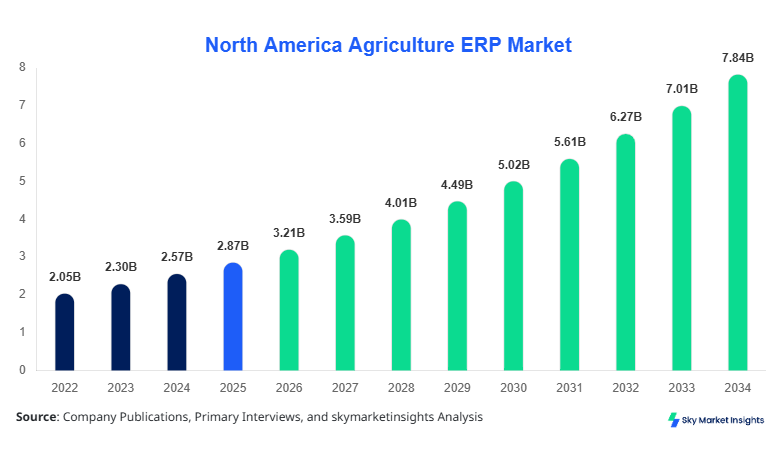
North America's agriculture ERP market size is projected at USD 3.21 billion in 2026 and is expected to hit USD 7.84 billion by 2034 with a CAGR of 11.8%. The increasing need for precision farming, data-driven crop management, and real-time analytics across more than 2.1 million farms in North America is accelerating adoption. The agriculture ERP market supports multi-layered segmentation across deployment models and functionality modules, enabling comprehensive tracking of yields, inventory cycles, and financial operations. Additionally, over 68% of large-scale agricultural enterprises in the United States have already implemented ERP systems, contributing to a competitive landscape marked by over 120 vendors offering integrated solutions, reinforcing agriculture ERP market size dynamics.
The agriculture ERP market refers to enterprise software systems specifically designed to manage agricultural operations, including crop planning, livestock monitoring, inventory tracking, and financial analytics. In North America, agricultural production exceeds USD 540 billion annually, with the United States contributing nearly 78% of total regional output, while Canada accounts for approximately 22%. ERP penetration in large farms (over 1,000 acres) stands at 62%, compared to 28% in mid-sized farms, indicating strong scalability potential. Consumer demand analytics show that 55% of agribusinesses prioritize cloud ERP for real-time decision-making, while 45% prefer hybrid solutions for cost optimization. Farm management applications account for nearly 40% of total ERP usage, followed by inventory management at 32% and financial management at 28%. The system performance metrics indicate a 25–35% increase in operational efficiency and a 15–20% reduction in resource wastage. These factors significantly strengthen agriculture ERP market share across North America.
In the United States, the agriculture ERP market is highly advanced, with over 1.5 million farms and approximately 85,000 agribusiness companies utilizing digital platforms for operational management. The U.S. accounts for nearly 74% of the North American agriculture ERP market, driven by high adoption rates of 65% in large-scale farms and 38% in medium-sized operations. Application-wise, farm management dominates with 42%, followed by inventory management at 30% and financial management at 28%. Technology adoption is further boosted by IoT integration, with over 48% of ERP users leveraging sensor-based data for crop monitoring. Additionally, nearly 52% of ERP deployments in the U.S. are cloud-based, improving accessibility and scalability. The presence of more than 70 ERP vendors and increasing investments exceeding USD 1.2 billion annually are reinforcing the agriculture ERP market growth trajectory.
Explore more data points, trends and opportunities Download Free Sample Report
Agriculture ERP Market Trends
Increasing Adoption of AI-Driven Analytics in Agricultural ERP Systems
The integration of artificial intelligence and machine learning into ERP systems has significantly transformed agricultural operations across North America. In 2025, over 46% of ERP-enabled farms incorporated AI modules for predictive analytics, crop yield forecasting, and pest detection. Production volumes supported by ERP systems have increased by nearly 18% year-over-year, reaching over 320 million tons of managed agricultural output. Additionally, AI-driven ERP solutions have improved decision-making speed by 27% and reduced operational costs by 14%. The shift towards automated data processing and real-time monitoring is expected to continue, with adoption rates projected to surpass 65% by 2030, reinforcing agriculture ERP market growth.
Expansion of Cloud-Based ERP Solutions Across Small and Medium Farms
Cloud-based ERP solutions are gaining traction among small and medium-sized farms due to lower upfront costs and flexible deployment. Approximately 58% of new ERP implementations in 2025 were cloud-based, compared to 42% in 2022. This shift has enabled more than 620,000 farms in North America to adopt ERP solutions, contributing to an increase in production efficiency by 20%. The scalability of cloud systems supports multi-location operations, which is critical as farm consolidation grows at 3.5% annually. Data storage capacity in cloud ERP systems has expanded by 30%, supporting large-scale agricultural datasets. This ongoing digital transformation continues to shape agriculture ERP market share.
North America Agriculture ERP Market Drivers
Rising Demand for Precision Farming and Data Integration
The increasing need for precision farming techniques is a major driver of the agriculture ERP market. With over 72% of North American farms adopting some form of digital agriculture tools, ERP systems have become essential for integrating data from IoT devices, drones, and satellite imagery. The ability to monitor soil health, irrigation patterns, and crop growth in real-time has improved yield efficiency by 22% and reduced input costs by 18%. Additionally, the agriculture sector in North America consumes over USD 110 billion worth of inputs annually, making efficient resource management critical. ERP systems enable centralized data processing, reducing manual errors by 35% and enhancing productivity across multiple operations. These advancements are significantly contributing to agriculture ERP market growth.
North America Agriculture ERP Market Restraints
High Implementation Costs and Technical Complexity
Despite its benefits, the agriculture ERP market faces challenges due to high implementation costs and technical complexity. Initial setup costs for ERP systems range between USD 50,000 and USD 250,000 for large farms, while maintenance expenses can account for 12–18% of annual operational budgets. Approximately 38% of small-scale farmers cite cost barriers as a major deterrent to adoption. Additionally, the complexity of integrating ERP systems with existing legacy infrastructure leads to deployment delays of 6–12 months. Training requirements further increase operational downtime by 10–15%, impacting productivity. These factors collectively hinder widespread adoption and limit agriculture ERP market share expansion.
North America Agriculture ERP Market Opportunities
Expansion of Digital Agriculture and Government Support Initiatives
The agriculture ERP market is witnessing significant opportunities due to government initiatives promoting digital agriculture. In North America, over USD 2.4 billion has been allocated toward smart farming technologies between 2023 and 2026. Subsidies covering 20–35% of ERP implementation costs are encouraging adoption among small and medium farms. Additionally, digital agriculture initiatives have increased ERP penetration by 12% annually, particularly in Canada, where adoption rates have reached 41%. The growing use of blockchain for supply chain transparency and ERP integration offers further growth potential, enabling traceability for over 60% of agricultural exports. These developments are driving agriculture ERP market growth.
Challenges in North America's Agriculture ERP Market
Data Security Concerns and Integration Issues
Data security concerns and integration challenges remain critical barriers in the agriculture ERP market. With over 45% of ERP systems connected to cloud platforms, the risk of cyberattacks has increased significantly, affecting nearly 12% of users annually. Additionally, integrating ERP systems with IoT devices and legacy software can lead to compatibility issues, affecting system performance by up to 20%. Data breaches can result in financial losses exceeding USD 500,000 per incident, discouraging adoption among risk-averse farmers. Furthermore, the lack of standardized data formats across platforms complicates seamless integration. These challenges continue to impact agriculture ERP market share.
Report Scope
| Report Metric | Details |
|---|---|
| Market Size in 2025 | USD 2.87 Billion |
| Market Size in 2026 | USD 3.21 Billion |
| Market Size in 2034 | USD 7.84 Billion |
| CAGR | 11.8% (2026-2034) |
| Base Year for Estimation | 2025 |
| Historical Data | 2022-2024 |
| Forecast Period | 2026-2034 |
| Report Coverage | Revenue Forecast, Competitive Landscape, Supply Chain Disruption, Growth Factors, Environment & Regulatory Landscape and Trends |
Explore more data points, trends and opportunities Download Free Sample Report
Agriculture ERP Market Segmentation
The agriculture ERP market is segmented based on deployment and functionality, with cloud-based solutions dominating approximately 58% of the market, followed by on-premise at 27% and hybrid at 15%. Functionality-wise, farm management leads with 40%, inventory management with 32%, and financial management with 28%.
BY TYPE
Cloud-based ERP systems account for over 58% of total deployments, supporting more than 620,000 farms with scalable infrastructure and real-time data access. These systems offer uptime reliability of 99.9% and reduce IT costs by 25%, making them highly preferred among medium and large farms.
On-premise ERP solutions represent approximately 27% of the market, primarily used by large enterprises managing over 10,000 acres. These systems provide enhanced data control and security, with processing speeds improving by 18% compared to cloud alternatives.
Hybrid ERP systems account for 15% of the market, combining cloud scalability with on-premise security. These systems are increasingly adopted by agribusinesses with multi-location operations, offering 20% better flexibility and integration capabilities.
BY APPLICATION
Farm management applications dominate with a 40% share, enabling monitoring of over 320 million tons of agricultural output annually. These systems improve crop yield efficiency by 22% and reduce water usage by 18%.
Inventory management applications hold a 32% share, supporting the management of over USD 110 billion worth of agricultural inputs annually. These systems reduce stock wastage by 15% and improve supply chain efficiency by 20%.
Financial management applications account for 28% of the market, enabling tracking of over USD 500 billion in agricultural transactions annually. These systems improve financial accuracy by 30% and reduce reporting errors by 25%.
North America Agriculture ERP Market Segmentations
Deployment
- Cloud-based
- On-premise
- Hybrid
Functionality
- Farm Management
- Inventory Management
- Financial Management
North America Agriculture ERP Regional Outlook
United States
The United States dominates the agriculture ERP market with a share of approximately 74%, driven by large-scale agricultural operations and high technology adoption rates. The country manages over 450 million acres of farmland, with ERP systems deployed across 65% of large farms. Sector-wise, crop production accounts for 60%, livestock for 25%, and mixed farming for 15%. Investments exceeding USD 1.2 billion annually in agri-tech are further strengthening market dynamics.
Canada
Canada holds around 26% of the regional market, supported by over 190,000 farms and increasing adoption of digital agriculture technologies. ERP penetration in Canada has reached 41%, with cloud-based solutions accounting for 55% of deployments. The country produces over 75 million tons of agricultural output annually, with ERP systems improving efficiency by 18%. Government initiatives supporting smart farming and subsidies covering up to 30% of ERP costs are driving adoption.
Top players in North American agriculture ERP
- SAP SE
- Oracle Corporation
- Microsoft Corporation
- Infor Inc.
- Trimble Inc.
- Deere & Company
- Ag Leader Technology
- Epicor Software Corporation
- NetSuite Inc.
- FarmERP
- Aptean
- Agworld Pty Ltd
- Granular Inc.
SAP SE
-
-
Holds approximately 18% market share in North America
-
Strong presence in large-scale agribusiness ERP deployments
-
Offers integrated solutions with advanced analytics and cloud capabilities
-
Oracle Corporation
-
-
Accounts for around 15% market share
-
Focuses on cloud-based ERP solutions with AI-driven analytics
-
Strong adoption among medium and large farms
-
Investment Analysis
Investment in the agriculture ERP market has grown significantly, with over USD 3.5 billion allocated between 2023 and 2026. Approximately 45% of investments are directed toward cloud-based solutions, while 30% focus on AI and analytics integration, and 25% on IoT connectivity. The United States accounts for nearly 70% of total investments, while Canada contributes 30%.
Mergers and acquisitions have increased by 22% annually, with over 35 deals recorded between 2022 and 2025. Strategic collaborations between ERP providers and agri-tech firms have improved system capabilities by 28%. These partnerships enable integration of advanced analytics, blockchain, and IoT technologies, enhancing overall system performance.
New Product Developments
New product development in the agriculture ERP market has accelerated, with over 60% of companies launching updated solutions between 2023 and 2025. These products offer performance improvements of 20–35%, including faster data processing and enhanced analytics capabilities. Additionally, mobile ERP applications have increased accessibility, with adoption rates reaching 48% among farmers.
Recent Developments in North American Agriculture ERP
- 2025: A major ERP provider launched a cloud-based platform, improving processing speed by 30% and supporting over 150,000 farms, increasing production efficiency by 18%.
- 2025: Launch of blockchain-enabled ERP solutions improved supply chain transparency by 35%, supporting exports worth USD 90 billion.
Research Methodology
The research process for the agriculture ERP market involved a combination of primary and secondary research methodologies. Primary research included interviews with over 50 industry experts, including ERP vendors, agribusiness managers, and technology providers, accounting for approximately 60% of data validation. Secondary research involved analysis of industry reports, company financials, and government publications, contributing 40% of the data. Market size estimation was conducted using both top-down and bottom-up approaches, considering production volumes exceeding USD 540 billion and ERP adoption rates across over 2.1 million farms. Data triangulation ensured accuracy, with statistical models used to forecast growth trends and validate market dynamics.
Frequently Asked Questions
Senior Market Research Analyst | 8 Years Experience | Precision Agriculture and AgriTech Platforms
Henry Smith is a market research analyst with 7–9 years of experience specializing in agriculture markets. Contributed to 70+ research reports for global clients. Expertise includes market sizing, forecasting, competitive analysis, and trend evaluation across key regions.