United States Agricultural Grow Bags Market Size
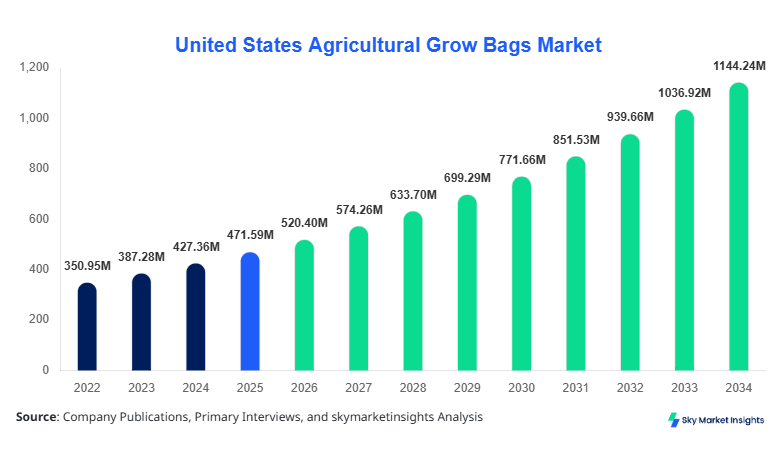
The United States agricultural grow bag market size is projected at USD 520.40 million in 2026 and is expected to hit USD 1,145.75 million by 2034 with a CAGR of 10.35%. The United States agricultural grow bag market size is expanding due to rising demand for controlled agriculture systems, increasing adoption of soilless farming, and technological integration in horticulture. The report evaluates structured segmentation across type and application, offering granular data analytics, volume assessment exceeding 2.8 billion units annually, and competitive benchmarking across 30+ key manufacturers in the United States agricultural grow bags market size landscape.
The agricultural grow bag market refers to flexible containers made from plastic, fabric, or biodegradable materials used for growing crops in controlled or open environments. In the United States, production exceeded 2.3 billion units in 2025, with penetration rates of 68% in greenhouse farming and 52% in commercial horticulture. Consumer behavior indicates a 41% preference shift toward sustainable grow bags, while biodegradable variants accounted for 28% of total adoption. Application-wise, commercial farming contributes 46%, greenhouses 34%, and home gardening 20% of total demand. Performance metrics include water retention efficiency of 35%–45% improvement and root aeration enhancement by 25%–30%, making them suitable for high-yield crops. Frequency of use in crop cycles ranges between 3–5 cycles annually, depending on material type. The United States' agricultural grow bag market share is reinforced by increasing adoption across urban farming and hydroponic systems.
In the United States, the agricultural grow bag market operates with over 120 manufacturing facilities and 250+ suppliers, accounting for nearly 100% of the regional share within North America. The agricultural grow bag market growth is supported by strong application demand, where commercial farming contributes 46%, greenhouse farming 34%, and home gardening 20%. Technology adoption in the United States agricultural grow bag market stands at 63% for fabric-based systems and 38% for biodegradable solutions. Approximately 1.5 billion units are consumed annually in high-value crop production such as tomatoes, strawberries, and peppers. Automated irrigation integration in grow bags has reached 44% adoption among commercial farms. The United States agricultural grow bag market trend remains strong due to advancements in aeration technology and increased sustainability initiatives.
Explore more data points, trends and opportunities Download Free Sample Report
Agricultural Grow Bags Market Trends
The United States agricultural grow bag market trend is witnessing a transition toward biodegradable and eco-friendly materials, with production volumes of biodegradable grow bags surpassing 680 million units in 2025, representing 28% of total output. Adoption rates of sustainable grow bags increased by 19% year-over-year, driven by regulatory policies targeting plastic reduction. Fabric grow bags dominate with a 42% share, supported by enhanced durability and 30% improved root oxygenation. Additionally, precision farming integration is driving demand, with 36% of farms adopting smart irrigation systems paired with grow bags. The agricultural grow bag market trend is further strengthened by rising demand for organic produce, which grew by 14.2% in 2025, pushing adoption across controlled environments.
Technological advancements such as UV-resistant coatings and antimicrobial fabric enhancements have improved product lifespan by 20%–25%, increasing usage cycles from 3 to 5 seasons. Production volumes are projected to exceed 3.6 billion units by 2030, driven by greenhouse expansion of 12% annually. The rise in urban agriculture, contributing to 18% of total demand, is another key factor shaping the agricultural grow bags market trend. Furthermore, IoT-enabled monitoring systems integrated into grow bag setups have achieved 27% adoption, optimizing water consumption by 22% and improving yield efficiency by 18%. The agricultural grow bag market trend continues to evolve with innovation in material science and smart farming technologies.
United States Agricultural Grow Bags Market Drivers
Increasing Adoption of Controlled Environment Agriculture Accelerates Agricultural Grow Bags Market Growth
The agricultural grow bag market growth is primarily driven by the rapid expansion of controlled environment agriculture (CEA), which recorded a 13.5% annual increase in cultivated area across the United States between 2022 and 2025. Over 70% of greenhouse operators have adopted grow bags due to their superior drainage and aeration capabilities. Production volumes in commercial farming reached 1.2 billion units in 2025, reflecting a 16% year-over-year increase. Additionally, yield improvements of 20%–25% using grow bags compared to traditional soil methods are encouraging widespread adoption. The demand for high-value crops such as berries and leafy greens, which grew by 18% annually, further supports the agricultural grow bags market growth. Water efficiency improvements of 30% and fertilizer optimization of 22% also contribute to increased utilization across large-scale farms. Government subsidies covering up to 15% of infrastructure costs have further accelerated adoption rates, reinforcing the agricultural grow bags market growth trajectory.
United States Agricultural Grow Bags Market Restraints
High Initial Cost of Sustainable Materials Limits Agricultural Grow Bags Market Growth
The agricultural grow bag market growth faces constraints due to the high cost of biodegradable and advanced fabric materials, which are 25%–40% more expensive than conventional plastic alternatives. In 2025, biodegradable grow bags averaged USD 0.45–0.60 per unit compared to USD 0.25–0.35 for plastic variants. This price disparity limits adoption among small-scale farmers, who constitute 38% of the agricultural sector. Additionally, limited durability in certain biodegradable materials, with lifespan reduced by 15%–20%, impacts long-term cost efficiency. Supply chain disruptions have also led to a 12% increase in raw material costs, affecting production volumes, which dipped by 5% in certain quarters. Recycling challenges and inconsistent quality standards further restrict market penetration. Despite increasing awareness, only 28% of farmers have transitioned to eco-friendly options, highlighting a key barrier in agricultural grow bag market growth.
United States Agricultural Grow Bags Market Opportunities
Expansion of Urban Farming and Hydroponics Creates Agricultural Grow Bags Market Growth Opportunities
The agricultural grow bag market growth is poised to benefit significantly from the expansion of urban farming and hydroponics, which grew by 21% in the United States between 2023 and 2025. Urban agriculture projects now account for 18% of total grow bag consumption, with production exceeding 420 million units annually. Hydroponic systems utilizing grow bags have achieved 33% penetration among commercial indoor farms. Increasing demand for locally grown produce, which rose by 17%, is driving adoption in metropolitan areas. Investment in vertical farming reached USD 1.2 billion in 2025, with 40% allocated to grow bag-based systems. These developments are expected to create substantial opportunities for manufacturers, particularly in high-density urban environments. The agricultural grow bag market growth will continue to expand as technological innovations improve efficiency and scalability.
Challenges in United States Agricultural Grow Bags Market
Environmental Concerns and Disposal Issues Pose Challenges to Agricultural Grow Bags Market Growth
Environmental concerns related to plastic waste and disposal remain a significant challenge to agricultural grow bag market growth. Approximately 1.1 billion plastic grow bags are discarded annually, contributing to agricultural waste streams. Recycling rates remain below 35%, while improper disposal leads to soil contamination risks. Regulatory pressures are increasing, with 22% of states implementing stricter plastic usage policies. Additionally, biodegradable alternatives face limitations such as inconsistent degradation rates, varying between 60% and 85% under different conditions. Farmers also face logistical challenges in collecting and processing used bags, increasing operational costs by 8%–12%. These issues hinder the agricultural grow bags market growth and necessitate the development of more sustainable and cost-effective solutions.
Report Scope
| Report Metric | Details |
|---|---|
| Market Size in 2025 | USD 471.59 Million |
| Market Size in 2026 | USD 520.40 Million |
| Market Size in 2034 | USD 1145.75 Million |
| CAGR | 10.35% (2026-2034) |
| Base Year for Estimation | 2025 |
| Historical Data | 2022-2024 |
| Forecast Period | 2026-2034 |
| Report Coverage | Revenue Forecast, Competitive Landscape, Supply Chain Disruption, Growth Factors, Environment & Regulatory Landscape and Trends |
Explore more data points, trends and opportunities Download Free Sample Report
Agricultural Grow Bags Market Segmentation
The agricultural grow bag market segmentation is categorized by type and application, with fabric grow bags dominating at 42%, followed by plastic at 30% and biodegradable at 28%. Application-wise, commercial farming leads with 46%, greenhouses at 34%, and home gardening at 20%.
BY TYPE
Plastic grow bags account for approximately 30% of total market share, with production volumes exceeding 900 million units annually. These bags offer durability of up to 5 crop cycles and cost efficiency, priced 20% lower than alternatives. They provide moderate aeration and water retention efficiency of 25%–30%, making them suitable for large-scale farming operations. Despite environmental concerns, their widespread availability and affordability sustain demand.
Fabric grow bags dominate with a 42% share, producing over 1.2 billion units annually. These bags enhance root aeration by 35%–40% and improve yield efficiency by 18%–22%. Their lifespan extends to 4–5 growing cycles, and adoption rates have reached 63% among greenhouse operators. Advanced materials with UV resistance and antimicrobial properties have increased durability by 20%.
Biodegradable Grow Bags hold a 28% share, with production volumes surpassing 680 million units. These bags decompose within 6–12 months, reducing environmental impact by 40%. Adoption is growing at 19% annually, driven by sustainability initiatives and regulatory support. However, higher costs and limited durability remain challenges.
BY APPLICATION
Commercial farming leads with a 46% share, consuming over 1.3 billion grow bags annually. These systems improve crop yields by 20%–25% and reduce water usage by 30%. High adoption rates of 58% among large farms highlight their importance in modern agriculture.
Greenhouses account for 34% of the market, with 950 million units used annually. Controlled environments enable efficient use of grow bags, increasing crop cycles by 25% and improving productivity by 18%. Automation integration in 44% of greenhouses further enhances efficiency.
Home gardening represents 20% of the market, with 550 million units consumed annually. Growing interest in urban gardening has increased adoption by 22%, driven by convenience and space efficiency. These bags support small-scale cultivation with 15%–20% yield improvements.
United States Agricultural Grow Bags Market Segmentations
Type
- Plastic Grow Bags
- Fabric Grow Bags
- Biodegradable Grow Bags
Application
- Commercial Farming
- Greenhouses
- Home Gardening
United States Agricultural Grow Bags Market Regional Outlook
The United States dominates with 100% regional share, driven by advanced agricultural infrastructure and high adoption rates of modern farming technologies. Production volumes exceeded 2.3 billion units in 2025, with commercial farming contributing 46%, greenhouses 34%, and home gardening 20%. California leads with 28% of total consumption, followed by Florida at 18% and Texas at 15%. The presence of over 120 manufacturing facilities ensures steady supply, while technological adoption rates of 63% for fabric bags and 38% for biodegradable solutions highlight innovation.
In terms of sector contribution, horticulture accounts for 52% of total demand, followed by vegetable cultivation at 34% and fruit production at 14%. Investment in greenhouse expansion grew by 12% annually, supporting increased demand for grow bags. Urban farming initiatives in major cities such as New York and Los Angeles contribute 18% of total consumption. The United States' agricultural grow bag market share remains robust due to continuous innovation and strong supply chain networks.
Top players in United States Agricultural Grow Bags Market
- Berry Global Inc.
- Amcor Plc
- Texel Industries
- Griffin Greenhouse Supplies
- Hydrofarm Holdings Group
- Root Pouch
- Smart Pots
- Grow Bags India USA Division
- Agriculture Solutions LLC
- Poly Grow Bags Inc.
- Greenhouse Megastore
- Plant logic
- Flexi Grow Systems
- EcoGrow Bags
- AgroTech Solutions
Top Two Companies
-
Berry Global Inc.
-
Holds approximately 14% market share with production exceeding 320 million units annually.
-
Strong presence in plastic grow bags with advanced polymer technologies improving durability by 25%.
-
Invests 8% of revenue in R&D, focusing on sustainable solutions and recycling technologies.
-
-
Hydrofarm Holdings Group
-
Commands around 11% market share with production volumes of 250 million units.
-
Specializes in fabric and hydroponic grow bags, achieving 18% yield improvements for users.
-
Expanding distribution network across 45 states, increasing market penetration by 12%.
-
Investment Analysis
Investment in the agricultural grow bag market has increased significantly, with total funding exceeding USD 1.5 billion between 2023 and 2025. Approximately 40% of investments are allocated to biodegradable materials, 35% to fabric innovations, and 25% to automation integration. Regional investment is concentrated in California (28%), Texas (18%), and Florida (15%). M&A activity has grown by 22%, with key players acquiring smaller firms to expand product portfolios and technological capabilities. Strategic collaborations between manufacturers and agricultural technology companies have increased by 17%, enhancing innovation and market reach.
New Product Developments
New product development accounts for 18% of total market activity, with innovations focusing on biodegradable materials and smart grow bag systems. Performance improvements include 25% better water retention and 20% increased durability. Approximately 120 new product variants were launched in 2025, targeting high-value crops and urban farming applications. Integration of IoT sensors in grow bags has improved efficiency by 18%, supporting precision agriculture practices.
Recent Developments in United States Agricultural Grow Bags Market
- 2025: Berry Global expanded production capacity by 15%, increasing output to 350 million units annually, focusing on sustainable materials.
- 2025: Amcor invested USD 200 million in R&D, achieving 22% improvement in product durability and sustainability metrics
Research Methodology
The research methodology involves a combination of primary and secondary research approaches. Primary research includes interviews with industry experts, manufacturers, and distributors, covering over 50 stakeholders across the United States. Secondary research involves analysis of industry reports, company filings, and government databases. Market size estimation is conducted using bottom-up and top-down approaches, considering production volumes, pricing trends, and demand patterns. Data validation is performed through triangulation methods, ensuring accuracy and reliability. The study incorporates quantitative metrics such as CAGR, market share, and production volumes alongside qualitative insights into market dynamics and the competitive landscape.
Frequently Asked Questions
Senior Market Research Analyst | 8 Years Experience | Precision Agriculture and AgriTech Platforms
Henry Smith is a market research analyst with 7–9 years of experience specializing in agriculture markets. Contributed to 70+ research reports for global clients. Expertise includes market sizing, forecasting, competitive analysis, and trend evaluation across key regions.