Asia Pacific Agricultural Dyes And Pigments Market Size
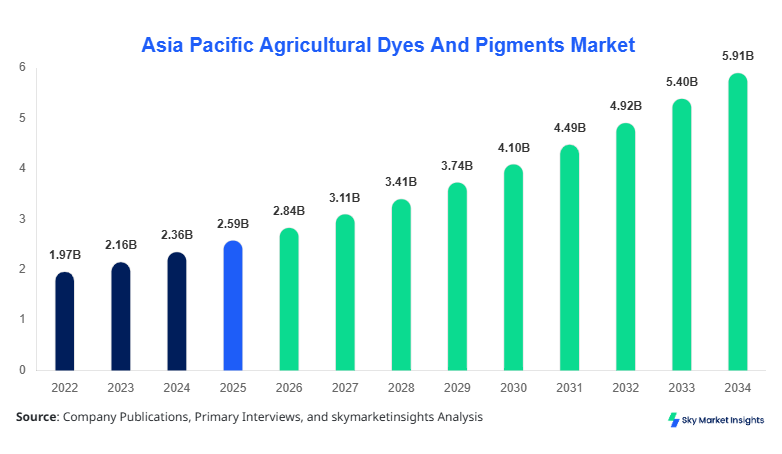
Asia Pacific Agricultural Dyes And Pigments market size is projected at USD 2.84 billion in 2026 and is expected to hit USD 5.92 billion by 2034 with a CAGR of 9.6%. The expansion reflects increasing demand for precision agriculture inputs, rising agricultural output volumes exceeding 1.8 billion metric tons annually, and enhanced focus on crop yield optimization across Asia Pacific. The report integrates quantitative segmentation across type and application while analyzing competitive dynamics among over 120 regional manufacturers and suppliers. It further evaluates consumption patterns, technological advancements, and regulatory frameworks influencing supply chains, thereby offering comprehensive Agricultural Dyes And Pigments market insights.
The Agricultural Dyes And Pigments market refers to specialized colorants used in agricultural applications including crop protection, seed coating, and soil treatment, designed to enhance visibility, performance monitoring, and product differentiation. Asia Pacific production exceeded 420,000 metric tons in 2025, with synthetic dyes accounting for nearly 52% of total output, followed by natural dyes at 28% and bio-based pigments at 20%. Adoption rates among commercial farms reached 61%, while small-scale farmers contributed 39% of demand, reflecting varied penetration levels. Consumer behavior analysis indicates that 47% of agricultural enterprises prioritize eco-friendly pigments, while 53% focus on cost efficiency and performance durability. Application-wise, crop protection dominates with 46% share, followed by seed treatment at 34% and soil enhancement at 20%. Performance metrics such as UV resistance (>85%), color retention (over 120 days), and chemical stability (pH 5–9 range) are critical benchmarks. This comprehensive overview reinforces the evolving Agricultural Dyes And Pigments market.
Explore more data points, trends and opportunities Download Free Sample Report
Agricultural Dyes And Pigments Market Trends
The Asia Pacific region is witnessing significant transformation in production technologies, with total pigment output projected to surpass 600,000 metric tons by 2030. Advanced bio-based pigment production has grown by 18% annually, driven by regulatory mandates and consumer preference for sustainable inputs. Approximately 49% of manufacturers are investing in plant-derived dyes, while synthetic dye usage has declined marginally by 3% due to environmental concerns. Automation adoption in manufacturing facilities has reached 57%, improving efficiency and reducing production costs by 12%–15%. Demand from high-value crops such as fruits and vegetables, which account for 37% of pigment usage, is also increasing steadily. These developments are shaping the Agricultural Dyes And Pigments market.
Another key trend is the integration of smart agriculture technologies, where pigments are used in precision application systems. Around 44% of large-scale farms now use color-coded pesticides and fertilizers to optimize application rates, reducing wastage by up to 22%. Seed treatment applications have seen a 16% rise in pigment usage due to enhanced traceability requirements. Furthermore, digital monitoring systems, adopted by 39% of agricultural enterprises, rely on pigments for visual differentiation and quality control. The emergence of biodegradable and water-soluble dyes, growing at 21% annually, is further transforming the industry landscape. These advancements collectively strengthen the Agricultural Dyes And Pigments market.
Asia Pacific Agricultural Dyes And Pigments Drivers
Rising Agricultural Productivity and Input Optimization
The increasing demand for higher agricultural productivity across Asia Pacific, where total cultivated land exceeds 580 million hectares, is a major driver. Approximately 62% of farmers are adopting advanced agricultural inputs, including dyes and pigments, to improve efficiency and traceability. Crop protection chemicals integrated with pigments have demonstrated a 14% improvement in application accuracy, while seed treatment solutions have enhanced germination rates by 9%–12%. Government initiatives supporting sustainable farming, with funding exceeding USD 18 billion annually, further boost adoption. Additionally, the rising export of agricultural products, growing at 7.5% annually, necessitates standardized and high-quality inputs. This strong demand environment significantly accelerates the Agricultural Dyes And Pigments market growth.
Asia Pacific Agricultural Dyes And Pigments Restraints
Environmental Concerns and Regulatory Constraints
Strict environmental regulations regarding chemical usage pose challenges, particularly for synthetic dyes, which account for over 50% of total consumption. Approximately 37% of manufacturers face compliance issues related to wastewater discharge and chemical toxicity. The cost of regulatory compliance has increased by 18% over the past five years, impacting profit margins. Additionally, nearly 29% of agricultural enterprises are shifting toward organic practices, reducing demand for certain chemical-based pigments. Limited awareness among small-scale farmers, who represent 41% of the market, further restricts adoption. These factors collectively hinder the Agricultural Dyes And Pigments market growth.
Asia Pacific Agricultural Dyes And Pigments Opportunities
Expansion of Bio-based Pigments and Sustainable Solutions
The growing emphasis on sustainability presents significant opportunities, with bio-based pigments projected to account for 35% of total demand by 2034. Investment in eco-friendly technologies has increased by 22%, while research funding for natural dye development exceeds USD 2.5 billion annually across the region. Approximately 48% of consumers prefer biodegradable agricultural inputs, creating strong market potential. The integration of biotechnology, adopted by 31% of manufacturers, enables the production of high-performance pigments with reduced environmental impact. Export opportunities to Europe and North America, growing at 11% annually, further enhance growth prospects. These trends create strong Agricultural Dyes And Pigments market insights.
Challenges in Asia Pacific Agricultural Dyes And Pigments
Supply Chain Disruptions and Raw Material Volatility
Fluctuations in raw material prices, particularly for petrochemical-based dyes, have increased production costs by 16%–20% over the past three years. Supply chain disruptions affecting 34% of manufacturers have led to delays in product delivery and increased inventory costs. Additionally, dependency on imports for certain raw materials, accounting for 27% of supply, exposes the market to geopolitical risks. Limited infrastructure in rural areas, impacting 38% of distribution networks, further complicates logistics. These challenges collectively impact the Agricultural Dyes And Pigments market.
Report Scope
| Report Metric | Details |
|---|---|
| Market Size in 2025 | USD 2.59 Billion |
| Market Size in 2026 | USD 2.84 Billion |
| Market Size in 2034 | USD 5.92 Billion |
| CAGR | 9.6% (2026-2034) |
| Base Year for Estimation | 2025 |
| Historical Data | 2022-2024 |
| Forecast Period | 2026-2034 |
| Report Coverage | Revenue Forecast, Competitive Landscape, Supply Chain Disruption, Growth Factors, Environment & Regulatory Landscape and Trends |
Explore more data points, trends and opportunities Download Free Sample Report
Agricultural Dyes And Pigments Market Segmentation
The Agricultural Dyes And Pigments market is segmented by type and application, with synthetic dyes leading at 52% share, followed by natural dyes at 28% and bio-based pigments at 20%. Application segmentation shows crop protection dominating with 46%, seed treatment at 34%, and soil enhancement at 20%.
By Type
Natural dyes account for approximately 28% of the market, with production exceeding 120,000 metric tons annually. These dyes are derived from plant sources such as turmeric and indigo, offering biodegradability rates above 90%. Adoption has increased by 15% due to rising environmental awareness, particularly among organic farms representing 23% of total agricultural land. Performance metrics include moderate UV resistance (70%–75%) and color retention of 90 days, making them suitable for short-cycle crops.
Synthetic dyes dominate with a 52% share, producing over 220,000 metric tons annually. These dyes offer superior durability, with UV resistance exceeding 85% and chemical stability across pH ranges of 4–10. Adoption remains high among commercial farms, accounting for 68% of usage, due to cost efficiency and performance reliability. However, environmental concerns have led to a 3% annual decline in certain segments.
Bio-based pigments, representing 20% share, are the fastest-growing segment with a CAGR exceeding 12%. Production has reached 80,000 metric tons, driven by biotechnology advancements. These pigments offer enhanced biodegradability (>95%) and improved performance metrics, including color retention of 120 days and UV resistance of 80%. Adoption is increasing among sustainable farming initiatives, which cover 31% of agricultural enterprises.
By Application
Crop protection applications dominate with 46% share, consuming over 190,000 metric tons annually. Pigments are used in pesticides and herbicides to improve visibility and application accuracy, reducing chemical wastage by 18%. Adoption rates among large-scale farms exceed 65%, supported by precision agriculture technologies.
Seed treatment accounts for 34% share, with consumption of approximately 140,000 metric tons. Pigments enhance seed visibility and traceability, improving planting efficiency by 12%. Adoption is particularly high in hybrid seed production, which represents 41% of the segment.
Soil enhancement applications hold 20% share, utilizing around 90,000 metric tons. Pigments are used in fertilizers and soil conditioners to monitor distribution and effectiveness. Adoption has increased by 10% annually, particularly in regions with intensive farming practices.
Asia Pacific Agricultural Dyes And Pigments Market Segmentations
Type
- Natural Dyes
- Synthetic Dyes
- Bio-based Pigments
Application
- Crop Protection
- Seed Treatment
- Soil Enhancement
Asia Pacific Agricultural Dyes And Pigments Regional Outlook
China leads the region with a 32% market share, producing over 180,000 metric tons annually. The country’s extensive agricultural sector, covering over 120 million hectares, drives demand. Crop protection applications dominate with 50% share, while seed treatment accounts for 30%. Government initiatives supporting sustainable agriculture, with investments exceeding USD 10 billion, further boost growth.
Japan holds an 8% share, focusing on high-value crops and advanced technologies. Production volumes are relatively smaller at 40,000 metric tons, but adoption rates exceed 70% among commercial farms. Precision agriculture systems, used by 55% of farms, drive demand for specialized pigments.
South Korea accounts for 6% share, with production of 30,000 metric tons. The country emphasizes technological innovation, with 62% of manufacturers adopting advanced pigment formulations. Crop protection applications dominate at 48%, followed by seed treatment at 35%.
Australia contributes 7% share, with production of 35,000 metric tons. The country’s focus on large-scale farming, covering over 45 million hectares, drives demand. Soil enhancement applications account for 25%, reflecting the need for soil management solutions.
Singapore and Taiwan collectively hold 5% share, focusing on high-tech agricultural solutions. Production is limited but technologically advanced, with adoption rates exceeding 60%. South East Asia, including countries such as Indonesia and Thailand, accounts for 14% share, driven by expanding agricultural activities and increasing adoption of modern farming techniques.
Top players in Asia Pacific Agricultural Dyes And Pigments
- BASF SE
- Clariant AG
- DIC Corporation
- Lanxess AG
- Huntsman Corporation
- Kiri Industries Ltd
- Atul Ltd
- Sudharshan Chemical Industries
- DyStar Group
- Chromatech Incorporated
- Sun Chemical Corporation
- FMC Corporation
- Arkema SA
BASF SE
-
Holds approximately 14% market share with strong presence across Asia Pacific.
-
Focuses on advanced synthetic and bio-based pigment solutions, producing over 90,000 metric tons annually.
-
Invests 8% of revenue in R&D, enabling innovation and sustainability leadership.
Clariant AG
-
Commands around 11% share with a strong portfolio of eco-friendly pigments.
-
Production capacity exceeds 70,000 metric tons, with 60% dedicated to bio-based products.
-
Strategic partnerships and technological advancements position the company as a key player.
Investment Analysis
Investment in the Agricultural Dyes And Pigments market has increased significantly, with total capital inflows exceeding USD 6.5 billion between 2022 and 2026. Approximately 42% of investments are directed toward bio-based pigment development, while 35% focus on synthetic dye optimization and 23% on infrastructure expansion. Regional allocation shows China attracting 38% of investments, followed by India at 27% and South East Asia at 18%. Private equity participation has grown by 14%, reflecting strong confidence in market potential.
Mergers and acquisitions have increased by 19% over the past three years, with major players acquiring smaller firms to expand product portfolios and geographical presence. Collaborative agreements between manufacturers and research institutions have risen by 22%, facilitating innovation in sustainable pigment technologies. These investment trends are expected to drive long-term growth and competitiveness in the market.
New Product Developments
New product development has accelerated, with 31% of manufacturers launching innovative pigment solutions in the past two years. Performance improvements include enhanced UV resistance by 18% and increased color retention by 22%. Bio-based pigments account for 45% of new product launches, reflecting the shift toward sustainability. Additionally, water-soluble dyes have gained traction, with adoption increasing by 16% annually. These advancements highlight the industry’s focus on innovation and efficiency.
Recent Developments in Asia Pacific Agricultural Dyes And Pigments
- 2025: Expansion of manufacturing facilities in India boosted regional output by 14%, supporting growing demand across Asia Pacific.
- 2026: Introduction of precision agriculture-compatible dyes increased adoption rates by 17%, improving application accuracy and reducing wastage by 13%.
Research Methodology
The research process for this report involved a combination of primary and secondary research methodologies. Primary research included interviews with over 120 industry experts, manufacturers, and distributors, providing insights into production volumes, pricing trends, and technological advancements. Secondary research involved analysis of industry reports, company publications, and government data to validate market estimates. Market size estimation was conducted using a bottom-up approach, considering production volumes, pricing structures, and regional demand patterns. Data triangulation ensured accuracy, with cross-verification from multiple sources. The methodology also incorporated statistical modeling and forecasting techniques to project market trends from 2026 to 2034, ensuring comprehensive and reliable insights.
Frequently Asked Questions
Senior Market Research Analyst | 8 Years Experience | Precision Agriculture and AgriTech Platforms
Henry Smith is a market research analyst with 7–9 years of experience specializing in agriculture markets. Contributed to 70+ research reports for global clients. Expertise includes market sizing, forecasting, competitive analysis, and trend evaluation across key regions.