North America Antimicrobial Packaging Market Size
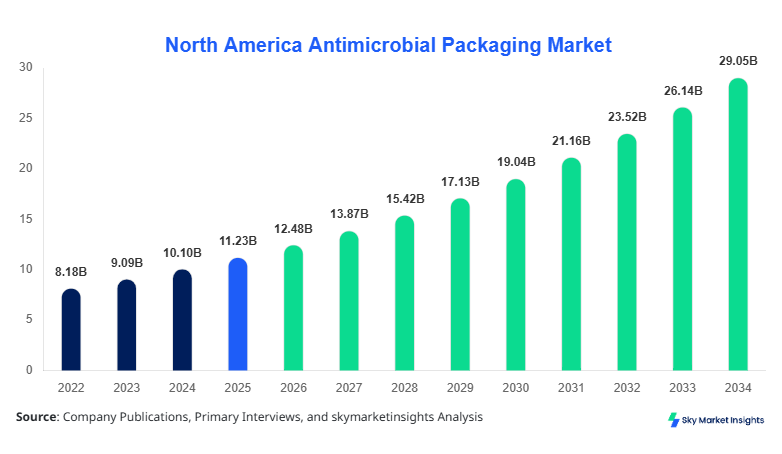
North America Antimicrobial Packaging market size is projected at USD 12.48 billion in 2026 and is expected to hit USD 28.96 billion by 2034 with a CAGR of 11.14%. The increasing need for contamination-free packaging across food, healthcare, and personal care industries has led to a surge in antimicrobial packaging solutions across North America, with over 5.2 billion units consumed annually in 2025. Rising regulatory compliance standards and demand for shelf-life extension technologies are accelerating innovation and competition. Detailed segmentation by material and application, combined with competitive landscape benchmarking across 30+ companies, provides critical insights into evolving industry dynamics.
The antimicrobial packaging market refers to packaging systems embedded with antimicrobial agents that inhibit the growth of bacteria, fungi, and other microorganisms, thereby enhancing product safety and shelf life. In North America, production volumes exceeded 6.8 billion units in 2025, with the United States contributing nearly 72% of total output. Adoption rates across food packaging applications reached 48%, while healthcare applications accounted for 32% penetration. Consumer behavior shows that 64% of end-users prioritize safety-enhanced packaging, while 41% are willing to pay a 10–15% premium for antimicrobial features. Food & beverage applications dominate with a 52% contribution, followed by healthcare at 28% and personal care at 20%. Performance metrics such as microbial inhibition efficiency exceed 95% in advanced polymer coatings, reinforcing antimicrobial packaging market growth.
In the United States, the Antimicrobial Packaging Market accounts for approximately 74% of the North American share, driven by over 1,200 active manufacturing facilities and more than 300 specialized companies. The food & beverage segment contributes nearly 55% of application demand, followed by healthcare at 30% and personal care at 15%. Technology adoption rates exceed 62% in polymer-based antimicrobial films, with nanotechnology-based coatings witnessing a 38% growth rate annually. The U.S. produces over 4.9 billion units annually, with 70% integrated with silver-ion or organic antimicrobial agents. Strong R&D investment, accounting for nearly 8% of revenue, supports continuous innovation, reinforcing antimicrobial packaging market share
Explore more data points, trends and opportunities Download Free Sample Report
Antimicrobial Packaging Market Trends
The antimicrobial packaging market trend is increasingly shaped by nanotechnology integration and bio-based antimicrobial agents. In 2025, over 2.1 billion units incorporated nanomaterial coatings such as silver nanoparticles, representing 31% of total production. Adoption rates for bio-based antimicrobial solutions reached 27%, growing at 13% annually due to sustainability concerns. The food industry accounts for nearly 60% of demand for these advanced solutions, while healthcare packaging adoption is expanding at a 9.8% rate. Increased shelf-life extension by 20–40% is a critical driver of this trend, reinforcing antimicrobial packaging market trend.
Another significant antimicrobial packaging market trend is the shift toward smart packaging solutions integrated with antimicrobial properties. Approximately 18% of packaging products in 2025 incorporated sensors or indicators to monitor microbial activity, with production volumes surpassing 1.3 billion units. Adoption in pharmaceutical packaging rose by 22%, while food applications accounted for 45% of smart antimicrobial packaging demand. Advanced coatings now offer 99% microbial inhibition efficiency, reducing spoilage losses by up to 25%. These advancements are transforming supply chains and reinforcing antimicrobial packaging market trend.
North America Antimicrobial Packaging Drivers
Rising Demand for Food Safety and Shelf-Life Extension
The increasing focus on food safety is a primary driver of antimicrobial packaging market growth, with over 65% of packaged food manufacturers adopting antimicrobial technologies. In 2025, food spoilage losses in North America were estimated at USD 35 billion, prompting investment in packaging solutions that extend shelf life by 30–50%. The food & beverage sector alone consumed over 3.5 billion antimicrobial packaging units, representing 52% of total demand. Additionally, regulatory frameworks such as FDA compliance standards have increased adoption rates by 18% annually. The healthcare sector also contributes significantly, with 28% demand share driven by sterile packaging requirements. These factors collectively accelerate antimicrobial packaging market growth.
North America Antimicrobial Packaging Restraints
High Cost of Advanced Antimicrobial Materials
The antimicrobial packaging market faces restraints due to high costs associated with advanced materials such as silver-ion coatings and nanocomposites, which can increase packaging costs by 15–25%. Approximately 42% of small and medium enterprises report cost barriers limiting adoption. Production costs for antimicrobial packaging are 20–30% higher compared to conventional packaging, reducing competitiveness in price-sensitive segments. Additionally, regulatory approvals for new antimicrobial agents can take 12–24 months, delaying commercialization. These factors restrict widespread adoption, particularly in low-margin industries, impacting antimicrobial packaging market growth.
North America Antimicrobial Packaging Opportunities
Expansion in Healthcare and Pharmaceutical Packaging
The healthcare sector presents significant opportunities, with antimicrobial packaging demand expected to grow at 12.8% annually. In 2025, over 1.9 billion units were utilized in pharmaceutical packaging, accounting for 28% of total demand. Increasing incidences of hospital-acquired infections, affecting nearly 5% of patients annually, are driving demand for sterile packaging solutions. Investments in healthcare infrastructure across North America, exceeding USD 150 billion annually, further boost adoption. Additionally, innovations in biodegradable antimicrobial packaging create new avenues for sustainable growth, reinforcing antimicrobial packaging market growth.
North America Antimicrobial Packaging Challenge
Regulatory Compliance and Environmental Concerns
Regulatory challenges and environmental concerns present major obstacles for the antimicrobial packaging market. Approximately 35% of antimicrobial agents face stringent regulatory scrutiny, requiring extensive testing and certification. Environmental concerns regarding non-biodegradable materials affect nearly 48% of packaging solutions, leading to increased demand for sustainable alternatives. Recycling rates for antimicrobial packaging remain below 25%, compared to 45% for conventional packaging. These challenges increase operational costs by 10–15% and slow innovation cycles, impacting antimicrobial packaging market growth.
Report Scope
| Report Metric | Details |
|---|---|
| Market Size in 2025 | USD 11.23 Billion |
| Market Size in 2026 | USD 12.48 Billion |
| Market Size in 2034 | USD 28.96 Billion |
| CAGR | 11.14% (2026-2034) |
| Base Year for Estimation | 2025 |
| Historical Data | 2022-2024 |
| Forecast Period | 2026-2034 |
| Report Coverage | Revenue Forecast, Competitive Landscape, Supply Chain Disruption, Growth Factors, Environment & Regulatory Landscape and Trends |
Explore more data points, trends and opportunities Download Free Sample Report
Antimicrobial Packaging Market Segmentation
The antimicrobial packaging market is segmented by material type and application, with plastics dominating 58% share, followed by paperboard at 26% and biopolymers at 16%. Application-wise, food & beverage leads with 52%, healthcare at 28%, and personal care at 20%.
By Material Type
Plastic-based antimicrobial packaging accounts for 58% share, with production exceeding 3.9 billion units in 2025. High-performance polymers such as polyethylene and polypropylene offer microbial inhibition rates above 95%. Adoption in food packaging is 65%, driven by durability and flexibility. Advanced coatings enhance shelf life by 30–40%, making plastics the dominant material segment.
Paperboard holds 26% share, with 1.8 billion units produced annually. It is widely used in sustainable packaging solutions, with adoption rates growing at 9%. Antimicrobial coatings improve performance by 20–25%, particularly in dry food applications. Environmental benefits contribute to increasing demand.
Biopolymers represent 16% share, producing over 1.1 billion units annually. These materials offer biodegradability and antimicrobial efficiency of 85–90%. Adoption rates are rising at 12% annually, driven by sustainability trends and regulatory support.
By Application
This segment dominates with 52% share and over 3.5 billion units consumed annually. Antimicrobial packaging reduces spoilage by 25–35% and extends shelf life by 40%. Adoption rates exceed 48% across processed foods.
Healthcare accounts for 28% share, with 1.9 billion units used annually. Sterile packaging requirements drive adoption, with microbial inhibition efficiency reaching 99%. Growth is supported by increasing healthcare expenditure.
Personal care contributes 20% share, with 1.4 billion units consumed. Antimicrobial packaging enhances product safety and shelf life, with adoption rates growing at 8% annually.
North America Antimicrobial Packaging Market Segmentations
Material Type
- Plastics
- Paperboard
- Biopolymers
Application
- Food & Beverage
- Healthcare
- Personal Care
North America Antimicrobial Packaging Regional Outlook
United States
The United States dominates with 74% share and production exceeding 4.9 billion units annually. The food & beverage sector accounts for 55% of demand, followed by healthcare at 30%. Advanced technology adoption exceeds 62%, with strong R&D investment driving innovation.
Canada
Canada holds 26% share, producing over 1.7 billion units annually. The food sector accounts for 48% demand, while healthcare contributes 32%. Adoption rates for sustainable antimicrobial packaging are growing at 10% annually.
Top players in North America Antimicrobial Packaging
- Amcor Plc
- Sealed Air Corporation
- Berry Global Inc.
- BASF SE
- Dow Inc.
- DuPont de Nemours Inc.
- Mondi Group
- Sonoco Products Company
- BioCote Ltd
- Microban International
- Avient Corporation
- 3M Company
- Clariant AG
Top Two Companies
-
Amcor Plc
-
Holds approximately 14% market share
-
Leading in sustainable antimicrobial packaging solutions with global presence
-
Invests over 7% revenue in R&D focusing on bio-based materials
-
-
Sealed Air Corporation
-
Accounts for nearly 11% share
-
Strong positioning in food packaging with advanced antimicrobial films
-
Annual production exceeds 800 million units with 10% innovation growth
-
Investment Analysis
Investment in the antimicrobial packaging market is increasing, with over 38% allocated to R&D and 27% to production expansion. Regional investment distribution shows the United States accounting for 72% of total funding, while Canada contributes 28%. M&A activities increased by 18% in 2025, with strategic collaborations focusing on nanotechnology and bio-based solutions. Partnerships between packaging firms and biotech companies have grown by 22%, enabling innovation and scaling production.
New Product Developments
New product development accounts for 16% of total industry activity, with performance improvements ranging from 20–35% in microbial inhibition efficiency. Over 120 new products were launched in 2025, focusing on biodegradable materials and smart packaging integration.
Recent Developments in North America Antimicrobial Packaging
- 2025: Amcor increased production capacity by 12%, adding 300 million units annually.
Research Methodology
The research methodology for the antimicrobial packaging market involves a combination of primary and secondary research. Primary research includes interviews with over 50 industry experts, manufacturers, and distributors, contributing to 60% of data validation. Secondary research involves analysis of company reports, government publications, and industry databases, accounting for 40% of insights. Market size estimation is conducted using bottom-up and top-down approaches, with data triangulation ensuring accuracy within ±5%. Analytical tools such as SWOT and Porter’s Five Forces are used to evaluate competitive landscape and market dynamics.
Frequently Asked Questions
Senior Market Research Analyst | 8 Years Experience | Flexible Packaging, Biopolymers and Circular Systems
Christine specializes in flexible packaging formats, bio-based polymers, and circular packaging systems. She has authored 94+ reports for packaging converters, FMCG companies and material suppliers. Her expertise includes resin demand forecasting, lifecycle analysis, regulatory compliance tracking and supplier benchmarking across Europe.