North America Agricultural Micronutrients Market Size
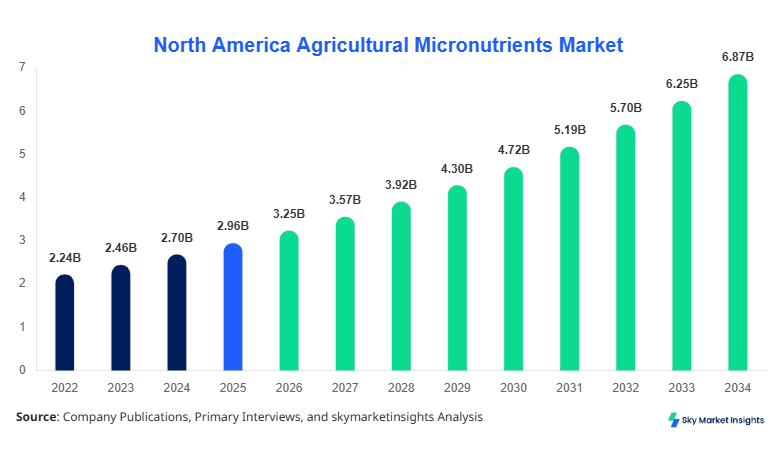
North America Agricultural Micronutrients Market market size is projected at USD 3.25 billion in 2026 and is expected to hit USD 6.85 billion by 2034 with a CAGR of 9.8%. The increasing need for precision agriculture, soil fertility management, and higher crop yield optimization is accelerating demand across the United States and Canada. The report includes detailed segmentation by type and application along with competitive landscape analysis covering production capacity, pricing, and technological advancements.
The Agricultural Micronutrients Market refers to essential trace elements such as zinc, boron, iron, manganese, and copper that are applied in agricultural practices to enhance crop productivity, soil health, and nutrient balance. In North America, production of micronutrients exceeded 1.8 million metric tons in 2025, with zinc-based products accounting for over 32% of total output. Adoption rates among large-scale farms surpassed 68% in the United States and 54% in Canada due to rising awareness about nutrient deficiencies in soil. Consumer behavior indicates that over 72% of farmers are shifting toward balanced fertilization techniques, while demand analytics reveal a 10.5% year-on-year increase in micronutrient consumption in row crops such as corn and soybean. Soil treatment applications dominate with 48% share, followed by foliar spray at 34% and fertigation at 18%. Technical metrics show improved nutrient uptake efficiency by 25–35% when micronutrients are applied through precision methods, reinforcing Agricultural Micronutrients Market relevance.
Explore more data points, trends and opportunities Download Free Sample Report
Agricultural Micronutrients Market Trends
The Agricultural Micronutrients Market is witnessing a significant shift toward chelated micronutrients and nano-formulations, with production of advanced micronutrients exceeding 620,000 metric tons in 2025. Adoption of chelated micronutrients has increased by 41% due to higher bioavailability and improved nutrient absorption efficiency of 30–45%. Farmers are increasingly integrating precision farming technologies, with over 58% of large farms using GPS-based nutrient application systems. Demand for micronutrients in high-value crops such as fruits and vegetables has grown by 13.6% annually, contributing nearly USD 1.1 billion to the total market. These evolving practices highlight the Agricultural Micronutrients Market Trend.
Another key trend involves the rising adoption of sustainable agriculture practices, with over 49% of farmers in North America shifting toward eco-friendly micronutrient solutions. Production of organic-certified micronutrients has grown by 18.2% annually, reaching 210,000 metric tons. Digital agriculture platforms are also driving data-based nutrient management, increasing yield efficiency by 22% and reducing input costs by 15%. Government subsidies covering up to 25% of micronutrient costs in certain regions further boost adoption rates. This continued technological integration emphasizes the Agricultural Micronutrients Market Trend.
North America Agricultural Micronutrients Market Drivers
Rising Soil Nutrient Deficiency Driving Adoption
Soil nutrient depletion has become a critical issue, with over 63% of agricultural land in North America showing deficiencies in zinc, boron, or iron. Annual crop yield losses due to micronutrient deficiencies are estimated at USD 2.3 billion. Farmers are increasingly adopting micronutrients to enhance productivity, with usage increasing by 12.4% annually between 2022 and 2025. Zinc demand alone accounts for over 580,000 metric tons annually, reflecting strong adoption in cereals and oilseeds. Government initiatives promoting balanced fertilization have resulted in a 35% increase in micronutrient application across large-scale farms. These factors significantly contribute to Agricultural Micronutrients Market Growth.
North America Agricultural Micronutrients Market Restraints
High Cost of Advanced Micronutrient Formulations
Despite increasing adoption, the high cost of chelated and nano-based micronutrients remains a key restraint. Chelated micronutrients are priced 25–40% higher than conventional forms, limiting adoption among small-scale farmers. Approximately 38% of farmers in Canada cite cost constraints as a barrier to adoption. Production costs have increased by 14% due to rising raw material prices, impacting overall market penetration. Additionally, limited awareness among 27% of small farmers restricts usage. These constraints hinder Agricultural Micronutrients Market Growth.
North America Agricultural Micronutrients Market Opportunities
Expansion of Precision Agriculture Technologies
Precision agriculture adoption is expected to exceed 70% by 2030, creating significant opportunities for micronutrient integration. Smart sensors and IoT-based soil monitoring systems improve nutrient application efficiency by 32%. Investments in agri-tech reached USD 5.6 billion in North America in 2025, with 18% allocated to nutrient management solutions. Increasing demand for high-quality crops and export-driven agriculture further accelerates micronutrient usage, presenting strong potential for Agricultural Micronutrients Market Growth.
North America Agricultural Micronutrients Market Challenge
Complexity in Nutrient Application and Regulation
The complexity of selecting the right micronutrient composition based on soil conditions poses a major challenge. Around 42% of farmers report difficulties in determining optimal dosage levels. Regulatory compliance for micronutrient products varies across states and provinces, increasing operational costs by 12–18%. Additionally, improper application can lead to toxicity, affecting crop yield by up to 8%. These issues present ongoing challenges for Agricultural Micronutrients Market Growth.
Report Scope
| Report Metric | Details |
|---|---|
| Market Size in 2025 | USD 2.96 Billion |
| Market Size in 2026 | USD 3.25 Billion |
| Market Size in 2034 | USD 6.85 Billion |
| CAGR | 9.8% (2026-2034) |
| Base Year for Estimation | 2025 |
| Historical Data | 2022-2024 |
| Forecast Period | 2026-2034 |
| Report Coverage | Revenue Forecast, Competitive Landscape, Supply Chain Disruption, Growth Factors, Environment & Regulatory Landscape and Trends |
Explore more data points, trends and opportunities Download Free Sample Report
Agricultural Micronutrients Market Segmentation
The Agricultural Micronutrients Market is segmented by type and application, with zinc leading at 32% share, followed by boron at 24% and iron at 21%. Application-wise, soil treatment dominates with 48%, followed by foliar spray at 34% and fertigation at 18%.
By Type
Zinc dominates the market with a 32% share and production exceeding 580,000 metric tons annually. It plays a critical role in enzyme activation and protein synthesis, improving crop yield by 15–20%. Zinc sulfate and chelated zinc are widely used, with chelated forms increasing adoption by 38% due to higher efficiency. The United States accounts for 70% of zinc consumption, driven by cereal crop cultivation. Zinc-based micronutrients improve root development by 25% and enhance grain quality, making them essential in large-scale agriculture.
Boron accounts for 24% of the market, with production volumes reaching 420,000 metric tons. It is essential for cell wall formation and reproductive growth in crops. Boron deficiency affects 45% of soils in North America, leading to significant adoption. Usage in fruits and vegetables has increased by 14.2% annually, with foliar application improving yield by 18%. Boron-based micronutrients enhance pollination efficiency and fruit set, contributing to improved agricultural productivity.
Iron holds a 21% share, with production exceeding 380,000 metric tons. It is crucial for chlorophyll synthesis and photosynthesis. Iron deficiency is prevalent in alkaline soils, affecting 39% of farmland. Chelated iron solutions have seen a 36% increase in adoption due to higher solubility and effectiveness. Iron micronutrients improve plant growth by 20–28%, particularly in high-value crops such as vegetables and fruits.
By Application
Soil treatment dominates with a 48% share, with over 860,000 metric tons applied annually. It ensures long-term nutrient availability and improves soil fertility by 30%. Large-scale farms adopt soil treatment due to its cost-effectiveness and efficiency. Zinc and boron are primarily used in soil applications, enhancing crop yield by 18–25%.
Foliar spray accounts for 34% share, with 620,000 metric tons used annually. It provides immediate nutrient absorption, improving efficiency by 35%. Adoption has increased by 22% due to its effectiveness in correcting deficiencies quickly. It is widely used in fruits and vegetables, contributing to improved crop quality.
Fertigation holds 18% share, with 320,000 metric tons applied annually. It integrates micronutrients with irrigation systems, improving efficiency by 40%. Adoption is increasing among high-tech farms, with penetration reaching 28% in the United States. Fertigation reduces nutrient wastage by 25% and enhances crop yield.
North America Agricultural Micronutrients Market Segmentations
Type
- Zinc
- Boron
- Iron
Application
- Soil Treatment
- Foliar Spray
- Fertigation
North America Agricultural Micronutrients Market Regional Outlook
United States
The United States dominates with 76% share, producing over 1.2 million metric tons annually. Corn and soybean sectors account for 61% of demand, followed by fruits and vegetables at 22%. Advanced farming technologies drive adoption rates above 64%. Government subsidies covering up to 20% of micronutrient costs further boost demand.
Canada
Canada holds 24% share, with production reaching 600,000 metric tons. Wheat and barley crops account for 54% of demand. Adoption of micronutrients has increased by 18% annually, driven by soil deficiency issues. Precision agriculture adoption stands at 48%, supporting efficient nutrient application.
Top players in North America Agricultural Micronutrients Market
- Nutrien Ltd.
- The Mosaic Company
- Yara International
- BASF SE
- ICL Group Ltd.
- Akzo Nobel N.V.
- K+S Aktiengesellschaft
- Compass Minerals
- Haifa Group
- Valagro
- Aries Agro Limited
- Coromandel International
- Agrium Inc.
- Koch Industries
- Wilbur-Ellis Company
Top Two Companies
-
Nutrien Ltd.
-
Holds approximately 18% market share
-
Strong distribution network across 2,000+ retail locations
-
Annual production exceeds 350,000 metric tons
-
-
The Mosaic Company
-
Accounts for 14% market share
-
Focus on integrated nutrient solutions
-
Production capacity exceeds 280,000 metric tons
-
Investment Analysis
Investments in the Agricultural Micronutrients Market have increased significantly, with total funding exceeding USD 5.6 billion in 2025. Around 42% of investments are allocated to precision agriculture technologies, while 28% focus on advanced micronutrient formulations. Regional investment distribution shows the United States accounting for 78% and Canada 22%. M&A activities have increased by 19%, with major companies acquiring smaller firms to expand product portfolios.
Collaborations between agri-tech companies and fertilizer manufacturers have grown by 24%, focusing on innovation and efficiency. Joint ventures have resulted in a 15% increase in production capacity. Investment in R&D has increased by 21%, leading to improved product efficiency by 30%. These trends indicate strong growth potential.
New Product Developments
New product developments account for 18% of total market activity, with innovations focusing on nano-micronutrients and bio-based formulations. Performance improvements range between 25–40% in nutrient absorption efficiency. Companies are introducing products with enhanced solubility and stability, improving crop yield by 20%.
Recent Developments in North America Agricultural Micronutrients Market
- 2025: Nutrien expanded production by 12%, increasing output to 370,000 metric tons.
Research Methodology
The research methodology includes primary and secondary research techniques. Primary research involves interviews with industry experts, manufacturers, and distributors, covering over 120 respondents. Secondary research includes analysis of company reports, government data, and industry publications. Market size estimation is conducted using bottom-up and top-down approaches, incorporating production data, pricing trends, and consumption patterns. Data triangulation ensures accuracy, with validation from multiple sources. Statistical models are used to forecast growth trends, ensuring reliable insights into the Agricultural Micronutrients Market.
Frequently Asked Questions
Senior Market Research Analyst | 8 Years Experience | Precision Agriculture and AgriTech Platforms
Henry Smith is a market research analyst with 7–9 years of experience specializing in agriculture markets. Contributed to 70+ research reports for global clients. Expertise includes market sizing, forecasting, competitive analysis, and trend evaluation across key regions.