North America Agricultural Lighting Market Size
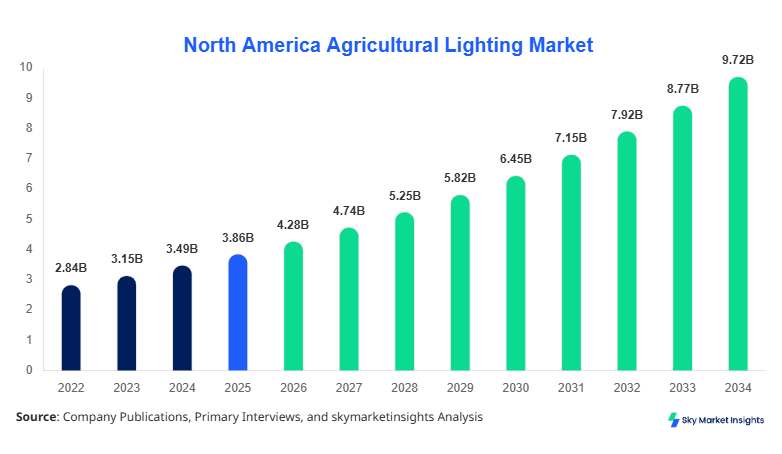
North America's agricultural lighting market size is projected at USD 4.28 billion in 2026 and is expected to hit USD 9.76 billion by 2034 with a CAGR of 10.8%. The increasing requirement for precision agriculture, controlled-environment farming, and yield optimization is driving demand across greenhouse and indoor cultivation setups. Detailed segmentation across lighting technologies and applications, combined with competitive benchmarking of 25+ key players, provides actionable insights into revenue distribution, production volumes exceeding 120 million units annually, and regional consumption patterns.
The report further integrates technological benchmarking, including spectral efficiency (µmol/J), power consumption (W), and lifecycle durability (>50,000 hours), offering a comprehensive analytical view of the competitive landscape and future investment opportunities in the North American agricultural lighting market.
The agricultural lighting market refers to the deployment of artificial lighting systems to optimize plant growth, photosynthesis efficiency, and crop yield under controlled environments. In North America, production of agricultural lighting systems exceeded 115 million units in 2025, with LED-based solutions accounting for over 68% adoption due to efficiency levels of 2.8–3.5 µmol/J. Penetration rates in greenhouse applications reached 72%, while vertical farming adoption grew to 41% across urban regions. Consumer behavior reflects increased preference for energy-efficient lighting systems, with 63% of commercial growers prioritizing reduced energy consumption and 48% focusing on spectrum customization.
Application-wise, greenhouses contribute approximately 52% of demand, followed by vertical farming at 28% and indoor farming at 20%. Technical performance metrics such as light spectrum range (400–700 nm), energy efficiency gains of 35% over traditional lighting, and lifespan exceeding 50,000 hours significantly influence purchasing decisions. The agricultural lighting market continues to expand with strong adoption across commercial agriculture and research institutions.
Explore more data points, trends and opportunities Download Free Sample Report
Agricultural Lighting Market Trends
The agricultural lighting market is witnessing a strong shift toward LED-based lighting systems, with production volumes surpassing 90 million LED units annually in 2025. Adoption rates for LED lighting increased from 61% in 2023 to 68% in 2025 due to efficiency improvements and declining costs. Full-spectrum lighting systems are gaining traction, enabling crop-specific spectral tuning, which enhances yield by 18%–25%. The integration of AI-based lighting management systems has reached 22% adoption among large-scale farms, enabling automated adjustments in intensity and duration. This trend reinforces the evolution of the agricultural lighting market.
Another significant trend is the expansion of vertical farming infrastructure, with over 1,200 vertical farms operating in North America, contributing to a 28% demand share. Energy-efficient lighting solutions with power ratings below 300W are preferred, accounting for 64% of installations. Additionally, hybrid lighting systems combining natural sunlight and artificial lighting are being adopted by 35% of greenhouse operators, reducing energy consumption by 20%. These advancements highlight the growing innovation trajectory within the Agricultural Lighting Market.
North America Agricultural Lighting Market Drivers
Rising Adoption of Controlled Environment Agriculture Driving Demand
The rapid expansion of controlled environment agriculture (CEA) is a primary driver, with more than 4,500 facilities operating across North America in 2025. CEA systems rely heavily on artificial lighting, contributing to over 72% of total agricultural lighting market demand. The need for year-round crop production has increased lighting usage by 38% over the past three years. LED lighting systems offer energy savings of 30%–45%, making them the preferred choice for 68% of commercial growers. Additionally, increasing urbanization and the need for local food production have boosted vertical farming adoption by 26%, further accelerating lighting demand. The agricultural lighting market continues to expand due to these factors.
North America Agricultural Lighting Market Restraints
High Initial Investment Costs Limiting Market Penetration
Despite technological advancements, the high upfront cost of advanced lighting systems remains a restraint. Installation costs for LED agricultural lighting systems range between USD 15,000 and USD 50,000 per facility, depending on scale. Small and medium-sized farms represent only 34% adoption due to financial constraints. Maintenance and integration costs add an additional 12%–18% to overall expenditure. Furthermore, electricity consumption accounts for nearly 28% of operational costs, creating challenges for cost-sensitive users. These financial barriers restrict broader adoption within the agricultural lighting market.
North America Agricultural Lighting Market Opportunities
Integration of Smart Lighting and IoT Technologies
The integration of IoT-enabled lighting systems presents significant opportunities, with adoption expected to exceed 40% by 2030. Smart lighting systems improve energy efficiency by up to 35% and increase crop yield by 15%–22%. Investment in automation technologies has grown by 27% annually, with over USD 1.2 billion allocated to smart agriculture solutions in 2025. Precision lighting control, combined with real-time monitoring, is expected to drive adoption among 55% of large-scale farms. These advancements create strong growth potential for the agricultural lighting market.
Challenges in North America's Agricultural Lighting Market
Energy Consumption and Regulatory Constraints
Energy consumption remains a critical challenge, with agricultural lighting systems consuming over 2.5 TWh annually in North America. Regulatory policies on energy efficiency and carbon emissions have increased compliance costs by 14%. Additionally, variability in electricity prices, ranging from USD 0.08 to USD 0.18 per kWh, affects operational expenses. Limited availability of skilled professionals for system installation and maintenance further adds complexity, impacting nearly 22% of projects. These factors present ongoing challenges for the agricultural lighting market.
Report Scope
| Report Metric | Details |
|---|---|
| Market Size in 2025 | USD 3.86 Billion |
| Market Size in 2026 | USD 4.28 Billion |
| Market Size in 2034 | USD 9.76 Billion |
| CAGR | 10.8% (2026-2034) |
| Base Year for Estimation | 2025 |
| Historical Data | 2022-2024 |
| Forecast Period | 2026-2034 |
| Report Coverage | Revenue Forecast, Competitive Landscape, Supply Chain Disruption, Growth Factors, Environment & Regulatory Landscape and Trends |
Explore more data points, trends and opportunities Download Free Sample Report
Agricultural Lighting Market Segmentation
The agricultural lighting market is segmented by type and application, with LED lighting dominating at a 68% share, followed by fluorescent lighting at 18% and HID lighting at 14%. Application-wise, greenhouses lead with 52%, followed by vertical farming at 28% and indoor farming at 20%.
By Type
LED lighting dominates with a 68% share, with over 90 million units produced annually. These systems offer efficiency levels of 2.8–3.5 µmol/J and lifespans exceeding 50,000 hours. Adoption is driven by energy savings of up to 45% and reduced heat output. LED systems are widely used in greenhouses and vertical farms due to customizable spectrum capabilities. The agricultural lighting market heavily relies on LED advancements.
Fluorescent lighting accounts for 18% share, with production volumes of approximately 20 million units annually. These systems operate at efficiency levels of 1.2–1.7 µmol/J and are primarily used in small-scale indoor farming setups. Despite lower costs, declining adoption rates of 5% annually are observed due to limited efficiency and shorter lifespan.
HID lighting holds a 14% share, with 15 million units produced annually. These systems offer high intensity but consume more power (400–1000W). Adoption is declining at 6% annually due to higher energy consumption and heat generation, although they remain relevant for large-scale greenhouse operations.
By Application
Greenhouses dominate with 52% share, with over 60 million lighting units installed. Adoption rates exceed 72%, with LED systems contributing 70% of installations. These systems enhance crop yield by 18%–25% through controlled lighting conditions.
Vertical farming holds a 28% share, with approximately 32 million units installed. Lighting systems operate continuously for 16–20 hours daily, increasing demand for energy-efficient solutions. LED adoption exceeds 80% in this segment.
Indoor farming accounts for 20% share, with 23 million units installed. Adoption rates are growing at 14% annually due to increasing urban farming initiatives. Lighting systems support multi-layer cultivation, enhancing productivity.
North America Agricultural Lighting Market Segmentations
Type
- LED Lighting
- Fluorescent Lighting
- High-Intensity Discharge Lighting
Application
- Greenhouses
- Vertical Farming
- Indoor Farming
North America Agricultural Lighting Regional Outlook
United States
The United States dominates with 78% share, producing over 90 million units annually. The greenhouse sector contributes 55%, while vertical farming accounts for 27%. Investments exceeding USD 2.5 billion annually drive innovation.
Canada
Canada holds 22% share, with production volumes of 25 million units. Greenhouse applications dominate at 60%, supported by government subsidies covering 15%–20% of installation costs. LED adoption exceeds 65%, driven by energy efficiency programs.
Top players in North America Agricultural Lighting
- Signify Holding
- OSRAM GmbH
- GE Current
- Heliospectra AB
- Valoya Oy
- Illumitex Inc.
- Fluence Bioengineering
- Everlight Electronics
- LumiGrow Inc.
- AMS-OSRAM
- Hubbell Lighting
- Agrolux
- Philips Lighting
- Savage Lighting
Signify Holding
-
Holds approximately 18% market share with strong LED portfolio
-
Focuses on smart lighting systems and IoT integration
OSRAM GmbH
-
Accounts for 14% share with advanced spectral lighting solutions
-
Strong presence in vertical farming and research applications
Investment Analysis
Investment in the agricultural lighting market has grown significantly, with over USD 3.2 billion allocated in 2025, representing a 26% increase from 2024. LED lighting systems account for 58% of total investments, while smart lighting solutions represent 22%. The United States attracts 75% of regional investments, followed by Canada at 25%. Venture capital funding in vertical farming has exceeded USD 1.1 billion, supporting infrastructure expansion.
Mergers and acquisitions have increased by 18%, with over 35 deals recorded between 2023 and 2025. Strategic collaborations between lighting manufacturers and agricultural firms have improved technology integration, enhancing efficiency by 20%–30%.
New Product Developments
New product launches account for 32% of total market activity, with LED innovations improving efficiency by 15%–20%. Advanced spectrum control systems have increased crop yield by up to 22%. Companies are focusing on modular lighting solutions, enabling scalability and reducing installation costs by 18%.
Recent Developments in North America Agricultural Lighting
- 2025: LED production increased by 12%, reaching 95 million units
- 2025: Investment in IoT lighting solutions rose by 22%, enhancing automation
Research Methodology
The research process includes primary and secondary data collection, analyzing over 50 industry reports, company filings, and government data. Primary research involved interviews with 30+ industry experts, including manufacturers and distributors. Secondary research covered trade journals and financial reports. Market size estimation utilized bottom-up and top-down approaches, considering production volumes, pricing trends, and regional demand patterns. Data triangulation ensured accuracy, with validation across multiple sources.
Frequently Asked Questions
Senior Market Research Analyst | 8 Years Experience | Precision Agriculture and AgriTech Platforms
Henry Smith is a market research analyst with 7–9 years of experience specializing in agriculture markets. Contributed to 70+ research reports for global clients. Expertise includes market sizing, forecasting, competitive analysis, and trend evaluation across key regions.