Europe Agro Textiles Market Size
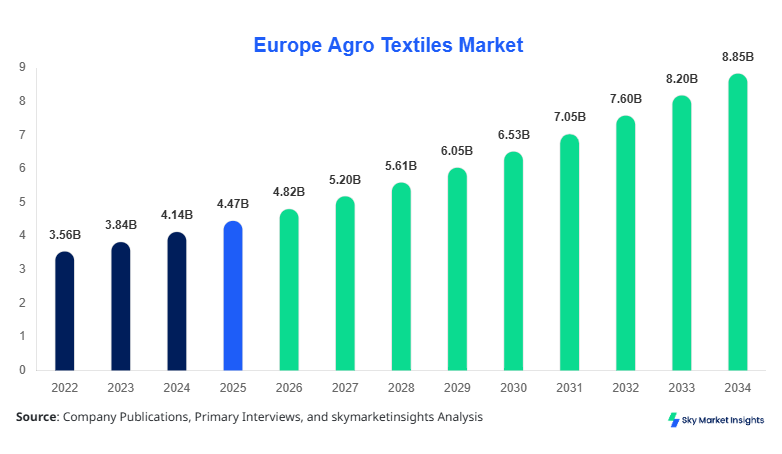
Europe's agro-textiles market size is projected at USD 4.82 billion in 2026 and is expected to hit USD 8.91 billion by 2034 with a CAGR of 7.98%. The market expansion is supported by rising protected farming acreage, increasing climate-resilient cultivation practices, and growing investment in precision agriculture technologies across Europe. More than 14.2 million hectares of controlled agricultural cultivation in Europe are expected to utilize agrotextile materials by 2034, compared with nearly 8.7 million hectares in 2025. Competitive benchmarking across Germany, France, Italy, Spain, and the United Kingdom indicates that manufacturers are prioritizing UV-resistant woven polymers, biodegradable fabrics, and recyclable polypropylene products to strengthen operational efficiency and sustainability compliance. The market ecosystem includes over 320 regional manufacturers, 1,100 distribution partners, and approximately 18% year-on-year expansion in high-performance agricultural covering systems.
Agrotextiles are specialized textile products used in agricultural, horticultural, floricultural, forestry, and aquaculture operations to improve crop yield, soil protection, water conservation, and climatic resistance. These materials include shade nets, mulch mats, bird protection nets, anti-hail systems, fishing nets, and crop covers manufactured using polyethylene, polypropylene, nylon, and biodegradable polymer fibers. Europe produced more than 2.6 million metric tons of technical agricultural textile materials in 2025, while Germany, France, and Italy collectively accounted for nearly 61% of regional output. Adoption penetration across greenhouse cultivation exceeded 74% in Western Europe, while horticulture usage penetration reached 58% in high-value fruit and vegetable production. Consumer demand analytics indicate that nearly 67% of commercial growers in Europe now prioritize UV stabilization and moisture retention efficiency while procuring agrotextile solutions. Agriculture applications contributed approximately 49% of total deployment, followed by horticulture at 33% and aquaculture at 18%. UV resistance performance exceeding 1,200 kLy exposure tolerance and tensile strength ranging between 24 MPa and 42 MPa remain critical purchasing parameters influencing the European agrotextiles market.
In Germany, the agro-textiles market accounted for nearly 29% of the overall Europe revenue contribution in 2025, supported by advanced agricultural modernization and large-scale protected farming adoption. Germany hosts more than 85 specialized agro-textile production facilities and approximately 190 technical textile processing companies involved in agricultural applications. Shade nets represented nearly 38% of domestic demand, mulch mats contributed 31%, and anti-hail nets accounted for approximately 19% of installations across vineyards and orchards. Technology adoption rates remain significantly high, with nearly 72% of commercial greenhouse operators integrating UV-resistant agrotextiles and smart climate-control systems. Germany processed more than 520,000 metric tons of agrotextile materials in 2025, while exports exceeded USD 1.1 billion across neighboring European countries. Sustainable textile adoption increased by 21% year-over-year due to stricter environmental directives and carbon reduction initiatives, reinforcing the European agrotextiles market.
Explore more data points, trends and opportunities Download Free Sample Report
Agro Textiles Market Trends
Expansion of Sustainable and Biodegradable Agrotextile Materials
The increasing adoption of biodegradable agrotextiles is reshaping production and procurement strategies across Europe. In 2025, biodegradable agricultural fabrics accounted for nearly 16% of total agrotextile consumption, compared with only 9% in 2022. Manufacturers are shifting toward bio-based polypropylene blends and starch-derived polymer composites to reduce landfill waste and comply with EU environmental policies. Production of biodegradable mulch mats exceeded 310 million square meters in 2025, while annual investments in sustainable textile innovation surpassed USD 420 million across Germany, France, and Italy. Nearly 44% of large-scale horticulture operators now prefer recyclable and biodegradable protective coverings due to enhanced soil aeration and an 18% reduction in synthetic waste generation. Smart UV-protected fibers with 5–7 year durability cycles are increasingly deployed in vineyards, fruit cultivation, and greenhouse vegetable farming, strengthening the European agrotextiles market.
Rising Integration of Precision Agriculture Technologies
Digital agriculture integration has accelerated demand for sensor-compatible agrotextile products across European farming operations. More than 61% of greenhouse farming projects initiated in 2025 incorporated climate-responsive textile systems integrated with IoT-based irrigation monitoring. Smart shade nets capable of regulating temperature by 4°C–6°C and reducing evaporation rates by 28% gained substantial traction in Spain and Italy. Europe recorded over 780 million square meters of technologically enhanced agro-textile deployment in 2025, supported by increasing precision farming investments. Agricultural cooperatives and commercial farms allocated approximately 14% of annual capital expenditure toward automated textile-supported crop management systems. Demand for high-tensile anti-hail protection systems increased by 23% year-over-year due to rising climate unpredictability and severe weather conditions, reinforcing long-term Europe agro-textiles market expansion.
Growth of Protected Cultivation Infrastructure
Protected cultivation continues to emerge as one of the strongest contributors to agrotextile consumption in Europe. Greenhouse acreage across the region exceeded 295,000 hectares in 2025, with Spain, Italy, and the Netherlands leading deployment volumes. More than 69% of greenhouse operators adopted woven agrotextiles for thermal insulation, pest management, and moisture retention applications. The use of high-density polyethylene crop covers increased by 18% during 2024–2025, while anti-insect nets achieved penetration of nearly 41% in commercial horticulture operations. Agricultural productivity improvements ranging from 22% to 37% have encouraged governments and cooperatives to expand subsidy programs supporting agro-textile installations. Advanced textile systems with light transmission optimization between 68% and 85% are increasingly preferred across fruit cultivation and nursery management applications, accelerating the European agro-textiles market.
Europe Agro Textiles Drivers
Increasing Protected Farming Adoption and Climate-Resilient Agriculture Investments
The expansion of controlled environment agriculture and climate-resilient farming infrastructure is significantly driving demand for agrotextile products across Europe. Agricultural losses caused by extreme weather events exceeded USD 12.6 billion in 2025, encouraging growers to invest heavily in protective textile systems. More than 4.3 million hectares of farmland across Europe integrated crop protection nets, mulch mats, and thermal covers during 2024–2025. Government-backed agricultural modernization programs allocated over USD 2.1 billion toward greenhouse expansion, water conservation systems, and advanced cultivation technologies. Germany, Spain, and Italy collectively represented approximately 57% of agrotextile installations due to increasing demand for high-yield vegetable and fruit cultivation. UV-stabilized shade nets demonstrated crop productivity improvement ranging between 18% and 34%, while water retention enhancement from mulch mats exceeded 26% across drought-prone agricultural regions. Increasing food security concerns and rising demand for sustainable farming practices are expected to accelerate long-term European agrotextile market expansion.
Europe Agro Textiles Restraints
Volatility in Raw Material Prices and Environmental Disposal Concerns
The market faces considerable challenges due to fluctuations in polymer raw material costs and increasing environmental concerns regarding synthetic textile disposal. Polypropylene and polyethylene prices increased by approximately 19% during 2024–2025 because of energy market instability and global supply chain disruptions. Nearly 38% of regional agro-textile manufacturers reported reduced operating margins due to escalating raw material procurement expenses. Europe generated more than 420,000 metric tons of agricultural textile waste annually, with only 31% currently processed through recycling systems. Environmental compliance regulations imposed by the European Union increased operational expenditure for textile producers by nearly 12% in 2025. Smaller agricultural operators in Eastern Europe continue to face affordability limitations, particularly for advanced UV-resistant products priced 18%–25% higher than conventional textile systems. These factors may temporarily limit adoption rates and slow Europe's agro-textiles market penetration in price-sensitive agricultural regions.
Europe Agro Textiles Opportunities
Rising Demand for Smart and Recyclable Agricultural Textile Solutions
The emergence of smart farming ecosystems and recyclable textile innovation presents substantial opportunities for industry participants. Europe’s smart agriculture investment exceeded USD 6.8 billion in 2025, with nearly 22% directed toward textile-supported cultivation systems. Demand for recyclable agrotextiles increased by 27% year-over-year due to regulatory pressure and sustainability targets established under the European Green Deal. Manufacturers are investing in sensor-integrated fabrics capable of monitoring temperature, humidity, and soil moisture conditions. More than 140 pilot projects involving intelligent agrotextile systems were launched across Germany, France, and the Netherlands in 2025. Commercial growers adopting recyclable crop covers achieved operational waste reduction exceeding 30% and irrigation efficiency improvements nearing 21%. Expansion of organic farming acreage beyond 19 million hectares across Europe is expected to create additional demand for biodegradable protective fabrics, supporting future European agrotextile market expansion.
Challenges in European Agro-Textiles
Limited Recycling Infrastructure and Product Durability Issues
Despite technological progress, the industry continues to face challenges associated with recycling inefficiencies and limited product lifespan under harsh climatic exposure. Nearly 46% of agricultural textile waste generated across Europe lacks organized collection and recycling channels. Exposure to high UV radiation and fluctuating temperature cycles reduces the operational lifespan of low-grade agrotextile products to less than three years in southern European climates. Farmers replacing damaged shade nets and crop covers incur maintenance costs representing nearly 11% of annual cultivation expenditure. Small-scale farms accounting for approximately 39% of total agricultural holdings remain reluctant to adopt premium agrotextiles because of replacement frequency concerns. Additionally, inconsistent product quality standards across regional suppliers create procurement uncertainty among commercial growers. The lack of harmonized recycling infrastructure and limited awareness regarding sustainable disposal methods continue to restrict full-scale European agro-textile market optimization.
Report Scope
| Report Metric | Details |
|---|---|
| Market Size in 2025 | USD 4.46 Billion |
| Market Size in 2026 | USD 4.82 Billion |
| Market Size in 2034 | USD 8.91 Billion |
| CAGR | 7.89% (2026-2034) |
| Base Year for Estimation | 2025 |
| Historical Data | 2022-2024 |
| Forecast Period | 2026-2034 |
| Report Coverage | Revenue Forecast, Competitive Landscape, Supply Chain Disruption, Growth Factors, Environment & Regulatory Landscape and Trends |
Explore more data points, trends and opportunities Download Free Sample Report
Agro Textiles Market Segmentation
The European agro-textiles market segmentation is primarily categorized by product type and application. Shade nets dominated the market with approximately a 38% share in 2025 due to extensive greenhouse deployment and climatic protection benefits. Agriculture remained the largest application segment with nearly 49% of total consumption, supported by expanding precision farming and crop protection initiatives.
BY TYPE
Shade nets accounted for approximately 38% of regional consumption in 2025 due to extensive deployment in greenhouse cultivation, vegetable farming, and fruit production. Europe consumed more than 1.1 billion square meters of shade nets during the year, with Germany, Spain, and Italy contributing nearly 63% of installations. These products typically provide shading efficiency ranging between 35% and 90% depending on crop requirements and climatic conditions. High-density polyethylene shade nets with UV stabilization exceeding 1,000 kLy resistance cycles are widely preferred in horticultural applications. Commercial growers utilizing shade nets reported temperature reduction of nearly 5°C and water evaporation control improvement exceeding 24%. Rising greenhouse cultivation across Southern Europe continues to strengthen demand for advanced shading technologies in the European agrotextiles market.
Mulch mats represented nearly 29% of the market volume in 2025, supported by increasing demand for soil conservation and moisture retention systems. Europe produced over 760 million square meters of mulch mats during the year, with biodegradable variants accounting for approximately 18% of total production. Polypropylene mulch mats are extensively utilized in vineyards, nurseries, and organic farming operations due to their ability to suppress weed growth by up to 92%. Water retention improvement ranging between 20% and 30% and soil temperature stabilization benefits have accelerated adoption among commercial vegetable cultivators. Germany and France collectively contributed approximately 44% of regional mulch mat demand, reinforcing expansion across the European agro-textiles market.
Anti-hail nets accounted for approximately 19% of total market revenue in 2025, particularly across vineyard and orchard cultivation regions in Italy, Spain, and France. More than 410 million square meters of anti-hail net systems were deployed during the year to reduce crop losses caused by severe climatic conditions. These textile systems demonstrate tensile strength between 32 MPa and 48 MPa and offer hail impact resistance exceeding 85%. Commercial orchard operators adopting anti-hail solutions achieved crop damage reduction nearing 40% during extreme weather events. Rising climate volatility and increasing insurance requirements for crop protection are expected to sustain long-term demand within the European agrotextiles market.
Others, including fishing nets, bird protection systems, and thermal crop covers, collectively represented approximately 14% of the market in 2025. Aquaculture applications utilized nearly 120 million square meters of protective textile materials for water filtration and fish containment systems. Bird protection nets achieved strong penetration across vineyards and berry cultivation farms, particularly in Spain and Italy. Thermal crop covers capable of increasing soil temperature by 2°C–4°C remain highly utilized in Northern European vegetable cultivation operations. Expanding multifunctional textile innovation and diversified agricultural applications continue to support the Europe agro-textiles market.
BY APPLICATION
Agriculture remained the dominant application segment with approximately 49% of total regional demand in 2025. Europe deployed more than 1.4 billion square meters of agrotextile products in open-field agriculture for crop protection, weed suppression, and water conservation. Shade nets and mulch mats contributed nearly 67% of agricultural installations, particularly in vegetable, grain, and oilseed cultivation. Water consumption reduction ranging from 18% to 28% and crop productivity improvements exceeding 24% encouraged wider adoption among commercial farming enterprises. Germany, France, and Spain collectively represented over 58% of agricultural agrotextile utilization. Increasing climate variability and expansion of precision farming infrastructure continue to accelerate Europe's agro-textiles market penetration.
Horticulture accounted for nearly 33% of total market revenue due to strong demand from greenhouse vegetables, ornamental plants, nurseries, and fruit cultivation. More than 920 million square meters of textile products were consumed across horticultural operations in 2025. High-value crops such as tomatoes, berries, grapes, and flowers extensively utilize UV-resistant protective fabrics and anti-insect netting systems. Horticultural operators adopting advanced agrotextiles achieved crop loss reduction between 19% and 35% while improving yield consistency by nearly 27%. Southern European countries accounted for approximately 61% of horticultural textile demand, reinforcing steady European agro-textile market expansion.
Aquaculture represented approximately 18% of total application demand in 2025, supported by increasing seafood production and sustainable fish farming investments. Europe consumed more than 180 million square meters of specialized textile materials in aquaculture applications, including fish containment nets, filtration systems, and algae protection fabrics. Norway, Russia, and the United Kingdom emerged as leading aquaculture and textile consumers due to expanding marine farming infrastructure. High-performance nylon and polyethylene textile systems demonstrated tensile strength exceeding 44 MPa and operational durability of more than seven years. Rising seafood consumption and expansion of offshore aquaculture facilities continue to create new opportunities for the European agro-textiles market.
Forestry and related environmental applications collectively contributed approximately 7% of specialized agrotextile deployment across Europe. These products are increasingly utilized in erosion control, soil stabilization, and reforestation projects. More than 75 million square meters of biodegradable textile systems were installed across environmental rehabilitation initiatives in 2025. Government-backed afforestation projects across Germany and France allocated nearly USD 210 million toward protective textile materials for sapling preservation and moisture retention. Sustainable land restoration initiatives continue supporting long-term diversification within the European agro-textiles market.
Europe Agro Textiles Market Segmentations
Product Type
- Shade Nets
- Mulch Mats
- Anti-Hail Nets
Application
- Agriculture
- Horticulture
- Aquaculture
Europe Agro Textiles Regional Outlook
United Kingdom
The United Kingdom accounted for approximately 11% of the European agro-textiles market revenue in 2025. The country consumed more than 240 million square meters of agrotextile materials, largely concentrated in horticulture and greenhouse vegetable production. Greenhouse farming contributed nearly 42% of domestic agrotextile demand, while aquaculture applications represented approximately 28% due to expanding marine fish farming activities in Scotland and Northern Ireland. Adoption of biodegradable mulch mats increased by nearly 19% during 2024–2025, supported by sustainability-focused agricultural policies. The United Kingdom hosts over 45 agro-textile manufacturers and distributors serving commercial growers and aquaculture operators.
Germany
Germany represented nearly 29% of total regional market revenue and remained the leading producer of agro-textile products in Europe. The country manufactured more than 520,000 metric tons of agrotextile materials in 2025, accounting for approximately 34% of regional production capacity. Agriculture applications contributed nearly 47% of domestic demand, followed by horticulture at 36%. Germany allocated more than USD 680 million toward smart agriculture modernization initiatives involving climate-controlled cultivation systems and recyclable protective fabrics. Commercial greenhouse penetration exceeded 74%, significantly reinforcing the European agro-textiles market.
France
France contributed approximately 16% of regional market revenue in 2025 due to strong vineyard, horticulture, and greenhouse farming activity. More than 360 million square meters of anti-hail and crop protection textiles were utilized across vineyards and fruit orchards. Horticulture accounted for nearly 39% of domestic agrotextile consumption, while mulch mats represented approximately 31% of total installations. France recorded over 14% year-on-year growth in biodegradable textile deployment as agricultural cooperatives prioritized sustainable cultivation systems. Government agricultural modernization subsidies exceeding USD 420 million further supported expansion of the European agro-textiles market.
Spain
Spain accounted for nearly 18% of total European agro-textile market consumption due to extensive greenhouse agriculture concentrated in Almería and Murcia. The country operated more than 72,000 hectares of greenhouse farming infrastructure utilizing shade nets and thermal crop covers. Shade nets represented approximately 44% of domestic demand due to high solar radiation and water conservation requirements. Spain consumed more than 480 million square meters of agrotextile products during 2025, while irrigation efficiency improvements exceeded 26% through advanced textile deployment. Rapid adoption of precision farming technologies continues strengthening long-term market opportunities.
Italy
Italy represented approximately 14% of the regional market in 2025, supported by vineyard cultivation and horticulture expansion. Anti-hail net systems contributed nearly 28% of domestic agrotextile installations, particularly across grape and fruit cultivation regions. Italy processed more than 210,000 metric tons of technical agricultural textiles in 2025, while exports exceeded USD 390 million across Europe. Horticulture accounted for approximately 41% of domestic demand due to high-value vegetable and fruit cultivation. Increasing climate protection investments continue accelerating the European agro-textiles market.
Russia
Russia accounted for approximately 8% of regional market revenue in 2025 due to growing greenhouse agriculture and aquaculture investments. The country consumed more than 160 million square meters of agrotextile materials during the year. Greenhouse cultivation contributed nearly 37% of total demand, while aquaculture applications represented approximately 24%. Government-backed agricultural modernization programs allocated over USD 310 million toward protected farming infrastructure and climate-resistant cultivation systems. Rising food security initiatives and expansion of cold-climate farming continue supporting the European agro-textiles market.
Top players in European agro-textiles
- Berry Global Inc.
- SRF Limited
- Beaulieu Technical Textiles
- Arrigoni S.p.A.
- Low & Bonar PLC
- Hy-Tex Limited
- Diatex SAS
- Capatex Ltd.
- Garware Technical Fibres Ltd.
- Freudenberg Group
- TenCate Geosynthetics
- Neo Corp International
- Belton Industries Inc.
- Shakti Polyweave Pvt. Ltd.
- Ginegar Plastic Products Ltd.
Berry Global Inc.
-
Estimated regional market share: 12%–14%
-
Strong presence in mulch mats, crop covers, and recyclable agro textile solutions
-
Operates advanced polymer processing facilities across Germany and France
-
Focuses on sustainable agricultural textile innovation and lightweight protective systems
Berry Global Inc. maintained leadership through extensive investment in recyclable agricultural fabrics and UV-resistant woven technologies. The company processed more than 180,000 metric tons of agro textile polymers in 2025 and allocated approximately 11% of annual revenue toward sustainable material development. Its biodegradable mulch mat product portfolio achieved nearly 22% year-over-year sales growth across Europe.
Arrigoni S.p.A.
-
Estimated regional market share: 9%–11%
-
Leading supplier of shade nets and anti-hail systems
-
Strong distribution network across Italy, Spain, and France
-
Specialized in climate-control textile technologies for greenhouse agriculture
Arrigoni S.p.A. strengthened its competitive positioning through high-performance climate-protection textile systems capable of reducing crop temperature by nearly 5°C. The company supplied more than 210 million square meters of agro textile products during 2025 and expanded smart greenhouse textile integration projects across Southern Europe. Advanced anti-insect and anti-hail systems remain key contributors to company revenue generation.
Investment Analysis
Investment activity within the Europe Agro Textiles market increased substantially during 2024–2025 due to growing demand for sustainable agriculture and climate-resilient farming systems. Total investments exceeded USD 3.6 billion across manufacturing expansion, smart textile development, and recycling infrastructure projects. Germany accounted for approximately 31% of regional investment allocation, followed by Spain at 18% and France at 16%. Nearly 42% of investments targeted biodegradable and recyclable agro textile production systems, while 28% focused on smart sensor-integrated fabrics. Agricultural cooperatives and greenhouse operators allocated approximately 14% of annual infrastructure spending toward advanced textile-supported climate management systems.
Mergers, acquisitions, and strategic collaborations intensified as manufacturers aimed to strengthen regional supply chains and sustainability capabilities. More than 24 partnership agreements were announced during 2025 involving polymer suppliers, technical textile manufacturers, and agricultural technology firms. Cross-border collaborations between German and Italian textile companies expanded production capacity by approximately 17%. Investment in automated weaving and polymer extrusion technologies improved manufacturing productivity by nearly 21%. Private equity participation in sustainable agro textile ventures increased by 26% year-over-year, indicating strong confidence in long-term Europe Agro Textiles market expansion.
Regional governments also accelerated investment support through agricultural modernization subsidies and environmental sustainability incentives. The European Union allocated more than USD 1.2 billion toward sustainable farming technologies and recyclable agricultural infrastructure under green transition initiatives. Commercial greenhouse developers invested nearly USD 740 million in textile-supported protected cultivation facilities. The growing integration of precision farming and sustainable textile innovation continues generating strong investment momentum across the Europe Agro Textiles market.
New Product Developments
Manufacturers across Europe increasingly introduced advanced agro textile products with enhanced durability, UV stabilization, and environmental sustainability features. Nearly 34% of newly launched agro textile products in 2025 incorporated biodegradable polymer blends or recyclable materials. Smart shade nets with integrated moisture and temperature sensors achieved operational efficiency improvements exceeding 19% in greenhouse farming applications. Anti-hail net systems with reinforced tensile strength between 45 MPa and 52 MPa gained strong traction across vineyard protection projects.
New product innovation also focused heavily on lightweight multifunctional fabrics capable of improving crop protection while reducing installation costs by nearly 14%. Companies introduced advanced thermal crop covers delivering insulation efficiency improvements of approximately 27% compared with conventional textile systems. Sustainable mulch mats capable of biodegrading within 18–24 months experienced strong commercial adoption across organic farming operations, supporting ongoing Europe Agro Textiles market innovation.
Recent Developments in Europe Agro Textiles
- 2025: Berry Global Inc. expanded its recyclable agro textile manufacturing facility in Germany, increasing production capacity by nearly 18% and adding over 42 million square meters annually. The expansion focused on biodegradable mulch mats and greenhouse protection fabrics designed to reduce agricultural plastic waste by approximately 24%. The project involved investment exceeding USD 95 million and strengthened regional distribution capabilities across Western Europe.
- 2025: Arrigoni S.p.A. launched a next-generation smart shade net system capable of reducing greenhouse temperature fluctuations by nearly 31%. The product integrated UV-stabilized fibers and moisture regulation technologies suitable for Mediterranean horticulture operations. Commercial deployment across Italy and Spain exceeded 17 million square meters during the first year of launch, significantly supporting productivity improvements in vegetable cultivation.
- 2025: Garware Technical Fibres Ltd. expanded its aquaculture textile portfolio targeting Northern European marine farming operations. The company improved fish containment net durability by approximately 20% and reduced maintenance expenditure by nearly 12%. Product deployment across offshore aquaculture facilities in the United Kingdom and Russia contributed significantly to regional seafood production infrastructure.
Research Methodology
The research process for the Europe Agro Textiles market involved extensive primary and secondary data collection supported by quantitative and qualitative assessment techniques. Primary research included interviews with agro textile manufacturers, greenhouse operators, agricultural cooperatives, polymer suppliers, distributors, and regulatory authorities across Germany, France, Spain, Italy, the United Kingdom, and Russia. More than 120 industry participants contributed operational insights regarding production capacity, pricing trends, technology adoption, and investment patterns. Secondary research involved analysis of trade databases, technical textile journals, agricultural ministry publications, customs statistics, sustainability reports, and company annual reports.
Market size estimation was conducted using both top-down and bottom-up analytical approaches to validate regional revenue, production volume, and consumption metrics. Data triangulation methods were applied to compare manufacturer-level sales data with agricultural deployment statistics and trade flow analysis. Forecast modeling incorporated macroeconomic indicators, greenhouse farming expansion trends, protected cultivation acreage, climate-resilient agriculture investments, and regulatory sustainability frameworks.
Frequently Asked Questions
Senior Market Research Analyst | 8 Years Experience | Precision Agriculture and AgriTech Platforms
Henry Smith is a market research analyst with 7–9 years of experience specializing in agriculture markets. Contributed to 70+ research reports for global clients. Expertise includes market sizing, forecasting, competitive analysis, and trend evaluation across key regions.