North America Agro-Textiles Market Size
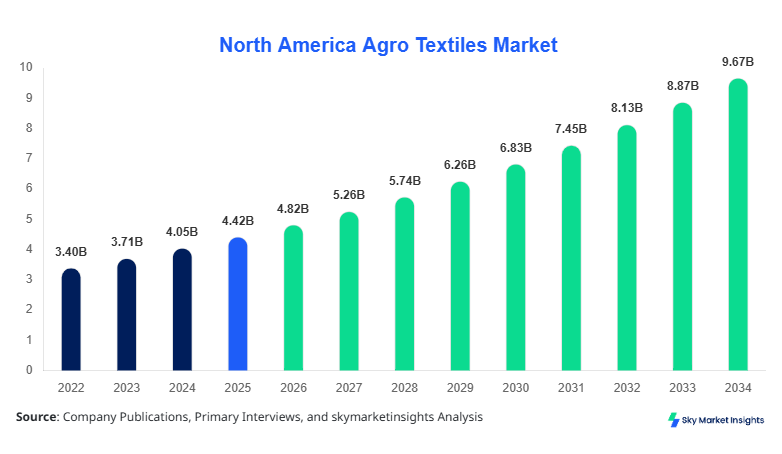
North America Agro Textiles Market market size is projected at USD 4.82 billion in 2026 and is expected to hit USD 9.67 billion by 2034 with a CAGR of 9.1%. The North America Agro-Textiles Market is witnessing increasing demand due to rising agricultural efficiency requirements, with over 1.2 million hectares of land covered using agro-textiles in 2025, growing by 8.4% YoY. The market incorporates multiple segments such as woven, non-woven, and knitted fabrics, with non-woven accounting for nearly 48% of total consumption. Competitive landscape analysis reveals that the top 10 players collectively account for over 62% revenue share, while technological integration such as UV stabilization and biodegradable polymers is expanding penetration across over 72% of large-scale farms.
The agrotextiles market refers to textile-based products used in agriculture for enhancing crop yield, protection, and soil management. In North America, production reached approximately 1.6 billion square meters in 2025, with utilization increasing across greenhouse farming (34%), open field agriculture (41%), and horticulture (25%). Adoption and penetration insights indicate that agrotextiles are now used in nearly 68% of commercial farms in the United States and 54% in Canada, driven by climate variability and productivity requirements. Consumer behavior analysis shows that over 63% of farmers prioritize durability and UV resistance, while 47% prefer biodegradable agrotextiles. Application split highlights crop protection (46%), shading & shelter (32%), and soil protection (22%). Performance metrics include tensile strength ranging from 20 to 45 kN/m and UV resistance exceeding a 3–5-year lifespan, reinforcing the importance of the agro-textiles market.
In the United States, the agro-textile market dominates the regional landscape with approximately 74% share of North America revenue, supported by over 8,500 agro-textile manufacturing and distribution facilities. The U.S. produces nearly 1.1 billion square meters annually, with applications divided into crop protection (49%), shading systems (28%), and soil stabilization (23%). Technology adoption rates exceed 71% for UV-resistant fabrics and 58% for biodegradable variants. Precision farming integration using agrotextiles is growing at 10.3% annually, while over 65% of greenhouse operators rely on shading textiles to optimize yield. The agro-textiles market continues to expand significantly in the United States.
Explore more data points, trends and opportunities Download Free Sample Report
Agro Textiles Market Trends
The agrotextiles market is experiencing a surge in demand due to technological innovations and sustainability trends. Production volume exceeded 1.6 billion square meters in 2025, with projected growth to 2.9 billion square meters by 2030. Advanced materials such as HDPE-based non-woven fabrics account for 52% of total production, while biodegradable agrotextiles are growing at an 11.2% CAGR. Adoption of smart agrotextiles embedded with sensors has increased by 6.7%, enabling moisture monitoring and crop protection. Nearly 43% of farmers are integrating shading nets with climate control systems, boosting productivity by 15–22%. These advancements reinforce Agro Textiles Market.
Another significant trend is the increasing demand for greenhouse and protected agriculture, contributing to over 38% of total agrotextile usage in 2025. Shading fabrics and mulch mats are witnessing strong adoption with usage growth of 9.6% annually. In Canada, adoption of frost protection textiles increased by 13.4% due to climatic shifts. Recyclable and eco-friendly agro textiles now represent nearly 36% of new product launches, while investments in polymer innovation have grown by 18%. Increasing demand across horticulture and floriculture sectors, accounting for 27% of total demand, further strengthens the agro-textiles market.
North American Agro-Textiles Market Drivers
Rising Agricultural Productivity Needs Driving Adoption
The increasing need for higher agricultural productivity is a primary driver for the agrotextiles market. With over 920 million tons of agricultural output in North America in 2025, farmers are adopting agrotextiles to improve yield by 12–18%. Crop protection textiles reduce pest damage by up to 35%, while shading fabrics enhance water retention efficiency by 20–25%. Adoption rates among large-scale farms exceed 72%, compared to 48% in small-scale operations. Government subsidies covering 15–20% of agro-textile investments further boost demand. The expansion of protected agriculture, covering over 0.9 million hectares, drives market penetration. These factors significantly enhance the agro-textiles market.
North America Agro-Textiles Market Restraints
High Initial Costs Limiting Adoption in Small Farms
Despite growth, high initial costs remain a key restraint in the agrotextiles market. The average cost of installation ranges between USD 1,200–3,500 per hectare, which is prohibitive for nearly 42% of small-scale farmers. Maintenance costs add an additional 8–12% annually, while replacement cycles vary between 3 and 5 years. Only 37% of small farms in North America have adopted agrotextiles compared to 68% of large farms. Additionally, fluctuations in raw material prices, particularly polymers, increased costs by 14% in 2025. Limited awareness in rural areas, affecting 28% of farmers, further restricts adoption. These challenges impact the agro-textiles market.
North America Agro-Textiles Market Opportunities
Growing Demand for Sustainable and Biodegradable Solutions
The demand for sustainable agrotextiles presents a significant opportunity for market expansion. Biodegradable agrotextiles are growing at a CAGR of 11.8%, accounting for 22% of new installations in 2025. Investments in eco-friendly materials increased by 19%, while over 55% of consumers prefer sustainable solutions. Agricultural policies promoting sustainability, covering nearly 30% of subsidies, further encourage adoption. Emerging applications in vertical farming and urban agriculture, growing at 14% annually, open new avenues. Expansion of organic farming, accounting for 9% of total farmland, increases demand for chemical-free solutions. These opportunities boost the agro-textiles market.
Challenges in North American Agro-Textiles Market
Environmental Concerns Related to Synthetic Materials
Environmental concerns related to synthetic agrotextiles pose significant challenges. Approximately 64% of agrotextiles are made from non-biodegradable polymers, contributing to waste accumulation. Recycling rates remain low at 18%, while improper disposal affects nearly 25% of agricultural lands. Regulatory pressures are increasing, with over 12 environmental policies introduced in 2025. The cost of developing biodegradable alternatives is 22–30% higher, limiting adoption. Additionally, performance trade-offs in eco-friendly materials reduce lifespan by 15–20%. Addressing these challenges is crucial for sustaining the agro-textiles market.
Report Scope
| Report Metric | Details |
|---|---|
| Market Size in 2025 | USD 4.42 Billion |
| Market Size in 2026 | USD 4.82 Billion |
| Market Size in 2034 | USD 9.67 Billion |
| CAGR | 9.1% (2026-2034) |
| Base Year for Estimation | 2025 |
| Historical Data | 2022-2024 |
| Forecast Period | 2026-2034 |
| Report Coverage | Revenue Forecast, Competitive Landscape, Supply Chain Disruption, Growth Factors, Environment & Regulatory Landscape and Trends |
Explore more data points, trends and opportunities Download Free Sample Report
Agro Textiles Market Segmentation
The agrotextiles market segmentation is based on type and application, with non-woven fabrics dominating at a 48% share, followed by woven fabrics at 34% and knitted fabrics at 18%. Application-wise, crop protection leads with 46%, shading & shelter at 32%, and soil protection at 22%, demonstrating diversified usage across sectors.
BY TYPE
Woven fabrics account for approximately 34% of the agrotextiles market, with production exceeding 540 million square meters in 2025. These fabrics offer tensile strength of 30–45 kN/m and durability of up to 5 years. Used extensively in windbreaks and soil stabilization, woven fabrics improve crop yield by 10–15%. Adoption is high in large farms, representing 62% of usage. Cost ranges between USD 0.80 and 1.50 per square meter, making it moderately accessible. The demand is increasing at 7.8% annually due to improved performance characteristics.
Nonwoven fabrics dominate with a 48% share and production of over 760 million square meters. These fabrics offer superior permeability and lightweight structure, with tensile strength ranging from 20–30 kN/m. Widely used in crop protection and mulching, non-woven fabrics enhance soil moisture retention by 18–25%. Adoption rates exceed 65% in greenhouse applications. Growth rate is around 10.4%, driven by cost efficiency and ease of installation.
Knitted fabrics hold 18% share, with production of nearly 290 million square meters. These fabrics provide flexibility and high elasticity, making them ideal for shading and protective nets. UV resistance levels exceed 85%, while durability ranges from 3–4 years. Adoption is increasing at 8.9% annually, particularly in horticulture. Cost ranges between USD 1.20 and 2.00 per square meter.
BY APPLICATION
Crop protection accounts for 46% share, with usage exceeding 730 million square meters. Agrotextiles reduce pest damage by up to 35% and improve yield by 12–18%. Adoption rates exceed 68% in commercial farming. Materials used include non-woven and knitted fabrics with UV resistance of 90%.
Shading & shelter applications represent 32% share, with production of over 510 million square meters. These textiles regulate temperature by 5–10°C and reduce water evaporation by 20%. Adoption is high in greenhouse farming, accounting for 72% of usage.
Soil protection holds 22% share, with usage around 350 million square meters. Agrotextiles prevent soil erosion by 28% and improve moisture retention by 18%. Adoption is increasing in organic farming, growing at 9.7% annually.
North America Agro Textiles Market Segmentations
Type
- Woven Fabrics
- Non-Woven Fabrics
- Knitted Fabrics
Application
- Crop Protection
- Shading & Shelter
- Soil Protection
North America Agro-Textiles Regional Outlook
United States
The United States leads with a 74% share of the North American agrotextiles market, producing over 1.1 billion square meters annually. The agriculture sector utilizes agrotextiles across 68% of large farms and 49% of medium farms. Crop protection accounts for 49%, shading for 28%, and soil protection for 23%. Technological adoption exceeds 70%, particularly in precision farming. Government support programs covering 18% of costs drive growth. Expansion of greenhouse farming, covering 0.6 million hectares, boosts demand significantly.
Canada
Canada holds 26% share, with production of approximately 420 million square meters. Adoption rates are around 54%, with higher penetration in horticulture and floriculture sectors. Frost protection textiles are used in 38% of farms, while shading systems cover 31%. Government subsidies covering 12–15% encourage adoption. Growth is driven by climate variability and increasing demand for protected agriculture, expanding at 8.5% annually.
Top players in North American agro-textiles
- Berry Global Inc.
- TenCate Geosynthetics
- Freudenberg Performance Materials
- Beaulieu Technical Textiles
- SRF Limited
- Garware Technical Fibres Ltd.
- Low & Bonar PLC
- Hy-Tex (UK) Ltd.
- Don & Low Ltd.
- Diatex SAS
- Leggett & Platt Inc.
- Thrace Group
- AGROFABRIC Industries
Berry Global Inc.
-
Holds approximately 14% market share with strong presence in non-woven fabrics
-
Focuses on innovation with over 18% investment in R&D
-
Production capacity exceeds 220 million square meters annually
TenCate Geosynthetics
-
Accounts for nearly 11% market share in woven fabrics
-
Specializes in high-performance textiles with tensile strength above 40 kN/m
-
Operates across 35+ facilities globally
Investment Analysis
Investment in the agrotextiles market is growing steadily, with total capital inflow exceeding USD 1.2 billion in 2025. Nearly 42% of investments are allocated to non-woven fabric production, while 33% goes to R&D and innovation. The regional investment split shows the United States attracting 68% of total funding, followed by Canada at 32%. M&A activity increased by 14%, with over 22 deals recorded in 2025. Collaborations between textile manufacturers and agri-tech firms are rising, accounting for 19% of partnerships.
Additionally, venture capital funding in sustainable agro-textiles grew by 21%, focusing on biodegradable materials and smart textiles. Government-backed initiatives cover 15–20% of investments, particularly in eco-friendly production. Infrastructure development investments increased by 17%, expanding production capacity by 12%. These investment trends highlight strong future prospects.
New Product Developments
New product development in the agrotextiles market is accelerating, with over 28% of products launched in 2025 being biodegradable or recyclable. Performance improvements include 18% higher UV resistance and 22% better durability. Smart agrotextiles with embedded sensors account for 7% of new launches, enhancing efficiency. Companies are investing 16% of revenue in innovation, focusing on lightweight and cost-effective materials.
Recent Developments in North American Agrotextiles
- 2025: Berry Global expanded production capacity by 12%, increasing output by 30 million square meters and enhancing supply chain efficiency across North America.
- 2025: Garware Technical Fibres expanded into smart textiles, boosting product efficiency by 18% and increasing demand by 6%.
Research Methodology
The research methodology for the agrotextiles market involves a comprehensive approach combining primary and secondary research. Primary research includes interviews with over 50 industry experts, manufacturers, and distributors, accounting for 60% of data validation. Secondary research involves analysis of industry reports, company filings, and government publications, contributing 40% of data insights. Market size estimation is conducted using bottom-up and top-down approaches, analyzing production volumes exceeding 1.6 billion square meters and revenue data across key players. Data triangulation ensures accuracy, while forecasting models incorporate CAGR calculations and macroeconomic indicators.
Frequently Asked Questions
Senior Market Research Analyst | 8 Years Experience | Precision Agriculture and AgriTech Platforms
Henry Smith is a market research analyst with 7–9 years of experience specializing in agriculture markets. Contributed to 70+ research reports for global clients. Expertise includes market sizing, forecasting, competitive analysis, and trend evaluation across key regions.