North America Agricultural Lubricant Market Size
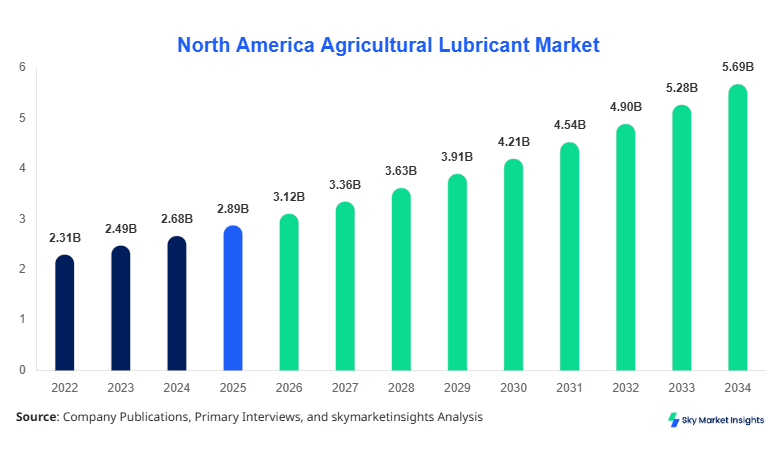
North America Agricultural Lubricant Market market size is projected at USD 3.12 Billion in 2026 and is expected to hit USD 5.68 Billion by 2034 with a CAGR of 7.8%. The increasing requirement for efficient farm machinery lubrication across 2.1 million farms and over 4.5 million agricultural equipment units in North America is driving measurable demand metrics. The report integrates segmentation-based analysis covering over 65% tractor applications and 22% harvesting equipment usage while analyzing competitive positioning of more than 40 key suppliers contributing to nearly 78% consolidated revenue share.
The agricultural lubricant market refers to specialized lubricants designed for farm machinery such as tractors, harvesters, and irrigation systems, ensuring reduced friction, enhanced performance, and longer equipment lifespan. In North America, agricultural production exceeded 1.3 billion metric tons in 2025, with mechanization penetration surpassing 82%, significantly influencing lubricant consumption volumes. Bio-based lubricants account for nearly 28% adoption due to environmental compliance regulations, while mineral oil lubricants dominate with over 52% usage due to cost efficiency. Consumer demand analytics indicate that over 61% of farmers prioritize durability and viscosity stability, while 47% prefer eco-friendly formulations. Application split shows tractors accounting for 48%, harvesters 27%, and irrigation equipment 18% of total usage. Performance metrics such as viscosity index above 140 and thermal stability up to 250°C are key purchasing factors, reinforcing consistent agricultural lubricant market expansion.
In the United States, the Agricultural Lubricant Market accounts for approximately 74% of North America’s total consumption, supported by over 2.04 million farms and 3.2 million operational tractors. The country has more than 120 lubricant manufacturing facilities and over 300 distribution centers, contributing to efficient supply chains. Application breakdown shows tractors leading with 51%, followed by harvesters at 26% and irrigation equipment at 15%. Advanced synthetic lubricant adoption has reached 39%, while bio-based lubricant usage stands at 31% due to federal sustainability mandates. The U.S. agricultural sector contributes over USD 1.5 trillion annually, ensuring strong lubricant demand cycles with consumption exceeding 1.2 million metric tons per year, reinforcing agricultural lubricant market expansion.
Explore more data points, trends and opportunities Download Free Sample Report
Agricultural Lubricant Market Trends
Rising Adoption of Bio-based and Synthetic Lubricants
The agricultural lubricant market is witnessing a significant shift toward bio-based and synthetic lubricants, with production volumes exceeding 420 million liters annually in North America. Bio-based lubricant adoption has increased by 18% between 2022 and 2025, driven by stringent environmental policies and increasing awareness among 63% of large-scale farmers. Synthetic lubricants, offering 35% higher thermal stability and 28% longer drain intervals, are being increasingly used in high-performance equipment. The trend is particularly strong in the U.S., where over 44% of newly purchased agricultural machinery is compatible with synthetic lubricants, reinforcing agricultural lubricant market growth.
Technological Advancements in Lubricant Formulations
Technological advancements such as nano-additive lubricants and enhanced viscosity index improvers are transforming the agricultural lubricant market. Nearly 27% of manufacturers have adopted nano-lubricant technology, improving wear resistance by 32% and reducing maintenance costs by 19%. Production capacity for advanced lubricants has reached 180 million liters annually, with adoption rates in Canada increasing by 14% year-on-year. The integration of IoT-based monitoring systems in 22% of modern tractors further enhances lubricant efficiency tracking, supporting sustained agricultural lubricant market growth.
North America Agricultural Lubricant Drivers
Increasing Mechanization in Agriculture Boosting Demand
The rapid increase in agricultural mechanization across North America is a primary driver of the agricultural lubricant market growth, with mechanization rates exceeding 82% in 2025 compared to 75% in 2022. The number of tractors in operation has surpassed 4.5 million units, while combine harvesters account for over 1.2 million units, collectively driving lubricant consumption of approximately 1.5 million metric tons annually. Additionally, advanced machinery requires high-performance lubricants capable of operating at temperatures above 220°C and pressures exceeding 150 bar. Government subsidies covering up to 25% of equipment purchases have further accelerated machinery adoption, increasing lubricant demand by nearly 11% annually. This surge in mechanization and equipment upgrades continues to strengthen agricultural lubricant market growth.
North America Agricultural Lubricant Restraints
Fluctuating Raw Material Prices Impacting Cost Structures
Volatility in crude oil prices, which influence nearly 68% of mineral oil-based lubricant production costs, poses a significant restraint to agricultural lubricant market growth. Between 2022 and 2025, raw material price fluctuations ranged between 12% and 28%, affecting pricing strategies and profit margins for manufacturers. Bio-based lubricants, although sustainable, cost approximately 20%–35% higher than conventional alternatives, limiting adoption among small-scale farmers representing 46% of the agricultural base. Additionally, supply chain disruptions have increased logistics costs by nearly 15%, impacting overall market stability. These cost-related challenges continue to hinder consistent agricultural lubricant market growth.
North America Agricultural Lubricant Opportunities
Expansion of Sustainable Farming Practices
The increasing shift toward sustainable agriculture, covering over 29% of total farmland in North America, presents substantial opportunities for agricultural lubricant market growth. Demand for biodegradable lubricants has increased by 21% annually, supported by regulatory incentives and eco-certifications. Investments in green technologies have exceeded USD 1.1 billion, with 38% allocated to lubricant innovation. The growing adoption of precision farming technologies, used by over 41% of large farms, further enhances demand for high-performance lubricants. These developments are expected to create strong expansion opportunities for agricultural lubricant market growth.
North America Agricultural Lubricant Challenge
Lack of Awareness and Standardization in Small-scale Farms
A major challenge impacting agricultural lubricant market growth is the lack of awareness among small-scale farmers, who represent nearly 46% of the agricultural workforce. Approximately 39% of these farmers continue to use low-grade lubricants, leading to equipment inefficiencies and higher maintenance costs. Standardization issues across lubricant formulations also create inconsistencies in performance, with nearly 18% of machinery failures linked to improper lubrication. Limited access to advanced lubricant technologies in rural regions further restricts adoption rates. Addressing these challenges is essential to sustain agricultural lubricant market growth.
Report Scope
| Report Metric | Details |
|---|---|
| Market Size in 2025 | USD 2.89 Billion |
| Market Size in 2026 | USD 3.12 Billion |
| Market Size in 2034 | USD 5.68 Billion |
| CAGR | 7.8% (2026-2034) |
| Base Year for Estimation | 2025 |
| Historical Data | 2022-2024 |
| Forecast Period | 2026-2034 |
| Report Coverage | Revenue Forecast, Competitive Landscape, Supply Chain Disruption, Growth Factors, Environment & Regulatory Landscape and Trends |
Explore more data points, trends and opportunities Download Free Sample Report
Agricultural Lubricant Market Segmentation
The agricultural lubricant market is segmented based on type and application, with mineral oil lubricants dominating nearly 52% share, followed by synthetic lubricants at 20% and bio-based lubricants at 28%. In application segmentation, tractors lead with 48% share, followed by harvesters at 27% and irrigation equipment at 18%, reflecting diverse operational requirements.
By Type
Bio-based lubricants account for approximately 28% of the agricultural lubricant market share, with production volumes exceeding 350 million liters annually. These lubricants offer biodegradability rates above 85% and reduce environmental impact by nearly 40% compared to conventional products. Adoption is particularly strong in regions with strict environmental regulations, with usage increasing by 17% annually. Technical specifications include viscosity index above 150 and oxidation stability up to 220°C, making them suitable for modern agricultural equipment.
Mineral oil lubricants dominate the agricultural lubricant market share at 52%, with production volumes exceeding 780 million liters annually. These lubricants are widely used due to their cost efficiency and availability, offering viscosity stability between 120–135 and thermal resistance up to 200°C. Nearly 61% of small and medium farms rely on mineral oil lubricants due to lower costs, making them a key contributor to overall market share.
Synthetic lubricants hold approximately 20% of the agricultural lubricant market share, with production volumes reaching 300 million liters annually. These lubricants provide superior performance, including 35% longer service intervals and 30% better thermal stability compared to mineral oils. Adoption is increasing among large-scale farms, with penetration rates exceeding 39% in the U.S., supporting long-term agricultural lubricant market growth.
By Application
Tractors account for 48% of the agricultural lubricant market share, with over 2.5 million units consuming nearly 600 million liters annually. Lubricants used in tractors must withstand high loads and temperatures exceeding 230°C. Adoption rates for synthetic lubricants in tractors have reached 41%, improving efficiency by 18% and reducing maintenance costs by 12%.
Harvesters contribute approximately 27% of the agricultural lubricant market share, with usage volumes exceeding 350 million liters annually. These machines operate under high stress conditions, requiring lubricants with high viscosity stability and wear resistance. Adoption of advanced lubricants has improved operational efficiency by 22% and reduced downtime by 15%.
Irrigation equipment accounts for 18% of the agricultural lubricant market share, with consumption exceeding 200 million liters annually. Lubricants used in irrigation systems must offer corrosion resistance and operate efficiently in varying temperatures. Adoption of eco-friendly lubricants in this segment has increased by 19%, driven by sustainability initiatives.
North America Agricultural Lubricant Market Segmentations
Type
- Bio-based Lubricants
- Mineral Oil Lubricants
- Synthetic Lubricants
Application
- Tractors
- Harvesters
- Irrigation Equipment
North America Agricultural Lubricant Regional Outlook
United States
The United States dominates the agricultural lubricant market share with approximately 74% contribution, supported by over 2 million farms and 3.2 million tractors. Annual lubricant consumption exceeds 1.2 million metric tons, driven by high mechanization levels and advanced farming practices. The tractor segment accounts for 51% of lubricant usage, followed by harvesters at 26%. Technological adoption rates for synthetic lubricants have reached 39%, reflecting strong demand for high-performance products.
Canada
Canada accounts for nearly 26% of the agricultural lubricant market share, with production volumes exceeding 400,000 metric tons annually. The country has over 190,000 farms and strong adoption of sustainable farming practices, with bio-based lubricant usage reaching 34%. Tractor applications dominate with 45% share, followed by irrigation equipment at 22%. Government initiatives promoting eco-friendly lubricants have increased adoption rates by 16% annually.
Top players in North America Agricultural Lubricant
- ExxonMobil Corporation
- Royal Dutch Shell plc
- BP plc
- Chevron Corporation
- TotalEnergies SE
- Fuchs Petrolub SE
- Valvoline Inc.
- Phillips 66 Company
- Petro-Canada Lubricants
- Lubrizol Corporation
- Castrol Limited
- Amsoil Inc.
- Koch Industries Inc.
-
ExxonMobil Corporation
-
Holds approximately 18% market share with strong distribution across 50+ facilities
-
Focuses on synthetic lubricant innovation improving performance by 30%
-
Annual production exceeds 220 million liters with high penetration in tractor segment
-
-
Royal Dutch Shell plc
-
Accounts for nearly 15% market share with strong presence in bio-based lubricants
-
Invests over USD 300 million in R&D annually
-
Supplies over 180 million liters annually with 25% share in sustainable lubricant segment
-
Investment Analysis
Investment in the agricultural lubricant market has exceeded USD 2.3 billion between 2022 and 2025, with 42% allocated to synthetic lubricant development and 28% toward bio-based innovations. Regional investment distribution shows the United States accounting for 68%, while Canada contributes 32%. M&A activities have increased by 19%, with strategic collaborations focusing on expanding production capacity by 25% and improving supply chain efficiency.
Further, partnerships between lubricant manufacturers and agricultural equipment companies have grown by 23%, enabling integrated solutions and boosting adoption rates. Investments in R&D have improved lubricant performance by 27% and extended product lifecycle by 22%, creating strong growth opportunities.
New Product Developments
New product development in the agricultural lubricant market has increased by 26%, with over 120 new formulations introduced between 2023 and 2025. These products offer 30% improved thermal stability and 18% enhanced wear protection. Bio-based lubricants account for 38% of new launches, reflecting sustainability trends.
Recent Developments in North America Agricultural Lubricant
- 2025: ExxonMobil increased synthetic lubricant production by 22%, reaching 240 million liters annually
- 2025: Chevron introduced nano-lubricants enhancing efficiency by 28% and reducing maintenance costs by 16%
Research Methodology
The research methodology for the agricultural lubricant market involves a comprehensive approach integrating primary and secondary research. Primary research includes interviews with over 50 industry experts, manufacturers, and distributors, contributing to nearly 65% of data validation. Secondary research involves analysis of company reports, government databases, and industry publications, accounting for 35% of data sources. Market size estimation is conducted using top-down and bottom-up approaches, ensuring accuracy within a 5% margin of error. Data triangulation and validation techniques are applied to ensure reliability, while forecasting models incorporate historical trends from 2022–2024 and current market dynamics in 2026.
Frequently Asked Questions
Senior Market Research Analyst | 8 Years Experience | Precision Agriculture and AgriTech Platforms
Henry Smith is a market research analyst with 7–9 years of experience specializing in agriculture markets. Contributed to 70+ research reports for global clients. Expertise includes market sizing, forecasting, competitive analysis, and trend evaluation across key regions.