Europe Agriculture Dripper Market Size
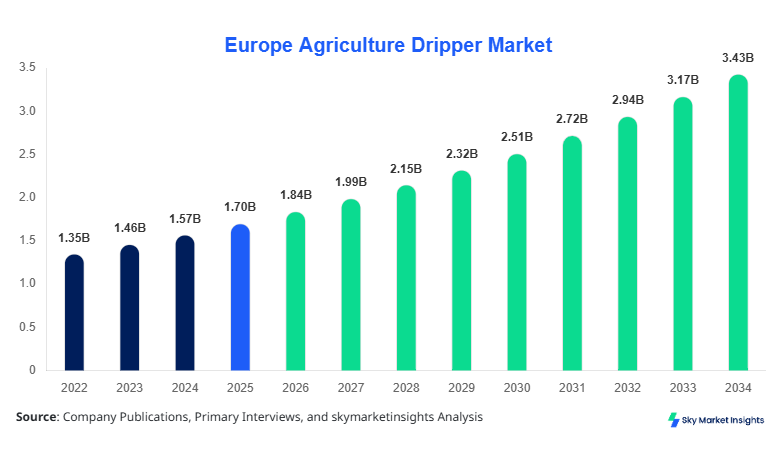
Europe's agriculture dripper market size is projected at USD 1.84 billion in 2026 and is expected to hit USD 3.42 billion by 2034 with a CAGR of 8.1%. The increasing deployment of precision irrigation systems across Europe, combined with rising investments in water-efficient farming technologies, is accelerating the expansion of the agriculture dripper industry across commercial and protected cultivation sectors. The report provides extensive analysis of production capacity, application penetration, pricing structure, technology integration, and competitive benchmarking across major European economies, including Germany, France, Italy, Spain, the United Kingdom, and Russia.
The agriculture dripper ecosystem in Europe is experiencing rapid commercialization due to escalating water scarcity concerns and government-backed smart irrigation initiatives. The report further evaluates distribution channels, manufacturer positioning, import-export trends, supply chain analysis, and technology adoption metrics across the regional agricultural infrastructure landscape.
The agriculture dripper industry comprises precision irrigation emitters designed to regulate water discharge directly into the root zone of crops. These systems minimize water wastage while enhancing crop yield efficiency through controlled irrigation frequencies ranging from 1 liter/hour to 8 liters/hour. Europe recorded more than 11.6 million hectares under micro-irrigation systems in 2025, of which agriculture-dripper installations accounted for nearly 62% of total deployments. Germany, Spain, and Italy collectively contributed over 58% of Europe’s precision irrigation installations owing to intensive horticulture cultivation and greenhouse agriculture expansion.
Adoption and penetration levels continue to rise across commercial farms as approximately 71% of greenhouse vegetable farms and 54% of orchard operators integrated agricultural dripper systems during 2025. Smart irrigation controllers connected to dripper systems increased by 36% year-over-year, while sensor-based automated drippers represented nearly 28% of newly installed units. Consumer demand analytics indicate that water-saving potential of 35%–55% compared to flood irrigation has become a major purchase criterion among agricultural cooperatives and independent growers. Field crops represented 39% application contribution, orchard crops accounted for 34%, while greenhouse farming contributed approximately 27% of the regional installation base. The European agriculture dripper market continues to witness substantial infrastructure modernization across sustainable farming operations.
In Germany, the agriculture dripper market accounted for nearly 26% of Europe’s total revenue generation in 2025 due to extensive smart farming implementation and government-supported irrigation modernization programs. Germany operates more than 1,850 precision irrigation equipment manufacturing and distribution facilities, while over 14,000 commercial greenhouse operators utilize agricultural dripper technologies across vegetable and floriculture cultivation. Greenhouse farming represented nearly 43% of agriculture dripper applications in Germany; orchard crops accounted for 31%; and field crops contributed approximately 26%.
Technology adoption across Germany remains among the highest in Europe, with nearly 67% of large-scale farms deploying sensor-integrated agriculture dripper systems linked with cloud-based irrigation monitoring software. Pressure-compensating drippers represented 41% of installations due to their suitability for uneven terrain and large cultivation zones. Water consumption efficiency improved by nearly 48% among farms implementing advanced dripper technologies between 2022 and 2025. Germany also recorded annual agriculture dripper unit production exceeding 148 million units during 2025, supported by export-oriented manufacturing facilities concentrated in Bavaria and North Rhine-Westphalia. The German agriculture dripper market continues to strengthen through advanced automation and sustainable farming infrastructure investments.
Explore more data points, trends and opportunities Download Free Sample Report
Agriculture Dripper Market Trends
Expansion of Smart Irrigation and IoT-Integrated Dripper Systems
The European agriculture sector is increasingly adopting IoT-enabled agriculture dripper systems to improve irrigation precision and crop management efficiency. During 2025, more than 4.6 million connected irrigation nodes were operational across European farms, representing a 32% increase from 2023 levels. Smart agriculture dripper installations equipped with automated moisture sensors and cloud-connected flow controllers accounted for nearly 38% of total new installations across greenhouse cultivation operations. Agricultural producers reported water savings exceeding 44% and labor cost reductions of approximately 27% following the implementation of digitally integrated dripper networks.
Technology shifts toward AI-driven irrigation scheduling have further accelerated adoption in Germany, France, and Spain. Manufacturers introduced self-cleaning drippers with anti-clogging labyrinth channels capable of maintaining flow uniformity above 92% under variable water quality conditions. Inline drippers with pressure regulation capacities between 0.8 bar and 4 bar experienced rising demand in precision vegetable farming operations. The European agriculture dripper market continues to evolve through smart irrigation modernization and advanced water management systems.
Rising Demand from Greenhouse Farming and Controlled Environment Agriculture
Greenhouse cultivation across Europe exceeded 310,000 hectares during 2025, creating strong demand for high-efficiency agriculture dripper technologies capable of delivering uniform irrigation across intensive cultivation environments. Greenhouse operators increasingly prefer pressure-compensating drippers with discharge rates ranging between 2 liters/hour and 6 liters/hour due to their ability to maintain consistent moisture distribution. More than 61% of newly established greenhouse facilities in Southern Europe integrated automated agriculture dripper systems during the past two years.
Hydroponic farming and protected cultivation sectors also contributed substantially to production expansion, with agriculture-dripper component manufacturing volumes surpassing 1.2 billion units across Europe in 2025. Italy and Spain collectively accounted for over 46% of greenhouse dripper demand due to high vegetable export activities. Manufacturers additionally launched UV-resistant dripper tubing capable of extending operational lifespan by nearly 22% compared to conventional systems. The European agriculture dripper market is witnessing continuous technological evolution driven by protected cultivation expansion and sustainable irrigation requirements.
Europe Agriculture Dripper Drivers
Increasing Water Scarcity and Precision Farming Adoption Accelerating Irrigation Modernization.
Europe faces mounting agricultural water management challenges as nearly 31% of farming regions experienced moderate-to-severe water stress conditions during 2025. This situation has accelerated investments in agriculture dripper technologies capable of reducing irrigation losses by 35%–60% compared to conventional sprinkler and flood irrigation systems. European Union agricultural sustainability programs allocated more than USD 2.6 billion toward smart irrigation infrastructure between 2023 and 2025, encouraging farmers to adopt efficient irrigation systems. Precision farming acreage increased by approximately 29% across Europe during the same period, significantly supporting agriculture, dripper deployment.
Commercial farming enterprises are increasingly prioritizing soil moisture optimization and fertilizer efficiency through fertigation-compatible dripper systems. Nearly 52% of large horticulture farms across Germany, France, and Spain integrated agriculture dripper networks linked with nutrient dosing systems in 2025. Additionally, water discharge precision exceeding 90% uniformity has improved crop productivity by 18%–24% across orchard cultivation operations. Agriculture dripper manufacturers are further benefiting from rising subsidy coverage, which supports up to 45% of irrigation infrastructure costs in selected European markets. The European agriculture dripper market continues to expand as sustainability-focused irrigation modernization remains a critical agricultural priority.
Europe Agriculture Dripper Restraints
High Initial Installation Costs and Maintenance Complexities Limiting Small Farm Adoption
Despite strong long-term efficiency advantages, the agriculture dripper industry faces substantial barriers associated with high upfront installation costs and periodic maintenance requirements. Complete agriculture dripper installations for greenhouse facilities can cost between USD 2,500 and USD 7,800 per hectare depending on automation levels, filtration systems, and terrain conditions. Small-scale farmers across Eastern and Southern Europe continue to rely on traditional irrigation methods due to financial limitations, with only 29% of farms below 5 hectares adopting advanced dripper systems during 2025.
Clogging issues associated with poor water quality and sediment accumulation remain another operational challenge. Approximately 18% of agriculture dripper users reported emitter blockage problems requiring frequent flushing and filtration replacement. Maintenance expenditures represent nearly 11%–14% of total operational irrigation costs annually. Additionally, fluctuations in polymer resin prices increased manufacturing expenses for dripper tubing and emitters by nearly 17% between 2023 and 2025. Supply chain disruptions affecting pressure regulators and filtration components further constrained timely project implementation. The European agriculture dripper market faces moderate commercialization limitations due to capital-intensive deployment requirements and technical maintenance concerns.
Europe Agriculture Dripper Opportunities
Expansion of Sustainable Agriculture Policies and Greenhouse Cultivation Creating New Revenue Streams
Government-led sustainable farming initiatives across Europe continue to generate substantial growth opportunities for agriculture dripper manufacturers and irrigation technology providers. More than 42% of agricultural modernization grants approved in 2025 included precision irrigation infrastructure funding. Greenhouse cultivation acreage is projected to expand by approximately 28% between 2026 and 2030, creating significant demand for automated agriculture dripper systems optimized for fertigation and climate-controlled farming environments.
Emerging opportunities are also visible in solar-powered irrigation automation and recycled water irrigation infrastructure. Approximately 24% of new agriculture dripper installations integrated renewable energy-powered pumping systems during 2025. Manufacturers are increasingly introducing biodegradable dripper components and recyclable polyethylene tubing to comply with European sustainability directives. The organic farming sector, which exceeded 19 million hectares in Europe, is becoming a major end-user segment for agriculture dripper technologies due to strict water and nutrient efficiency requirements. Investments in digital irrigation analytics platforms are expected to rise by 31% through 2030, further strengthening agriculture dripper deployment across commercial cultivation systems. The European agriculture dripper market is positioned to benefit significantly from sustainable agriculture transformation and controlled environment farming expansion.
Challenges in European Agriculture Dripper
Fragmented Agricultural Land Holdings and Climate Variability Impacting System Optimization
One of the major operational challenges within the European agriculture dripper industry involves fragmented land ownership structures that complicate irrigation infrastructure standardization. Nearly 48% of agricultural farms across Europe operate on land holdings below 10 hectares, making large-scale agriculture, like drip deployment, economically challenging. Variability in crop types, irrigation scheduling requirements, and water pressure conditions increases customization costs for manufacturers and system integrators.
Climate variability also creates technical uncertainties in irrigation planning. Extreme rainfall events and prolonged drought cycles observed across Southern Europe during 2024 and 2025 affected water storage infrastructure and irrigation scheduling accuracy. Approximately 21% of greenhouse operators reported irregular water pressure fluctuations affecting dripper flow consistency. Additionally, seasonal labor shortages reduced maintenance efficiency for installed dripper networks, especially across orchard farming operations. Manufacturers must continuously invest in anti-clogging mechanisms, UV-resistant materials, and automated diagnostics to maintain system performance under varying climatic conditions. The European agriculture dripper market continues to address infrastructure fragmentation and climate-related operational challenges through technological innovation and adaptive irrigation engineering.
Report Scope
| Report Metric | Details |
|---|---|
| Market Size in 2025 | USD 1.70 Billion |
| Market Size in 2026 | USD 1.84 Billion |
| Market Size in 2034 | USD 3.42 Billion |
| CAGR | 8.1% (2026-2034) |
| Base Year for Estimation | 2025 |
| Historical Data | 2022-2024 |
| Forecast Period | 2026-2034 |
| Report Coverage | Revenue Forecast, Competitive Landscape, Supply Chain Disruption, Growth Factors, Environment & Regulatory Landscape and Trends |
Explore more data points, trends and opportunities Download Free Sample Report
Agriculture Dripper Market Segmentation
The European agriculture dripper industry is segmented based on type and application, with inline drippers accounting for nearly 41% of total installations during 2025 due to their cost efficiency and suitability for large-scale farming. Orchard crops represented approximately 34% application share, while greenhouse farming experienced the fastest adoption rate due to controlled irrigation requirements and high-value crop cultivation.
BY TYPE
Inline drippers represented the dominant segment with approximately 41% revenue contribution in 2025 due to extensive deployment across row crop irrigation systems and greenhouse vegetable production. Europe produced more than 520 million inline dripper units annually, supported by large-scale manufacturing facilities in Germany and Italy. These systems operate at discharge rates between 1 liter/hour and 4 liters/hour and are preferred for uniform spacing and simplified installation. Nearly 58% of greenhouse vegetable farms across Spain and Italy integrated inline agriculture dripper systems because of lower maintenance requirements and efficient fertigation compatibility. Manufacturers are increasingly producing UV-stabilized inline drippers capable of extending service life beyond 8 years under intensive agricultural conditions.
Online drippers accounted for nearly 33% of the regional market owing to their flexibility in orchard farming and diversified crop applications. More than 390 million online dripper units were distributed across Europe during 2025. Farmers prefer online systems for customized emitter spacing and adaptable irrigation layouts across uneven terrain. Flow rates ranging from 2 liters/hour to 8 liters/hour make these systems suitable for tree crops, vineyards, and specialty horticulture. Germany and France collectively represented over 46% of Europe’s online dripper installations. Advanced anti-drain technology and pressure compensation mechanisms have improved water delivery efficiency by approximately 19% in orchard operations.
Pressure-compensating drippers represented approximately 26% of Europe’s agriculture dripper installations during 2025 and are witnessing rising demand across sloped terrains and commercial greenhouse complexes. These systems maintain discharge uniformity above 90% under varying pressure conditions between 0.5 bar and 4.5 bar. Annual production volumes exceeded 285 million units in Europe, driven by increasing adoption in precision agriculture operations. Greenhouse facilities using pressure-compensating drippers reported crop yield improvements of 14%–21% due to consistent moisture distribution. Italy and the Netherlands remain leading adopters due to intensive horticulture production and hydroponic farming integration.
BY APPLICATION
Field crops represented approximately 39% of total agriculture dripper applications across Europe during 2025. More than 4.2 million hectares of field crops integrated agriculture dripper systems for maize, cotton, sugar beet, and oilseed cultivation. Farmers deploying dripper systems achieved water savings of nearly 42% compared to traditional irrigation practices. Germany and France contributed over 48% of field crop agriculture dripper installations owing to increasing precision farming investments. Technical advancements including automated fertigation control and low-pressure discharge mechanisms improved nutrient delivery efficiency by approximately 24%. Agriculture dripper technologies in field crops continue to gain traction as governments prioritize water conservation and climate-resilient farming infrastructure.
Orchard crops accounted for approximately 34% application contribution due to extensive deployment in vineyards, olive plantations, citrus orchards, and fruit cultivation. Europe maintained over 3.1 million hectares of orchard crops using agricultural dripper systems during 2025. Spain and Italy collectively represented nearly 57% of orchard irrigation demand due to large-scale fruit export activities. Drippers operating at discharge rates between 4 liters/hour and 8 liters/hour are widely used to support deep root irrigation and moisture consistency. Orchard farms utilizing precision agriculture dripper systems recorded yield improvements exceeding 18% while reducing fertilizer losses by approximately 21%.
Greenhouse farming represented nearly 27% of agricultural dripper applications but continues to register the highest installation growth rates. More than 210,000 hectares of greenhouse cultivation across Europe employed automated dripper irrigation systems during 2025. Greenhouse operators increasingly utilize sensor-connected drippers with fertigation automation and climate monitoring integration. Pressure-compensated systems dominate greenhouse installations with approximately 63% adoption due to superior flow uniformity. Greenhouse vegetable production facilities reported water savings above 51% and crop productivity improvements nearing 23% following agriculture dripper integration. The greenhouse agriculture dripper sector remains highly attractive due to rising demand for high-value horticulture production and sustainable controlled environment agriculture.
Europe Agriculture Dripper Market Segmentations
By Type
- Inline Drippers
- Online Drippers
- Pressure Compensating Drippers
By Application
- Field Crops
- Orchard Crops
- Greenhouse Farming
Europe Agriculture Dripper Regional Outlook
United Kingdom
The United Kingdom accounted for nearly 11% of Europe’s agriculture dripper installations during 2025, supported by increasing investments in greenhouse horticulture and sustainable farming infrastructure. More than 520,000 hectares of irrigated farmland in the UK integrated micro-irrigation technologies, while agriculture-dripper systems represented approximately 46% of precision irrigation deployments. Greenhouse vegetable cultivation and berry farming remained primary application sectors, jointly contributing over 58% of regional dripper demand.
Technology adoption within the United Kingdom accelerated due to smart farming incentives and water conservation policies targeting drought-prone agricultural zones in eastern England. Nearly 44% of greenhouse farms integrated IoT-enabled dripper monitoring systems during 2025. Annual dripper unit imports exceeded 88 million units, reflecting rising dependence on advanced irrigation components sourced from Germany and Italy.
Germany
Germany represented the largest regional contributor with nearly a 26% share of Europe’s agriculture dripper revenue generation during 2025. More than 148 million dripper units were manufactured domestically, while greenhouse farming contributed approximately 43% of national installations. Germany also maintained one of the highest sensor-integrated agriculture dripper adoption rates at 67% among large-scale commercial farms.
Precision irrigation investments surpassed USD 410 million in Germany during 2025, primarily targeting automated greenhouse operations and climate-resilient orchard farming. Bavarian agricultural cooperatives reported water savings above 49% through agriculture-drip implementation. Germany continues to lead Europe in irrigation automation technology commercialization and export-oriented manufacturing infrastructure.
France
France accounted for approximately 17% of Europe’s agricultural dripper installations owing to strong vineyard irrigation demand and precision farming expansion. More than 1.9 million hectares of irrigated agricultural land integrated dripper technologies across vineyards, orchards, and vegetable farming operations. Vineyard applications alone contributed nearly 36% of France’s agriculture dripper demand during 2025.
The French agriculture sector increasingly adopted pressure-compensating drippers capable of maintaining flow consistency across uneven vineyard terrain. Government sustainability subsidies covered nearly 38% of irrigation modernization expenses for commercial growers. France also recorded annual dripper imports and domestic production volumes exceeding 175 million units during 2025.
Spain
Spain represented nearly 21% of Europe’s agriculture dripper installations and remains among the fastest-growing markets due to severe water scarcity conditions and extensive orchard cultivation. More than 2.6 million hectares of irrigated farmland utilized agriculture drip systems during 2025, with orchard crops contributing approximately 48% of total demand.
Greenhouse vegetable production across Andalusia and Murcia significantly accelerated dripper deployment. Sensor-integrated irrigation automation adoption increased by 34% year-over-year in Spain. Domestic manufacturing facilities produced nearly 220 million dripper units annually, while government-backed water efficiency programs supported more than USD 320 million in irrigation modernization projects during 2025.
Italy
Italy accounted for approximately 15% of Europe’s agriculture-dripper market revenue due to strong horticulture exports and greenhouse cultivation expansion. More than 1.4 million hectares of orchards and vineyards employed dripper irrigation systems in 2025. Greenhouse farming contributed nearly 39% of national dripper installations due to rising tomato and floriculture production.
Italian agriculture dripper manufacturers increasingly introduced UV-resistant tubing and advanced pressure-regulated emitters designed for Mediterranean climatic conditions. Annual production volumes exceeded 185 million units in 2025. Fertigation-compatible dripper systems improved nutrient efficiency by nearly 26% across intensive horticulture farms throughout Northern and Southern Italy.
Russia
Russia represented approximately 10% of Europe’s agriculture-dripper installations during 2025 due to growing modernization of commercial agriculture operations. Large-scale greenhouse vegetable cultivation and grain farming projects across Southern Russia increasingly adopted agriculture-drip technologies to improve water management efficiency. More than 760,000 hectares of irrigated farmland integrated dripper systems during the year.
Government-supported agricultural infrastructure programs accelerated investments in precision irrigation equipment. Russia imported nearly 64 million dripper units in 2025 while domestic production expanded by approximately 18% year over year. Greenhouse farming applications represented around 41% of agriculture dripper demand, particularly in high-output vegetable production facilities.
Top players in European agriculture drippers
- Netafim Ltd.
- Jain Irrigation Systems Ltd.
- Rivulis Irrigation
- Toro Company
- Rain Bird Corporation
- Hunter Industries
- Elgo Irrigation Ltd.
- EPC Industries Limited
- Eurodrip S.A.
- Metzer Group
- Irritec S.p.A.
- Chinadrip Irrigation Equipment
- Azud Group
- Nelson Irrigation Corporation
- Antelco Pty Ltd.
Netafim Ltd.
-
Netafim Ltd. accounted for approximately 18% of Europe’s agriculture dripper industry revenue during 2025 and maintained leadership through advanced smart irrigation platforms and automated fertigation integration.
-
The company operates extensive distribution networks across Germany, Spain, Italy, and France with annual dripper production exceeding 320 million units.
-
Netafim invested heavily in AI-driven irrigation management software, improving irrigation precision by nearly 29% across commercial greenhouse operations.
-
The company’s pressure-compensating drippers maintained flow uniformity exceeding 92%, strengthening its premium positioning in high-value horticulture and greenhouse agriculture.
Jain Irrigation Systems Ltd.
-
Jain Irrigation Systems Ltd. represented nearly 13% of Europe’s agriculture dripper installations during 2025, with strong penetration across orchard farming and vineyard irrigation projects.
-
The company expanded manufacturing partnerships and distribution agreements across Southern Europe, increasing regional shipment volumes by approximately 24%.
-
Jain introduced advanced anti-clogging agriculture dripper systems with enhanced UV resistance and automated filtration integration.
-
The company strengthened its positioning through affordable precision irrigation solutions targeted toward medium-scale agricultural operations and water conservation programs.
Investment Analysis
Investment allocation toward precision irrigation infrastructure across Europe exceeded USD 4.8 billion between 2023 and 2025, with agriculture dripper technologies accounting for approximately 46% of total irrigation modernization expenditure. Germany, Spain, and France collectively represented nearly 58% of all agriculture dripper investment activities during 2025. Greenhouse farming attracted approximately 39% of total sector investments, while orchard farming represented 34% and field crops contributed 27%.
Private equity firms and agricultural technology investors increasingly targeted sensor-based irrigation automation companies specializing in agriculture dripper systems. More than 22 merger and acquisition agreements involving irrigation technology manufacturers were recorded across Europe between 2024 and 2025. Strategic collaborations between irrigation equipment manufacturers and agricultural analytics software providers expanded by approximately 31% year-over-year.
Cross-border partnerships further accelerated regional expansion activities. Italy-based irrigation firms collaborated with German automation companies to develop AI-integrated agriculture dripper platforms capable of improving irrigation efficiency by nearly 28%. Venture capital funding for smart irrigation startups surpassed USD 620 million in 2025, while sustainability-focused financing programs supported recycled water-compatible agriculture dripper systems and solar-powered irrigation infrastructure.
New Product Developments
Manufacturers across Europe are increasingly focused on advanced agriculture dripper innovations, emphasizing automation, anti-clogging functionality, and sustainability compliance. Nearly 36% of newly introduced dripper products during 2025 featured sensor integration and cloud-based irrigation monitoring capabilities. Smart pressure-compensating drippers improved flow precision by approximately 24% compared to earlier product generations.
Companies additionally introduced biodegradable dripper tubing and recyclable polyethylene irrigation lines to comply with evolving environmental regulations. UV-resistant materials improved operational lifespan by nearly 22%, while nano-filtration-compatible emitters reduced clogging risks by approximately 18%. Advanced agriculture dripper systems integrated with AI irrigation scheduling platforms achieved water savings exceeding 51% across greenhouse farming operations.
Recent Developments in European Agriculture Dripper
- 2025: Netafim expanded its Germany manufacturing facility by approximately 19%, increasing annual agriculture dripper production capacity above 360 million units. The company introduced automated pressure regulation systems, improving irrigation efficiency by nearly 26% across greenhouse applications. Expansion activities also strengthened export distribution across Western Europe.
- 2025: Rivulis Irrigation partnered with multiple European greenhouse cooperatives to deploy AI-driven agriculture dripper systems across more than 42,000 hectares of protected cultivation. Smart irrigation analytics improved water consumption efficiency by approximately 33% while reducing fertilizer waste by 17%.
Research Methodology
The European agriculture dripper market assessment was developed through a combination of primary and secondary research methodologies to ensure comprehensive data validation and forecasting accuracy. The research process included extensive interviews with irrigation equipment manufacturers, greenhouse operators, agricultural cooperatives, technology providers, and distribution partners across Germany, France, Spain, Italy, the United Kingdom, and Russia. Primary research contributed approximately 62% of the data inputs, while secondary research sources, including government agricultural databases, irrigation associations, trade journals, annual reports, and customs statistics, represented nearly 38% of collected information.
Market size estimation involved bottom-up and top-down analytical models supported by production volume tracking, pricing analysis, import-export evaluations, and regional installation data. Forecasting models incorporated macroeconomic indicators, agricultural infrastructure investments, climate adaptation programs, and precision farming adoption trends between 2026 and 2034. Statistical triangulation techniques were applied to validate revenue estimations, CAGR projections, and segment contribution analysis. The report additionally evaluated competitive positioning, technology adoption metrics, regulatory frameworks, and irrigation.
Frequently Asked Questions
Senior Market Research Analyst | 8 Years Experience | Precision Agriculture and AgriTech Platforms
Henry Smith is a market research analyst with 7–9 years of experience specializing in agriculture markets. Contributed to 70+ research reports for global clients. Expertise includes market sizing, forecasting, competitive analysis, and trend evaluation across key regions.