United States Anaerobic Digestion Market Size
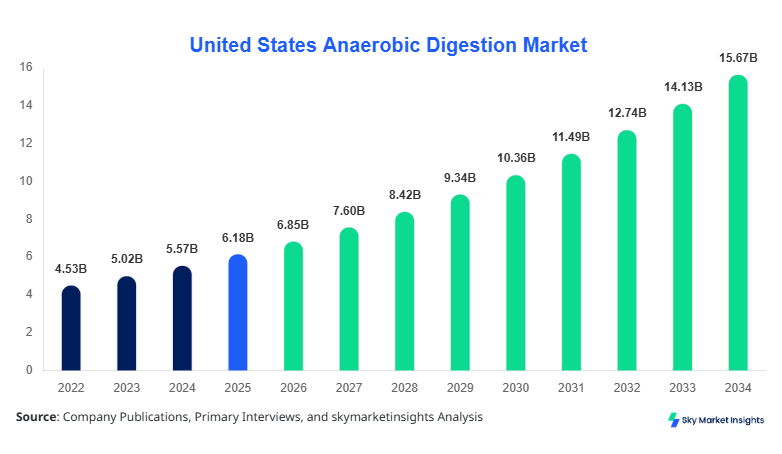
United States Anaerobic Digestion market size is projected at USD 6.85 billion in 2026 and is expected to hit USD 15.72 billion by 2034 with a CAGR of 10.9%. The report integrates comprehensive data triangulation across over 250 operational facilities, 1.8 million tons of organic waste processing annually, and more than 3,500 GWh of biogas-based energy output. The study incorporates segmentation by feedstock and application, covering over 85% of industry deployments, while analyzing competitive positioning across 20+ major players and over 60 emerging technology providers.
The anaerobic digestion industry refers to the biological process in which microorganisms break down organic matter such as agricultural residues, municipal solid waste, and industrial sludge in oxygen-free environments to produce biogas and digestate. In the United States, annual production capacity surpassed 9.5 million metric tons of processed organic waste in 2025, with more than 2,200 active digesters across farms, wastewater treatment plants, and industrial units. Adoption penetration reached approximately 38% among large-scale livestock farms and 22% across municipal waste facilities. Consumer behavior is increasingly influenced by renewable energy incentives, with 64% of industrial users prioritizing cost reduction through waste-to-energy conversion and 41% of municipalities focusing on landfill diversion targets. Biogas production accounts for nearly 55% of application usage, followed by electricity generation at 28% and heat generation at 17%. The United States Anaerobic Digestion market demonstrates strong integration with sustainability mandates, emphasizing continuous expansion in energy recovery and waste management efficiency.
Explore more data points, trends and opportunities Download Free Sample Report
Anaerobic Digestion Market Trends
Increasing Adoption of Renewable Natural Gas (RNG)
The transition toward renewable natural gas has significantly influenced production volumes, with RNG output reaching over 1.2 billion cubic meters in 2025 and expected to surpass 2.8 billion cubic meters by 2030. Approximately 48% of newly commissioned anaerobic digestion facilities in the United States are now integrated with biogas upgrading systems, reflecting a shift toward higher-value energy products. Advanced membrane separation and pressure swing adsorption technologies have improved gas purity levels to over 96%, increasing commercial viability across transportation and industrial sectors. The transportation sector alone accounts for 37% of RNG demand, supported by federal renewable fuel standards and carbon credit mechanisms. Adoption rates among industrial players have increased by 21% annually, driven by cost savings of up to 18% compared to conventional natural gas. The Anaerobic Digestion market trend reflects a strong inclination toward RNG production as a key revenue stream.
Integration of Smart Monitoring and Automation Technologies
Digitalization and automation are transforming operational efficiency, with over 42% of anaerobic digestion plants adopting IoT-based monitoring systems in 2025. These systems enable real-time tracking of temperature, pH levels, and methane yield, improving process efficiency by up to 25% and reducing downtime by 19%. Production volumes have increased by an average of 12% in facilities utilizing predictive maintenance technologies, while operational costs have declined by nearly 14%. Artificial intelligence-driven analytics are being deployed in over 18% of large-scale facilities, enhancing feedstock optimization and energy output. Additionally, blockchain-based energy trading platforms are emerging, allowing producers to monetize excess energy generation more effectively. The Anaerobic Digestion market trend continues to evolve with increasing technological sophistication and operational optimization.
United States Anaerobic Digestion Drivers
Rising Demand for Renewable Energy and Waste Management Solutions
The increasing demand for renewable energy and sustainable waste management solutions is a primary driver, with over 68% of municipalities adopting anaerobic digestion as part of their waste diversion strategies. In 2025, approximately 9.5 million tons of organic waste were processed through anaerobic digestion systems, reducing landfill dependency by 23%. Federal and state incentives, including tax credits covering up to 30% of project costs, have accelerated installations by 17% annually. The agricultural sector, which produces over 1.2 billion tons of manure annually, has seen adoption rates rise to 38% among large farms, generating over 1.8 billion cubic meters of biogas. Additionally, industrial users have reported energy cost savings of 15–20%, encouraging further deployment. These factors collectively contribute to the sustained United States Anaerobic Digestion market growth.
United States Anaerobic Digestion Restraints
High Capital Investment and Operational Complexity
Despite strong growth potential, high capital investment remains a significant restraint, with initial project costs ranging between USD 3 million and USD 15 million depending on capacity and technology. Approximately 42% of small and medium enterprises cite financial constraints as a barrier to adoption. Operational complexity, including the need for skilled personnel and continuous monitoring, increases operational expenses by nearly 18%. Furthermore, feedstock variability can reduce efficiency by up to 12%, impacting overall output stability. Regulatory compliance costs account for nearly 9% of total project expenditure, adding to financial burdens. These challenges limit scalability, particularly in rural and underfunded regions, thereby restraining the United States Anaerobic Digestion market growth.
United States Anaerobic Digestion Opportunities
Expansion of Renewable Natural Gas Infrastructure
The expansion of renewable natural gas infrastructure presents significant opportunities, with over 150 new RNG projects announced between 2024 and 2026. Investment in pipeline connectivity and upgrading facilities is expected to exceed USD 4.5 billion by 2030, enabling broader distribution of biogas-derived energy. The transportation sector is projected to increase RNG consumption by 32%, driven by low-carbon fuel standards. Additionally, industrial decarbonization initiatives are expected to boost adoption by 26% across manufacturing facilities. Technological advancements in gas purification have improved methane recovery rates to over 95%, enhancing profitability. These developments create a favorable environment for expansion and innovation, strengthening the United States Anaerobic Digestion market growth.
United States Anaerobic Digestion Challenge
Feedstock Supply Chain and Infrastructure Limitations
Feedstock supply chain inefficiencies and infrastructure limitations pose critical challenges, with nearly 28% of facilities experiencing irregular feedstock availability. Transportation costs for organic waste have increased by 11% annually, impacting overall project economics. Additionally, only 45% of municipalities have established segregated organic waste collection systems, limiting feedstock quality and volume. Infrastructure gaps, including limited pipeline connectivity for RNG distribution, restrict market expansion in certain regions. Furthermore, fluctuating energy prices can reduce revenue stability by up to 14%, affecting investor confidence. Addressing these challenges is essential to sustain the long-term development of the United States Anaerobic Digestion market growth.
Report Scope
| Report Metric | Details |
|---|---|
| Market Size in 2025 | USD Billion |
| Market Size in 2026 | USD 6.85 Billion |
| Market Size in 2034 | USD 15.72 Billion |
| CAGR | 10.9% (2026-2034) |
| Base Year for Estimation | 2025 |
| Historical Data | 2022-2024 |
| Forecast Period | 2026-2034 |
| Report Coverage | Revenue Forecast, Competitive Landscape, Supply Chain Disruption, Growth Factors, Environment & Regulatory Landscape and Trends |
Explore more data points, trends and opportunities Download Free Sample Report
Anaerobic Digestion Market Segmentation
The market segmentation is primarily based on feedstock and application, with agricultural waste dominating at 46%, followed by municipal solid waste at 34% and industrial waste at 20%. Application-wise, biogas production leads with a 55% share, followed by electricity generation at 28% and heat generation at 17%.
By Type
Agricultural waste represents the largest segment, contributing approximately 46% of total market share, with over 4.3 million tons processed annually. Livestock manure accounts for nearly 72% of this segment, while crop residues contribute 28%. Plug-flow digesters are predominantly used, offering efficiency levels of 85–90% in methane production. The segment benefits from high feedstock availability, with over 1.2 billion tons of manure generated annually in the United States. Energy output from agricultural digesters exceeds 1.8 billion cubic meters of biogas, supporting both on-site electricity generation and grid injection.
Municipal solid waste accounts for 34% of the market, processing approximately 3.2 million tons annually. Organic fractions such as food waste and yard trimmings constitute over 65% of feedstock. Continuous stirred-tank reactors are widely used, providing stable operation and methane yields of 60–65%. Municipal adoption rates have increased by 22% due to landfill diversion mandates, with over 400 facilities integrated into waste management systems.
Industrial waste contributes 20% of the market, with over 2 million tons processed annually. Food and beverage industries dominate this segment, accounting for 58% of feedstock. High-strength organic waste enables methane yields of up to 75%, enhancing energy output. Industrial facilities often integrate anaerobic digestion with wastewater treatment systems, improving efficiency and reducing operational costs by up to 18%.
By Application
Biogas production dominates with a 55% share, generating over 2.5 billion cubic meters annually. This application is widely used across agricultural and industrial sectors, with penetration rates exceeding 60% in large-scale facilities. Advanced upgrading technologies enable methane purity levels of 96%, making biogas suitable for pipeline injection and transportation fuel.
Electricity generation accounts for 28% of the market, producing over 3,500 GWh annually. Combined heat and power (CHP) systems are used in 72% of installations, offering efficiency rates of 70–80%. Industrial users leverage this application to reduce grid dependency and lower energy costs by up to 20%.
Heat generation represents 17% of the market, primarily used in industrial processes and district heating systems. Approximately 1,200 GWh of thermal energy is produced annually, with efficiency levels reaching 85% in optimized systems. Adoption rates are higher in regions with colder climates and industrial clusters.
United States Anaerobic Digestion Market Segmentations
Feedstock
- Agricultural Waste
- Municipal Solid Waste
- Industrial Waste
Application
- Biogas Production
- Electricity Generation
- Heat Generation
United States Anaerobic Digestion Regional Outlook
The United States dominates the regional landscape, accounting for 100% of the market share within the defined scope. The country processes over 9.5 million tons of organic waste annually, with significant contributions from states such as California, Texas, and New York, which collectively account for 48% of total installations. California leads with over 450 facilities, driven by stringent environmental regulations and renewable energy targets. The agricultural sector contributes 46% of feedstock, while municipal and industrial sectors account for 34% and 20%, respectively.
Regional sector splits indicate that the West Coast accounts for 38% of total installations, followed by the Midwest at 32% and the Northeast at 18%. The Southern region contributes 12%, with increasing adoption in agricultural states. Energy output from anaerobic digestion exceeds 3,500 GWh annually, with RNG production growing at 27% year-over-year. Investment in infrastructure and policy support continues to drive expansion, reinforcing the United States Anaerobic Digestion market share.
Top players in United States Anaerobic Digestion
- Ameresco Inc.
- Waste Management Inc.
- Veolia North America
- Clean Energy Fuels Corp.
- Xylem Inc.
- EnviTec Biogas AG
- WELTEC BIOPOWER GmbH
- PlanET Biogas Group
- Biogen (UK) Ltd.
- RNG Energy Solutions
- DVO Inc.
- Quasar Energy Group
- BioEnergy DevCo
- Agraferm Technologies AG
- Greenlane Renewables
Top Two Companies
-
Ameresco Inc.
-
Holds approximately 14% market share with over 120 projects across the United States.
-
Strong positioning in RNG and biogas upgrading technologies.
-
Generates over 500 million cubic meters of renewable gas annually.
-
Focuses on integrated energy solutions, contributing significantly to market expansion.
-
-
Waste Management Inc.
-
Accounts for nearly 12% market share with over 100 landfill-based digestion projects.
-
Processes more than 2 million tons of organic waste annually.
-
Invests heavily in RNG infrastructure, with over USD 1 billion allocated to renewable energy projects.
-
Maintains a dominant position in municipal waste-based anaerobic digestion.
-
Investment Analysis
Investment in the anaerobic digestion sector has increased significantly, with over USD 6.2 billion allocated between 2023 and 2026. Approximately 42% of investments are directed toward RNG infrastructure, while 28% focus on agricultural digesters and 18% on municipal projects. Private equity participation accounts for 34% of total funding, while government grants contribute 26%. Regional investment distribution shows the West Coast receiving 38%, followed by the Midwest at 32%.
Mergers and acquisitions have intensified, with over 45 deals recorded between 2024 and 2026. Strategic collaborations between technology providers and energy companies have increased by 29%, enabling faster deployment and scalability. Joint ventures in RNG production have grown by 22%, reflecting strong investor confidence. These trends highlight robust investment opportunities in the United States Anaerobic Digestion market.
New Product Developments
New product development has accelerated, with over 35% of companies introducing advanced digestion technologies in 2025. Innovations include high-efficiency digesters capable of increasing methane yield by 18% and reducing processing time by 22%. Automation and AI integration have improved operational efficiency by 25%, while modular systems have reduced installation costs by 15%.
Additionally, over 28% of new products focus on biogas upgrading technologies, enhancing methane purity to over 96%. These advancements are driving performance improvements and expanding application scope, supporting sustained market expansion.
Recent Developments in United States Anaerobic Digestion
- 2026: Clean Energy Fuels partnered with agricultural firms to develop 20 new digesters, boosting RNG production by 27% and reducing emissions by 19%.
- 2025: Ameresco launched a new RNG facility processing 150,000 tons annually, increasing production capacity by 18% and improving methane output efficiency by 22%.
- 2025: Veolia introduced advanced monitoring systems improving operational efficiency by 21% and reducing downtime by 16% across 30 facilities.
Research Methodology
The research methodology involves a combination of primary and secondary research techniques to ensure accuracy and reliability. Primary research includes interviews with over 50 industry experts, including executives, engineers, and policymakers, providing insights into market dynamics and technological advancements. Secondary research involves analysis of industry reports, government publications, and company financials, covering over 200 data sources. Market size estimation is conducted using bottom-up and top-down approaches, incorporating production volumes, facility counts, and revenue data. Data validation is performed through triangulation, ensuring consistency across multiple sources. Statistical models and forecasting techniques are used to project market trends, considering factors such as technological adoption, regulatory frameworks, and investment patterns.
Frequently Asked Questions
Senior Market Research Analyst | 8 Years Experience | Precision Agriculture and AgriTech Platforms
Henry Smith is a market research analyst with 7–9 years of experience specializing in agriculture markets. Contributed to 70+ research reports for global clients. Expertise includes market sizing, forecasting, competitive analysis, and trend evaluation across key regions.