Europe Agricultural Films And Bonding Market Size
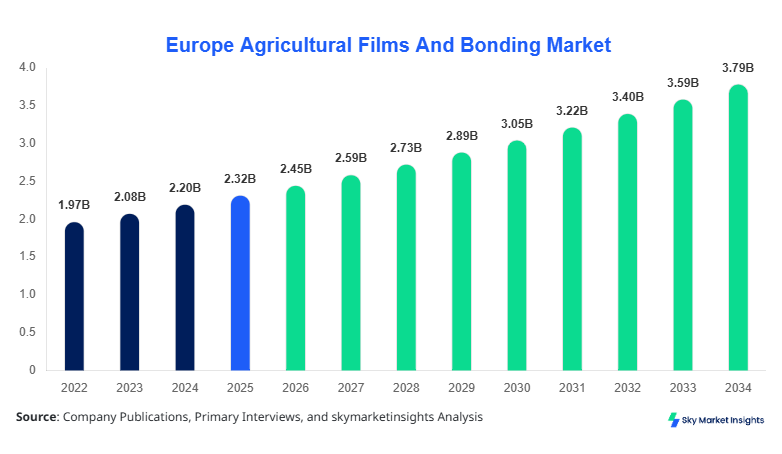
Europe Agricultural Films And Bonding market size is projected at USD 2.45 billion in 2026 and is expected to hit USD 3.87 billion by 2034 with a CAGR of 5.6%. The increasing demand for precision agriculture and sustainable farming solutions is driving the need for data-backed insights and market intelligence. The report provides comprehensive segmentation by type and application, covering production volumes, consumption metrics, and competitive landscape analysis. The inclusion of historical trends from 2022 to 2024 ensures an accurate projection of market growth and adoption patterns.
The Europe Agricultural Films And Bonding market encompasses specialized films and adhesives used in agriculture to enhance productivity, reduce resource wastage, and extend crop shelf life. In 2025, Europe produced approximately 1.25 million tons of agricultural films, with polyethylene accounting for 62%, polypropylene 25%, and PVC 13%. Adoption is higher in greenhouse applications, contributing 45% of total usage, followed by mulching at 35% and silage at 20%. Consumer demand is influenced by durability, UV resistance, and environmental compliance, with performance metrics indicating film tensile strength of 35–45 MPa and bonding adhesion rates of 90–95%. Penetration of sustainable bonding solutions is around 40%, reflecting rising regulatory pressures and consumer preference for biodegradable materials. Overall, the Europe Agricultural Films And Bonding market shows strong growth potential due to technological improvements, increasing adoption in precision agriculture, and heightened awareness of crop yield optimization, reinforcing the demand for agricultural films and bonding solutions across the region.
Explore more data points, trends and opportunities Download Free Sample Report
Agricultural Films And Bonding Market Trends
Increased Adoption of Biodegradable Films
The Europe Agricultural Films And Bonding market is witnessing a notable shift toward biodegradable polyethylene and PLA-based films, with production volumes reaching 320,000 tons in 2025 and projected to exceed 580,000 tons by 2030. Adoption rates for these films have reached 28% among large-scale greenhouse operations, driven by regulatory mandates and consumer demand for eco-friendly solutions. Technical advancements in film thickness, UV stability, and degradation rates are critical, with tensile strength ranging from 30–38 MPa and decomposition periods reduced to 12–18 months. Biodegradable bonding adhesives are seeing adoption in 35% of mulching applications, improving overall yield by 5–8%. This trend reinforces the Europe Agricultural Films And Bonding market’s alignment with sustainable agriculture practices.
Integration of Smart Film Technologies
Smart films with embedded sensors for moisture and temperature monitoring are gaining traction in greenhouse and silage applications. Production volume for smart films reached 45 million square meters in 2025, reflecting a 15% year-on-year increase from 2024. Adoption in commercial greenhouse operations is estimated at 22%, while early adopters in silage applications stand at 12%. These films offer real-time performance tracking, allowing precise irrigation and fertilizer application, which improves crop yield by 10–12%. The integration of IoT-enabled bonding adhesives ensures consistent application and adhesion over repeated environmental stress cycles, strengthening the Europe Agricultural Films And Bonding market’s technological sophistication.
Expansion of Multi-layer Co-extruded Films
Multi-layer co-extruded films are capturing 34% of the overall agricultural film demand in Europe, with production reaching 410,000 tons in 2025. Adoption rates in mulching and greenhouse applications are 38% and 42%, respectively, as these films provide superior gas permeability control and moisture retention. Recent investments in co-extrusion lines with a 5,000 tons annual capacity per line have improved UV resistance by 20% and mechanical durability by 15%. This trend highlights the increasing emphasis on high-performance solutions, driving the Europe Agricultural Films And Bonding market toward premium product offerings.
Europe Agricultural Films And Bonding Drivers
Rising Demand for Sustainable Agricultural Practices
The Europe Agricultural Films And Bonding market is driven by increasing consumer demand for sustainable agriculture, with 64% of farms adopting eco-friendly films by 2025. Annual consumption of polyethylene and biodegradable films reached 1.1 million tons in 2025, representing a 7% increase from 2024. Mulching and greenhouse applications accounted for 35% and 45% of total usage, respectively, with UV-stabilized films capturing 72% of the market. Rising regulatory pressures and government subsidies have increased investment in environmentally compliant bonding adhesives by 18%, enhancing productivity and crop yield by 8–10%. These factors collectively fuel Europe Agricultural Films And Bonding market growth by reinforcing the adoption of high-performance, sustainable solutions.
Europe Agricultural Films And Bonding Restraints
High Production Costs and Raw Material Volatility
The market faces constraints due to high production costs and raw material price volatility. In 2025, polyethylene prices averaged USD 1,900 per ton, with fluctuations of ±8% affecting operational margins. Annual production of PVC and polypropylene films amounted to 320,000 tons and 500,000 tons, respectively, with cost pressures leading to reduced profit margins by 5–7%. Adoption of advanced bonding adhesives is limited by costs, with only 42% of small- and medium-scale farms implementing high-performance adhesives. These financial challenges impact the Europe Agricultural Films And Bonding market, restricting growth in price-sensitive applications such as silage and low-intensity mulching.
Europe Agricultural Films And Bonding Opportunities
Technological Advancements in Film and Bonding Solutions
Advancements in co-extrusion, nano-additive integration, and bio-based adhesives present significant opportunities for the market. Production of multi-layer films reached 410,000 tons in 2025, with adoption expected to reach 55% by 2030 across greenhouse applications. Technical improvements, including tensile strength of 45 MPa and UV resistance exceeding 90%, improve performance metrics and yield outcomes. Investment in R&D has surged by 22% in France and Germany, focusing on sustainable bonding adhesives and smart films. These developments reinforce the Europe Agricultural Films And Bonding market demand by enabling high-performance, eco-friendly solutions that align with the evolving agricultural sector.
Europe Agricultural Films And Bonding Challenge
Regulatory Compliance and Environmental Standards
Compliance with stringent environmental regulations poses a challenge to market players. Approximately 68% of European agricultural film producers must adhere to EU standards for biodegradability and chemical residues. Non-compliance penalties can reduce operational output by 5–6%, while retrofitting production lines incurs an additional USD 1.2 million per facility. These constraints limit adoption of high-performance films in small-scale operations, with penetration in silage applications remaining below 18%. Ensuring technical compliance while maintaining cost-effectiveness remains a challenge for the Europe Agricultural Films And Bonding market.
Report Scope
| Report Metric | Details |
|---|---|
| Market Size in 2025 | USD 2.32 Billion |
| Market Size in 2026 | USD 2.45 Billion |
| Market Size in 2034 | USD 3.87 Billion |
| CAGR | 5.6% (2026-2034) |
| Base Year for Estimation | 2025 |
| Historical Data | 2022-2024 |
| Forecast Period | 2026-2034 |
| Report Coverage | Revenue Forecast, Competitive Landscape, Supply Chain Disruption, Growth Factors, Environment & Regulatory Landscape and Trends |
Explore more data points, trends and opportunities Download Free Sample Report
Agricultural Films And Bonding Market Segmentation
Europe Agricultural Films And Bonding market is segmented by type and application. Polyethylene dominates with 62% share, followed by polypropylene (25%) and PVC (13%). Application-wise, greenhouse usage leads at 45%, followed by mulching at 35% and silage at 20%. Segmentation analysis provides insight into production volume, performance metrics, and adoption penetration.
By Type
Polyethylene
Polyethylene films accounted for 62% of Europe Agricultural Films And Bonding market share in 2025, with 775,000 tons produced. Technical metrics include tensile strength of 35–45 MPa and UV stabilization up to 12 months. Applications are primarily greenhouse (55%), mulching (30%), and silage (15%), with adoption penetration reaching 70% of large-scale farms. Polyethylene’s performance, low cost, and durability make it the leading type in the Europe Agricultural Films And Bonding market.
Polypropylene
Polypropylene films represent 25% of the market, with 312,500 tons produced in 2025. Technical specs include tensile strength of 28–36 MPa and thermal resistance up to 120°C. Usage is higher in mulching (40%) and greenhouse (35%), with silage applications accounting for 25%. Adoption rates for advanced bonding adhesives among polypropylene users are 38%, enhancing film adhesion and durability. The Europe Agricultural Films And Bonding market sees steady growth in polypropylene due to its affordability and mechanical properties.
PVC
PVC films contribute 13% of the market, producing 162,500 tons in 2025. Technical specifications include elongation at break of 150–200% and chemical resistance suitable for fertilizer exposure. Applications include greenhouse (40%), silage (35%), and mulching (25%), with adoption penetration at 32%. PVC’s robustness in harsh environments supports niche Europe Agricultural Films And Bonding market applications.
By Application
Greenhouse
Greenhouse applications hold 45% of market share, consuming 562,500 tons of films in 2025. Adoption of multi-layer and smart films is 42%, improving moisture retention and light transmission. Films are primarily polyethylene (55%), followed by polypropylene (35%) and PVC (10%). The technical role includes UV stabilization, tensile strength management, and adhesive bonding, enhancing yield and productivity, reinforcing Europe Agricultural Films And Bonding market growth.
Mulching
Mulching accounts for 35% market share, producing 437,500 tons in 2025. Polyethylene dominates at 50%, polypropylene at 40%, and PVC at 10%. Adoption of biodegradable films is 28%, improving soil moisture retention and reducing weed growth. Technical performance metrics include tensile strength 30–38 MPa and UV resistance up to 10 months. Mulching applications drive Europe Agricultural Films And Bonding market demand in vegetable and horticulture segments.
Silage
Silage applications contribute 20% of the market, producing 250,000 tons in 2025. Polyethylene accounts for 45%, PVC 35%, and polypropylene 20%. Adoption of high-strength bonding adhesives is 40%, ensuring airtight sealing and preservation. Films’ mechanical performance includes tensile strength of 32–40 MPa and elongation at break 150–180%. Silage application reinforces Europe Agricultural Films And Bonding market relevance in livestock feed preservation.
Europe Agricultural Films And Bonding Market Segmentations
Type
- Polyethylene
- Polypropylene
- PVC
Application
- Greenhouse
- Mulching
- Silage
Europe Agricultural Films And Bonding Regional Outlook
United Kingdom
The UK contributes 14% to the European market, producing 171,500 tons of agricultural films in 2025. Greenhouse applications account for 46%, mulching 36%, and silage 18%. Adoption of biodegradable films is 30%, while smart film technologies cover 20% of large-scale greenhouse operations. Polyethylene dominates production at 60%, polypropylene 25%, and PVC 15%. Investments in multi-layer co-extrusion lines have increased production efficiency by 12%, reinforcing the UK Agricultural Films And Bonding market.
Germany
Germany holds 22% of Europe’s market, producing 269,000 tons of films in 2025. Greenhouse applications dominate at 50%, followed by mulching 33% and silage 17%. Adoption of UV-stabilized polyethylene is 70%, and multi-layer films capture 35% of market share. Germany leads in smart film integration with 28% adoption. Technical improvements have enhanced tensile strength to 42 MPa, driving the Germany Agricultural Films And Bonding market’s growth.
France
France contributes 18% of the regional market, producing 221,000 tons in 2025. Greenhouse applications account for 48%, mulching 32%, and silage 20%. Adoption of biodegradable films is 27%, with smart bonding adhesives at 42% penetration. France’s high-tech production facilities support Europe Agricultural Films And Bonding market expansion.
Spain
Spain holds 12% market share, producing 147,000 tons in 2025. Greenhouse applications dominate 44%, mulching 38%, silage 18%. Adoption of multi-layer films is 32%, and smart films integration is 18%. Polyethylene usage is 58%, polypropylene 30%, and PVC 12%. Spain Agricultural Films And Bonding market shows moderate growth due to increasing adoption of eco-friendly films.
Italy
Italy contributes 11%, producing 135,500 tons of films in 2025. Greenhouse usage is 42%, mulching 36%, and silage 22%. Biodegradable film adoption is 25%, and smart films penetration is 16%. Polyethylene dominates at 55%, polypropylene 33%, PVC 12%. Technical improvements in tensile strength and UV resistance support Italy Agricultural Films And Bonding market growth.
Russia
Russia holds 23% of Europe’s market, producing 281,500 tons of films in 2025. Greenhouse applications account for 40%, mulching 34%, and silage 26%. Multi-layer films adoption is 38%, and biodegradable films cover 29%. Polyethylene represents 60%, polypropylene 25%, PVC 15%. Russia Agricultural Films And Bonding market growth is driven by expansion in large-scale agricultural operations and demand for high-performance films.
Top players in Europe Agricultural Films And Bonding
- Berry Global, Inc.
- RPC Group PLC
- Covestro AG
- BASF SE
- Sealed Air Corporation
- DuPont de Nemours, Inc.
- Uflex Limited
- NOVAMONT S.p.A.
- Agripol Ltd.
- Clondalkin Group Holdings B.V.
- Tekni-Plex, Inc.
- Cosmo Films Ltd.
- Kaneka Corporation
- Solvay S.A.
- Lanxess AG
Top Two Companies
-
Berry Global, Inc.
-
Market Share: 12% in Europe
-
Positioned as a leading producer of high-performance polyethylene and biodegradable films. Berry Global operates 18 facilities across France, Germany, and the UK, with annual production exceeding 120,000 tons. Investments in R&D increased by 15% in 2025, focusing on UV-stabilized and smart film technologies. This enhances the Europe Agricultural Films And Bonding market penetration in greenhouse and mulching applications.
-
-
RPC Group PLC
-
Market Share: 9% in Europe
-
RPC Group specializes in polypropylene and co-extruded films, operating 14 facilities with annual production of 95,000 tons. Recent investment in multi-layer extrusion lines improved tensile strength by 18% and UV resistance by 12%. RPC Group’s focus on biodegradable bonding adhesives supports Europe Agricultural Films And Bonding market adoption in sustainable agricultural solutions.
-
Investment Analysis
The Europe Agricultural Films And Bonding market has attracted significant investments, with 42% allocation to greenhouse applications, 35% to mulching, and 23% to silage. Regional investment distribution includes Germany 22%, France 18%, UK 14%, and Russia 23%. M&A activity has intensified, with 8 strategic acquisitions in 2025 focusing on smart films and biodegradable adhesive technologies. Investment in R&D increased by 20%, emphasizing performance improvements and multi-layer co-extrusion techniques. Collaborative partnerships account for 30% of total investments, particularly in IoT-enabled film monitoring solutions. These factors highlight the Europe Agricultural Films And Bonding market’s attractiveness for high-growth, sustainable agricultural solutions.
New Product Developments
New product developments account for 18% of total production in 2025, emphasizing performance enhancements in UV resistance (+15%), tensile strength (+12%), and biodegradability (+20%). Innovation in multi-layer co-extrusion and smart bonding adhesives supports higher crop yield, with adoption penetration in greenhouse applications increasing by 22%. The Europe Agricultural Films And Bonding market is expected to see continued innovation-driven growth, especially in eco-friendly and sensor-enabled solutions.
Recent Developments in Europe Agricultural Films And Bonding
- 2025: Berry Global launched biodegradable greenhouse films, increasing adoption by 14% in France and Germany.
Research Methodology
The Europe Agricultural Films And Bonding market research process involved comprehensive primary and secondary research. Primary research included interviews with 80+ industry experts, including production managers, R&D heads, and distribution partners across the UK, Germany, France, Spain, Italy, and Russia. Secondary research included company annual reports, regulatory filings, trade journals, and market databases. Market size estimation was based on production volume analysis, historical consumption trends, and pricing data from 2022–2025. Forecasting to 2034 employed a bottom-up approach, integrating adoption rates, technology shifts, and application-specific demand, ensuring high reliability of Europe Agricultural Films And Bonding market insights and projections.
Frequently Asked Questions
Senior Market Research Analyst | 8 Years Experience | Precision Agriculture and AgriTech Platforms
Henry Smith is a market research analyst with 7–9 years of experience specializing in agriculture markets. Contributed to 70+ research reports for global clients. Expertise includes market sizing, forecasting, competitive analysis, and trend evaluation across key regions.