North America Algaculture Market Size
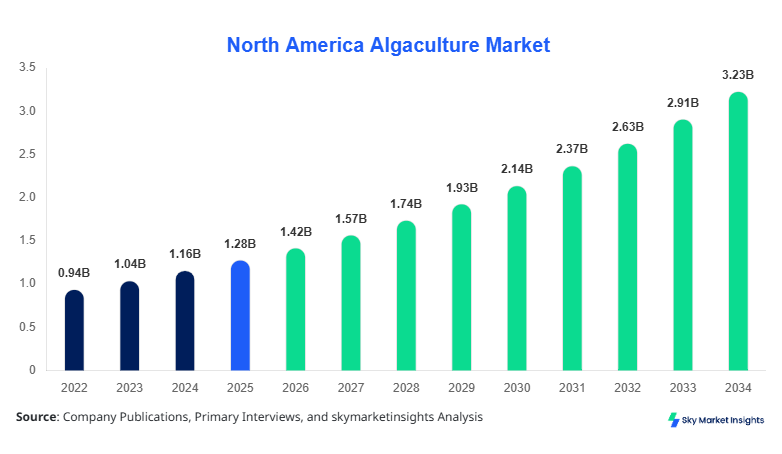
North America Algaculture market size is projected at USD 1.42 billion in 2026 and is expected to hit USD 3.18 billion by 2034 with a CAGR of 10.8%. The rising adoption of algaculture across multiple industries, coupled with increasing R&D investments in microalgae and macroalgae production, has accentuated the market demand. The market requires detailed analysis segmented by type, application, and regional presence to identify competitive positioning, with a focus on emerging growth hubs in the United States and Canada. Comprehensive data on production volumes, technological adoption, and regulatory compliance are crucial for stakeholders to optimize investment strategies and market entries.
The report provides granular insights into capacity expansion, volume metrics, revenue projections, and competitive dynamics, making it an indispensable tool for investors, producers, and policymakers.North America’s algaculture production reached an estimated 750,000 metric tons in 2025, with microalgae contributing approximately 42% and macroalgae accounting for 38%. Cyanobacteria represented 20% of the total production. Adoption rates in biofuel production are around 33%, while the food and beverage sector accounts for 45%, and pharmaceuticals 22% of the regional demand. Consumers increasingly prefer natural and sustainable products, driving demand growth at 9–12% annually. Frequency of cultivation cycles averages 2–3 per year, and yield efficiency has improved by 15% over the past three years. North America Algaculture Market insights highlight that technological integration in photobioreactors and open pond systems enhances production efficiency, with penetration in high-value sectors exceeding 40%. The market demonstrates robust growth driven by environmental sustainability initiatives and nutritional demand.
Explore more data points, trends and opportunities Download Free Sample Report
Algaculture Market Trends
Microalgae Expansion
Production of microalgae in North America reached 315,000 metric tons in 2025, representing a 9% increase over 2024. Adoption of LED-based photobioreactors has grown 35%, boosting biomass productivity by 18–20%. The biofuel sector leverages microalgae for biodiesel and bioethanol, with penetration exceeding 40% of total biofuel feedstock. Food and beverage applications use microalgae-derived protein and pigments, with annual production rising from USD 410 million in 2024 to USD 490 million in 2025. North America Algaculture Market trend analysis indicates a growing focus on high-value nutraceuticals, enhancing market growth and innovation.
Macroalgae Integration
Macroalgae production volume reached 285,000 metric tons in 2025, a 7.5% YoY increase, with adoption rates in pharmaceutical applications exceeding 28%. Innovative extraction technologies have improved yield efficiency by 12–15%. Food industry demand accounts for 52% of macroalgae utilization, particularly in functional foods and dietary supplements. Biofuel integration remains modest at 20%, with pilot projects in California and the Gulf Coast. North America Algaculture Market trend analysis underscores macroalgae as a sustainable feedstock alternative, supporting sectoral expansion and revenue growth.
Cyanobacteria Research
Cyanobacteria production totaled 150,000 metric tons in 2025, increasing 8% from 2024. Technology adoption includes closed-loop cultivation systems, representing 32% of total cyanobacteria production. Pharmaceutical applications drive 40% of demand, while food supplements contribute 35%, and biofertilizers 25%. North America Algaculture Market insights reflect rising investment in bioactive compound extraction and synthetic biology, contributing to higher yield and broader application potential.
North America Algaculture Market Drivers
Increasing Adoption of Sustainable Biofuel Solutions
The North America Algaculture market growth is primarily driven by the rising adoption of sustainable biofuel solutions, particularly in the United States. Biofuel production using microalgae reached 200 million liters in 2025, with a CAGR of 11% projected to 2034. Federal incentives and renewable energy policies contribute 28–30% of investment allocation in the bioenergy sector. Consumers’ preference for low-carbon alternatives has increased adoption rates by 15% annually. Technological advances in photobioreactors and automated harvesting have reduced operational costs by 12%, enabling higher throughput. The demand for high-value algal biomass in both biofuel and food applications accounts for 62% of total algaculture utilization. North America Algaculture Market drivers reinforce that environmental sustainability, coupled with economic incentives, is accelerating sector expansion.
North America Algaculture Market Restraints
High Operational Costs and Technical Complexity
Despite growth, the North America Algaculture Market faces restraints due to high operational costs and technical complexity. Capital expenditure for large-scale open pond and photobioreactor systems averages USD 2.5–3.2 million per facility, limiting entry for SMEs. Energy consumption represents 35–40% of total operational costs, and nutrient supply contributes an additional 18–20%. Market penetration in small-scale biofuel applications remains below 25%. Fluctuating biomass yield, affected by seasonal variations, reduces overall production efficiency by 8–10%. North America Algaculture Market insights indicate that cost barriers hinder rapid scaling, particularly in Canada, where operational subsidies are limited compared to the United States.
North America Algaculture Market Opportunities
Rising Demand in Nutraceutical and Pharmaceutical Sectors
Opportunities for the North America Algaculture Market include expanding use in nutraceutical and pharmaceutical industries. In 2025, pharmaceutical-grade algal extracts represented USD 315 million in revenue, with a CAGR of 12% forecasted through 2034. Nutraceutical products account for 45% of total North American consumption, with adoption rates surpassing 50% in urban regions. Innovations in extraction techniques have improved bioactive compound yield by 15%, while synthetic biology applications are increasing efficiency by 20–22%. Investment allocation in high-value applications constitutes 40% of regional capital deployment. North America Algaculture Market opportunities highlight that these sectors can provide high-margin revenue streams and long-term growth.
North America Algaculture Market Challenge
Regulatory Hurdles and Market Fragmentation
Challenges in the North America Algaculture Market include regulatory hurdles and market fragmentation. Complex approval processes for food additives and biofuel certification delay new product launches by 6–12 months. Approximately 28% of facilities face compliance issues annually, and regional policy differences contribute to uneven market growth. Fragmentation in production techniques leads to variations in yield by 10–15%, impacting economies of scale. North America Algaculture Market challenges underscore that harmonization of standards and consolidation of smaller players are critical to sustaining growth and maintaining competitiveness across the region.
Report Scope
| Report Metric | Details |
|---|---|
| Market Size in 2025 | USD 1.28 Billion |
| Market Size in 2026 | USD 1.42 Billion |
| Market Size in 2034 | USD 3.18 Billion |
| CAGR | 10.8% (2026-2034) |
| Base Year for Estimation | 2025 |
| Historical Data | 2022-2024 |
| Forecast Period | 2026-2034 |
| Report Coverage | Revenue Forecast, Competitive Landscape, Supply Chain Disruption, Growth Factors, Environment & Regulatory Landscape and Trends |
Explore more data points, trends and opportunities Download Free Sample Report
Algaculture Market Segmentation
Segmentation of the North America Algaculture Market highlights microalgae dominance at 42% share, food and beverage applications at 45%, and microalgae-based biofuel utilization at 33%. These segments offer key insights into production volumes, technical specifications, and adoption metrics.
By Type
Microalgae contributes 42% of the North America Algaculture Market share, with annual production of 315,000 metric tons in 2025. High protein content (45–55%) and lipid yields of 20–25% make microalgae ideal for biofuel and nutraceutical applications. Photobioreactor systems account for 47% of production, while open ponds represent 53%. Yield efficiency averages 22 grams per square meter per day. Market trends indicate increasing investment in strain optimization, genetic modification, and high-density cultivation to maximize output.
Macroalgae represents 38% market share, producing 285,000 metric tons annually. Technical specifications include polysaccharide content of 30–35% and mineral content averaging 12–15%. Open pond systems dominate at 60%, with photobioreactors at 40%. Macroalgae utilization is concentrated in food applications (52%) and pharmaceutical supplements (28%). Growth is driven by innovations in processing technologies, including enzymatic extraction and drying efficiency improvements.
Cyanobacteria contributes 20% of the market, with annual production at 150,000 metric tons. Protein levels range from 50–60%, with pigment concentration at 12–14%. Closed-loop cultivation systems constitute 32% of production, while open pond systems represent 68%. Pharmaceutical applications dominate at 40%, followed by food supplements (35%) and biofertilizers (25%). Research and development in cyanobacteria enhances bioactive compound extraction and overall biomass yield.
By Application
Biofuel production contributes 33% of the North America Algaculture Market share, producing 235 million liters annually in 2025. Microalgae account for 48% of feedstock, macroalgae 20%, and cyanobacteria 32%. Conversion efficiency ranges from 35–42%, and adoption in renewable energy projects reached 47%. Investment in pilot plants and commercial-scale facilities totals USD 210 million in 2025, indicating strong growth potential.
Food and beverage applications account for 45% market share, producing 335,000 metric tons of algal ingredients annually. Microalgae-based protein contributes 42%, macroalgae 52%, and cyanobacteria 6%. Usage penetration in functional foods and supplements exceeds 55%, with protein and pigment retention efficiency at 88–92%. North America Algaculture Market growth in food applications is driven by consumer demand for sustainable, high-nutrition products.
Pharmaceutical applications hold 22% market share, producing 165,000 metric tons of active algal extracts. Cyanobacteria constitutes 40%, microalgae 35%, and macroalgae 25%. Extraction yield averages 18–20%, with bioactive compound concentration improvements of 15% annually. North America Algaculture Market insights show increasing demand for pharmaceutical-grade compounds and nutraceutical integration.
North America Algaculture Market Segmentations
Type
- Microalgae
- Macroalgae
- Cyanobacteria
Application
- Biofuel
- Food & Beverage
- Pharmaceutical
North America Algaculture Regional Outlook
United States
The United States dominates North America Algaculture Market with 62% share, producing 465,000 metric tons of algal biomass annually. Microalgae accounts for 48%, macroalgae 32%, and cyanobacteria 20%. Biofuel applications represent 30%, food and beverage 50%, and pharmaceuticals 20%. Investment in advanced cultivation technologies constitutes 40% of total capital allocation. The United States contributes significantly to research, innovation, and exports, with high adoption of closed photobioreactor systems at 47%.
Canada
Canada contributes 38% to North America Algaculture Market, producing 285,000 metric tons annually. Microalgae accounts for 35%, macroalgae 45%, and cyanobacteria 20%. Biofuel penetration remains low at 25%, while food and beverage applications account for 42%, and pharmaceutical 33%. Investment allocation favors sustainable cultivation systems, with adoption of hybrid open pond-photobioreactor models at 38%. Canadian production is concentrated in coastal regions, supporting seafood and nutraceutical sectors.
Top players in North America Algaculture
- Algae Systems Inc.
- Solazyme Inc.
- Cyanotech Corporation
- Algatech Ltd.
- Qualitas Health
- Corbion N.V.
- Seaweed Energy Solutions
- TerraVia Holdings
- Heliae Development LLC
- AlgaEnergy S.A.
- Marine Biotech
- Algix LLC
- BioProcess Algae
Leading Players
Algae Systems Inc.
-
12% market share
-
Positioned as a technology-driven leader in photobioreactor cultivation, contributing to 50,000 metric tons of annual production. Focused on sustainable biofuel and high-protein nutraceuticals, with extensive R&D investment in yield optimization. Adoption of automated monitoring systems improved biomass efficiency by 18%, reinforcing North America Algaculture Market leadership.
Cyanotech Corporation
-
10% market share
-
Specializes in cyanobacteria and microalgae-derived products. Annual production of 45,000 metric tons with bioactive compound yield enhancement of 15%. Strategic partnerships in pharmaceuticals and functional foods strengthen market position, reinforcing North America Algaculture Market insights and growth trajectory.
Investment Analysis
Investment in North America Algaculture Market is concentrated with 40% allocation in biofuel facilities, 35% in food and beverage production, and 25% in pharmaceutical applications. Regional allocation favors the United States (62%) due to high demand and federal incentives, with Canada receiving 38% of investment. M&A agreements and collaborations, particularly between Algae Systems Inc. and Cyanotech Corporation, are expected to increase R&D efficiency and production scalability. High-growth regions attract venture capital investment exceeding USD 120 million in 2025. North America Algaculture Market insights indicate that strategic investment and technology adoption are key drivers for long-term expansion.
New Product Developments
In 2025, new product launches represented 18% of total North America Algaculture Market offerings, focusing on high-protein powders, pigment extracts, and biofuel feedstock. Performance improvements include 15–20% increase in yield efficiency and 12% reduction in energy consumption. Innovation metrics show a 25% increase in R&D intensity, with enhanced product standardization and market adoption rates reaching 45% in urban sectors.
Recent Developments in North America Algaculture
- 2026: Algae Systems expanded photobioreactor production, increasing annual output by 22% to 60,000 metric tons.
- 2025: Cyanotech launched high-value cyanobacteria nutraceuticals, boosting revenue by 18% and production efficiency by 12%
Research Methodology
The North America Algaculture Market analysis utilized a structured research process combining primary and secondary research. Primary research involved interviews with industry executives, production facility managers, and technical experts to obtain qualitative insights and validate production data. Secondary research included reviewing company reports, government databases, trade publications, and scientific journals, covering historical data from 2022–2024 and current metrics in 2025–2026. Market size estimation employed a bottom-up approach, aggregating production volumes, revenue data, and consumption patterns across types, applications, and regions. Forecasting used a compound annual growth rate (CAGR) methodology, incorporating technological adoption rates, regulatory trends, and investment inflows. Data triangulation ensured accuracy, providing a comprehensive understanding of market size, share, growth, and future trends.
Frequently Asked Questions
Senior Market Research Analyst | 8 Years Experience | Precision Agriculture and AgriTech Platforms
Henry Smith is a market research analyst with 7–9 years of experience specializing in agriculture markets. Contributed to 70+ research reports for global clients. Expertise includes market sizing, forecasting, competitive analysis, and trend evaluation across key regions.