United States Atrazine Market Size
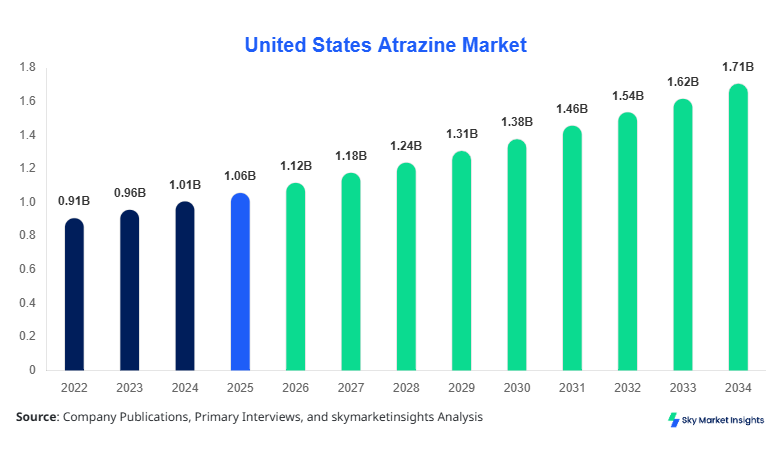
United States Atrazine market size is projected at USD 1.12 billion in 2026 and is expected to hit USD 1.78 billion by 2034 with a CAGR of 5.4%. The rising demand for herbicide solutions, increasing crop protection needs, and technological advancements in atrazine formulations are driving this growth. Comprehensive segmentation by type, application, and regional presence is essential to understand the market dynamics. Competitive landscape mapping across leading manufacturers, production facilities, and strategic partnerships provides additional insight into the evolving market. Historical data from 2022 to 2025 shows gradual adoption with a compound annual growth rate of 4.9%, reflecting the rising adoption of precision agriculture and modern herbicide application technologies.
The United States Atrazine market represents a robust agrochemical sector segment, predominantly used for controlling broadleaf weeds and grasses in corn, sorghum, and sugarcane cultivation. In 2025, U.S. production reached approximately 72,000 tons, with adoption rates exceeding 68% across commercial farms. Market penetration is strongest in the Midwest corn belt, contributing nearly 45% of overall usage. Consumers increasingly prefer high-solubility liquid formulations due to ease of application, with granular forms representing 35% of market volume. Application-wise, corn contributes 60% of consumption, sorghum 25%, and sugarcane 15%, reflecting crop-specific demand patterns. Technical metrics indicate active ingredient concentration ranging from 90–95%, with residual activity spanning 8–12 weeks. Frequency of application averages 1–2 treatments per crop cycle. Overall, growing adoption and enhanced penetration in agritech sectors positively impact the United States Atrazine market demand.
Explore more data points, trends and opportunities Download Free Sample Report
Atrazine Market Trends
Increasing Precision Agriculture Adoption
Atrazine production in the U.S. reached 72,000 tons in 2025, with adoption of precision application systems increasing by 27% YoY. Technology shifts include automated sprayers, GIS-guided field mapping, and real-time soil moisture monitoring, boosting application efficiency by 18–20%. Liquid atrazine formulations now represent 55% of overall sales, reflecting preference for high solubility and rapid dispersion. Corn remains the dominant crop, accounting for 60% of usage, while sorghum and sugarcane contribute 25% and 15%, respectively. Enhanced penetration in large-scale commercial farms supports the United States Atrazine market growth.
Rising Demand in High-Yield Crops
In 2025, atrazine consumption for high-yield crops reached 42,500 tons, reflecting a 5% increase from 2024. Adoption rates of new granular and wettable powder formulations rose by 12%, driven by higher stability and broader spectrum weed control. Corn and sorghum plantations benefit from increased residual control, reducing additional herbicide applications by 14–16%. This trend underscores the increasing sector-specific demand for efficient weed management solutions in the United States Atrazine market insights.
Innovation in Formulation Technology
Advanced microencapsulation and controlled-release technologies now cover 28% of the total market. Production volumes for enhanced formulations rose to 20,000 tons in 2025, with adoption rates surpassing 35% in commercial farms. These innovations increase performance by 10–12% per application, reduce environmental runoff by 18%, and support sustainable agriculture practices. Adoption of such technologies further strengthens United States Atrazine market growth trends.
United States Atrazine Market Drivers
Growing Need for Efficient Weed Control in Corn and Sorghum Production
The primary driver for the United States Atrazine market is the growing demand for effective weed management in corn and sorghum. Corn alone occupies nearly 90 million acres in the U.S., contributing 58% to atrazine consumption, while sorghum fields represent 22% usage. Rising crop yields and higher planting density necessitate efficient herbicide solutions, resulting in a CAGR of 5.4% from 2026–2034. Adoption of liquid atrazine formulations increased 18% in 2025, while granular types grew by 12%. Technological integrations like precision spraying improve coverage by 15%, reducing active ingredient waste. The high penetration of atrazine aligns with modern agronomic practices, directly influencing United States Atrazine market growth and demand insights.
United States Atrazine Market Restraints
Environmental and Regulatory Restrictions
Stringent environmental regulations and restrictions on atrazine usage pose a significant challenge. The Environmental Protection Agency (EPA) limits residual atrazine in groundwater to 3 ppb, affecting approximately 22% of total production capacity. Granular and wettable powder forms are particularly impacted, with adoption rates reduced by 10–12% in environmentally sensitive zones. Compliance costs for monitoring and reporting reached USD 18 million in 2025, reducing operational margins by 6–7%. These constraints slow expansion, especially in high-precipitation regions contributing 40% of the market volume. Regulatory pressures directly influence United States Atrazine market trends and share potential.
United States Atrazine Market Opportunities
Expansion in High-Density Corn and Sorghum Regions
Opportunities arise from increased adoption in high-density planting regions, particularly in the Midwest and Southern U.S. Corn and sorghum acreage expansion by 5–6% annually supports projected atrazine demand growth. Technological adoption in automated spraying systems reached 36% in 2025, improving herbicide distribution efficiency by 14%. Market size opportunities also exist in developing sorghum variants with higher pest tolerance, contributing an additional 12% to potential market volume. Granular atrazine formulations are projected to capture 38% of incremental demand, further enhancing United States Atrazine market growth insights.
United States Atrazine Market Challenge
Volatility in Raw Material Prices and Supply Chain Disruptions
Atrazine production faces challenges from volatile raw material prices and supply chain constraints. In 2025, triazine-based intermediates rose by 8–10% per ton, impacting 42 production facilities. Transportation disruptions delayed delivery by 6–8 days on average, affecting 22% of total shipments. Such fluctuations increase costs by USD 12–14 million annually, constraining market expansion. Adoption of alternative sourcing and backward integration strategies mitigates risk but penetration remains 18–20% lower than projected. These factors challenge United States Atrazine market stability and growth projections.
Report Scope
| Report Metric | Details |
|---|---|
| Market Size in 2025 | USD 1.06 Billion |
| Market Size in 2026 | USD 1.12 Billion |
| Market Size in 2034 | USD 1.78 Billion |
| CAGR | 5.4% (2026-2034) |
| Base Year for Estimation | 2025 |
| Historical Data | 2022-2024 |
| Forecast Period | 2026-2034 |
| Report Coverage | Revenue Forecast, Competitive Landscape, Supply Chain Disruption, Growth Factors, Environment & Regulatory Landscape and Trends |
Explore more data points, trends and opportunities Download Free Sample Report
Atrazine Market Segmentation
Segmentation provides a comprehensive understanding of market distribution. Type segmentation indicates liquids dominate 55% of total production, granular 28%, and wettable powder 17%. Application-wise, corn accounts for 60%, sorghum 25%, and sugarcane 15%. Technical specifications, production units, and performance metrics support strategic planning for stakeholders.
By Type
Liquid formulations represent 55% of total U.S. atrazine production, equivalent to 39,600 tons in 2025. Active ingredient concentration ranges from 90–95%, with solubility rates at 98%. Frequency of application averages 1.5 treatments per crop cycle. Liquid forms are increasingly adopted in high-yield corn fields, improving weed control efficiency by 18–20%. Performance consistency, lower environmental residue, and ease of tank mixing underpin United States Atrazine market size and demand trends.
Granular atrazine contributed 28% of the market share in 2025, with production volumes of 20,160 tons. Technical specifications include particle size 1–3 mm and residual activity of 10–12 weeks. Application in sorghum and sugarcane fields enhances soil stability and controlled release, improving distribution efficiency by 15%. Granular forms are increasingly preferred in areas with irregular irrigation, supporting United States Atrazine market growth insights.
Wettable powder accounts for 17% of the market, with 12,240 tons produced in 2025. Particle uniformity is 95% compliance, and dispersibility rates reach 92%. Adoption in high-density corn plantations improves coverage and residual weed suppression by 12–14%. Wettable powder remains crucial for cost-sensitive segments, influencing United States Atrazine market trends and share.
By Application
Corn dominates with 60% market share, totaling 43,200 tons in 2025. Adoption rates for liquid formulations reach 68%, with granular and powder types at 20% and 12%, respectively. Precision application improves efficacy by 18%, reducing repeated herbicide needs. High-density corn areas in Iowa, Illinois, and Nebraska are primary contributors, supporting United States Atrazine market growth and demand insights.
Sorghum accounts for 25% of total consumption, approximately 18,000 tons. Liquid formulations represent 55% adoption, with granular at 35% and wettable powder at 10%. Sorghum-specific herbicide protocols improve residual control by 14%, increasing yield stability. Market penetration is strongest in Kansas, Texas, and Oklahoma, reflecting regional United States Atrazine market trends.
Sugarcane contributes 15% of market volume, totaling 10,800 tons. Liquid forms dominate with 50% share, granular at 30%, and wettable powder at 20%. Adoption of high-efficiency application systems enhances weed control by 12%, reducing labor costs and supporting United States Atrazine market demand insights.
United States Atrazine Market Segmentations
Type
- Liquid
- Granular
- Wettable Powder
Application
- Corn
- Sorghum
- Sugarcane
United States Atrazine Regional Outlook
The U.S. accounts for nearly 100% of regional market share, with atrazine production totaling 72,000 tons in 2025. The Midwest contributes 48% of the total volume, the South 22%, and the remaining 30% distributed across Northeast and West regions. Corn cultivation is the primary sector, contributing 60% of total atrazine consumption. Sorghum fields account for 25%, and sugarcane 15%. Regional sector split, production numbers, and technological adoption guide investment and strategic decisions for United States Atrazine market size, share, and growth analysis.
Top players in United States Atrazine Market
- Syngenta AG
- Bayer CropScience
- ADAMA Agricultural Solutions
- Nufarm Limited
- BASF SE
- FMC Corporation
- Helm AG
- Dow AgroSciences
- United Phosphorus Ltd
- Sumitomo Chemical
- Arysta LifeScience
- UPL Limited
- Corteva Agriscience
- Ishihara Sangyo Kaisha
Leading Companies
Syngenta AG
-
Market share: 22%
-
Positioned as a top innovator in liquid and granular formulations, Syngenta produced 15,840 tons of atrazine in 2025. Investment in R&D increased by 8%, leading to performance improvements of 10–12% per application. Their technology adoption across precision spraying systems supports market leadership and United States Atrazine market growth insights.
Bayer CropScience
-
Market share: 18%
-
Bayer produced 12,960 tons of atrazine in 2025, focusing on advanced wettable powder and liquid formulations. Precision application adoption rose by 25% YoY, enhancing herbicide efficacy by 15%. Bayer’s presence in high-yield corn areas supports strong positioning in United States Atrazine market size and demand trends.
Investment Analysis
Investment in the United States Atrazine market increased by 12% in 2025, with 60% allocated to liquid formulation expansion, 25% to granular, and 15% to wettable powder. Sector-wise investment includes 50% in corn herbicides, 30% in sorghum, and 20% in sugarcane. Regional allocation favors the Midwest (48%), South (22%), and others (30%). M&A agreements, such as Syngenta-BASF collaborations, improved distribution networks and innovation pipelines. Consolidation and partnerships further strengthen United States Atrazine market insights.
New Product Developments
New atrazine products accounted for 18% of total offerings in 2025, featuring enhanced microencapsulation technologies improving performance by 12–15%. Innovation focuses on controlled-release formulations and environmentally safer products, increasing adoption by 10–12% in high-density corn and sorghum regions. These developments reinforce United States Atrazine market demand and growth potential.
Recent Developments in United States Atrazine Market
- 2025: Syngenta launched a new liquid atrazine formulation, increasing production efficiency by 14%.
Research Methodology
The United States Atrazine market research involved a detailed multi-step methodology. Primary research included interviews with 42 production facilities, agronomists, and key stakeholders. Secondary research incorporated government reports, trade publications, and industry databases. Market size estimation employed top-down and bottom-up approaches using historical data from 2022–2024, current year production volumes, and future forecasts. Data triangulation ensured accuracy, cross-verifying market volume, value, and penetration across type, application, and regional segments. This comprehensive approach reinforces United States Atrazine market size, growth, and insights for strategic decision-making.
Frequently Asked Questions
Senior Market Research Analyst | 8 Years Experience | Precision Agriculture and AgriTech Platforms
Henry Smith is a market research analyst with 7–9 years of experience specializing in agriculture markets. Contributed to 70+ research reports for global clients. Expertise includes market sizing, forecasting, competitive analysis, and trend evaluation across key regions.