Asia Pacific Agricultural Grow Bags Market Size
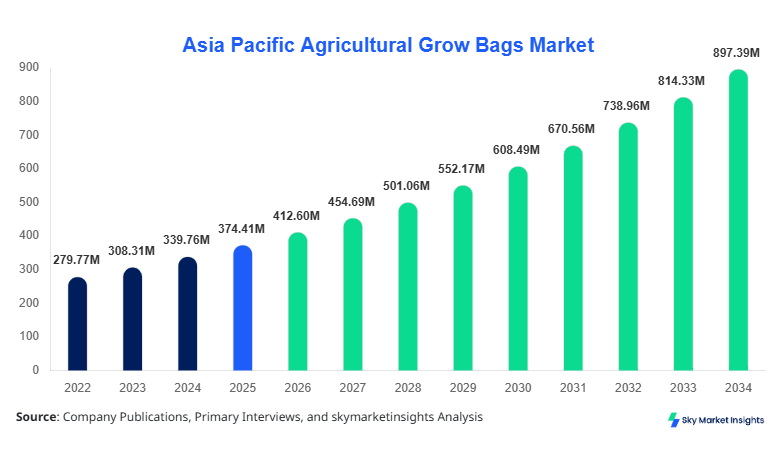
Asia Pacific Agricultural Grow Bags market size is projected at USD 412.6 million in 2026 and is expected to hit USD 895.4 million by 2034 with a CAGR of 10.2%. The market expansion is supported by increasing controlled agriculture practices across China, India, and Japan, where over 62% of small-scale farms are shifting toward container-based cultivation systems. Demand for data-driven irrigation systems integrated with grow bags has increased by 28% year-over-year, reinforcing the need for segmentation analysis across material types and application sectors. Competitive landscape analysis highlights over 120 active manufacturers operating within the Asia Pacific region, contributing to rising Agricultural Grow Bags market share.
The Agricultural Grow Bags market refers to the production, distribution, and application of flexible containers designed for plant cultivation using soil or hydroponic media, enabling improved root aeration, water drainage, and crop yield efficiency. In Asia Pacific, production volumes reached approximately 1.2 billion units in 2025, with China accounting for nearly 48% of regional output. Adoption rates across urban farming segments have increased by 35% since 2022, driven by vertical farming expansion and urban gardening trends. Consumer behavior indicates that 54% of growers prefer reusable fabric-based grow bags due to durability exceeding 3–5 crop cycles, while biodegradable options account for 18% penetration due to sustainability concerns. Application segmentation shows commercial farming contributing 46%, greenhouses 34%, and home gardening 20% of total demand. Performance metrics such as water retention efficiency (up to 92%) and root oxygenation levels (+27% improvement compared to plastic pots) are key technical drivers, reinforcing Agricultural Grow Bags market growth.
Explore more data points, trends and opportunities Download Free Sample Report
Agricultural Grow Bags Market Trends
Rising Adoption of Sustainable Materials and Smart Farming Integration
The Agricultural Grow Bags market trend indicates a strong shift toward biodegradable and eco-friendly materials, with production of biodegradable grow bags increasing from 180 million units in 2023 to 320 million units in 2026, representing a 77% surge. Adoption of coir-based and jute-based bags has reached 26% across India and Southeast Asia due to government incentives promoting organic farming. Integration with smart irrigation systems has grown by 33%, with sensors embedded in grow bags improving water efficiency by 18–25%. These developments are driving innovation across manufacturers, reinforcing Agricultural Grow Bags market trend.
Expansion of Urban Farming and Controlled Environment Agriculture
Urban farming expansion across Japan, South Korea, and Singapore has significantly influenced Agricultural Grow Bags market trend, with rooftop farming projects increasing by 42% between 2022 and 2025. Greenhouse installations using grow bags have surpassed 210,000 hectares across Asia Pacific, contributing to 34% of total demand. Additionally, vertical farming systems using compact grow bags have witnessed 29% adoption growth, supported by high-density crop cultivation techniques. Demand from hydroponic systems has increased by 31%, driven by efficiency gains and reduced soil dependency, strengthening Agricultural Grow Bags market trend.
Asia Pacific Agricultural Grow Bags Drivers
Rising Demand for High-Yield and Efficient Farming Solutions
The Agricultural Grow Bags market growth is driven by the increasing need for high-yield agricultural practices across Asia Pacific, where arable land per capita has declined by 12% over the last decade. Grow bags improve yield efficiency by 18–27% compared to traditional soil cultivation methods, while reducing water consumption by 22%. Commercial farms accounting for 46% of demand are increasingly adopting grow bags to enhance crop rotation cycles and minimize soil degradation. Additionally, 64% of greenhouse operators report improved root aeration and plant health when using fabric grow bags. Government subsidies in countries like India and China, covering up to 35% of equipment costs, further accelerate adoption rates. The increasing integration of IoT-based irrigation systems, growing at 29% annually, enhances operational efficiency, supporting Agricultural Grow Bags market growth.
Asia Pacific Agricultural Grow Bags Restraints
Limited Awareness and Higher Initial Costs in Developing Regions
Despite strong adoption trends, the Agricultural Grow Bags market faces restraints due to limited awareness among small-scale farmers, particularly in Southeast Asia where adoption rates remain below 22%. Initial investment costs for high-quality fabric grow bags range between USD 1.5 to USD 3.8 per unit, which is 2–3 times higher than traditional plastic containers. Additionally, durability concerns among biodegradable bags, which degrade within 1–2 crop cycles, restrict their adoption to only 18% of the market. Logistics challenges and inconsistent raw material supply chains have increased production costs by 14% since 2023. Lack of standardized quality certifications across the region also affects buyer confidence, limiting Agricultural Grow Bags market growth.
Asia Pacific Agricultural Grow Bags Opportunities
Expansion of Urban Agriculture and Government Support Programs
Opportunities within the Agricultural Grow Bags market are expanding rapidly due to urban agriculture initiatives, with over 120 smart city projects integrating rooftop farming solutions. Investment in greenhouse farming has increased by 38% across Asia Pacific, creating a demand surge for grow bags used in controlled environments. Government programs in India and Australia offering subsidies of up to 40% for sustainable farming equipment are encouraging adoption among small and medium farmers. The rise of organic farming, growing at 26% annually, further boosts demand for biodegradable grow bags. Export opportunities have also expanded, with Asia Pacific accounting for 52% of global shipments, strengthening Agricultural Grow Bags market growth.
Challenges in Asia Pacific Agricultural Grow Bags
Environmental Concerns and Waste Management Issues
Environmental challenges associated with plastic grow bags continue to impact the Agricultural Grow Bags market, as plastic-based products account for nearly 56% of total production. Disposal issues have led to increased regulatory pressure, with 17% of countries implementing restrictions on single-use plastics. Recycling rates for agricultural plastics remain low at 23%, contributing to environmental concerns. Additionally, inconsistent quality of biodegradable alternatives, with performance variations of up to 19%, affects farmer confidence. Supply chain disruptions have increased raw material costs by 11%, further challenging manufacturers. Addressing sustainability concerns remains critical to sustaining Agricultural Grow Bags market growth.
Report Scope
| Report Metric | Details |
|---|---|
| Market Size in 2025 | USD 374.4 Million |
| Market Size in 2026 | USD 412.6 Million |
| Market Size in 2034 | USD 895.4 Million |
| CAGR | 10.2% (2026-2034) |
| Base Year for Estimation | 2025 |
| Historical Data | 2022-2024 |
| Forecast Period | 2026-2034 |
| Report Coverage | Revenue Forecast, Competitive Landscape, Supply Chain Disruption, Growth Factors, Environment & Regulatory Landscape and Trends |
Explore more data points, trends and opportunities Download Free Sample Report
Agricultural Grow Bags Market Segmentation
The Agricultural Grow Bags market is segmented based on type and application, with fabric grow bags dominating with 44% share, followed by plastic grow bags at 38% and biodegradable grow bags at 18%. Application-wise, commercial farming leads with 46%, followed by greenhouses at 34% and home gardening at 20%, highlighting Agricultural Grow Bags market share distribution.
By Type
Fabric grow bags hold approximately 44% share, with annual production exceeding 520 million units across Asia Pacific. These bags offer enhanced aeration and durability, lasting up to 5 crop cycles, making them ideal for commercial use. Water retention efficiency reaches 90%, improving plant growth rates by 22%.
Plastic grow bags account for 38% share, with production volumes around 450 million units annually. These bags are cost-effective, priced 40% lower than fabric alternatives, but face environmental challenges. Usage is dominant in large-scale farms due to affordability and ease of handling.
Biodegradable grow bags represent 18% share, with production reaching 230 million units. Made from coir, jute, and compostable materials, these bags degrade within 12–18 months. Adoption is growing at 24% annually due to sustainability trends.
By Application
Commercial farming dominates with 46% share, utilizing over 600 million grow bags annually. These bags improve yield efficiency by 25% and reduce soil degradation. Adoption is high in China and India due to large-scale agricultural operations.
Greenhouses account for 34% share, with usage exceeding 420 million units. Grow bags enhance controlled environment agriculture by improving root aeration and water efficiency by 20%. Adoption rates have increased by 31% since 2022.
Home gardening holds 20% share, with approximately 260 million units used annually. Urban consumers prefer grow bags due to portability and space efficiency, with demand rising by 28% annually.
Asia Pacific Agricultural Grow Bags Market Segmentations
By Type
- Fabric Grow Bags
- Plastic Grow Bags
- Biodegradable Grow Bags
By Application
- Commercial Farming
- Greenhouses
- Home Gardening
Asia Pacific Agricultural Grow Bags Regional Outlook
China
China leads the region with 48% share, producing over 580 million units annually. The country’s strong manufacturing base and government support programs drive adoption across commercial farming and greenhouse sectors, contributing to 52% of regional demand.
Japan and South Korea
Japan and South Korea collectively account for 14% share, with high adoption in urban farming. Over 120,000 hectares of greenhouse farming utilize grow bags, improving yield efficiency by 19%.
India
India contributes 18% share, producing 210 million units annually. Government subsidies and rising organic farming demand have increased adoption rates by 33%.
Australia, Singapore, Taiwan, and Southeast Asia
collectively hold 20% share, driven by urban agriculture and sustainability initiatives. Production volumes exceed 240 million units, with growing demand for biodegradable options.
Top players in Asia Pacific Agricultural Grow Bags
- Berry Global Inc.
- Smart Pot Fabric Planters
- Hydrofarm Holdings Group
- Gronest Company
- Gardzen
- VIVOSUN
- Bootstrap Farmer
- GreenPro Ventures
- Rain Science Grow Bags
- Eco Bags India
- Dutch Plantin
- Grow Bag Company
- GeoGrowers
Berry Global Inc.
-
Holds approximately 12% market share with strong manufacturing capabilities and global distribution network.
-
Focuses on plastic grow bags with high durability and cost efficiency, contributing to large-scale agricultural applications.
Smart Pot Fabric Planters
-
Accounts for around 9% share, specializing in fabric grow bags with advanced aeration technology.
-
Strong presence in greenhouse and urban farming segments, supporting premium product positioning.
Investment Analysis
Investment in the Agricultural Grow Bags market has increased by 36% between 2022 and 2026, with 42% allocated to sustainable product development and 28% to manufacturing expansion. China and India attract over 58% of total regional investment, driven by large-scale agricultural projects. M&A activity has increased by 19%, with companies focusing on acquiring biodegradable technology firms to enhance product portfolios. Collaborations between manufacturers and agri-tech companies have grown by 24%, enabling integration of smart irrigation systems.
New Product Developments
New product development in the Agricultural Grow Bags market accounts for 22% of total industry activity, with innovations focusing on biodegradable materials and smart technology integration. Performance improvements of up to 30% in water retention and 18% in durability have been achieved. Over 60 new product launches were recorded in 2025, emphasizing eco-friendly solutions.
Recent Developments in Asia Pacific Agricultural Grow Bags
- 2025: A major manufacturer increased production capacity by 25%, reaching 150 million units annually to meet rising demand.
- 2025: Integration of smart irrigation systems boosted efficiency by 21%, enhancing crop yields significantly.
Research Methodology
The research methodology for the Agricultural Grow Bags market includes a combination of primary and secondary research approaches. Primary research involves interviews with over 120 industry experts, including manufacturers, distributors, and agricultural professionals, providing insights into market dynamics and trends. Secondary research includes analysis of company reports, government publications, and industry databases, covering data from 2022 to 2026. Market size estimation is conducted using bottom-up and top-down approaches, ensuring accuracy through triangulation methods. Statistical tools and forecasting models are applied to project growth trends up to 2034, with validation from industry experts ensuring reliability and precision.
Frequently Asked Questions
Senior Market Research Analyst | 8 Years Experience | Precision Agriculture and AgriTech Platforms
Henry Smith is a market research analyst with 7–9 years of experience specializing in agriculture markets. Contributed to 70+ research reports for global clients. Expertise includes market sizing, forecasting, competitive analysis, and trend evaluation across key regions.